Decoding the Mysteries of Medically Unexplained Neurologic Diseases
By Greg Bruno
Date January 10, 2024
Using advanced research techniques, Rutgers Health–led scientists have shed light on how chronic fatigue syndrome and fibromyalgia are related, paving the way to even bigger breakthroughs.
New research may create some respite for sufferers of two medically unexplained fatigue-inducing conditions: myalgic encephalomyelitis/chronic fatigue syndrome (ME/CFS) and fibromyalgia (FM).
The conclusion, and the methods used to reach it, could inform how these and other conditions – such as multiple sclerosis, long COVID, Alzheimer’s and post-treatment Lyme disease – are diagnosed and treated.
“Using mass spectrometry to analyze spinal fluid, the liquid that bathes the brain, we found that these two illnesses may fall along a common disease spectrum,” said Steven Schutzer, a professor of medicine at the Rutgers New Jersey Medical School and lead author of the study published in the Annals of Medicine.
“The results have implications for how the conditions can be investigated, while the technique may help advance treatment approaches with these diseases, and many others,” Schutzer said.
(See link for article)
________________
**Comment**
Due to advances in mass spectrometry, of 2,083 proteins quantified, 1,789 proteins were present in both samples of ME/CFS and fibromyalgia, and only ME/CFS, indicating there is a relationship between the two diseases.
Pharma Influences Diagnoses and Treatments in “Bible” of Psychiatric Disorders
by Barbara Cáceres
Published January 16, 2024
Article Excerpts:
A new study published in the British Medical Journal (BMJ) found that 55 of the 92 American doctors who determine what diagnoses and treatments are included in the American Psychiatric Association’s (APA) most recent edition of their Diagnostic and Statistical Manual (DSM) collectively received more than $14 million in previously undisclosed industry funding.1
The APA’s manual is often referred to as the “bible” of psychiatric disorders because of its enormous influence on clinical practice, affecting such disparate domains as jurisprudence and insurance claims. The APA also produces and disseminates clinical-practice guidelines directly tied to DSM diagnoses.2 The DSM’s fifth edition, the DSM-V, was published in May 2013; a text revision was published in March 2022 as the DSM-5-TR.
Transparency is Not the Answer
After the 1994 release of DSM-4, the APA instituted a policy requiring expert advisors to disclose drug industry ties. But the move toward transparency did little to cut down on conflicts of interest, with nearly 70 percent of DSM-5 task force members reporting financial relationships with pharmaceutical companies—up from 57 percent for DSM-4.7
(See link for article)
______________
A few points:
The study used info only from Open Payments which doesn’t include payments to doctors based outside the U.S. so the problem is worse.
Panel members with Pharma ties have introduced new diagnoses and revisions to treatment which have lacked scientific evidence but helps industry.
In 2019, 1 in 6 Americans over age 18 took medication for a psychiatric disorder.
The Institute of Medicine (IOM) is recommending that only independent experts without commercial ties be involved in clinical guideline decision-making.
One would hope this last point would be common practice, but alas, it isn’t.
More Than Half of CDC Employees End Up Working for Pharma
by TVR Staff
Published January 14, 2024
Article Excerpts:
A study conducted by researchers at the University of Southern California (USC) and Harvard University and published in the journal Health Affairs found that 54 percent of the staff members, who were employed at the U.S. Centers for Disease Control and Prevention (CDC) and left the federal health agency during 2004-2020, went on to work for the pharmaceutical industry.123
According to the study:
Exiting staff went to not only biopharmaceutical and device manufacturers, but also health insurers, information and communication technology firms, real estate firms with medical property portfolios, and consulting firms.1
Current Laws and Regulations Have Little Impact on CDC/Pharma Conflicts of Interest
Current federal laws and regulations, which were supposed to reduce conflicts of interest that arise from the revolving door between the CDC employees and pharma, do not appear to adequately address the “pre- and post-departure risks.” Study authors Kanter and Carpenter cited 18 U.S. Code Section 207, which imposes a one- to two-year “cooling-off period” on former officials within the executive branch of the federal government and prohibits them from lobbying the government on behalf of private organizations.13
Kanter said that the cooling off period laws “do not cover much lobbying related to federal agency decision making, like regulations and drug authorizations, so they don’t necessarily deter that behavior.”3
Revolving Door Between CDC and Pharma a Serious Problem
The “sheer scale” of the revolving door between the CDC and other DHHS agencies, such as the U.S. Food and Drug Administration (FDA), is apparently serious enough that Kanter and Carpenter described it as a “troubling” and one that “merits further scrutiny.”1
It’s important to note that these guidelines have remained frozen in time for over 40 years despite new science and reality. This of course means the controversy continues making doctors too frightened to treat patients and depart from the accepted narrative.
Recently at the Select Subcommittee on the COVID ‘Pandemic,’ Dr. Fauci developed selective amnesia when asked questions that pointed out his hypocrisy, frustrating many representatives. In fact, there were over 100 or so “I don’t recall’, or “I don’t remember’ answers. He did seem to finally acknowledge that the ‘6 foot’ social distancing recommendation promoted by federal health ‘officials’ was likely not based on any data.
“It just sort of appeared.” ~ Dr. Fauci
For those paying attention, COVID magic sort of appearedeverywhere in the past 4 years.
Now, former NIH head Francis Collins is admitting that the origin of COVID is not settled and that there is NO SCIENCE to support social-distancing guidance used during the pandmic.
Fauci also acknowledged that the “lab-leak hypothesis is not a conspiracy theory” despite stating repeatedly that he “strongly” believed it was a natural occurrence, leading mainstream media and ‘authorities’ to also call it a natural occurrence over and over in 2020 and vilifying anyone who stated otherwise – even going as far labeling anyone questioning the narrative as “racist” and “misinformed.” There was an orchestrated smear campaign against health experts who created a saner more scientific approach to the ‘pandemic’ called The Great Barrington Declaration.
My questions are rhetorical because I already know the answer. Absolutely nothing will change because the amalgamation of corporations & the government is on purpose to skirt the law so people can be controlled. It’s called corporate fascism or corporatism where the government uses corporations and corporations in turn use the government. It’s a nice, cozy arrangement for everyone but the average citizen.
And right on time, the WEF is ranking “misinformation” and “disinformation” as the number one global threat demonstrating perfectly the attempted pernicious global takeover by dangerous unelected groups. The following video on Fauci gaslighting Americans also exemplifies the MO of the ‘illuminated ones’ who are required to tell the truth using predictive programming, symbols, and numbers to disclose their intentions in advance and mock those who believe their lies. It’s all scripted and as old as time itself.
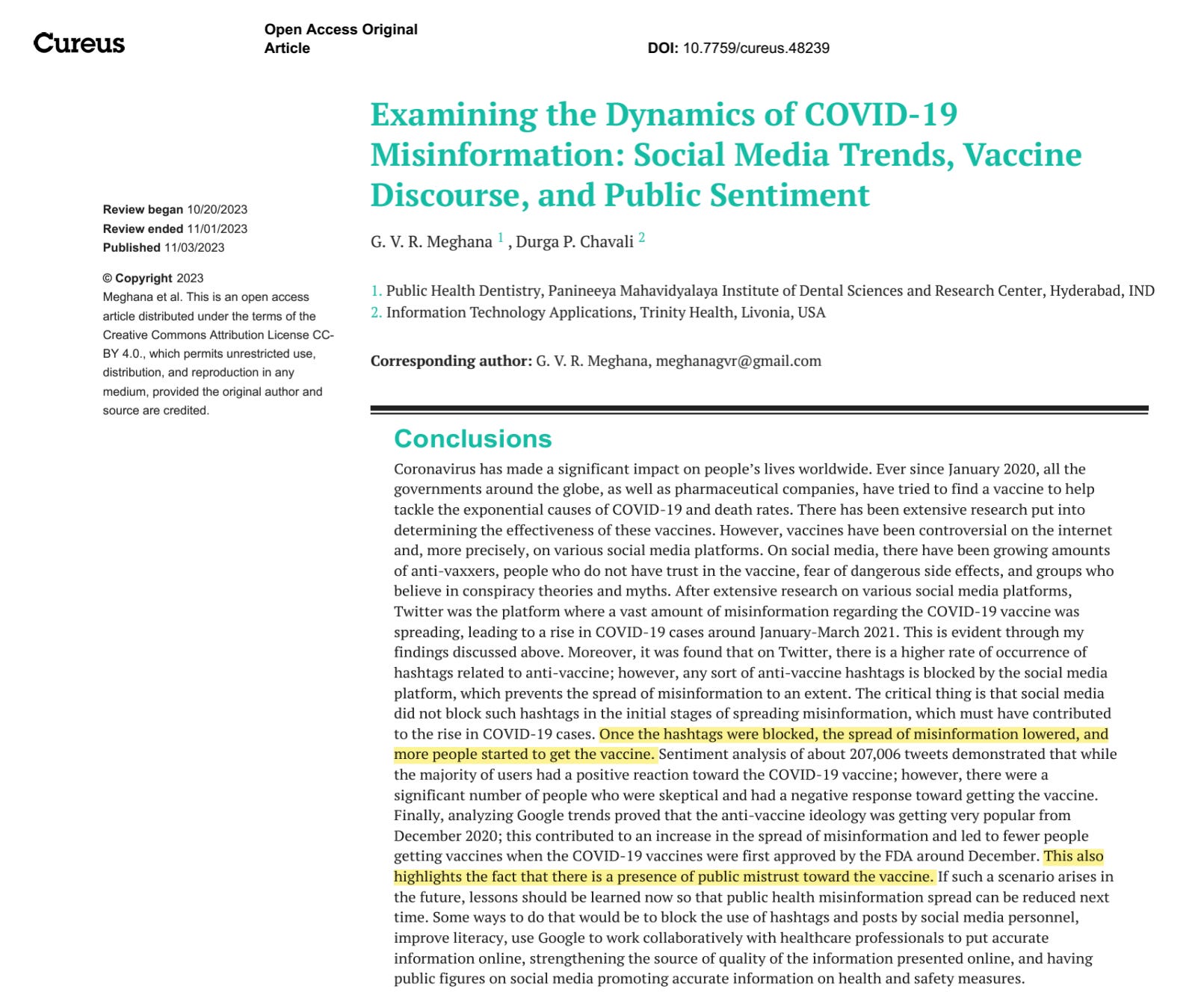
Introduction: COVID-19, known as coronavirus disease, has prompted a global reevaluation of societal norms. The World Health Organization (WHO) declared it a worldwide Public Health Emergency on January 30, 2020. Subsequently, governments and pharmaceutical firms developed vaccines, such as mRNA options from Pfizer and Moderna, alongside viral vector alternatives to combat the escalating COVID-19 case tally. Extensive inquiry was directed toward assessing vaccine efficiency. Nonetheless, vaccine discourse has surged across social media, prominently involving the anti-vaxxer community. This faction’s hesitancy, rooted in reservations about efficacy, potential side effects, and conspiracy notions, contributes to an ongoing dialogue.
Objective: This investigation delves into social media’s role in proliferating COVID-19 misinformation, utilizing tools like Python, Excel, and external resources to craft data visuals that elucidate trends influencing misinformation dissemination and its hypothetical ties to elevated COVID-19 cases. Scrutiny of Twitter trends illuminates the prevalence of the hashtag #covidvaccine, although the platform curbs anti-vaccine hashtags.
Result: Analysis of sentiment across 207,006 tweets reveals a prevailing positive sentiment toward COVID-19 vaccines, coexisting with lingering skepticism. Google trends reflect increased anti-vaccine ideology queries, notably post-FDA vaccine approval in December 2020, indicating public doubt.
Conclusion: While limitations encompass data granularity, geographic origins of false tweets, bot account quantification on Twitter, and comprehensive digital resources, this study pioneers reference for forthcoming investigations. Its objective is to mitigate the diffusion of misinformation.
The researcher’s misuse of the term “misinformation” in this paper should be duly noted and corrected.
There’s a reason for COVID magic and much of it was explained back in December with the CTIL files which uncover a plan set in place back in 2018 to criminalize your thoughts through widespread censorship.
A lawsuit was just dismissed by the Appellate Division court over the NY state executive order to permit the building and use of federal quarantine camps, which have also been built elsewhere (Nebraska). Of course they are not named that, but that is precisely what they are. The court did not touch the merit of the case but ruled that the plaintiffs do not have standing to sue. Evidently, only someone forcibly locked in their home against their will, or ripped from their home and thrown into a detention center has the right to sue. All of the judges are appointed by the governor who created this heinous quarantine regulation that the case has now paved the way for Hochul and DOH to reissue this tyrannical regulation where the DOH can pull you from your home and life with the force of police & hold you anywhere they want for as long as they want. The good news is there is a plan for an appeal, where you can contribute as the attorney handling the case has been doing it pro bono for the past two years.
Did you know that all 50 states have adopted provisions for quarantine camps?
The Model State Emergency Health Powers Act (MSEHPA) was drafted in the wake of 9/11 by none other than CDC (with the help of The Center for Law and the Public’s Health at Georgetown and Johns Hopkins Universities) which gives the government the authorization to collect data, records, property, people and their health info, use property as necessary (care, treatment, housing), and separate people, and all 50 states have adopted this tyrannical provision. Please read Katherine Watt’s work on how many things that once were federal and state crimes and civil rights violations have been legalized by Congress through legislative, statutory revisions to the United States Code, signed by US Presidents, and implemented at the administrative, regulatory level by the Department of Health and Human Services and Department of Defense through the Code of Federal Regulations.
Congress, HHS, DOD, and presidents have been legalizing and funding the overthrow of the Constitution, government, and American public through a massive domestic bioterrorism program relabeled as a public health program under the direction of WHO, WEF, and other global stakeholders.
Watts states these actions can not be classified as crimes or civil torts, and there are no victims or plaintiffs because legally nothing has been done and no one has done anything to anyone else.
Documents received by investigative journalists Michael Shellenberger, Alex Gutentag and Matt Taibbi from an anonymous but “highly credible” whistleblower reveals new details on how the U.S. censorship-industrial complex — a network of more than 100 government agencies, private firms, academia and nonprofits — seeks to police and criminalize “wrong-think”
The documents describe how the modern digital censorship programs were created, and the various roles of the military, U.S. intelligence agencies, civil society organizations and commercial media
They also describe the methods and techniques used, such as the creation and use of sock puppet accounts to spy on and steer online discussions and propagate desired narratives, and the discrediting of dissenters “as a necessary prerequisite of demanding censorship against them”
The documents show that the weaponization of the financial sector originated with the Cyber Threat Intelligence League (CTIL), which expressly sought to get banks to “cut off financial services to individuals who organize rallies or events”
The CTIL files also show there was a clear intent to circumvent the First Amendment by outsourcing censorship to the private and nongovernmental sector. According to the whistleblower, “The ethos was that if we get away with it, it’s legal”
While the weight of propaganda appears to have eased up a little in recent months, evidence shows there’s much more to come.
Documents received by investigative journalists Michael Shellenberger, Alex Gutentag and Matt Taibbi from an anonymous but “highly credible” whistleblower reveals new details on how the U.S. censorship-industrial complex — a network of more than 100 government agencies, private firms, academia and nonprofits — polices and criminalizes “wrong-think.”1
Explosive Revelations
The new cache of documents, referred to as the “CTIL files,” which refers to the Cyber Threat Intelligence League, were released by the three journalists in late November 2023.
“A whistleblower has come forward with an explosive new trove of documents, rivaling or exceeding the Twitter Files and Facebook Files in scale and importance,” the trio wrote on their Substack, “Public.”2
“They describe the activities of an ‘anti-disinformation’ group called the Cyber Threat Intelligence League, or CTIL, that officially began as the volunteer project of data scientists and defense and intelligence veterans but whose tactics over time appear to have been absorbed into multiple official projects, including those of the Department of Homeland Security (DHS).
The CTI League documents offer the missing link answers to key questions not addressed in the Twitter Files and Facebook Files. Combined, they offer a comprehensive picture of the birth of the ‘anti-disinformation’ sector, or what we have called the Censorship Industrial Complex.”
The documents describe how the modern digital censorship programs were created, and the various roles of the military, U.S. intelligence agencies, civil society organizations and commercial media.
They also describe the methods and techniques used, such as the creation and use of sock puppet accounts to spy on and steer online discussions and propagate desired narratives, the discrediting of dissenters, and the intentional weaponization of the financial industry against the same.
According to the whistleblower, CTIL was also involved in the creation of a counter-disinformation project to “prevent a repeat of 2016,” a reference to Brexit and Donald Trump’s surprise election win — two situations in which the democratic processes actually won out.
As noted by Jimmy Dore in the video above, this was not about preventing the circulation of false information. It was to ensure that no political outsider will ever be able to get into the Oval Office again. The instruction to prevent a repeat of 2016 was a direct call to undermine, if not eliminate, the process of free and fair elections.
Importantly, the documents admit that censorship efforts against Americans must be done by partners in the private sector, because the government doesn’t have the “legal authority” to do so.
The CTIL
The new cache of documents and videos reveal that 2019 was a pivotal year for the censorship-industrial complex. According to Public,3 that’s when “U.S. and U.K. military and intelligence contractors led by a former U.K. defense researcher, Sara-Jayne ‘SJ’ Terp, developed the sweeping censorship framework.”
These contractors became co-leaders of the CTIL, the original founders of which included a former Israeli intelligence official, Ohad Zaidenberg, Microsoft security manager Nate Warfield, Chris Mills, another Microsoft security officer, and Marc Rogers, the head of security operations for the hackers convention, DEF CON.
According to media articles,4 these highly skilled and in-demand professionals made the altruistic decision to volunteer their services to help billion-dollar hospitals with their cybersecurity, free of charge, no strings attached. It wasn’t a credible cover story then, and it sure hasn’t aged any better.
Within one month of the CTIL’s founding in March 2020, this supposedly all-volunteer group had grown to 1,400 “by invitation only” members in 76 countries and officially partnered with the U.S. Department of Homeland Security’s Cybersecurity and Information Security Agency (CISA). As reported by Public:5
“The CTIL framework and the public-private model are the seeds of what both the US and UK would put into place in 2020 and 2021, including masking censorship within cybersecurity institutions and counter-disinformation agendas; a heavy focus on stopping disfavored narratives, not just wrong facts; and pressuring social media platforms to take down information or take other actions to prevent content from going viral.”
Parallel Censorship Agendas
In the spring of 2020, CISA also created the Election Integrity Partnership (EIP) — a consortium made up by the Stanford Internet Observatory (SIO), the University of Washington’s Center for an Informed Public, the Atlantic Council’s Digital Forensic Research Lab, and Graphika (a social media analytics company) — and outsourced what would otherwise be illegal and unconstitutional censorship to it.
During the 2020 election cycle, the EIP and CISA worked with the State Department’s Global Engagement Center (GEC) and the DHS-backed Elections Infrastructure Information Sharing and Analysis Center (EI-ISAC) to influence and police political discussions online. The EIP coordinated the take-down of undesirable content using a real-time chat app that the DHS, EIP and social media companies all share.6
At the same time, the CTIL was tracking and reporting anti-lockdown views on social media. A “law enforcement” channel was created specifically to spy on and track social media users who posted anti-lockdown hashtags. CTIL even kept a spreadsheet with details from their Twitter bios.
According to Public, the CTIL also “engaged in offensive operations to influence public opinion, discussing ways to promote ‘counter-messaging,’ co-opt hashtags, dilute disfavored messaging, create sock puppet accounts, and infiltrate private invite-only groups.” In February 2021, the EIP was rebranded as the Virality Project, at which point their focus of censorship shifted from elections to COVID-related matters.
Government Infiltration and Take-Over
While one CTIL member, Bonnie Smalley, replied to a query by Public saying the CTIL “had nothing to do with the government,” the evidence shows otherwise. At least a dozen of government employees who worked with the DHS, FBI and CISA were also active members of CTIL.
According to the whistleblower, the CTIL’s goal “was to become part of the federal government.” Terp’s plan was to set up “MisinfoSec communities” that would include the federal sector, and the documents show this aim was achieved. In April 2020, Chris Krebs, then-director of CISA, also publicly announced the agency’s partnership with CTIL.
Public continues:7
“The documents also show that Terp and her colleagues, through a group called MisinfoSec Working Group, which included [Stanford Internet Observatory research manager Renee] DiResta, created a censorship, influence, and anti-disinformation strategy called Adversarial Misinformation and Influence Tactics and Techniques (AMITT).
They wrote AMITT by adapting a cybersecurity framework developed by MITRE … Terp later used AMITT to develop the DISARM framework, which the World Health Organization then employed in ‘countering anti-vaccination campaigns across Europe.’
A key component of Terp’s work through CTIL, MisinfoSec, and AMITT was to insert the concept of ‘cognitive security’ into the fields of cybersecurity and information security …
The ambitions of the 2020 pioneers of the Censorship Industrial Complex went far beyond simply urging Twitter to slap a warning label on Tweets, or to put individuals on blacklists.
The AMITT framework calls for discrediting individuals as a necessary prerequisite of demanding censorship against them. It calls for training influencers to spread messages. And it calls for trying to get banks to cut off financial services to individuals who organize rallies or events.”
Weaponization of Finance Sector Originated With CTIL
So, now we know where the weaponization of the financial sector came from. It originated with the CTIL, which expressly sought to get banks to “cut off financial services to individuals who organize rallies or events.”
Clearly, as evidenced by my own case and many others, banks and online payment processors have also been enticed into cutting services for people who simply expressed opposing views. It isn’t just rally organizers that are being targeted.
Under the Cover of Altruism
While CTIL officials have repeatedly stressed that the organization was founded on purely altruistic principles, the clear goal of its leaders was to “build support for censorship among national security and cybersecurity institutions,” Public writes, and they built that support by promoting Terp’s idea of “cognitive security.”
The choice of the term “cognitive security” takes on a rather sinister flavor in light of Dr. Michael Nehls’ findings that there’s been what appears to be an intentional effort to destroy the autobiographical memory function in the brains of the public over the past four years, thereby facilitating mass indoctrination and inhibiting personal will and critical thinking.
He presents his thesis in the book “The Indoctrinated Brain: How to Successfully Fend Off the Global Attack on Your Mental Freedom,”8 published in mid-December 2023.
The whistleblower’s material clearly reveal that sophisticated military tactics were turned on the American public, powerful psychological tools — the very tools Nehls says can literally alter biological brain function.
Public cites a MisinfoSec report in which “The authors called for placing censorship efforts inside of ‘cybersecurity’ even while acknowledging that ‘misinformation security’ is utterly different from cybersecurity. They wrote that the third pillar of ‘The information environment’ after physical and cybersecurity should be ‘The Cognitive Dimension.’”
Indeed, your mind — your cognition, your very ability to think independently — is the battlefield of today’s war, as Nehls proposes in his book. The frightening part is that the tools employed actually have the power to reprogram who you are.
We are indeed “hackable animals,” as proposed by Yuval Noah Harari, and the censorship-industrial complex has been hacking into the very brain structure of billions of people for the last four years already. Gutentag even touches on this in a December 3, 2023, article:9
“What was once considered a ‘conspiracy theory’ that military and intelligence forces were manipulating public opinion through inorganic interventions, has now been confirmed.
Our study of the Censorship Industrial Complex has exposed a far-reaching plan to subvert the democratic process and engage in activities that have a basis in military techniques and which are tantamount to attempts at thought or mind control.”
‘It’s Legal if We Can Get Away With It’
The CTIL files also show there was a clear intent to circumvent the First Amendment by outsourcing censorship to the private and nongovernmental sector. According to the whistleblower:10
“The ethos was that if we get away with it, it’s legal, and there were no First Amendment concerns because we have a ‘public-private partnership’ — that’s the word they used to disguise those concerns. ‘Private people can do things public servants can’t do, and public servants can provide the leadership and coordination.’”
Good News, Bad News
The good news is that more and more information is coming out about the U.S. government’s illegal outsourcing of censorship, and with it, legal challenges that throw up blocks against this circumvention of the Constitution.
We’ve also had other victories. In August 2022, the DHS was forced to terminate the Disinformation Governance Board due to public backlash.CISA has also deleted information about domestic censorship work from its website, and has dismantled its Misinformation, Disinformation, and Malinformation (MDM) subcommittee.
The Select Subcommittee on the Weaponization of the Federal Government is also continuing its search for truth, and will (hopefully) use whatever power at its disposal to rein in the abuse. Its most recent report, “The Weaponization of ‘Disinformation’ Pseudo-Experts and Bureaucrats: How the Federal Government Partnered with Universities to Censor Americans’ Political Speech”11 was published November 6, 2023.
Unfortunately, we also have a global effort underway to not only normalize but also legalize this kind of third-party censorship.In an August 1, 2023, video (below), Mike Benz12 explained this strategy.
In short, they’re trying to restructure the censorship industry “away from a top-down government-driven model” to a “competitive middleware model” where “content curation” (read censorship) is simply outsourced to third-party organizations.
This way, a “legal” disinformation compliance market is created while government can claim it has nothing to do with the control of information. Basically, what we’re looking at is the emergence of organized corporate censorship.
There’s no clear solution to this threat, other than to continue pushing back against any and all efforts to legalize, standardize and normalize censorship. To vocally object, to refuse using middleware like NewsGuard, and to boycott any company or organization that uses middleware or engages in censorship of any kind.
Combination Antibiotic Therapy for Treatment of Lyme Disease
Course overview: This module discusses differences between antibiotic tolerance and resistance in Lyme disease, demonstrates persistence via tolerance by the Lyme disease spirochete, and evaluates the efficacy of combination therapy versus monotherapy in both animal models and humans.
Instructor: Monica E. Embers, PhD Associate Professor in the Division of Immunology Director of Vector-borne Disease Research Tulane National Primate Research Center
About: This course is part of the Invisible Education Initiative, funded by the Montecalvo Foundation, which provides free, accredited Continuing Medical Education (CME) courses that focus on vector-borne and environmental illness and utilize a One Health framework.
Learn more: https://learn.invisible.international. CME Pending Application for CME credit has been filed with the American Academy of Family Physicians. Determination of credit is pending.
A very real U.S. Government laboratory shrouded in secrecy that existed at Plum Island(which has been moved to Kansas state University) was inspired by a Nazi bioweapons expert, and housed Fort Terry a biological warfare defense research facility. The lab had a mission to poison cattle in the Soviet Union during the Cold War and was also connected to an African Swine Fever outbreak in Cuba. It should come as no surprise that strange genetically mutated creatures have washed up on the shores of the mainland.
Tick experimentation by the government has been going on since at least the 60’s due to their ability to spread disease, with certain pathogens never showing up on testing. The “discoverer” of Lyme disease – Willy Burgdorfer, just happened to work at the NIH state of the art BSL- 4biomedical research facility called the Rocky Mountain Lab (RML) in Montana force-feeding ticks various pathogens. There is also a record of dropping infected ticks from airplanes to study their distribution patterns.
It doesn’t take a rock-scientist to realize the implications of these actions.
In the early 1970’s, a mysterious ailment was discovered among children living around the town of Lyme, CT. What was first diagnosed as isolated cases of juvenile arthritis, eventually became known as Lyme disease, an illness triggered by spiral-shaped bacteria, similar to the microorganisms that cause syphilis. Today, many of those untreated will suffer chronic debilitating illness. Some unknowingly will pass the disease onto their unborn children. Many will lose their livelihoods, and still others, their lives.
Yet Lyme disease is one of the most misunderstood and controversial illnesses of our time. Difficult to test accurately, tens of thousands of people go undiagnosed — or misdiagnosed with such conditions as fibromyalgia, chronic fatigue, autism, MS and ALS. The Centers for Disease Control estimates more than 300,000 people acquire Lyme disease each year, a number greater than breast cancers and AIDS combined. And yet, the medical establishment — with profound influence from the insurance industry — has stated that the disease is easily detectable and treatable, and that “chronic Lyme” is some other unrecognized syndrome or a completely psychosomatic disorder.
UNDER OUR SKIN is a powerful and often terrifying look not only at the science and politics of the disease, but also the personal stories of those whose lives have been affected and nearly destroyed. From a few brave doctors who risk their medical licenses, to patients who once led active lives but now can barely walk, the film uncovers a hidden world that will astound viewers. While exposing a broken health care and medical research system, the film also gives voice to those who believe that instead of a crisis, Lyme is simply a “disease du jour,” over diagnosed and contributing to another crisis: the looming resistance of microbes and ineffectuality of antibiotics. As suspenseful and hair-raising as any Hollywood thriller, UNDER OUR SKIN is sure to get under yours.
In this dramatic follow-up to the widely acclaimed UNDER OUR SKIN, EMERGENCE takes the viewer on a journey from horror to hope. We witness the emerging epidemic of Lyme disease as infection and education spread globally. We watch as the truth emerges about the disease’s persistence and reach, about promising new research, and about medical collusion and conflicts of interest that continue to impede progress. We revisit the characters from UNDER OUR SKIN as they emerge into better health, reclaiming their lives and dignity, and offering hope to the legions now suffering. As Lyme disease surges, EMERGENCE shines a probing light on the issue and becomes a beacon in the dark.
Bitten: The Secret History of Lyme Disease and Biological Weapons (Book)
A riveting thriller reminiscent of The Hot Zone, this true story dives into the mystery surrounding one of the most controversial and misdiagnosed conditions of our time — Lyme disease — and of Willy Burgdorfer, the man who discovered the microbe behind it, revealing his secret role in developing bug-borne biological weapons, and raising terrifying questions about the genesis of the epidemic of tick-borne diseases affecting millions of Americans today.
While on vacation on Martha’s Vineyard, Kris Newby was bitten by an unseen tick. That one bite changed her life forever, pulling her into the abyss of a devastating illness that took ten doctors to diagnose and years to recover: Newby had become one of the 300,000 Americans who are afflicted with Lyme disease each year.
As a science writer, she was driven to understand why this disease is so misunderstood, and its patients so mistreated. This quest led her to Willy Burgdorfer, the Lyme microbe’s discoverer, who revealed that he had developed bug-borne bioweapons during the Cold War, and believed that the Lyme epidemic was started by a military experiment gone wrong.
In a superb, meticulous work of narrative journalism, Bitten takes readers on a journey to investigate these claims, from biological weapons facilities to interviews with biosecurity experts and microbiologists doing cutting-edge research, all the while uncovering darker truths about Willy. It also leads her to uncomfortable questions about why Lyme can be so difficult to both diagnose and treat, and why the government is so reluctant to classify chronic Lyme as a disease.
A gripping, infectious page-turner, Bitten will shed a terrifying new light on an epidemic that is exacting an incalculable toll on us, upending much of what we believe we know about it.
…….
December 27, 2023
Jay Bhattacharya @DrJBhattacharya writes:
I just finished @krisnewby’s Bitten, which tells the history of the US government’s secret program in the 1950s and 1960s to weaponize ticks to deliver deadly bacteria to incapacitate unsuspecting populations.
Newby, a talented journalist and science writer, structures her history around a biography of Willy Burgdorfer, the Swiss-American scientist who discovered borellia burgdorferi, a spirochete bacteria often found in Lyme disease patients.
It’s an incredible, infuriating, well-written book worth your time.
A few lessons:
1. The mid-20th century US biomedical research establishment was psychopathic, whole-heartedly embracing reckless, deadly investigations in the name of developing vaccines and bioweapons.
2. It is possible (& perhaps likely, though not proven) that the emergence and spread of Lyme disease may have been caused by this research program, which included large open-air testing of intentionally infected ticks on US soil.
3. The bioweapons program used combinations of viruses and bacteria infecting the same tick to hide the body’s immune response to infection from detection by standard medical tests.
4. Lyme disease and related syndromes are likely caused by more than just borellia burgorferi. Newby makes a circumstantial case for a shadowy rickettsia bacteria that Willy Burgdorfer studied, which he called the “Swiss agent.”
5. The financial interests of biomedical researchers and testing companies peddling faulty tests — alongside their control over the official pronouncements and policy of the National Institute of Health and the US Infectious Disease Society of America — have frozen in place a diagnostic doctrine that has led to countless Lyme disease patients misdiagnosed and gaslit about the symptoms they are suffering.
Closing thought: similar tendencies in the biomedical research and medical establishments are still extant and may help explain many things about the covid pandemic. History does not repeat, but it rhymes.
https://madisonarealymesupportgroup.com/2019/02/22/why-mainstream-lyme-msids-research-remains-in-the-dark-ages/ In this article you will learn how Lyme/MSIDS research has been hijacked by a literal Cabal who attack anyone with a diverging view of the disease. Most of these researchers have patents on the very things they are doing research on with and have a history with bioweapons. Research has been rigged from the beginning by requiring patients to test positive on the rigged and arbitrary CDC-2-tiered test and have the “classic” bullseye rash which isn’t classic but highly variable and missing altogether in a majority of cases to even gain entrance into research trials. Despite all of this, even their studies show that there are treatment failures in nearly every study ever done, yet the faulty testing and mono-therapy for a couple of weeks claptrap is still being pushed at all costs.