
Podcast: Medical Gaslighting, Human Rights, and Lyme Disease
https://www.lymedisease.org/podcast-gaslighting-lyme/
PODCAST: Medical gaslighting, human rights, and Lyme disease

By Fred Diamond
May 1, 2024
When I was researching my book “Love, Hope, Lyme: What Family Members, Partners, and Friends Who Love a Chronic Lyme Survivor Need to Know,” I had no idea that medical gaslighting was something that persistent Lyme survivors had to commonly deal with.
I also had no idea that gaslighting was emblematic of the human rights challenges Lyme survivors have historically dealt with when seeking medical treatment.
I met hundreds of Lyme survivors who shared stories about being dismissed, mocked, and disbelieved by dozens of doctors.
Unfortunately, this gaslighting led to family members disbelieving that their loved ones had the disease, which led to further detachment, alienation, and suffering.
The patient experience
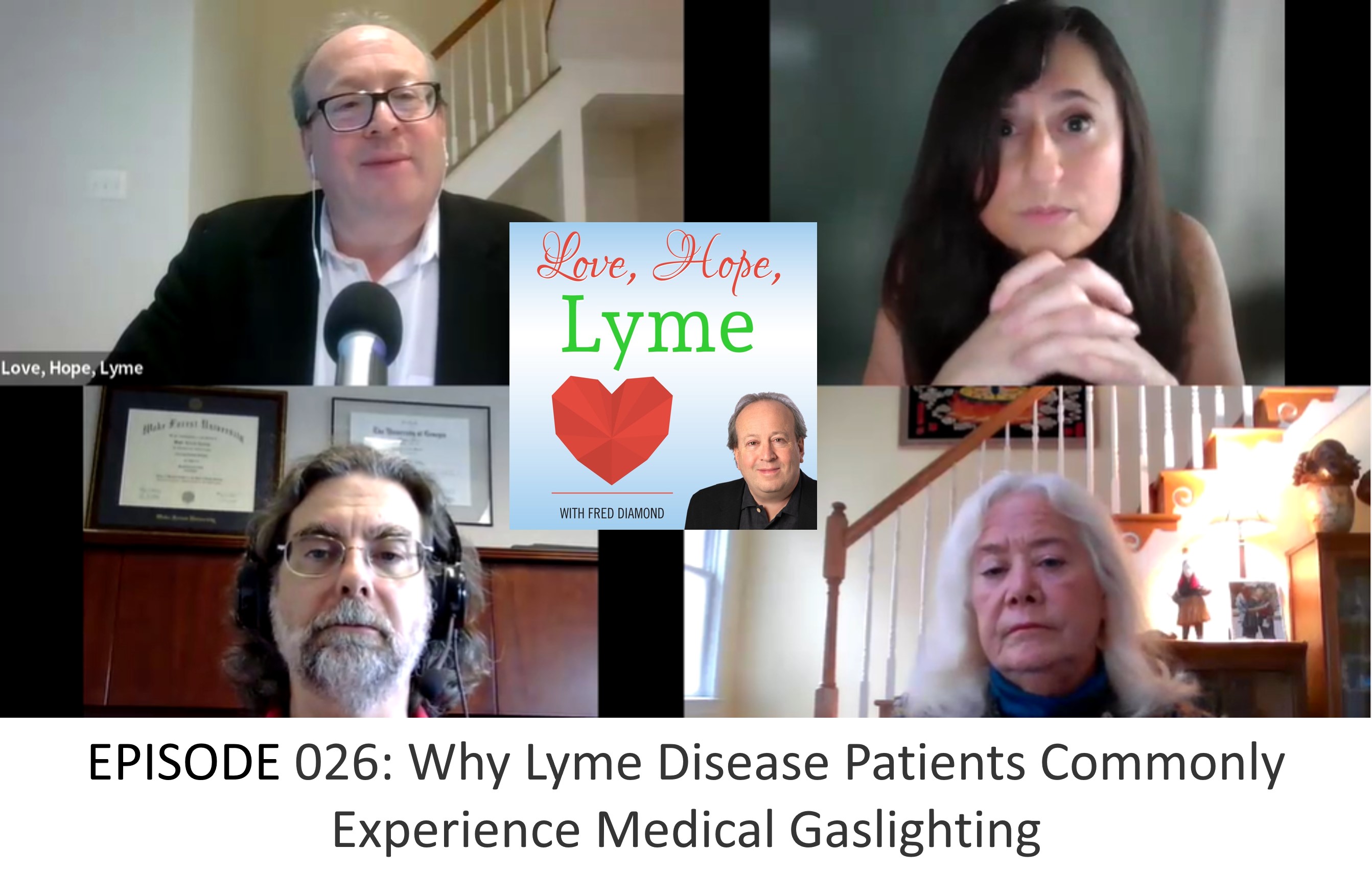
A peer-reviewed, international medical article was published in the journal Healthcare in 2023 called Medical Gaslighting and Lyme Disease: The Patient Experience. I interviewed the authors of the report, Jennifer Fagen, PhD, and Jeremy Shelton, PhD, both from Lamar University in Texas, and Human Rights Advocate Jenna Luché-Thayer, on two episodes of the Love, Hope, Lyme podcast.
The article states “Lyme disease is a recognized public health threat and is a designated notifiable disease. As such, Lyme disease is mandated to be reported by the CDC. Despite this, both acute and chronic Lyme disease have been relegated to the category of ‘contested illnesses’ which can lead to medical gaslighting.
“By analyzing results from an online survey of respondents with Lyme disease, 986 people, we elucidate the lived experiences of people who have been pushed to the margins of the medical system by having their symptoms attributed to mental illness, anxiety, stress, and aging. Further respondents have had their blood tests and rashes discounted and were told that chronic Lyme disease simply does not exist. As a result, a series of fruitless consultations often result in the delay of a correct diagnosis, which has deleterious consequences.”
Challenges with contested illnesses
According to Dr. Fagen, “Contested illnesses are conditions that lack cultural legitimacy as their nature and even their existence is often questioned. Any physical manifestations or symptoms may be deemed purely subjective as they lack objective biological markers. The result is that patients are in the unfortunate position of having to convince medical practitioners that they’re in need of medical attention, often leading to seeing many doctors before receiving a proper diagnosis.
“People with contested illnesses might not qualify for disability, despite their inability to work. Insurance may not cover their treatments and they could be denied the social recognition of their condition.”
She continued, “Despite the fact that there is such a high incidence of them in the US and internationally, and because they often have objective biological markers, such as blood tests and the EM or bullseye rash, it’s really quite counterintuitive that they are considered contested illnesses.”
Ignoring symptoms
The article discussed the wide range of gaslighting techniques used by doctors.
“The most common one by far was doctors just telling their patients, ‘You’re just overreacting to these symptoms,’ which is unfortunate because it doesn’t really address those symptoms at all. It essentially ignores them. Other reactions that we found that were common were implying that the symptoms were psychosomatic,” said Dr. Shelton.
He continued, “Many patients were told there’s just no such thing as chronic Lyme disease. A few people were told that it was fairly common that their symptoms were due actually to mental illness. It’s one thing to say it’s psychosomatic, but it’s a whole other category to say that you actually are suffering from some sort of mental illness.”
“Others were commonly told that their symptoms were due to stress. The common theme that you can see here is that doctors were trying to argue either the symptoms were due to some other cause besides Lyme disease, or that the symptoms were entirely fictitious and just in the person’s head, or they should just learn to live with those symptoms. Of course, that’s not what you want to hear when you go to a medical professional,” Dr. Shelton continued.
Lyme disease and human rights violations
Jenna Luché-Thayer put the findings in the article in the context of the human rights framework. On a special follow up episode of the podcast, she discussed the role of the World Health Organization (WHO) in developing medical codes that are linked directly to how insurance recognizes and reimburses their medical care and how governments track diseases.
She said, “If there is not a [WHO] code for a particular illness or disease or medical condition, it’s very hard to get the recognition, research, financial support, insurance support, Medicare, and Medicaid support to take care of the illness.”
Luché-Thayer formed a voluntary, nonprofit international organization that petitioned the World Health Organization and documented the science as well as the human rights violations related to Lyme disease. WHO expanded the codes to include multiple medical conditions that are caused by Lyme disease, including dementia, demyelinating conditions, Lyme carditis, and the ophthalmic complications from it.
“This is now part of the medical system that’s being integrated across the United States and other countries. People understand the importance of knowing their codes and bringing these codes to the attention of their medical providers. That means that the medical providers understand these codes have been validated, and it greatly helps to validate the multiple complications and chronic conditions disabling and potentially fatal complications from Lyme disease,” said Luché-Thayer.
Lyme survivors had their human rights compromised for decades. On the podcast, we discussed the extremes this might lead to.
“One of the key human rights is the highest attainable standard of health. If you are denied diagnosis and you are being denied treatment, clearly your health human rights are being violated,” she said. “If you are being told, as in a gaslighting situation, that you are not sick, when in fact you are infected with a bacteria that’s going throughout your body, your right to information is being denied. If you are a Lyme patient who has been told that not only are you not sick, but we think you need to go into psychiatric care, and you’re forced into a psychiatric care, then your personal security, which is also another human right, is being violated.”
Using the article for self-advocacy
Dr. Fagen said that one of the survey’s findings is that a patient’s positive blood test did not always influence how likely a doctor was to believe they have Lyme disease. On average, almost 14 doctors were seen prior to receiving a Lyme disease diagnosis. The article can be used as a tool for self-advocacy. (Download the article here.)
“It is important for patients to bring research with them to doctors’ appointments. This article not only contains a good deal of data from peer-reviewed medical journals that validate the existence of chronic Lyme disease, but it also provides data regarding the incidents and types of Lyme disease in our respondent pool. The latter can potentially encourage medical practitioners’ self-reflection if they are employing such techniques,” she said.
Dr. Fagen continued, “It’s also important for Lyme patients to know that these experiences are not uncommon, so they’d be less likely to doubt themselves. We’ve shared the research among medical doctors far and wide globally, including medical doctors who treat Lyme disease and other medical doctors who could perhaps benefit from some education about Lyme disease and Lyme patients’ experiences. We hope this accomplishes those goals.”
Click here to listen to all episodes of the Love, Hope, Lyme Podcast or on YouTube.
Fred Diamond is based in Fairfax, Virginia and can be contacted via Facebook. His popular book, “Love, Hope, Lyme: What Family Members, Partners, and Friends Who Love a Chronic Lyme Survivor Need to Know” is available on Amazon. The e-version of the book is always free to Lyme survivors. PM Fred on Facebook for your copy.
For more:
- https://madisonarealymesupportgroup.com/2024/01/04/medical-gaslighting-and-lyme-disease-the-patient-experience/
- https://danielcameronmd.com/chronic-lyme-disease-patients-dismissed-by-medical-community/
- https://madisonarealymesupportgroup.com/2021/09/02/let-the-gaslighting-stigmatization-stop-here/
- https://madisonarealymesupportgroup.com/2020/10/31/gaslighting-by-some-doctors-can-undermine-the-chronically-ill/
- https://madisonarealymesupportgroup.com/2022/03/23/military-family-members-and-lyme/
- https://madisonarealymesupportgroup.com/2023/09/13/before-they-scrub-this-history-group-documents-stories-of-covid-protocol-victims/
- https://madisonarealymesupportgroup.com/2019/11/29/its-all-in-your-head-medicines-silent-epidemic/
- https://madisonarealymesupportgroup.com/2019/05/27/have-you-been-told-its-all-in-your-head-the-new-biology-of-mental-illness/
- https://madisonarealymesupportgroup.com/2019/02/16/lyme-is-all-in-your-head-a-wake-up-call-to-mental-health-professionals/
- https://madisonarealymesupportgroup.com/2017/09/21/its-all-in-your-head-until-finally-a-lyme-diagnosis/
- https://madisonarealymesupportgroup.com/2017/06/30/child-with-lymemsidspans-told-by-doctors-she-made-it-all-up/
- https://madisonarealymesupportgroup.com/2020/09/06/helping-our-child-through-lyme-disease-shouldnt-be-this-hard/
- https://madisonarealymesupportgroup.com/2023/11/06/jacksonville-lyme-disease-patients-say-they-had-to-ask-a-dozen-times-for-a-test/
- https://madisonarealymesupportgroup.com/2023/08/15/living-well-when-you-dont-feel-well-overcoming-lyme-disease-illness/

 Madison Area Lyme Support Group