Archive for the ‘research’ Category

Lyme Disease Mimics Cellulitis Skin Infection

https://danielcameronmd.com/lyme-disease-mimics-cellulitis-skin-infection/

LYME DISEASE MIMICS CELLULITIS SKIN INFECTION

patient with lyme disease being examined for cellulitis

Lyme disease can mimic acute and chronic illness. In their article “Lyme Disease Mimics Postoperative Cellulitis,” the authors describe a patient who developed an abdominal rash, which was initially diagnosed as cellulitis, six days after a laparoscopic left salpingo-oophorectomy surgery. [1]

The 40-year-old woman, who developed redness, swelling, pain, and a rash at the excision site, was treated with cephalexin and later switched to trimethoprim/sulfamethoxazole (TMP/SMX).

“Over the next 24 hours, there was a rapid expansion of abdominal redness and patchy areas of redness on her left groin and her right forearm,” the authors write. The patient had complained of muscle and joint stiffness but attributed it to recent outdoor camping and exercise.

The woman was “admitted for postoperative cellulitis remote from surgery.” She was treated with doxycycline for possible Lyme disease, due to her recent camping trip and exposure to ticks.

Within hours of starting doxycycline, the patient’s “abdominal erythema [rash] significantly receded, the forearm and leg rashes resolved, and the joint pain and stiffness improved markedly.”

The Lyme disease diagnosis was confirmed with an IgM Western blot test.

“Initial suppression of the worsening rash could have been due to a low level of TMP/SMX activity on Borrelia burgdorferi stationary phase cells,” the authors explain.

The woman’s IgG Western blot test was negative.

Although Lyme disease can present with erythema migran rashes, early rashes can be confused with cellulitis. The authors suggest, “Lyme disease should be considered in patients with cellulitis in areas of endemic Lyme.”

Lyme disease rashes have been misidentified

Lyme disease rashes were misidentified in a case series involving 88 patients who presented with an erythema migrans (EM).  In 13 of these patients, the rash had been incorrectly identified or treated.

“Rashes were often misidentified by clinicians and patients as a spider bite, cellulitis, or shingles,” wrote Aucott and colleagues. [2]

The authors concluded, “Until more accurate tests are developed for early Lyme disease, cases without a diagnostic EM rash will need to be managed carefully.

In patients with cutaneous lesions where the differential diagnosis of cellulitis is not certain, empiric antibiotics should be chosen that will have activity against both Lyme disease and common agents of cellulitis.”

Editor’s note: I have prescribed cefuroxime or amoxicillin/clavulanic acid if Lyme disease is a consideration. Neither cephalexin nor TMP/SMX are effective against Lyme disease. If I believe Lyme disease is involved, I will treat patients longer than 7 to 10 days.  You can look at the rash yourself as the journal is open access.

References:
  1. Miles S, Mansuria S. Lyme Disease Mimics Postoperative Cellulitis. J Minim Invasive Gynecol. Nov 15 2020;doi:10.1016/j.jmig.2020.11.002
  2. Aucott J, Morrison C, Munoz B, Rowe PC, Schwarzwalder A, West SK. Diagnostic challenges of early Lyme disease: lessons from a community case series. BMC Infect Dis. Jun 1 2009;9:79. doi:10.1186/1471-2334-9-79

____________________

For more:  

1st Cases of Natural Infections With Borrelia Hispanica in European Dogs and Cat

https://pubmed.ncbi.nlm.nih.gov/32824647/

First Cases of Natural Infections with Borrelia hispanica in Two Dogs and a Cat from Europe

Free PMC article

Abstract

Canine cases of relapsing fever (RF) borreliosis have been described in Israel and the USA, where two RF species, Borrelia turicatae and Borrelia hermsii, can cause similar clinical signs to the Borrelia persica in dogs and cats reported from Israel, including fever, lethargy, anorexia, thrombocytopenia, and spirochetemia. In this report, we describe the first clinical cases of two dogs and a cat from Spain (Cordoba, Valencia, and Seville) caused by the RF species Borrelia hispanica. Spirochetes were present in the blood smears of all three animals, and clinical signs included lethargy, pale mucosa, anorexia, cachexia, or mild abdominal respiration. Laboratory findings, like thrombocytopenia in both dogs, may have been caused by co-infecting pathogens (i.e., Babesia vogeli, confirmed in one dog). Anemia was noticed in one of the dogs and in the cat. Borrelia hispanica was confirmed as an infecting agent by molecular analysis of the 16S rRNA locus. Molecular analysis of housekeeping genes and phylogenetic analyses, as well as successful in vitro culture of the feline isolate confirmed the causative agent as B. hispanica.

_______________________

**Comment**

Our feline and canine friends are sentinels for human diseases and these cases are no different.

To date, 23 TBRF-related Borrelia species have been confirmed, but additional species are proposed (2). B. hispanica is the primary TBRF-related Borrelia species identified in Spain (3,4), where it is endemic.  It is transmitted mainly through the bite of O. erraticus ticks (5) but also can be transmitted by O. occidentalis ticks (4). B. hispanica also has been found in Portugal (6), Morocco (4,7,8), and Tunisia (4).  https://wwwnc.cdc.gov/eid/article/26/5/19-0745_article?deliveryName=USCDC_331-DM26146

As of 2015, B. hispanica is considered an emerging infectious agent causing Neuroborreliosis:  https://n.neurology.org/content/84/14_Supplement/P6.310

Please keep in mind that migrating birds and animals are transporting ticks everywhere and spreading the pathogens they carry.

O. erraticus ticks feed nocturnally on multiple warm- blooded vertebrate hosts, including humans, and are found living buried in soil of traditional pigpens: https://repository.uel.ac.uk/download/ef62f8a0e6b1b15a27c35d240d126464385ad171f0be9af9d7768571b17460b0/128662/Portuguese%2520hosts%2520for%2520Ornithodoros%2520erraticus%2520ticks.pdf

Regarding O. occidentals ticks, according to this 2020 article,

“we have not sampled Ornithodoros ticks to evaluate densities and infection rates, nor have we collected samples from small mammals to investigate the reservoir of Borrelia spp.” 19-0745

Important excerpt:

Because the spirochetemia phase is short and laboratory diagnosis is exclusively dependent on the observer, we believe TBRF is underdiagnosed, even in areas where suspicion should be relatively high. 19-0745

Survey of Ticks Infesting Dogs & Cats in Ireland

https://pubmed.ncbi.nlm.nih.gov/32806603/

A Survey of Ticks Infesting Dogs and Cats in Ireland

Free PMC article

Abstract

Ticks are important ectoparasites of dogs and cats. Infestations can result in itching and localised dermatitis. In addition, ticks can act as vector of a range of viral, bacterial and protozoal pathogens. This paper reports the results of a nationwide survey of ticks infesting dogs and cats in Ireland. Seventy veterinary practices submitted a total of 120 ticks collected from 56 dogs and 16 cats.

  • Ixodes ricinus was the most abundant species on dogs
  • Ixodes hexagonus was the most abundant species on cats
  • The remainder were Ixodes canisuga and a single Rhipicephalus sanguineus specimen
  • The garden was most frequently associated with tick exposure in both dogs and cats
  • Sporting dog breeds (n = 17; 31%) were more likely to be infested with ticks than any other breed
  • Nearly all (n = 56; 95%) veterinarians indicated that ticks are a concern to their clients when they are found on their pets
  • Pet owners used a variety of products to control ectoparasites on their animals but a significant number (n = 18, 31%) indicated that they felt that the products are less effective highlighting the need for further investigations
  • Field sampling indicated that ticks are present at a low level in much of the greater Dublin area

______________________

For more:  https://madisonarealymesupportgroup.com/2017/08/12/pet-owners-have-nearly-2-times-the-risk-of-finding-ticks/

https://madisonarealymesupportgroup.com/2020/12/10/local-veterinarians-seeing-an-increase-in-tick-borne-illnesses-among-dogs/

https://madisonarealymesupportgroup.com/2020/12/21/dogs-are-testing-positive-for-new-tick-borne-bacteria/

https://madisonarealymesupportgroup.com/2020/03/19/are-current-tick-prevention-methods-for-dogs-working/

I just listened to a presentation on how the insecticide Lambda Cyhalothrin (a pyrethroid) offers nearly 100% control of the Asian Long-horned tick for up to 7 weeks when sprayed on foliage.  They sprayed in June, July, and August.  For more:  http://www.npic.orst.edu/factsheets/l_cyhalogen.pdf

Tick prevention is for your yard, yourself, and your pets:  https://madisonarealymesupportgroup.com/2019/04/12/tick-prevention-2019/

Controlled burns are also effective:  https://madisonarealymesupportgroup.com/2018/04/03/fire-good-news-for-tick-reduction/

Mothers & Children Panel: 5th Annual LymeMIND Conference 2020

http://

Mothers & Children Panel: 5th Annual LymeMIND Conference 2020

Nov. 2, 2020

  • Sue Faber, RN, BScN, President, LymeHope
  • Holly Ahern, MT(ASCP), Associate Professor of Microbiology, SUNY Adirondack 
  • Charlotte Mao, MD, Pediatric infectious disease specialist, Spaulding Rehabilitation Hospital/Massachusetts General Hospital Congenital Lyme research has been on hold for 25 years.
CDC just updated and acknowledged the importance of this field of study. We are interested in exploring the paradigm shifting potential of this.
  • How can we detect and treat Lyme and TBD in children – especially infants?
  • What are the special considerations for children?
  • Children are most at-risk population in the US, so how do we prevent infection?
  • What should pregnant and new mothers do if they have (or suspect they have) Lyme or TBD?

For more:

Don’t get your hopes up.  The CDC still falsely states congenital transmission to be “rare,” which is their way of saying, “Nothing to see here!”

As Lyme advocate Carl Tuttle states, how can they even know it’s rare when nobody’s counting?!  https://madisonarealymesupportgroup.com/2020/02/19/how-can-mother-to-fetus-transmission-of-lyme-disease-be-rare-when-no-one-is-counting/


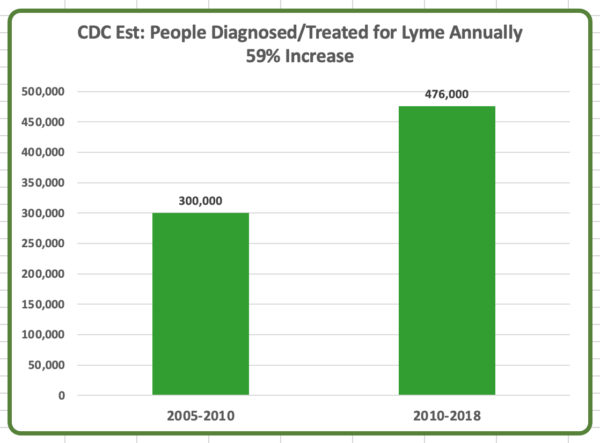
CDC Updates Annual Estimate of Those Diagnosed/Treated For Lyme Disease From 300,000 to 476,000

https://www.cdc.gov/lyme/stats/humancases.html

CDC.Lyme_.Cases_.Bar_.Graph_.4-600x443Fig. 1: Prepared by LDA, Jan. 2021

The CDC published, in the February edition of its “Emerging Infectious Diseases,” two new papers pertaining to Lyme disease case numbers. CDC indicates that the researchers found 476,000 people are diagnosed with and treated for Lyme disease each year in the U.S.

This is a 59% increase from their previous estimate of 300,000.

Also, CDC posted a new page to its website, Syndromic Surveillance of Emergency Department Visits for Tick Bites, showing tick bites by time, age/sex, and region:  https://www.cdc.gov/ticks/tickedvisits/

While quick to state this increased number is “likely an over-estimate of actual infections because patients are sometimes treated presumptively,” they fail to mention the other side of the equation: that many fail to be diagnosed due to abysmal testing and doctor bias.  Interestingly they state tick-borne illness is a burden on the health care system but fail to state the need to improve testing and treatment, but simply say more effective prevention measures are needed.

The new numbers are based on more recent data and insurance claims.