Archive for the ‘Psychological Aspects’ Category

PTSD, COVID-19 & Lyme Disease: A Perspective

https://danielcameronmd.com/ptsd-covid-19-and-lyme-disease-a-perspective/

PTSD, COVID-19 AND LYME DISEASE: A PERSPECTIVE

man with PTSD and COVID-19 getting console in therapy

“Post-traumatic stress disorder (PTSD) is a severe mental health condition caused by a terrifying event outside the normal range of usual human experience.”[1] While it is often associated with events such as an assault or disaster, post-traumatic stress disorder can occur in people with severe health problems.

Patients with chronic Lyme disease have reported symptoms of PTSD. Now, an article entitled “PTSD as the second tsunami of the SARS-Cov-2 pandemic,” by Dutheil et al. indicates that some COVID-19 patients are experiencing post-traumatic stress disorder, as well.¹

The authors highlight several observations on the SARS-Cov-2 pandemic and PTSD that would also apply to Lyme disease patients that I have seen in my practice.

PTSD in COVID-19 pandemic

  • “With a poor understanding of viruses and spreading mechanisms, the evocation of SARS is generating a great anxiety contributing to promote PTSD.”
  • “In the families of cases, the brutal death of family members involved a spread of fear and a loss of certainty, promoting PTSD.”
  • “PTSD symptoms involve chronic severe anxiety with re-experiencing the traumatic event, flashbacks, nightmares, increased arousal, and reduced social life.”
  • “People suffering from PTSD are prone to not seek care, because of barriers such as lack of information and cost of mental health care, being afraid of stigmatization, or beliefs that symptoms may increase with time.”
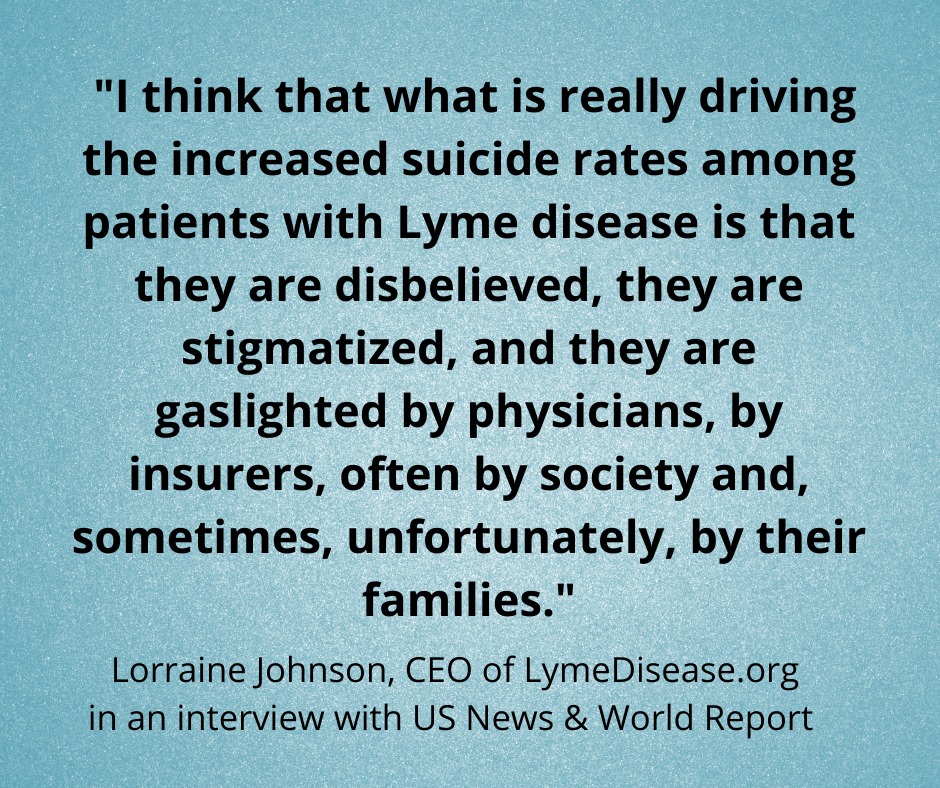
  • “PTSD individuals are more at-risk of suicidal ideation, suicide attempt, and deaths by suicide, in huge proportions.”

PTSD in chronic Lyme disease

  • The poor understanding of Lyme disease and associated tick-borne illnesses has generated a great deal of anxiety.
  • The severity of chronic illness following Lyme disease involves a spread of fear and a loss of certainty.
“People suffering from PTSD are prone to not seek care, because of barriers such as lack of information and cost of mental health care, being afraid of stigmatization, or beliefs that symptoms may increase with time.”
  • I have Lyme disease patients who re-experience the traumatic event, flashbacks, nightmares, increased arousal, and reduced social life, as described by the authors.
  • I have seen Lyme disease patients who “are prone to not seek care, because of barriers such as lack of information and cost of mental health care, being afraid of stigmatization, or beliefs that symptoms may increase with time.”
  • I have seen suicidal ideation in patients I have treated. Dr. Robert Bransfield, a psychiatrist specializing in tick-borne illnesses, has described suicidal ideation, suicide attempt, and deaths by suicide in patients in his practice.²

Author’s perspective: I hope that a better understanding of post-traumatic stress disorder in COVID-19 patients will lead to a better understanding of PTSD in Lyme disease.

References:
  1. Dutheil F, Mondillon L, Navel V. PTSD as the second tsunami of the SARS-Cov-2 pandemic. Psychol Med. Apr 24 2020:1-2. doi:10.1017/S0033291720001336
  2. Bransfield RC. Aggressiveness, violence, homicidality, homicide, and Lyme disease. Neuropsychiatr Dis Treat. 2018;14:693-713. doi:10.2147/NDT.S155143

______________________

**Comment**

PTSD is very, very real.  I’ve had it myself.  My husband had it. People don’t typically understand that Lyme/MSIDS IS a brain disease and can affect you psychologically in many ways.  You can hear voices, hallucinate, have PTSD or OCD, depression, de-personalization, and so many other mental issues.

It’s important to get to the root of the issue – and that’s treating the infections; however, you may also need to address the mental health aspects as well with a trained professional.  A word of warning; however, I would highly recommend a Lyme literate professional as many patients have been abused at the hands of uneducated professionals who blindly follow the CDC/IDSA ideology.  These people can cause more harm than good.  I would also seek to get a referral from either a knowledgable patient or health professional you know and trust.

For more:

Combating Isolation By Creating Online Space For Teens With Lyme & Coinfections

https://www.lymedisease.org/online-space-teens-lyme-disease/

Combating isolation by creating online space for teens with Lyme disease

By Camille Deschapelles 

Many of you reading this don’t need me to explain what often happens when you bring up chronic Lyme disease to others. You’ve probably dealt with it plenty of times.

When you talk about your chronic illness that affects you every day, people assume it’s like a two-week cold. In places outside of the Northeastern US, Lyme is often assumed to be rare. This makes it even less likely that people will believe your diagnosis.

Some illnesses automatically bring out sympathy and consolation from others. But Lyme generally brings about confusion, even after an awkward and often long-winded explanation.

Here’s a bit little about me. I’m 17 years old and was diagnosed with juvenile rheumatoid arthritis at 14, and later chronic Lyme and Bartonella at 16. My arthritic symptoms greatly limit what I can do most days.

This was especially true at the start of my treatment. If I mustered up the strength to hang out with my friends, I would limp behind them or struggle to keep up as they rushed through shopping malls or parks.

Although they would always ask what was wrong, I never wanted to get into the nitty gritty of my complicated diagnosis and treatment. So, I’d brush it off, telling them it was just a small injury. When I pulled out my pills after meals, I’d swallow them off to the side so my friends couldn’t see.

When school started in person, I tried to avoid limping and used the stairs instead of the elevator. I didn’t want anyone to know, because I knew that none of them would understand even if I explained it to them. Thus, I absolutely refused to talk about my illness with others.

A breakthrough

But this denial kept everything bottled up inside. Then, I came across an article by a 17-year-old girl who dealt with Lyme disease throughout high school. She wrote about feeling robbed of teenage experiences that she should have enjoyed, because of a disease that went undiagnosed for too long.

Those were my exact thoughts and feelings! That article has stuck with me, as I realized that, of course, there are other people like me. Other teenagers with Lyme who feel just as lonely and isolated as me and would give anything for people to understand them.

I searched for support groups for those with Lyme disease. But most groups I found were made up of adults who didn’t have the same experiences as me – going to school while sick, missing out on social events like prom, or the combined weight of being a teenager and a Lyme disease patient. My parents put me in touch with some adults they knew with Lyme, but talking to them, while helpful, was sometimes awkward.

On-Lyme

I decided to make my own support network. Called On-Lyme, it’s an online community of adolescents with Lyme and co-infections. I chose a Discord server to be the core of it because it’s essentially a large group platform that makes it easy to chat with others casually.

[Editor’s note: Discord is an online platform that allows users to communicate with voice, video, text messaging, media and files.]

Through this, I’ve made meaningful connections with people in different states, countries and even continents. Other teens have shared their stories with people who won’t judge but sympathize. We complain about painful symptoms, the messed up medical system, or laugh about Shrek. We share advice and comfort each other when times are tough.

My closest online friends are fellow Lyme patients. One lives in Massachusetts, and we Zoom call weekly, talking about whatever is on our minds. Lyme does come up often. It’s easy with her. I know that she understands my frustrations with friends or experimenting with a new round of antibiotics.

My other friend lives in Scandinavia. We talk almost every day, regardless of the distance or time difference. Our shared experiences connect us in a way that I don’t feel with even my closest in-person friends.

The importance of community

With a disease as stigmatizing as Lyme or Bartonella, it’s important to have a supportive community behind you. A community that understands and sympathizes with you. And while teenagers and young people with Lyme aren’t the most common types of Lyme patients, we still exist.

So, to the teen out there who is desperately searching for others who understand, I hope this article impacts you like the one that I read impacted me.

Find comfort in knowing that you aren’t alone, and that there are better days ahead, even if today sucks.

That’s something I’d wish someone who understood how bad it was in the moment could have told me months ago.

For those rough days, for those good days, and the ones in between, On-Lyme or whatever support community you end up falling into is there for you. You are stronger than you know and will get through this. But it doesn’t hurt to have some people backing you up as well.

Camille Deschapelles lives in FloridaClick here to reach the On-Lyme website.

Tickborne Illnesses “Can Look Like Anything” Podcast

https://www.mindbodygreen.com/articles/physical-and-psychological-signs-of-tick-borne-illness Podcast in link

I’m A Functional MD & These Sneaky Signs Can Signal A Tickborne Illness

By Jason Wachob

Here’s the thing about tickborne illnesses: According to functional medicine doctor Kenneth Bock, M.D., they can cover different organ systems, and so patients often present myriad symptoms. “It can look like anything,” he shares on this episode of the mindbodygreen podcast, which poses a problem in clinical settings: If a patient comes in with a laundry list of complaints, some professionals may resort to a psychological diagnosis (especially if those said symptoms are, in fact, psychological, which we’ll get into later).

However, says Bock, “If you listen, and you look, and you think hard…these tickborne diseases can cause this myriad of complaints.” Meaning, it’s important not to rule out the possibility of a tickborne illness, even if you don’t necessarily live in a hotbed state. Below, he explains some of the most common signs he has seen.

Physical symptoms.

“It can range from skin rashes to heart palpitations, shortness of breath, brain fog, numbness, tingling, burning, dysesthesias (which is pain), and also general fatigue and headaches,” Bock says.

He also mentions that some ticks can carry Bartonella bacteria, which can “give you these purple-ish, reddish stretch marks” in uncommon areas you wouldn’t typically have stretch marks—like in the middle of the back or behind the knee. (We should note: There is little evidence to suggest the transmission of Bartonella from ticks to humans directly; most of the data shows that the bacteria can be transmitted from ticks to pets to a person during a scratch.)

He continues that Babesia, another tickborne illness that often goes hand-in-hand with Lyme disease, can cause symptoms like fever, chills, sweats, and air hunger (aka, feeling like you can’t get enough air).

The purpose of listing these symptoms isn’t to scare you—Bock emphasizes that when people point out their multiple symptoms, he takes tickborne illnesses into account. “Rather than [saying], ‘Oh, the person has air hunger, so they’re just anxious,’ these are clues to some of the tickborne illnesses.”

Psychological symptoms.

We mentioned brain fog, but Bock says tickborne illnesses can manifest as a host of psychological symptomssometimes for younger folks, the only symptoms at all are psychological. 

“The thing about kids and adolescents is that sometimes the only symptoms of tickborne disease are neuropsychiatric,” Bock explains. “All you see is anxiety, or OCD, or panic attacks, or depression, and sometimes rage.” In fact, studies show that a portion of Lyme disease patients can experience explosive anger and aggressiveness (commonly referred to as “Lyme rage”).

All that to say: It’s important we don’t rule out tickborne illnesses, even if someone only presents psychological symptoms. “They can carry a diagnosis of mood disorder, [like] anxiety and panic attacks, but if they have a tickborne disease, they’ll never get better. All the psychotropics in the world and all the therapy will not [help them] get better,” says Bock.

The takeaway.

Tickborne illnesses can be scary—understandably so. Again, explaining all of these symptoms is not to spook you into thinking you have a tickborne illness. But if you present myriad symptoms, it’s important to get to the root of the issue and make sure a tickborne illness is not the driver.

“The key is to recognize that they exist,” notes Bock.

**Comment**
Regarding ticks transmitting Bartonella directly to humans, I personally asked Dr. Breitshwerdt if this is true.  He strongly believes ticks transmit it.  Info here.  There are many people with Bartonella who have not had cat or pet exposure, although it is known that Bartonella is transmitted by numerous insects and arachnids.  BTW: you can have Bartonella without the purplish stretch-mark looking rashes.
For a nifty coinfection symptom chart go here, although it’s important to remember there are symptoms not on this chart, as well as the fact you may not present with the typical symptoms.  I appreciate the fact he said some peoples’ only symptoms are psychiatric.  This is very true but not considered by mainstream medicine.
One of the most telling quotes within the article is the phrase about having a “laundry-list” of symptoms.  Dr. Jemsek gives the following quote when speaking about Lyme:
“You either have 20 diseases or you have Lyme disease.”
I would add that you should also suspect other coinfections as well.
For more:

One thing the article did not mention is testing, which nearly all mainstream doctors will use, even though these tests have been proven to be a joke.  This isn’t discussed and you have to be your own advocate and understand this.  I would seriously bypass mainstream medicine and head directly to a Lyme literate doctor, who will diagnose and treat you clinically based upon symptoms.

From my perspective with helping patients, mainstream doctors continue to utilize faulty testing, take a “wait and see” approach which is dooming patients to a life-time of suffering, and even IF they miraculously test positive on an abysmal test, treat them inappropriately with no more than the insufficient monotherapy of 21 days of doxycycline.

You can look up more articles by typing in key words into the search bar on the website.  For instance, if you want to know more about Bartonella, just type Bartonella into the search bar and other articles will pop up.

Lyme Borreliosis & Associations With Mental Disorders & Suicidal Behavior: A Nationwide Danish Cohort Study

https://ajp.psychiatryonline.org/doi/10.1176/appi.ajp.2021.20091347

Lyme Borreliosis and Associations With Mental Disorders and Suicidal Behavior: A Nationwide Danish Cohort Study

Objective:

Lyme borreliosis is a tick-borne infectious disease that may confer an increased risk of mental disorders, but previous studies have been hampered by methodological limitations, including small sample sizes. The authors used a nationwide retrospective cohort study design to examine rates of mental disorders following Lyme borreliosis.

Methods:

Using Denmark’s National Patient Register and the Psychiatric Central Research Register, and including all persons living in Denmark from 1994 through 2016 (N=6,945,837), the authors assessed the risk of mental disorders and suicidal behaviors among all individuals diagnosed with Lyme borreliosis in inpatient and outpatient hospital contacts (N=12,156). Incidence rate ratios (IRRs) were calculated by Poisson regression analyses.

Results:

  • Individuals with Lyme borreliosis had higher rates of any mental disorder (IRR=1.28, 95% CI=1.20, 1.37)
  • of affective disorders (IRR=1.42, 95% CI=1.27, 1.59)
  • of suicide attempts (IRR=2.01, 95% CI=1.58, 2.55)
  • and of death by suicide (IRR=1.75, 95% CI=1.18, 2.58) compared with those without Lyme borreliosis

The 6-month interval after diagnosis was associated with the highest rate of any mental disorder (IRR=1.96, 95% CI=1.53, 2.52), and the first 3 years after diagnosis was associated with the highest rate of suicide (IRR=2.41, 95% CI=1.25, 4.62). Having more than one episode of Lyme borreliosis was associated with increased incidence rate ratios for mental disorders, affective disorders, and suicide attempts, but not for death by suicide.

Conclusions:

Individuals diagnosed with Lyme borreliosis in the hospital setting had an increased risk of mental disorders, affective disorders, suicide attempts, and suicide. Although the absolute population risk is low, clinicians should be aware of potential psychiatric sequelae of this global disease.

___________________

For more:

Research Consortium Aims to Develop New Drug For Bartonellosis

https://www.lymedisease.org/research-consortium-bartonellosis/

Research consortium aims to develop new drug for bartonellosis

July 15, 2021

Key infectious disease researchers at Tulane University, Duke University and North Carolina State University will collaborate on an initiative to develop a treatment for bartonelloses, a spectrum of vector-borne diseases that can cause debilitating symptoms.

The three-year, $4.8 million initiative funded by The Steven and Alexandra Cohen Foundation, will establish the Bartonella Research Consortium to develop a novel treatment for bartonelloses.

Bartonella are zoonotic, stealth bacterial pathogens that were not known to infect animals or humans prior to the HIV epidemic when immunocompromised patients began showing symptoms of bartonelloses.

Bartonelloses are often self-limiting diseases that can be cleared by the immune systems of healthy individuals. In immunocompromised individuals or as co-infections, they can cause severe neuropsychiatric, cardiovascular, and rheumatological symptoms. Cats and fleas often harbor the pathogen, which increases the likelihood of transmission to humans.

The principal investigators of the consortium support a collaborative approach to the study of complex, poorly understood infectious diseases. By working together to prevent and treat Bartonella infections, they will provide patient-relevant solutions that improve both animal and human health. Targeted antimicrobial strategies to eliminate long-standing Bartonella infections will dramatically improve patient outcomes.

Similarities between Bartonella and Lyme infections

Bartonella symptoms overlap with those of other vector borne organisms such as Borrelia burgdorferi, the bacteria that causes Lyme disease. In some instances, patients have been infected with both Bartonella and Borrelia burgdorferi infections, which can cause an exacerbation of symptoms

As often seen in Lyme disease patients, a subset of people with bartonelloses develop chronic symptoms despite prior antibiotic therapy. Treatment failures have been documented with both infections, thus the need for drugs that specifically target and eliminate these bacteria.

Associate Professor Monica Embers, a microbiologist and immunologist at the Tulane National Primate Research Center, focuses on the persistence of tick-borne infectious disease despite antibiotic therapy and will bring her expertise to the consortium.

“There are a lot of similarities between Bartonella and Borrelia infections, both of which are notoriously difficult to detect and treat. Developing targeted treatments has the potential to alleviate a lot of suffering, both in the human and pet populations,” said Embers.

There are over 40 known Bartonella species or subspecies and at least 17 have been associated with a spectrum of disease symptoms. Although Bartonella remain neglected in human and veterinary medicine, more recent evidence supports an important role for these bacteria in a variety of diseases.

Funding for this research initiative combines the strengths of research laboratories located at Duke University, North Carolina State University and Tulane University.

Principal investigators include Drs. Edward B. Breitschwerdt, Monica E. Embers, Timothy A Haystead and Ricardo G. Maggi. During the next three and a half years, these established investigators and their highly skilled research teams will develop a novel drug for the treatment of bartonelloses.

SOURCE OF PRESS RELEASE: Tulane University

__________________

For more: