Archive for the ‘Psychological Aspects’ Category

“Messages on the Mirror”: Family Endurance & a Lyme Love Story

https://www.lymedisease.org/messages-lyme-love-story-falcone/

“Messages on the Mirror”: Family endurance and a Lyme love story

By Donna Z. Falcone

If you have lived with chronic Lyme disease, you may be familiar with this phenomenon.

Significant life events—the ones most people never forget—can suddenly disappear, like water down the drain, only to bubble up again around the bend.

Take, for example, the brown shipping box that sits on the floor of my art room. Every so often, I notice the brown box and wonder what’s inside.

Since I don’t feel like crouching all the way down to the ground for a look inside, I just stare at it until the memory returns.

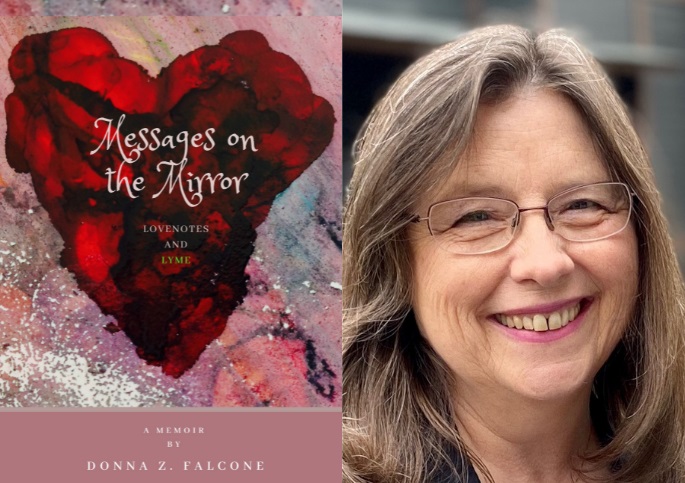
Oh . . . that’s right, I tell myself. I wrote a memoir… Messages on the Mirror: Lovenotes and Lyme. Those are extra copies. I leave it there, unopened.

How could someone forget that, right? I mean, writing a whole book, even if it’s not on the best seller list, is a victory! I even give myself extra kudos for having done it under the duress of chronic Lyme disease. The irony is not lost on me that someone with a memory like mine would set out to write a memoir in the first place.

Years of gathering bits and pieces of my life in journals, computer files, calendars, and the backs of pharmacy receipts and old envelopes or whatever else was handy at the time—and managing to not lose them!—was an accomplishment. Spending eight years organizing it all, hammering down timelines, then writing and rewriting to transform a scattered heap of notes into a memoir, seems too big a deal to forget about.

My family’s story

When I pass by that box, and do (eventually) recall what it holds, I’m reminded that this is the story of my Lyme journey. This is my family’s story! And, I am reminded of the many reasons I wrote it.

I wanted to tell my story for the patients going through the surreal journey of diagnosis and treatment of Lyme and all that goes with it. For them, I hope my book can serve as evidence that they are not imagining things. To tell the truth, it surprised me a little that I also needed evidence. I needed something to hold in my hands that says, Yes Donna, that really happened. See . . . It’s all right here.

It also felt important to tell people who love someone with Lyme—I see you and know it’s hard for you, too. Lyme disease impacts everyone: parents, spouses, children, friends, family, co-workers. Diagnostic tests can be unreliable and well-informed doctors are hard to find. We don’t always know how long treatment will last or how much it will cost to get better.

I know you want nothing more than to have us back, whole, so that we can move forward together. We want what you want, and things can get very emotional. We try to stay positive, but we often struggle. We fight, even.

Isolation is hard. Intimacy is hard. We can feel disoriented, frightened, demoralized, and hopeless, and we are always wishing this thing called Lyme disease was just a bad dream. But it’s real, and its impact is far-reaching, and sometimes it can even teach us that we are never not whole, and we can always move forward from where we are, now. We don’t have to wait to move forward.

Making it to the other side

I want to share what my family and I went through, what it was like when my kids and husband bore the brunt of all the housework, shopping, and cooking—and how we came out on the other side.

In the end, I think my favorite thing about my book, is this: It’s not only a Lyme story, but a love story. And who doesn’t love a good love story now and then?

For my fellow Lyme disease patients, do you struggle with reading print (like I did)? I have tried to make this book more accessible to you. It’s printed it in a larger font with wider than expected spaces on the page. The chapters are very short, in case you have a hard time focusing (or staying awake, for that matter) while reading. The titles are very descriptive, in hopes they’ll provide distinct clues for finding your way back to your place should the bookmark fall out and get lost.

If you have walked the Lyme journey, I hope you can see yourself in my story. If you love or care for someone with chronic Lyme, I hope it’s helpful to see another family traveling a similar, often messy, road. Messages on the Mirror is my story—but parts of it may be yours, too.

Donna Z. Falcone is a writer, poet, and artist.

Learn more about Donna and her book on her website.

Messages On the Mirror can be ordered in paperback and e-book formats on Blurb.com, an independent book platform.

____________________

**Comment**

I’m thankful that patients that “reach the other side” of health are taking the time to write.

Years ago, when I was desperate and at my worst, I contacted a recovered patient online that had a website. I just needed to hear that there was hope.  Not knowing me from Adam, he replied immediately.  I have found this to be the case with most patients.  They “get it.”  They understand the looming fear, isolation, doubting your own sanity, and concern over what the future holds, and they all want to be of help.  If there’s one thing this monster can do, it can give you compassion for others.

The piece of advice I never forgot was, “Don’t be depressed about feeling depressed.”

He said you need to give yourself permission to feel lousy and depressed.

Man, did that help me.

The other thing that helped came from my mom – who struggled with the ability to sleep.  She wasn’t a Lyme/MSIDS patient – just an elderly woman, like so many others, who struggled with sleep.  She also told me to give myself permission that sleep just isn’t happening, but to use it to be productive.

During these sleepless hours, usually between 3-5am, I read countless books and articles on tick-borne illness and other health topics.  I covered a lot of ground in those wee hours of the morning.  Looking back, those well spent hours gave me the foundation I need today to deeply understand topics to help others on the journey.

We all have a place on planet earth, and we are all needed.  Chin up and don’t quit.  Your better days are coming.  For now, give yourself permission to feel like crap, be unable to sleep, to hurt virtually everywhere, to forget simple words like “where,” and all the other lovely things happening to your poor body and mind.  There are many silver linings – you just can’t see them clearly right now, but you will.

Go here for my story.

Let the Gaslighting & Stigmatization Stop Here

https://www.lymedisease.org/tbdwg-comment-lyme-leland/

TOUCHED BY LYME: Let the gaslighting and stigmatization stop here

The third panel of the federal Tick-Borne Disease Working Group held its first meeting today–online. I was one of 10 people selected to deliver verbal comments. There was a three-minute time limit. Here’s what I said:

A topic not addressed by the first two Working Group panels is the severe impact Lyme disease can have on mental health.

A study recently published in the American Journal of Psychiatry shows that people with Lyme disease have a 75% higher risk of dying by suicide than those without it.

Lyme patients also have a high rate of other psychiatric conditions, such as depression.

Lead author Dr. Brian Fallon, of Columbia University, points out that Lyme is not a simple illness. He states: “In addition to the risk of severe cardiac, rheumatologic, and neurologic problems, Lyme disease can cause severe mental health problems as well.”

MyLymeData bears this out

Furthermore, results from the MyLymeData patient registry tell us that

  • 29% of Lyme patients surveyed say they have had severe psychiatric symptoms
  • 30% report that they take antidepressants—compared to 13% of the general population
  • 32% say they are too disabled to work. This situation leads many to despair.

When patients seek help from their physicians for debilitating symptoms, far too often, their doctors dismiss their concerns out of hand.

Doctors essentially say, “I don’t believe you. Your symptoms aren’t real.”

Some call this gaslighting. It undermines the patient’s self-confidence, and makes them doubt their own experiences.

Without treatment options, suffering people are left adrift in a sea of hopelessness.

Stigma of Lyme disease

Patients say the stigma surrounding Lyme disease profoundly affects them.

74 percent say they have been treated disrespectfully by a healthcare provider.

67 percent say they have postponed or avoided medical treatment due to discrimination, disrespect or difficulty obtaining care.

US News and World Report recently asked Lorraine Johnson, the head of LymeDisease.org, to comment on Dr. Fallon’s study of Lyme disease and suicide.

She said in part:

“We know that there’s a psychiatric component to what is going on, but I think [a major driver of] the increased suicide rates among patients with Lyme disease is that they are disbelieved, they are stigmatized, and they are gaslighted by physicians, by insurers, often by society and, sometimes, unfortunately, by their families.”

I urge this panel to listen to patients. Let the gaslighting and stigmatization stop here. Together, let’s work to change the system that deprives people with Lyme disease of the medical care they need to get well. Thank you.

TOUCHED BY LYME is written by Dorothy Kupcha Leland, LymeDisease.org’s Vice-president and Director of Communications. She is co-author of When Your Child Has Lyme Disease: A Parent’s Survival Guide. Contact her at dleland@lymedisease.org.

IDSA Guidelines Ignore Psychiatric Consequences of Lyme Disease

https://www.lymedisease.org/bransfield-psychiatric-lyme-disease/

27 AUG 2021

Bransfield: IDSA guidelines ignore psychiatric consequences of Lyme disease

Dr. Robert Bransfield delivered the following public comment at the recent meeting of the federal Tick-Borne Disease Working Group.

I’m a psychiatrist from New Jersey, who has treated thousands of Lyme disease patients over the past thirty years. I have also performed research. Three issues I would like to raise:

*A recent study unequivocally proves Lyme disease causes mental illnesses.

*This Working Group needs to be more attentive to the psychiatric symptom from TBD.

*The IDSA guidelines fail to recognize this causal association.

I recommend the following

The Working Group needs to gather and share information on psychiatric symptoms caused by Lyme/TBD.

Since the IDSA guidelines fail to recognize this causal association, they are outdated and the committee needs to recommend that all federal references and links to their guidelines must be removed.

To expand:

A recent article using the 7 million patients in the Danish nationwide database was published in the American Journal of Psychiatry, the number one psychiatric journal in the world. It proved the causal association between Lyme and any mental disorder, affective disorders, suicide attempts and death by suicide.

There are 400 other peer-reviewed journal articles proving the causal association between tick-borne diseases and psychiatric symptoms and 73 with dementia. Mental illness is the major cause of disability and death from tick-borne disease.

Psychiatric findings from TBD can include

  • developmental disorders
  • autism spectrum disorders
  • affective disorder
  • depression
  • anxiety disorders
  • addiction
  • opioid addiction
  • cognitive impairments
  • dementia
  • suicidality
  • violence
  • other impairments
This has caused chronic disability and deaths from suicides, drug overdoses, auto accidents and homicides.

This working group needs input from psychiatrists who understand tick-borne diseases and psychoimmunology. Addressing the causal association between tick-borne diseases and psychiatric symptoms and sharing this information with legislators and the public is critical.

When the psychiatric morbidity, mortality and disability are adequately considered, it greatly shifts risk/benefit clinical decision making involving diagnosis and treatment.

The American Psychiatric Association guidelines recognize this association, but the IDSA guidelines fail to consider the psychiatric consequences of Lyme disease. Therefore, these guidelines are outdated, unscientific, and hazardous.

The Working Group needs to recommend that all federal government links and references to these guidelines be removed.

Robert Bransfield, MD, DLFAPA, a past president of the International Lyme and Associated Diseases Society, is an internationally recognized expert in how Lyme disease affects mental health.

Dr. Bransfield’s list of 473 peer-reviewed articles that support the evidence of Lyme and other tick-borne diseases causing neuropsychiatric illness: List of citations

____________________

**Comment**

Dr. Bransfield is a true pioneer when it comes to psychiatric manifestations of Lyme/MSIDS.  He has fought long and hard on this arena.  He’s a rock star in my book.

For more:

US News & World Report: Lyme Disease Can Wreak Havoc On Mental Health

https://www.lymedisease.org/us-news-world-report-lyme-disease-can-wreak-havoc-on-mental-health/

US News & World Report: Lyme disease can wreak havoc on mental health

US News and World Report, August 17, 2021

by Steven Reinberg

Lyme disease can exact a significant mental toll as well as a physical one on its sufferers, a new study confirms.

Patients hospitalized for Lyme disease had a 28% higher incidence of mental disorders and were twice as likely to attempt suicide than people without Lyme, researchers report.

“These findings highlight the need for greater awareness in the medical community that patients after a serious case of Lyme disease are at increased risk of mental disorders and suicidal behaviors, particularly during the first year after diagnosis,” said study author Dr. Brian Fallon….

“While most people with Lyme disease do not develop subsequent psychiatric problems, some do. Clinicians need to ask about suicidal thoughts and depression in particular, if symptoms persist,” Fallon said. READ MORE

Learning to Be Supportive When Your Partner Has Lyme Disease

https://www.lymedisease.org/challenges-partner-lyme-disease/

Learning to be supportive when your partner has Lyme disease

By Fred Diamond

The woman I love has been coping with chronic Lyme for many years. For most of the 11 years we’ve been together, I thought I was doing my best to support her.

However, I came to realize recently that her challenges went further than I had imagined.

My mantra was “pay attention and keep her stress-free.” Shortly after I met her, she told me she had Lyme disease. I knew that meant she was easily fatigued, often in pain, and sometimes anxious. But she also had good energy, was very funny and beautiful.

I also knew that she had dietary restrictions, which meant we had to find the best gluten-free pizza in town. I knew she was concerned about heavy metals which meant she did not eat fish which might have mercury. It meant she had beef and rice when I had sushi.

I knew she was concerned about going into the basement when we realized there was mold there.

But I had no idea about the challenges she faced with Lyme and the stress she was under until I decided to really understand what her life was like battling this insidious disease.

You see, I pictured her as beautiful, funny, warm, and kind. My family loved her. My friends were happy for me knowing that I had such an amazing, loving, and supportive partner.

But I would always wonder why she seemed guilty whenever I did something for her and why she would often say I was working too hard for her when I had so many other things to worry about.

So, recently I decided to go deep into her world to understand the Lyme life she was living.

And I recommend that all partners of people with Lyme do the same. It changed my life in ways I never could have imagined.

Seeking to understand her illness

First off, I went online and purchased a few dozen books on Lyme, chronic illness, and anxiety. It was eye-opening! I joined a half-dozen Facebook groups and signed up for mailing lists at LymeDisease.org and other care organizations. I also called everyone I knew who ever uttered the word “Lyme.”

And I was shocked at what I discovered.

I thought I knew everything she dealt with, but I learned it was a constant battle for her to stay on top of treatments, supplements, and relief tools. Many days, all she could do was try to eliminate the pain, remove the anxiety, and find relief.

Even though I thought I was on top of things, I did not have a clue why certain things were so important.

Here are some things I discovered.

She felt a lot worse than I ever imagined

In a loving relationship, the balance of care shifts. When one partner is struggling at work, the other steps in and maybe takes a second job. When one partner is fatigued, the other does the housework and cooks the meals. I came to learn that she often felt the balance was uneven. Since she was sometimes unable to do some of the chores, she felt that since I was devoting more time and energy to her it was not fair. It never once occurred to me that this was an issue.

I had never thought of her as a Lyme sufferer.  I knew she had Lyme, but I never thought that was her identity. I always saw her as beautiful, caring, and funny, while she often saw herself as sick and was often in more pain than I ever knew.

I saw the anxiety and depression but never appreciated it. I always thought some rest and time would help. The supplements and herbals? I always saw them as merely vitamins, not part of a protocol. I had no idea that it took everything she had just to make it through the day, plagued by pain in her legs, or her neck, or her head.

Mold

We had mold in the basement after a leak. I didn’t realize how devastating mold can be for someone with Lyme. There are hundreds of thousands of people suffering from mold allergies. I now understand what mold can do and how someone who is susceptible can suffer from even a brief exposure.

Genes and heavy metals

We liked watching the “Finding Your Roots” show together but I was always watching for the aha moment or when they disclose the family member who was a slave owner. She was watching to see how the genetic matching might have affected the guest.

I would hear her talk about how genetic makeup may impact your body’s ability to detoxify. Who must spend a second of their life knowing about these enzymes and how they may or may not impair the detox? And that’s why she was always so concerned about copper, iron, zinc and the other heavy metals and how they can get in the way of your healing.

Letting healing take its course

I’ve come to realize that healing from Lyme is a personal, private, and sensitive process that only the person going through it can figure out. Hopefully there’s a good Lyme literate doctor who can help. For many, there are not. I’m amazed at how many doctors still do not understand Lyme.

I had often said that her health was one of my two top priorities, since I know it was her main priority. With my business background, I might have treated it like a business process. What are all the steps we need to do to get to healing? But it does not work that way.

As you let the healing take its course, you need to let the person going through it lead the way. They know their body; you do not.

No one has ever said they wanted to get Lyme. No one in their right mind would be thankful they have it. No one really wants to be a “Lyme Warrior,” But until acceptance comes in, healing is near impossible. I have come to realize that her recovery must be on her own terms and all I can do is educate myself and be as sensitive and available as needed.

Recovering from Lyme is a very personal process. It’s different for everyone.

How to be a better source of support

I didn’t know what healing meant until recently. As a spouse, all you can do is get educated, be considerate, and supportive where needed.

You can’t do it alone. It’s too overwhelming. Life’s overwhelming. Getting through the day even when everything is going your way is hard enough.

As a partner, you need to make the extra effort to understand your partner’s world and what they must do to make it through the day with chronic Lyme.

When I realized this, our lives changed for the better.

Fred Diamond lives in Fairfax, Virginia.