Archive for the ‘Lyme’ Category

The Power Trio: NAD+, Glutathione, & Methylcobalamin in Lyme Treatment

https://www.lymedisease.org/power-trio-nad-glutathione-b12/

The power trio: NAD+, glutathione, and methylcobalamin in Lyme treatment

California’s Board of Pharmacy may soon restrict access to a variety of compounds that many Lyme patients find essential to getting well. This doctor explains why she thinks that’s a bad idea–and how you can take action to stop it. Sign the petition here.

By Pamela M. Davis, MD

If you’re dealing with Lyme disease or know someone who is, you’ve probably heard about NAD+, glutathione, and methylcobalamin. These compounds are generating significant buzz in the Lyme treatment community, and for good reason.

Let’s dive into what makes these treatments so promising and why they might be game-changers for Lyme patients.

Living with Lyme disease is like fighting a battle on multiple fronts. From crushing fatigue to brain fog, from joint pain to neurological symptoms, Lyme can feel overwhelming.

What makes it particularly challenging is how the bacteria affects multiple body systems simultaneously, creating a complex web of symptoms that can be difficult to address.

Enter the power trio

This is where our three heroes come in: NAD+, glutathione, and methylcobalamin. When properly compounded in sterile conditions (this part is crucial!), these substances work together to support your body’s natural healing processes. Let’s break down how each one helps.

Your cellular battery charger: NAD+

Think of nicotinamide adenine dinucleotide (NAD+) as your cells’ rechargeable battery. In Lyme disease, these batteries often run dangerously low. Here’s what NAD+ does:

  • Boosts energy production at the cellular level
  • Helps clear the mental fog that many Lyme patients struggle with
  • Supports your body’s repair systems
  • Helps regulate sleep cycles (which are often disrupted in Lyme patients)

Real talk: Many Lyme patients report feeling a noticeable uptick in energy and mental clarity within days of starting NAD+ treatment. Especially when it is given intravenously. While individual results vary, the energy boost can be significant enough to help patients return to daily activities they’d previously given up.

Your body’s master detoxifier: glutathione

If NAD+ is your battery charger, glutathione is your body’s cleanup crew. During Lyme treatment, your body deals with a lot of toxins, both from the bacteria themselves and from their die-off during treatment.

Here’s where glutathione shines:

  • Neutralizes harmful free radicals that cause inflammation
  • Supports your liver in processing and eliminating toxins
  • Helps reduce the severity of herxheimer reactions
  • Strengthens your immune response

Pro tip: Many Lyme patients find that glutathione helps them tolerate their primary treatments better by reducing side effects and detox symptoms.

Your nerve repair expert: methylcobalamin

This active form of vitamin B12 is particularly crucial for Lyme patients dealing with neurological symptoms.

Here’s what makes it special:

  • Directly supports nerve repair and protection
  • Helps improve brain fog and cognitive function
  • Supports energy production
  • Aids in mood regulation

The best part? Methylcobalamin’s benefits often become noticeable within weeks, particularly in areas of cognitive function and energy levels.

Better together: the synergy effect

While each of these compounds is powerful on its own, the magic really happens when they work together. Think of it as a well-coordinated team: NAD+ provides the energy; glutathione handles the cleanup; methylcobalamin repairs the damage. Together, they create a comprehensive support system for your body during Lyme treatment.

What makes this approach different? The key lies in proper compounding and administration. When these substances are prepared in sterile conditions and administered properly (usually through IV or injection), they can:

  • Reach therapeutic levels more effectively
  • Work more quickly than oral supplements
  • Provide more consistent results
  • Support your primary Lyme treatment protocol

Real-world implementation

If you’re considering these treatments, here’s what you should know:

  • They work best as part of a comprehensive treatment plan
  • Proper administration via IV or injection is crucial for effectiveness
  • Response can vary from person to person
  • Regular monitoring helps optimize results

Looking Forward: The use of these compounds in Lyme disease treatment continues to evolve, with new protocols and applications being developed. While they’re not a magic bullet, they represent a powerful tool in the Lyme treatment toolkit.

The bottom line

For many Lyme patients, the combination of NAD+, glutathione, and methylcobalamin provides valuable support during treatment. While they shouldn’t replace your primary Lyme protocol, they can significantly enhance your body’s ability to heal and manage symptoms.

Remember: Always work with a qualified healthcare provider who understands both Lyme disease and these compounds. They can help you determine the right protocol for your specific situation and ensure you’re getting the highest quality, properly compounded versions of these supplements.

Alarming developments in California

Recently the California Board of Pharmacy (BOP) has proposed limiting and/or completely blocking access to these life changing compounds. They are also looking to further reduce the number of credentialed compounding pharmacies operating in the state of California.

Because of the need to control costs and to keep these compounds fresh and protected from excessive heat in order for them to be effective, local pharmacies are key.

Firefighters in particular are making statements about their need to have easy access to glutathione to help their lungs recover after battling fires.

Please consider signing the petition to stop the pharmacy board from closing the very necessary compounding pharmacies and blocking access to these very effective treatments.

Dozens of vitamins, antioxidants, enzymes, peptides, hormones and herbs that are legal, effective and needed by so many suffering with chronic diseases are also at risk of being banned by the California board of Pharmacy. Even if you are from another state, your opinion matters because where California goes many other states might follow.

You can give a public comment at the Board of Pharmacy meeting on November 7. You can either do this in person in San Diego, or online via WebEx. Go to StopTheBOP to learn more about this issue and how you can make your opinion known.

*Disclaimer: This post is for informational purposes only and should not be considered medical advice. Always consult with your healthcare provider before starting any new treatment protocol.*

Pamela Davis, MD, is in private practice in Los Angeles. She sees patients in person and via telemedicine, and can be reached through her website.
Molecular Detection of Lyme, Babesia, and Anaplasma in Canadian Ixodes Ticks

https://www.jelsciences.com/abstracts/1838

Molecular Detection of Borrelia burgdorferi sensu lato, Borrelia miyamotoi, Babesia odocoilei, Babesia microti and Anaplasma phagocytophilum in Ixodes Ticks Collected across Canada

John D Scott* and Catherine M Scott

Volume5-Issue10
Dates: Received: 2024-09-28 | Accepted: 2024-10-18 | Published: 2024-10-22
Pages: 1321-1337

Abstract

Tick-borne zoonotic diseases are a profound challenge to healthcare practitioners, and an overwhelming scourge to patients worldwide. On the whole, patients have great difficulty getting diagnosed and treated, and often become chronically ill. In this study, we tested 224 ticks consisting of Ixodes angustus, Ixodes pacificus, and Ixodes scapularis. Using real-time PCR and nested PCR, we obtained the following positives:

  • Borrelia burgdorferi sensu lato (n = 74)
  • Borrelia miyamotoi (n = 4)
  • Babesia odocoilei (n = 82)
  • Babesia microti (n = 1)
  • Anaplasma phagocytophilum (n = 8)

Markedly, B. odocoilei and B. burgdorferi were detected in I. scapularis ticks nationwide. As well, the Canada-wide prevalence of B. burgdorferi s.l. and B. odocoilei in I. scapularis adults was 40% and 36%, respectively. The statistical ratio of B. odocoilei to B. microti in I. scapularis adults was 60 to 1. Babesia odocoilei is, unquestionably, the predominant Babesia sp. across Canada. We provide the first report of B. odocoilei in an I. angustus tick. In addition, we unfurl the first report of B. odocoilei in I. scapularis in British Columbia, Alberta, Saskatchewan, Manitoba, Prince Edward Island, and Newfoundland and Labrador.

From a professional healthcare standpoint, I. scapularis ticks are just as likely to be infected with Babesia odocoilei as Borrelia burgdorferi s.l. Since people spend considerable time in outdoor areas, clinicians must be familiar with current acumen in tick-borne zoonotic diseases.

ACTION: Flood Inboxes of Task Force on Health Care Monopolies and Collusion

https://www.change.org/p/the-us-senate-calling-for-a-congressional-investigation-of-the-cdc-idsa-and-aldf/u/32992416

Calling on all Lyme patients, caregivers, and clinicians across the globe!

Carl Tuttle
Hudson, NH, United States
Oct 26, 2024

The following timeline for the deliberate mishandling of Lyme disease was forwarded to Attorney Katrina Rouse of the United States Antitrust Division, head of a Task Force on Health Care Monopolies and Collusion. Please forward your respectful request for an investigation into the collusion to deny chronic Lyme disease which has stifled research for better antimicrobials in treating this antibiotic resistant/tolerant superbug. Your email should describe how this denial has affected your ability to obtain treatment and affordable healthcare. What has been deceitfully established here in the US is being emulated across the globe.

Note to clinicians: Your experience on the front lines in treating chronic Lyme and witnessing the devastation first hand should be described in detail.

Let’s flood the inboxes of these two attorneys!

Contact info for Attorney Katrina Rouse and Assistant Attorney General Jonathan Kanter

Katrina Rouse: katrina.rouse@usdoj.gov

Jonathan Kanter: jonathan.kanter@usdoj.gov

Letter to Grace E. Marx, MD Medical Epidemiologist, Centers for Disease Control and Prevention:

———- Original Message ———-
From: CARL TUTTLE <runagain@comcast.net>
To: “grace.marx@cuanschutz.edu” <grace.marx@cuanschutz.edu>, “gmarx@cdc.gov” <gmarx@cdc.gov>
Cc: “katrina.rouse@usdoj.gov” <katrina.rouse@usdoj.gov>, “jonathan.kanter@usdoj.gov” <jonathan.kanter@usdoj.gov>
Date: 10/25/2024 9:11 AM EDT
Subject: Tick-Borne Diseases and Associated Illnesses, Community Engagement Series: Mental Health and Neurological Effects

Tick-Borne Diseases and Associated Illnesses, Community Engagement Series: Mental Health and Neurological Effects
https://www.hhs.gov/oidp/initiatives/tick-borne-diseases-associated-illnesses-national-community-engagement-initiative/index.html3:00 pm – 3:20 pm   A Clinician Toolkit: Improving Care for Patients with Prolonged Symptoms and Concerns about Lyme Disease By Grace E. Marx, MD Medical Epidemiologist, Centers for Disease Control and Prevention

Dear Dr. Marx,

I listened to your presentation yesterday with great interest and I must congratulate you for your outstanding performance in suppressing all evidence of persistent infection; chronic Lyme disease.

We have studies proving persistent infection after antibiotic treatment for micedogsponiesmonkeyscowsiris biopsy, and ligamentous tissue but if you perform a simple Google search for the following statement, “There is no convincing scientific evidence that chronic Lyme exists” you will find the top search results are connected to “elements of academic medicine” involved in the denial of the late stage Lyme epidemic.

In 1991 the Lyme disease organism, Borrelia burgdorferi, was grown from the cerebrospinal fluid of Lyme patient Vicki Logan at the Centers for Disease Control in Fort Collins, Colorado despite prior treatment with intravenous antibiotics. The patient died when the insurer refused additional IV antibiotics. Here is a copy of Logan’s CDC positive culture report for your review.

(Vicky Logan’s Chronic Lyme Autopsy results Page #1234, 567)

There are 700 peer-reviewed publications referencing persistent infection and in a 2018 study all patients were culture positive even after multiple years on antibiotics so there was no relief from current antimicrobials. Some of these patients had taken as many as eleven different types of antibiotics.

Thirty-four years ago Dr. Allen Steere identified chronic Lyme disease which should have set off a red flag prompting an immediate search for better antimicrobials but then did a 180° as he became principal investigator (PI) of the Phase 3 clinical trial for the first Lyme disease vaccine. So all the eggs were put into the vaccine basket while a campaign was orchestrated to discredit the sick and disabled patient population along with the courageous clinicians attempting to help these patients. Apparently, a chronic relapsing seronegative disease did not fit the business model of patent royalties, vaccine development and pharmaceutical profits.

Here is Dr. Steere’s 1990 publication summary for your review:

The New England Journal of Medicine 

Published November 22, 1990

Chronic neurologic manifestations of Lyme disease
https://www.nejm.org/doi/full/10.1056/NEJM199011223232102

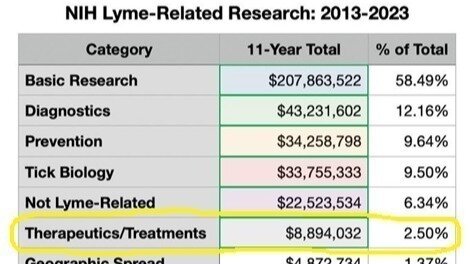
The chart below summarizes Lyme research funded by the NIH and only 2.5% has been allocated for treatment:

https://www.dropbox.com/scl/fi/4fpjivy7stiztfs5ib6sz/NIH-Lyme-Research.png?rlkey=71yrfa6r7e6osq2he7qwsjj75&dl=0

For the record there are many infections requiring long-term antibiotics so why Klempner stopped his NIH funded antibiotic treatment trials for Lyme after 90 days makes absolutely no sense whatsoever:

From the following publication:

Benefit of intravenous antibiotic therapy in patients referred for treatment of neurologic Lyme disease
https://www.dovepress.com/benefit-of-intravenous-antibiotic-therapy-in-patients-referred-for-tre-peer-reviewed-fulltext-article-IJGM

Infections requiring long-term antibiotics:

https://www.dropbox.com/scl/fi/pserdbenw4n1vovv14z2a/Infections-requiring-long-term-antibiotics.jpg?rlkey=281zg7alxl4gqm2e2jipy9szj&dl=0

Lyme misdiagnosed/undiagnosed for months, years or decades is far more incapacitating than “acute” Lyme and 2-4 weeks of antibiotics does not scratch the surface of this well-established/immune suppressive infection. These are the patients who need help the most but have been excluded in research for decades. There are countless stories of patients seroconverting after the initial few doses of Doxycycline and now that a toxin has been identified that puts Lyme disease in an altogether different category of infection:

Toxins 
Published: 21 May 2024

Borrelia burgdorferi 0755, a Novel Cytotoxin with Unknown Function in Lyme Disease
https://www.mdpi.com/2072-6651/16/6/233

So it would appear that one way to get a medical association (AMA) to go along with the suppression of evidence is to throw them a boatload of money… five million taxpayer dollars to be exact for a so-called IDSA biased “Clinician Toolkit”  (CDC grant number  NU50CK000597)

This controlling of the narrative has caused unimaginable pain and suffering all across America as insurance companies refuse to pay for long-term treatment, personal bankruptcies from out-of-pocket expenses to treat chronic infection, suicides from despair all while Valneva Received FDA Fast Track Designation for its Lyme Disease Vaccine.

Chronic Lyme must be recognized and finally addressed with 100% attention to effective antimicrobials for all stages of disease.

Question:

Is collusion to control the narrative through suppression of the truth, facts and scientific references a criminal offense?

Carl Tuttle
Hudson, NH

Cc: Assistant Attorney General Jonathan Kanter, Attorney Katrina Rouse
Attorneys for the United States Antitrust Division

Assistant Attorney General Jonathan Kanter Announces Task Force on Health Care Monopolies and Collusion
https://www.justice.gov/opa/pr/assistant-attorney-general-jonathan-kanter-announces-task-force-health-care-monopolies-and

“Every year, Americans spend trillions of dollars on health care, money that is increasingly being gobbled up by a small number of payers, providers and dominant intermediaries that have consolidated their way to power in communities across the country,” said Assistant Attorney General Jonathan Kanter of the Justice Department’s Antitrust Division. “Led by Katrina Rouse, the task force will identify and root out monopolies and collusive practices that increase costs, decrease quality and create single points of failure in the health care industry.

“The Quiet Epidemic” Showing at the U.S. Capital Nov. 20, 2024

https://www.change.org/p/the-us-senate-calling-for-a-congressional-investigation-of-the-cdc-idsa-and-aldf/

The Quiet Epidemic Film Presentation at the U.S. Capitol November 20th

Carl Tuttle
Hudson, NH, United States
Oct 29, 2024

The Quiet Epidemic Film Presentation at the U.S. Capitol

Please join us on Capitol Hill for a special presentation of the award-winning documentary The Quiet Epidemic

Hosted by Senator Richard Blumenthal, with a special appearance by Chris Meloni, Actor & Global Lyme Alliance Celebrity Ambassador

Since the earliest days of production, the team and supporters behind The Quiet Epidemic hoped the film might one day screen on Capitol Hill, and that moment has arrived.

Please join us for a free and open to the public presentation of The Quiet Epidemic on Wednesday, November 20th, from 5:30 PM to 9:00 PM, at the U.S. Capitol. The film will be preceded by a reception and followed by a discussion and Q&A with the film’s subjects, experts and actor Chris Meloni.

While the event is free to attend, RSVPs via Eventbrite are required for entry. You’ll find a PDF invitation attached to this email which includes the RSVP link—please circulate this widely, as our team is prohibited from promoting the event on social media. Details regarding the exact venue location within the Capitol will be sent to all registrants via Eventbrite approximately one week prior to November 20th.

The Quiet Epidemic team would like to thank our generous sponsors who have made our Capitol Hill events possible: LymeLight Foundation, Global Lyme Alliance, Sarena Snider, Project Lyme, NatCapLyme and lymeLNK. Among our sponsors are The Quiet Epidemic Executive Producers Phyllis & Scott Bedford—founders of LymeLight Foundation—and Sarena Sarena, each of whom generously supported the creation of the film itself, the film’s festival tour and release, and our team since the very beginning.

Please share the Eventbrite link and the attached PDF with anyone in your network who may wish to attend this event—especally those in the Washington D.C. area. We also encourage you to invite your representatives and include a brief statement about the impact Lyme has had on your life, and the prevalence in their state.

PDF invitation

https://www.dropbox.com/scl/fi/rp1qqnln1w6ztk6yimecq/11.20.24_The-Quiet-Epidemic-on-Capitol-Hill.pdf?rlkey=ecmsm63kwn8w27pymi1x8dlqk&dl=0

This is a culminating moment for The Quiet Epidemic film and impact campaign, nine years in the making. Thank you for being a part of this journey and for making it possible in so many ways! We hope to see you in D.C.

With gratitude,
The Quiet Epidemic Team

Watch The Quiet Epidemic trailer:
https://www.youtube.com/watch?v=I4C71N290co

Brazil Faces Same Problems With Lyme Disease As Seen in the USA

http://cameronmd.com/brazil-faces-problems-lyme-disease-seen-usa/

Brazil faces same problems with Lyme disease as seen in the USA

An article published in the Brazilian Journal of Microbiology entitled “Brazilian borreliosis with special emphasis on humans and horses” examines the growing number of cases in Brazil of Lyme disease, referred to, in that country, as the Lyme-like or Baggio-Yoshinari Syndrome (BYS).

The authors take an in-depth look at BYS and how it compares to Lyme disease (LD) found in the United States. Although there are slight differences between the diseases, BYS and LD share similarities on many fronts. [1] “Despite the increasing number of suspect cases, this disease [BYS] is still neglected in Brazil by the medical and veterinary communities,” writes Basile and colleagues.

BYS causes some of the same symptoms seen in Lyme disease, such as erythema migrans, arthritis, neurological symptoms and cardiac disease. Both are difficult to diagnose.

“The disease is often unrecognized, especially at secondary or tertiary stages when patients do not remember what occurred months or years before the current disease,” stated Basile. “Certainly, many cases of unrecognized chronic neurological or articular disease are in fact cases of BYS not identified and treated at early stage.”

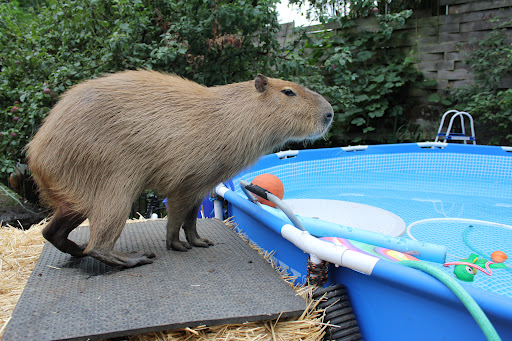
The capybaras, a popular Brazilian house pet, is a known reservoir for ticks infected with the Lyme-like or Baggio-Yoshinari Syndrome (BYS).

The Brazilian disease can also be multisystemic. “Baggio-Yoshinari Syndrome has been reported to cause neurological, cardiac, ophthalmic, muscle, and joint alterations in humans.” Furthermore, it has been associated with a high morbidity “due to the presence of symptom recurrence, severe reactive manifestations such as autoimmunity, and the need for prolonged treatment.”

According to Basile and colleagues, the disease progresses with recurrences, “especially if antibiotic treatment is initiated later than three months after infection.” Thus, treating the disease in its early stages is critical.

Cystic forms have been described, as well. “Because motile and spiral spirochetes were never isolated or cultured in Brazil, researchers from LIM-17 assumed that the etiological agent in Brazil was present in cystic form.”

The Brazilian patients may also be suffering from co-infections, as investigators identified other microrganisms in the blood of BYS patients. Tests showed “the occurrence of microorganisms with morphological structures similar to Mycoplasma spp., Chlamydia spp., and non-flagellated spirochetes in the peripheral blood of patients with BYS who were seropositive for B. burgdorferi sensu lato,” according to Basile. “Those patients exhibited negative serology for Mycoplasma spp. and Chlamydia spp.”

Additionally, laboratory testing for BYS is unreliable. There is a low sensitivity and specificity with the ELISA, enzyme immunosorbent assay, or western blotting for B. burgdorferi, in part because these tests utilize antigens from B. burgdorferi stricto sensu from the Northern Hemisphere.

Domestic pets have been described as potential reservoirs for ticks carrying the disease. The capybaras, a large rodent and popular house pet in Brazil, has been identified as a likely reservoir and is thus a threat in spreading the disease.

Wild and domestic animals can be infected. “Studies indicate that LB [Lyme borreliosis] in horses has clinical signs similar to the disease in humans, including fever and lethargy, arthritis, polysynovitis, lameness, muscle stiffness, abortion, meningitis, cranial neuritis, radiculoneuritis and encephalitis, uveitis, and premature death of foals,” according to Basile.

The authors’ findings reminds us that the challenges faced in the United States in gaining recognition for a disease that is growing in numbers and has the potential to cause chronic, debilitating illness is not unique to our country. The Brazilian patients suffering from the Lyme-like or Baggio-Yoshinari Syndrome are struggling to conquer the same obstacles.

“Lyme disease is a condition of extreme importance because it is a zoonosis that causes physical and psychological sequelae in affected individuals. It remains poorly investigated in Brazil, especially in the field of veterinary medicine. Therefore, studies describing the unique aspects of the disease in Brazil and the etiological agents found are needed.”

References:

  1. Basile, R.C., et al., Brazilian borreliosis with special emphasis on humans and horses. Braz J Microbiol, 2016.

Update: Oliveira from the Ministry of Health, Brasilia, DF, Brazil was not able confirm Lyme-like borreliosis in Brazil in a letter in the journal Travel Medicine and Infectious Disease.1 “The interpretations of the results have not followed those recommended by the CDC.” writes Oliveira. Only three cases of Lyme-like borreliosis were identified. “This evidence reinforces the hypothesis that Lyme borreliosis does not occur in Brazil.” writes Oliveira.

  1. de Oliveira SV, Faccini-Martinez AA, Cerutti Junior C. Lack of serological evidence for Lyme-like borreliosis in Brazil. Travel Med Infect Dis. 2018.

________________

**Comment**

Another perfect example of why the CDC must go.

This corrupt, inept organization rules the world.