Archive for the ‘Lyme’ Category

Shania Twain’s Netflix Documentary Discusses “Scary” Lyme Symptoms

https://www.lymedisease.org/shania-twain-netflix-lyme-doc/

Shania Twain’s Netflix documentary discusses “scary” Lyme symptoms

In a new Netflix documentary, “Not Just a Girl,” country pop mega-star Shania Twain discloses details of her harrowing experience with Lyme disease.

The July 26 release of the film has prompted a lot of media coverage about the Canadian-born singer of such hits as “Man! You Make Me Feel Like a Woman” and “You’re Still the One.”

Watch what Good Morning America had to say.

Here are samples of other news coverage.

Today:  Shania Twain details Lyme disease symptoms: ‘I was afraid I was going to fall off the stage

Popsugar:  Shania Twain on Battle With Lyme Disease: “I Thought I’d Lost My Voice Forever”

Yahoo News:  Shania Twain opens up about ‘scary’ Lyme disease symptoms – what is the condition?

For more:

In Order To Prove How Sick I am, I Had to Make Myself Sicker

https://www.lymedisease.org/jamison-hill-prove-i-am-sick/

In order to prove how sick I am, I had to make myself sicker

By Jamison Hill

Aug. 1, 2022

The last few months have been rough. I have been going through a brutal intake interview for In-Home Supportive Services, which provides me with caregiving hours. The intake interview did not go well.

Throughout the interview, I was required to demonstrate, both verbally and physically, how sick I am and the limitations that my illness imposes upon me. The irony of this is that in order to prove how sick I am, I had to make myself sicker.

I had to speak more than I normally speak. I had to move more than I normally do. I had to use emotional and cognitive energy that I normally reserve for other things.

The case worker performing the interview didn’t seem to understand my illness. I tried to explain that my illness is not a steady thing. It’s unlike disabilities that are the same from one day to the next. My illness varies from day to day.

On good days, I might be able to sit up and even take a few steps. On bad days, I’ll be lucky to be able to get out of bed and take my mobility scooter to the bathroom. Standing up is out of the question on bad days. And lately, because of the stress and exertion of this intake process, there have been an exceedingly high number of bad days.

A demeaning and detrimental process

What bothers me most about the process of proving how sick I am, is that it is demeaning to my psyche and detrimental to my health. If someone is sick, they shouldn’t have to prove it. And they definitely shouldn’t have to make themself sicker to prove it.

No one should have to put their illness on display like an exhibit at a science fair. But because many chronic illnesses are invisible — the symptoms are not clearly noticeable — we often have to do just that.

We have to push ourselves to the brink of exhaustion just so someone can catch a glimpse of what we’re going through. And then whoever is observing us carries on with their life while we are confined to bed for days or weeks, recovering from proving the legitimacy of our illness.

It reminds me of a story Michael J. Fox told in one of his memoirs. He was reflecting on a time when he testified before Congress about his Parkinson’s disease. And in doing so, he chose not to take the medications that improved his condition and made it manageable, more or less.

Because of this decision, his illness was on full display for the politicians in the room and the people watching on TV. His hands were shaking. His voice was wavering. It was scary, but that was the reality of his illness.

Because Fox had not taken his medication, some commentators said that he was putting on an act, that he wasn’t being truthful about his illness. In reality, he wasn’t just being truthful, he was risking his health for the sake of being truthful. He was giving people a glimpse at the worst of his illness and making himself sicker in order to do so.

More people believed me when I was sicker

Six years ago, I was completely bedridden — unable to lift my head off a pillow, too weak to eat or speak. Now my health has improved some, and I can get out of bed and speak for short amounts of time. But when it comes to proving how sick I am, I have never struggled more.

When I was at my sickest, it was easier to show others how sick I was. More people believed me because no one in their right mind would go without speaking or eating just so people thought they were sick. No one would stay confined to bed literally all the time just to get sympathy or money or whatever. But now that I can get out of bed, things are more complicated.

At first glance, it’s not always obvious how sick I am. But if you observe me for any significant amount of time, it’s clear to see that I am not a healthy person. You won’t see me eating in restaurants and going to concerts and seeing movies and watching ball games and swimming in oceans and hiking mountains and running on beaches and flying in planes and getting married and having children and doing all of the other things I would do if I were healthy.

All the proof I need

And that, my friends, is all the proof I need. I so badly want to live a healthy life. I want to be active. I want to move. I want to do everything I can as much as I can. And yet, that mentality is at odds with my illness. To minimize my symptoms, I must rest. I must ask for help. I must delay. I must do things later, when I am feeling better.

Even still, here I am, more than a decade into my illness and still having to prove that I’m sick. It’s a soul-crushing, pride-swallowing process that won’t stop as long as my illness exists. I hate it. But perhaps one day it will stop, and I’ll no longer have strangers judging how sick I am.

Jamison Hill has written about his struggles with myalgic encephalomyelitis and Lyme disease in such publications as The New York Times, The Los Angeles Times, and the Washington Post, as well as in his memoir When Force Meets Fate. This article is republished from his blog, Jamison Writes.


Bacterial & Fungal Isolation From Face Masks Under the COVID Pandemic

**UPDATE Feb. 2024**

Eleven month old DIED from mask asphyxiation in Taiwan.  

Besides the harmful bacteria on masks which the wearer continually rebreathes – as well as the lack of oxygen, research now states probable aerosol transmission of the virus through floors and walls proving the futility of porous masks. 

A study looked at mandatory masking on the case fatality rate in Kansas and found that counties with mask mandates had significantly higher case fatality rates than countries without mandates.  The authors state the findings suggest mask usage might pose a yet unknown threat to the user instead of protecting them.  They call this the “Foegen effect”, which has been proven in vivo in an animal model and consists of a deep re-inhalation of hypercondensed droplets or pure virions caught in the facemasks as droplets can worsen prognosis and might be linked to long-term effects of COVID infection.

The warnings for masks have been given from the beginning but were completely ignored:

_____________________

https://www.nature.com/articles/s41598-022-15409-x#Tab1

Bacterial and fungal isolation from face masks under the COVID-19 pandemic

Ah-Mee Park, Sundar Khadka, Fumitaka Sato, Seiichi Omura, Mitsugu Fujita, Kazuki Hashiwaki & Ikuo Tsunoda

Abstract

The COVID-19 pandemic has led people to wear face masks daily in public. Although the effectiveness of face masks against viral transmission has been extensively studied, there have been few reports on potential hygiene issues due to bacteria and fungi attached to the face masks. We aimed to (1) quantify and identify the bacteria and fungi attaching to the masks, and (2) investigate whether the mask-attached microbes could be associated with the types and usage of the masks and individual lifestyles. We surveyed 109 volunteers on their mask usage and lifestyles, and cultured bacteria and fungi from either the face-side or outer-side of their masks. The bacterial colony numbers were greater on the face-side than the outer-side; the fungal colony numbers were fewer on the face-side than the outer-side. A longer mask usage significantly increased the fungal colony numbers but not the bacterial colony numbers. Although most identified microbes were non-pathogenic in humans; Staphylococcus epidermidis, Staphylococcus aureus, and Cladosporium, we found several pathogenic microbes; Bacillus cereus, Staphylococcus saprophyticus, Aspergillus, and Microsporum. We also found no associations of mask-attached microbes with the transportation methods or gargling. We propose that immunocompromised people should avoid repeated use of masks to prevent microbial infection.

_________________

**Comment**

If you are a Lyme/MSIDS patient, you are immunocompromised.

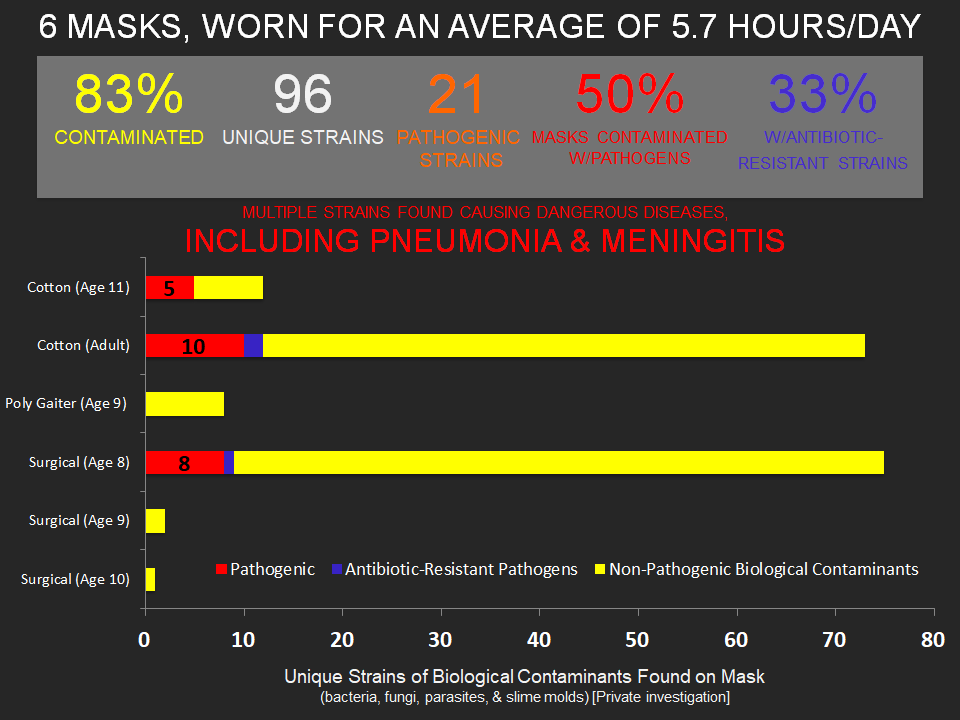
This is not the first time pathogens have been found on masks.  Concerned parents put clean or new masks on their kids in the morning, sent them to school for nearly 5-8 hours, and then had them tested in a lab.  Here’s what was found:

  • 83% of masks were contaminated
  • 96 unique strains
  • 21 pathogenic strains
  • 33% antibiotic resistant strains
11 dangerous pathogens were found:
  • treptococcus pneumoniae (pneumonia)
  • Mycobacterium tuberculosis (tuberculosis)
  • Neisseria meningitidis (meningitis, sepsis)
  • Acanthamoeba polyphaga (keratitis and granulomatous amebic encephalitis)
  • Acinetobacter baumanni (pneumonia, blood stream infections, meningitis, UTIs—resistant to antibiotics)
  • Escherichia coli (food poisoning)
  • Borrelia burgdorferi (causes Lyme disease)
  • Corynebacterium diphtheriae (diphtheria)
  • Legionella pneumophila (Legionnaires’ disease)
  • Staphylococcus pyogenes serotype M3 (severe infections—high morbidity rates)
  • Staphylococcus aureus (meningitis, sepsis)

Mask believers don’t seem to care that data shows mask usage has virtually no impact on COVID cases. Similarly to the useless (negative efficacy even) and dangerous COVID gene therapy injections, which don’t stop transmission, infection, severe illness, or even death, zealots don’t care.

The CDC refuses to fix it’s horribly flawed mask study which is being still being used to set public health policy, and the CDC and the FDA are completely guilty of mis or disinformation, yet are still coming after others who disagree with their narrative.  The current administration has been found guilty of colluding with social media companies to suppress freedom of speech under the guise of ‘misinformation,’ and nearly got away with a DHS ‘ministry of truth’ type disinformation board run by ‘Scary Poppins’ until the public gave fierce backlash.  And now the UN is declaring war on “conspiracy theories” and launches a #thinkbeforesharing campaign.  UNESCO has teamed up with Twitter, the European Commission and the World Jewish Congress to launch the campaign.

“In a time of universal deceit, telling the truth is a revolutionary act”. – George Orwell 1984

Until the public also gives fierce backlash against worthless, oxygen depriving, bacteria infested, carcinogenic, toxic masks, they will continue to be held hostage by tyrants. 

FYI: the EPA has just launched community engagement efforts on warning of new ethylene oxide risk information.

Masks are “sterilized” with Ethylene Oxide — a known carcinogen. Many teachers in various school boards have been experiencing significant symptoms as a direct result of the effects of this chemical.

Disulfiram for Lyme Update #2

https://www.treatlyme.net/guide/antabuse-disulfiram-chronic-lyme-disease-treatment  Video and Article Here

Updated: 5/9/2022

About Disulfiram and Lyme Disease

By Dr. Marty Ross

For 30 percent of people with chronic Lyme disease, disulfiram is a game changer. This is a medicine historically used to treat people with alcoholism. Ground-breaking research from Dr. Rajadas’ Stanford University lab in 2016 showed disulfiram kills persister and growing forms of Lyme germs. Based on Rajada’s research, disulfiram is being repurposed as a Lyme antibiotic.

In alcoholism, disulfiram prevents the breakdown of a toxic alcohol by-product called acetaldehyde. As acetaldehyde builds up, it makes a person sick with severe abdominal pains and even headaches. In alcoholism, a person takes this medicine daily to prevent them from drinking out of fear it will cause severe illness if they drink alcohol.

In Lyme disease, we do not know the mechanism of how disulfiram works. But we do know in the laboratory that it kills Lyme persisters and is moderately effective at treating growing Lyme too. We also theorize that it breaks up biofilm slime layers that protect the germs.

(See link for article and 7 Min video)

____________________

**Comment**

Please read Dr. Ross’s article in full as well as watch the video.  He gives dosages as well as supportive supplements.

SUMMARY of effectiveness:

Dr. Liegner’s review of his patient’s charts shows:

  • 92.5 percent of people have varying degrees of improvements
  • 36.4 percent – enduring remission (clinically well for 6 months without anti-infectives)
  • 49.3 percent – fatigue as a side effect
  • 31.3 percent – psychiatric problems like anxiety, depression, hallucinations
  • 14.9 percent – neuropathy
  • 14.9 percent – liver enzyme elevation
  • 50 percent – unable to reach the target dose due to side effects (see dosing section below)

Dr. Ross states: Even if a person cannot reach the target dose, in my experience many get benefit by staying at a dose they can tolerate for at least 4 months.

Dr. Ross also states that Disulfiram doesn’t work for Bartonella but may help Babesia.

Please also see:

If you are a single person, please educate yourself about the psychiatric issues.  Never take this drug without a plan in place to have people checking in on you daily.  Take it from me – you can go mad as a hatter and be completely oblivious to your madness.  Been there, done that.  Neuropathy can also be a real side effect problem.

I’m still glad I tried it!

Could There Be Subclinical Cardiac Involvement in Early Lyme Disease in Children?

https://danielcameronmd.com/could-there-be-subclinical-cardiac-involvement-in-early-lyme-disease-in-children/

Could there be subclinical cardiac involvement in early Lyme disease in children?

cardiac-lyme-disease-children
Cardiac involvement has been observed during the early disseminated stage Lyme disease. Could there be subclinical cardiac involvement in early Lyme disease in children?

In an earlier study by Woolf and colleagues, nearly 1 in 5 children (19.6%) children with an erythema migrans (EM) rash or a positive two-tier Lyme serology had EKG evidence of carditis. Twenty-four of the children had atrioventricular (11.2%). Their study did not report troponin levels.¹

High-sensitivity cardiac troponin assays have been used to identify patients at high risk of cardiovascular and non-cardiovascular events.² The authors identified pneumonia, an infective exacerbation of chronic obstructive pulmonary disease, and sepsis as causes of noncardiovascular events.

Lewandrowski and colleagues looked at high-sensitivity troponin T in 41 individuals with early Lyme disease.³ All individuals presenting in the summer of 2015 met the Centers for Disease Control and Prevention (CDC) surveillance case definition of EM.

“One patient had a value greater than the cutoff used for acute myocardial infarction,” wrote the authors.³ Another five patients had high-sensitivity troponin T values significantly above the expected values for their sex (p<0.0001).

There are many possible explanations for increased high-sensitivity troponin T values in different patients in the absence of acute cardiac damage. “cTn (cardiac troponin assay) is commonly elevated in acute non-ACS conditions, as well as in chronic diseases,” wrote Park and colleagues. They added, “It is unclear why these elevations occur; yet they cannot be ignored as cTn levels in chronically unwell patients are directly correlated to prognosis.”4

“Our results raise the possibility that subclinical cardiac involvement may be more common in ELD than previously recognized,” wrote the authors. They added, further studies will be necessary to elucidate the significance of this finding.”

Lyme carditis

Lyme carditis is uncommon. Nevertheless, Kannangara and colleagues summarized the growing list of cardiac problems in Lyme disease, as described in the medical literature:

  • First-degree heart block
  • Wenckebach phenomenon (Mobitz type I)
  • Mobitz type II
  • Complete Heart block / High degree AV block
  • Bundle branch block
  • Sinus arrest / Sinus pauses
  • Supraventricular tachycardia
  • Atrial fibrillation
  • Junctional tachycardia
  • Fascicular tachycardia
  • Ventricular tachycardia
  • Ventricular flutter
  • Bradycardia
  • Narrow QRS escape rhythm
  • Prolonged QT
  • ST depression / T inversion
  • ST elevation
  • Asystole
  • History of Wolf Parkinson White Syndrome. In a case of sudden death due to LC (Lyme Carditis).
References:
  1. Woolf PK, Lorsung EM, Edwards KS, et al. Electrocardiographic findings in children with Lyme disease. Pediatr Emerg Care. Dec 1991;7(6):334-6. doi:10.1097/00006565-199112000-00003
  2. Chapman AR, Adamson PD, Shah ASV, et al. High-Sensitivity Cardiac Troponin and the Universal Definition of Myocardial Infarction. Circulation. Jan 21 2020;141(3):161-171. doi:10.1161/CIRCULATIONAHA.119.042960
  3. Lewandrowski EL, Lewandrowski K. Measurement of High Sensitivity Troponin T in Patients with Early Stage Lyme Disease: Preliminary Evidence for Possible Subclinical Cardiac Involvement. Ann Clin Lab Sci. Mar 2022;52(2):179-184.
  4. Park KC, Gaze DC, Collinson PO, Marber MS. Cardiac troponins: from myocardial infarction to chronic disease. Cardiovasc Res. Dec 1 2017;113(14):1708-1718. doi:10.1093/cvr/cvx183

________________

**Comment**

Again, something can not be labeled as “rare” if nobody’s looking for it.  And this article just presented the fact that many are walking around with sub-clinical cases.  I believe this is far more common than many believe.  Patients will get tests but they all return “normal” yet they have flagrant symptoms.

The other fly in the ointment are the COVID shots, now fraudulently authorized for children who don’t need them.  Many are having heart issues with high troponin levels.  Also, the CDC only reports on two types: pericarditis and myocarditis.  There are many other types of heart issues. Now, it will be even harder to diagnose these kids.