TICK AND MOSQUITO-BORNE DISEASES: TRENDS IN THE UNITED STATES
The following data are abstracted from Gideon and the Gideon e-book series. [1] Charts were created using an interactive tool driven by over 30,000 base graphs in the program. [2]
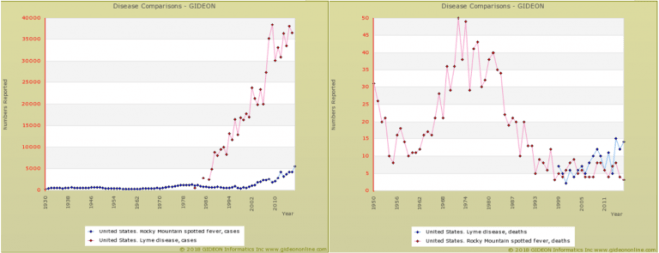
Chart 1 contrasts trends for reported incidence of Lyme disease and Rocky Mountain spotted fever (RMSF). Note that while rates of Lyme disease in 2016 are 15-fold those reported in 1987, those of RMSF increased by a factor of seven. The number of fatal cases for both diseases have remained similar in recent years (i.e., the relative case-fatality rate of Lyme disease has decreased)
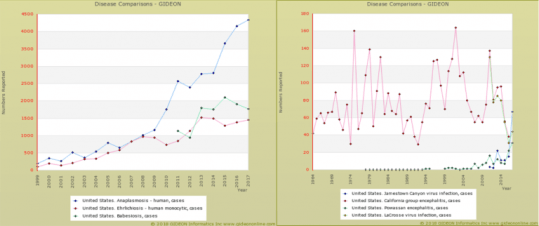
Chart 2 summarizes incidence data for a variety of tick-borne and mosquito-borne infections. Note that rates of Ehrlichiosis, Anaplasmosis, Babesiosis, Jamestown Canyon virus infection and Powassan encephalitis have increased since the year 2000. The incidence of LaCrosse encephalitis has decreased, while that of California encephalitis is largely unchanged.
Charts 3 and 4 demonstrate that incidence and reported deaths for Western equine encephalitis, Eastern equine encephalitis, St. Louis encephalitis and West Nile fever have changed little in recent years.
LYME DISEASE TREATMENT MEASURE PASSES ILLINOIS HOUSE
MAY 2, 2018 LOCAL NEWS
An issue that was brought before 74th District State Representative Dan Swanson by constituents was treatment for Lyme Disease.
Swanson passed the “Lauryn Russell Lyme Disease Prevention & Protection Law” through the Illinois House on Friday to allow physicians to prescribe more aggressive treatment for Lyme Disease without the fear of disciplinary action.
“It requires the Illinois Department of Public Health to create a Lyme Disease Task Force and also amend the Medical Practice Act that requires the treatment of Lyme Disease in certain individuals,” Swanson said.
The legislation was inspired by Lauryn Russell, a 12-year-old student from Mercer County, who has Lyme Disease and has had to seek treatment out of state due to potential disciplinary action that could be taken against her Illinois physician for treating Lauryn’s post-treatment Lyme Disease Syndrome (PTLDS) or Chronic Lyme Disease.
“After local families reported these problems to me with treatment of Lyme Disease, I felt compelled to act on behalf of my constituents,” Swanson said.
Advocates for Lyme Disease sufferers say the current recommended treatment of the disease, 10 to 21 days of antibiotics, is insufficient for people with advanced or chronic levels of the disease. Nine states have enacted similar legislation including: Iowa, California, Connecticut, Rhode Island, New York, Massachusetts, Vermont, New Hampshire and Virginia.
_____________
**Comment**
Way to go Illinois! We need this at the federal level as this modern-day plague is in every state and spreading world wide. Doctors should not have to quake in their boots for diagnosing and treating this devastating disease (s) with effective treatments.
Also, please note that the CDC is undermining work done at the state level with their Lyme Corps (or more accurately – corpse as this is killing us out here): https://madisonarealymesupportgroup.com/2017/07/07/cdc-sabotages-state-laws-protecting-lyme-patients/To be clear, the CDC is using Lyme Corps to tell health practitioners the only valid treatment for Lyme, chronic Lyme and complications from coinfections are found in the 2006 IDSA Lyme Guidelines. However, key science institutions and federal agencies would not support this objective.
Editor’s note: The topic of a Lyme vaccine has raised some controversy surrounding the federal Tick-Borne Disease Working Group, which meets this week in Washington DC. In order to shed light on the history of this contentious issue, we are publishing the following excerpt of CURE UNKNOWN: INSIDE THE LYME EPIDEMIC, by Pamela Weintraub.
First, some background: In 1994, at a meeting in Dearborn, Michigan, a group of laboratory scientists changed the serological definition of Lyme disease in concert with the development of a Lyme vaccine. The new blood test would make it easier to secure FDA approval for the vaccine, called LYMErix, those at the helm of product development said.
Instead of documenting an expansion and intensification of “bands” representing antibodies to the disease on a Western blot, as before, the new, more restrictive test, called for detection of 5 of 10 bands. This was one pattern of many, according to the manufacturer, that could indicate true infection.
Among the other changes, the test would no longer consider, for purposes of diagnosis, the protein that formed the active ingredient in the vaccine –Outer Surface Protein (Osp) A. Without screening for OspA and its connected protein, OspB, a vaccinated person would test negative, clearing an easy path for FDA approval of the vaccine. However, this made it virtually impossible for many of the sickest patients to get diagnosed with Lyme, including those who would have tested positive under the previous standards.
In this excerpt, Weintraub shows how these machinations impeded early diagnosis and access to care for 25 years, while never delivering a Lyme vaccine itself.
The Vaccine Connection: Lyme Gets a Business Model
By Pamela Weintraub
In 1980, Congress passed the Bayh-Dole Act, giving universities and their faculty members permission to stake patent claims on discoveries they made through research funded by federal agencies such as the National Institutes of Health. Instead of leaving the ownership of intellectual property with government, the scientists now had a chance to be stakeholders and entrepreneurs themselves. The new law accelerated the rate of academic breakthroughs like gene splicing, gave rise to three-way partnerships between government, universities, and start-up firms, and spawned the modern biotech industry almost overnight. By the early 1990s, university scientists were scrambling to patent genes, proteins, and organisms, hoping to launch products and profit from the discoveries they made.
In Lyme disease, the main product of interest was a vaccine aimed at restoring ease in the great outdoors. Toward that end, big pharma made millions of dollars in Lyme vaccine grant money available to scientists; when Lyme researchers applied for government funding, a vaccine was often in the crosshairs of their view. It logically followed that many of the top researchers would apply for vaccine-related patents and launch vaccine-related start-up companies while others would become big pharma consultants, garnering sizable grants for conducting vaccine studies at their university labs. As the years went on, it only made sense that the big decisions regarding Lyme disease—the paradigmatic issues like the literal disease definition and the exact serological pattern needed for diagnosis—would take the patents and future viability of the products into account. As in the rest of biomedicine, the scientists making those decisions were, by and large, stakeholders. Their partnership with industry was business as usual in the scientific culture of the day.
In many other diseases, the interests of the patients and commercialization of the products had somehow managed to converge. There was a confluence of interest and one hand seemed to wash the other. Yet Lyme was a special case: Moving a product past the obstacles to FDA approval required great exactitude, while the equivocal status of many Lyme patients and the many strains of the Lyme organism could thwart that goal.
To prove a vaccine effective, investigators had to be able to tell the difference between people who suffered infection and those who had reacted badly to the vaccine itself. The more flexible the definition of the disease—and thus, the more uncertainty associated with diagnosis—the more difficult this became. Lyme diagnosis often was uncertain—“shades of gray,” Leonard Sigal had said—yet writing that reality into the development of a new vaccine could derail its approval.
On top of that, B. burgdorferi ’s talent for altering its outer coat made it a poor candidate for vaccination in any usual sense. Most modern vaccines work by a simple method. A surface protein from the germ is multiplied through molecular technology and injected into the body. Our immune cells generate antibodies against the protein. Should the actual microbe later attack, the preexisting antibodies would latch on to the surface and wipe the infection out.
But the quick-change artist B. burgdorferi, which morphed continuously from tissue to tissue and over time, was far too nimble for such tricks. By the time the body made antibodies against any one protein, the spirochete would morph into something else. In fact, as scientists searched for vaccine candidates, only one B. burgdorferi protein appeared to protect mice against Lyme infection—outer surface protein (Osp) A. To Steve Barthold, then of Yale and an inventor of the OspA vaccine, this made perfect sense. It might be impossible to immunize a mammal against Lyme disease, but you could immunize a tick, where most spirochetes live in the midgut and don an unchanging coat made virtually exclusively of OspA.
When a tick bit a mammal “vaccinated” with OspA, it would ingest a surge of blood laced with the OspA antibody. The antibody would rush to the tick’s midgut, killing most of the spirochetes on the spot before they could flow back and infect the human host. Because some strains of the spirochete lacked OspA, the vaccine wasn’t foolproof; because it took days for a total kill inside the tick itself, there was a small window of opportunity for infection to spread, reducing the efficacy overall. Even so, industry executives thought that the OspA vaccine was a clever invention, representing a creative solution to the confounding complexities of Lyme.
It didn’t take long for two competing pharmaceutical giants—SmithKline Beecham and Pasteur Merieux Connaught—to launch two potential products. The Connaught effort, with the clinical trial headed by Leonard Sigal, was killed by the company in the wake of lawsuits over side effects. But the SmithKline vaccine, with Steere leading the study, promised to make it through the pipeline at FDA.
It was in 1998 that Steere announced the success of his large-scale clinical trial for the vaccine called LYMErix in the New England Journal of Medicine. There was just one fly in the ointment, and it was a whopper: Steere was elsewhere proposing that OspA, the active ingredient of his vaccine, was the specific trigger for chronic Lyme.
Steere’s chronic Lyme theory was based on the same molecular mimicry concept suggested by Klempner. In an act of scientific integrity, Steere even published evidence for the controversial theory in the prestigious journal Science the week after the release of the vaccine results— much to the ire of the manufacturer, by then called GlaxoSmithKline.
Steere and Tufts immunologist Brigitte T. Huber had found a striking resemblance between a portion of the OspA molecule and the human protein LFA-1. Antibodies against OspA, Steere theorized, might mistakenly attack LFA-1 in human cells—and would continue attacking even after the infection was gone. Steere had traced the suspect human protein to the common arthritis-linked gene, HLA-DR4, which was found in a third of the population, making risk of the reaction high.
The theory provoked skepticism. Barthold, Weis, and Philipp, researchers with intimate knowledge of infection and immunity, describe some cross-reactivity with almost every microbe. Just because one molecule resembles another doesn’t mean it fuels disease. Not even Steere, who felt he’d done his due diligence in alerting the world to the theory, could prove it was correct.
Could the OspA vaccine drive a few unlucky recipients to autoimmune disease? Steere hadn’t seen it in the vaccine trial, but found it “an issue of concern. If OspA vaccination induces joint symptoms, it must be a rare phenomenon,” Steere said. But when a contingent of LYMErix vaccinees popped up to say they’d been damaged by Glaxo’s vaccine through the mechanism of Steere’s theory, the stage was set for a debacle worthy of Lyme.
At first the FDA approved LYMErix anyway, sending it off to market in December 1998 and declaring a leap into the unknown. “Those who did the trial,” said Vanderbilt professor David Karzon, a member of FDA’s LYMErix panel, “have unearthed some very interesting sinister possibilities that may or may not be real.”
Yet by January 2001, amidst a hailstorm of LYMErix lawsuits, the FDA had reconvened on LYMErix at the Bethesda Holiday Inn. Among the presenters were a small army of vaccinees who said they’d been badly hurt.
There was Emily Biegel, who addressed the panel for her husband, John, vaccinated in April and May of 1999. “Some of you may have seen him come in with a walker,” she said. “An active outdoorsman before vaccination, John has since been through four hospitalizations, atrophy, insulin dependence, compression fractures, tremors, and twenty-five plasmapheresis treatments. He is positive for HLA-DR4.”
Jenny Marra, a New Jersey hospice nurse positive for HLA-DR4, had been living with severe joint and muscle pain since vaccination in 1999. Glaxo, she complained, did not include a warning about the potential risk. “Had I known this I personally would not have taken the vaccine,” she said.
Karen Burke, the mother of two toddlers from the Pocono Mountains of Pennsylvania, said that her husband, the vigorous owner of a construction business, got his second dose of LYMErix in July of 1999. By October, he couldn’t roll over in bed. “My standing joke with him is, honey, at least when our kids are big enough to go to Disney World you’ll be well enough to sit in a wheelchair, and we’ll get to the front of the line. It’s not funny, but you have to have some fun in your life,” Burke said.
Stony Brook’s Ben Luft, a panel member, described the “twilight zone” of the “disconnect” between patient testimony and Glaxo’s denial of the adverse events. Even Steere’s scientific collaborator, Brigitte Huber, entered the fray after Karen Forschner of the Lyme Disease Foundation discovered that Huber had filed a World Trade Patent for a second OspA vaccine based on research funded by the NIH. The Huber patent, based on elaborate animal experiments, offered a genetically modified OspA molecule said to cause less of an autoimmune reaction than the OspA used to make LYMErix.
Huber had literally assigned “binding scores” to the two OspA molecules, citing evidence that scores above a certain cutoff caused autoimmune disease. LYMErix tested above the cutoff, but the new molecule fell below.
The patent “details the autoimmune mechanism as reality, not theory,” Forschner said.
Despite all this, FDA officials ultimately kept LYMErix on the market in what it called “data-gathering mode,” aimed at determining whether it caused irreversible autoimmune disease or other adverse events. The warning labels and package inserts reflected no special danger and remained unchanged.
With the vaccine still available at any suburban doc-in-the-box, the numbers of the vaccinated naturally soared. As more people were vaccinated, problems that were rare or avoidable in a screened population increasingly began to emerge. Not only were reports of more “autoimmune” cases coming out of the woodwork, but there was another problem as well: The vaccine appeared to awaken old, presumably “cured” cases of Lyme disease, Boston University’s Sam Donta said. After he treated these patients with antibiotics, most got well—just as he would expect in bona fide cases of the disease.
But the confusion didn’t stop there. As LYMErix recipients got tested for Lyme disease in the course of their ordinary lives, laboratorians around the country found their Western blots on fire, with almost every band lit. Discounting the OspA band on the Western blot had proved an insufficient precaution; even with that step taken, virtually all vacinees tested positive for Lyme disease, whether they had the infection or not.
Paul Fawcett, director of the immunology laboratories at the Alfred I. duPont Hospital for Children in Wilmington, Delaware, and a noted expert on Lyme disease serology, observed the ability of the OspA vaccine to provoke a wide range of Borrelia-specific bands on Western blots well before the product reached market, as patients involved in clinical trials appeared for routine Lyme disease tests. Fascinated by the phenomenon, he coordinated a study of twenty adult volunteers, all employees of the hospital, who received three vaccine doses each and submitted blood for analysis.
As it turned out, the elaborate banding patterns showed up in all but one subject in Fawcett’s experimental group. In fact, the banding was so robust that thirty days after the second dose of vaccine, the only two commercial Western blots then approved by the FDA were “rendered virtually useless for diagnostic purposes,” Fawcett says. “Many people were so reactive that they often showed fifteen to twenty bands,” far more than the minimum requirement of five. What’s more, Fawcett found that the odd patterns were sometimes accompanied by adverse events. Two of the twenty patients in his study developed severe arthritic pain, and the strange symptom—not generally seen in Lyme disease itself—of swelling hands, despite the fact that they had no exposure whatsoever to the spirochete.
What could be going on? Describing himself as a “fan of data,” Fawcett reviewed his findings and concluded that the only explanation was a “hyperactivation” of the immune system after exposure to the vaccine. It was this activation, he felt, that accounted for adverse events.
The bizarre banding pattern was recorded as well by Philip J. Molloy, medical director of Imugen, the Massachusetts diagnostic laboratory identified by many in the mainstream as the sine qua non for diagnosing vector-borne disease, and David Persing, chief medical officer of Cepheid and one of the most respected microbiologists on the Lyme scene at the time.
Their investigation, published in Clinical Infectious Diseases, concluded that the problem was not the vaccine, but the Western blot itself. Like everyone else, Molloy and Persing found that vaccination led to a complex pattern of multiple bands, including CDC diagnostic bands, on Western blots, making it difficult to determine which bands came from the vaccine and which ones from infection. “It was possible to tell whether or not they had been vaccinated,” says Persing, “but not whether they had Lyme.”
Molloy suggested that the phenomenon was the result of instability of OspA—its degradation into smaller fragments and buildup into larger particles, resulting in Western blot tests with a diversity of bands that seemed to confirm the disease but actually meant nothing at all. One interesting implication of the finding, he theorized, was that even for those not vaccinated the banding pattern chosen at Dearborn represented nothing more than “an immune response to OspA, which is being ‘counted’ several times, while other bands presumed to be present are not really there at all.” That would make the Western blot pattern chosen at Dearborn “irrelevant” for garden variety diagnosis, says Molloy.
As for GlaxoSmithKline, it never denied the existence of the dirty blots. “We would need more time for our scientists to study the papers and reports in depth,” Glaxo communications director Carmel Hogan said at the time.
Whatever the explanation turns out to be, one wonders how researchers ever managed to differentiate between vaccine adverse reactions and Lyme disease itself. With such mixed-up results, how could they prove that the vaccine worked or that it was a vaccine at all? Researchers had tried their best to come up with a circumscribed serological definition for Lyme disease during the vaccine trials, but the utter messiness of Lyme, including all that was still unknown, may have tripped them up.
Hearing all the problems, patients couldn’t help but wonder whether conflicts of interest, including potential for profit, had played a role in so much sloppiness and such a frenzied rush to market on their behalf.
Thinking back over the years, they asked themselves whether the increasingly restrictive disease definition had been motivated by the vaccine. The thing that bothered Lyme patients most was the removal of the OspA and OspB markers from the diagnostic pattern chosen for the Western blot in Dearborn, Michigan, in 1994, just as the vaccine trials were getting under way.
Why had the markers, so specific for Lyme they were vaccine candidates, really been purged from the Western blot? Was it to make sure vaccines wouldn’t test positive on Lyme tests? Was it a misguided effort to avoid all the confusion that the OspA molecule was causing now?
The Dearborn panel voting on the Western blot pattern had particular potential for bias. Indeed, the nine voting consultants hired by the CDC included a scientist holding the patent for OspA; the inventor of the canine Lyme vaccine, Lymevac; and Allen Steere, who was both an author of the study used to generate the hotly contested Dearborn standard as well as the lead investigator for clinical trials of the vaccine. It wasn’t widely known, but the FDA had accepted Steere’s so-called Dearborn criteria as the serological standard for the LYMErix trials months before the vote in Michigan ever took place.
The circumscribed view of the disease was extended, as well, to the influential Clinical Treatment Guidelines published by the Infectious Diseases Society of America (IDSA) in 2000. As the mainstream standard of care, the guidelines were embraced by insurers to restrict antibiotic treatment for Lyme patients across the board. It’s notable that eleven of the twelve IDSA panel members had economic interests related to the Lyme vaccines under development since 1993. These eleven scientists received Lyme vaccine research grants, had the potential to profit from patents and development of associated diagnostic kits, or participated in clinical trials. At least four members of the 2000 panel ran Lyme vaccine trials for manufacturers in aggregate involving some 14,000 patients, all for a fee. Of course the money would not line the pockets of the researchers directly, but it would add to the importance and viability of their labs.
Beyond individuals, many institutions had a financial interest in the success of LYMErix. U.S. government agencies, including the CDC, the National Institutes of Health, and the Department of Defense owned partial rights to revenue from more than a third of the fifty-six U.S. patents identified as especially significant for Lyme disease vaccines and tests. Companies with Lyme vaccine claims included the multinational life science giants Aventis and AstraZeneca as well as Abbott Laboratories, American Home Products, and Schering-Plough, to name a few. Yale, which held rights to the OspA patent, would have seen a windfall had the vaccine been a hit. The web of vested interest was intricate and vast.
In fact, you could see Lyme (like any other disease) through the lens of the business plans it generated. Reading through business proposals on file at the NIH, it’s clear that OspA was supposed to be just a first step, one of many vaccines and test kits produced in lockstep, in an incremental plan. The next potential vaccine candidate was OspB, also removed as a diagnostic marker in the Dearborn vote. Projected revenues for the products add up to hundreds of millions of dollars annually in the United States and Europe, and there’s no question but that the derailment of the OspA vaccine, LYMErix, would throw everything off track.
Why purge both OspA and OspB from the Western blot at Dearborn? One possible influence could be the vaccine: “There was the feeling that OspA would lose its diagnostic value with widespread use of LYMErix,” points out Phillip J. Baker, executive director of the American Lyme Disease Foundation and former director of the Lyme program at NIH. If OspA was taken out, OspB, which resides on the same strip of DNA as OspA, would have to go, too.
Why limit the disease definition and dismiss chronic Lyme? One influence could be the vaccine. Vaccine development required a clinically testable disease definition to pass clinical trials and garner FDA approval. The manufacturer had to find a population free of Lyme disease, vaccinate it, and then prove the vaccine had worked by retesting the population. With an endemic population that might harbor lingering or under-the-radar infection even after treatment, without a restrictive case definition that ignored Lyme’s “shades of gray,” that would be impossible.
The point was made clearly by Raymond Dattwyler, the immunologist from Stony Brook, at an FDA meeting on the vaccine in Silver Spring, Maryland, in June 1994—just months before the circumscribed serological standard removing OspA was pushed through in Dearborn.
Dattwyler pointed out that the nonrheumatologic manifestations of fatigue, fever, headache, or stiff neck—the very symptoms Dattwyler himself said were often most common in his Long Island patients—“would be difficult to categorize from the point of view of a study population when one talks about vaccine trials.” Later on, another meeting participant, Stanley M. Lemon, M.D., dean of the School of Medicine at the University of Texas Medical Branch at Galveston, summarized the consensus as follows: “I get the sense from the committee, again, that we don’t believe that the CDC case definition can be applied, as it is, in a vaccine efficacy trial. . . . We believe that there probably should be a greater attention paid to supporting laboratory evidence of infection and stricter clinical definitions for each of the syndromes to be considered.”
In short, Lyme’s inconvenient complexity—its annoying fuzziness— had to be replaced by a mythical simplicity for the products to fly. With the dirty Western blots apparently unnoticed (or swept under the rug), and with the circumscribed disease definition in place, it became possible to “validate” LYMErix and get approval from the FDA.
To what extent did vaccine development really influence the various players? Was there a concerted conspiracy here? Deliberate collusion or fraud? I’ve never found any proof. Instead, money set the course. The factors that helped the various products and projects stay aloft included the restrictive Dearborn criteria (with the removal of OspA) and denial of any Lyme disease outside the definition imposed.
In the face of so many suspicions and all the uproar, LDA president Pat Smith asked her congressman, Chris Smith, to arrange a special meeting with the FDA in 2002. The day she arrived at headquarters, a dozen FDA top brass sat around a wood table the length of a large conference room, notepads in hand, awaiting their meeting with the powerful Congressman Smith. “Where’s Congressman Smith?” they asked Pat Smith when she arrived with her team.
“Oh, he had to cancel,” Pat Smith explained, but she’d brought someone else: the ultimate vaccine whistle-blower, Donald H. Marks, M.D., Ph.D., former lab director for Pasteur Merieux Connaught. In the early days of the OspA vaccine, Connaught’s product, ImuLyme, had been racing neck and neck with LYMErix to reach the market first. Accusations of adverse reactions early in its history brought a rain of lawsuits, and Connaught pulled the plug. Yet the two vaccines had been nearly identical, and it was fair to say that Marks knew more about OspA’s capabilities than almost anyone in the world.
Presenting his case to FDA officials, Marks said that all the issues in LYMErix had been noted in ImuLyme, too: the occasional autoimmune reaction, indicating Steere could be on to something; the relapse into old disease; and the hyperactivation of the immune system, including swollen hands and the dirty Western blots with every band lit.
“The dirty banding makes it impossible for physicians to differentiate between LYMErix vaccination, new infection with Borrelia burgdorferi, or reactivation of infection,” Marks told the FDA officers. “The net result is that cases of Lyme disease will go undiagnosed and untreated. Adverse reactions to LYMErix will be misdiagnosed as Lyme disease and people will be unnecessarily treated with antibiotics.” Physicians unaware of the potential problems could not appropriately treat the patients who were sick.
Marks reviewed twenty-two cases in which “the adverse event was not anecdotal but a medical certainty.” Of four neurological adverse events, all were caused by LYMErix (as opposed to Lyme disease), with presentations from peripheral nervous system disease to memory loss to an immune-related complex of joint pain and fatigue. Rheumatologic reactions included joint pain and arthritis itself. “You’ll never find statistical significance for the worst adverse events,” he told the FDA, “because they are so rare.” In these instances, you must weigh the risk of the disease against the risk, even if extremely low, that an individual could be damaged by the vaccine. Perhaps it was worth taking such risk for smallpox, but Lyme disease?
On February 25, 2002, a month after the meeting, the LDA received written answers to questions it had submitted to the FDA. In thirteen pages of response, the FDA repeated, again and again, that it saw no compelling evidence to suggest that LYMErix was unsafe. What of the Tufts patent for a safer OspA vaccine? “Theoretical concerns may spur scientists to develop what they believe are theoretically safer products,” the FDA replied. The next day, on February 26, GlaxoSmithKline quietly pulled LYMErix from the market, citing “poor sales.”
As for the vaccinees suing Glaxo, their class-action suit was settled in July 2003. The settlement was so small—about $1 million—that there was only enough to compensate the lawyers. The patients would not get a dime. “The case was never about lining plaintiffs’ pockets with millions of dollars, it was about public safety,” said Stephen A. Sheller, the attorney who brought the suit. In fact, as part of the settlement, Glaxo agreed to add better warnings should LYMErix ever be reintroduced in the United States.
Following the exit of ImuLyme and then LYMErix from the U.S. landscape, other vaccines that have been waiting in the wings may eventually appear. At Baxter Healthcare Corporation, a pharmaceutical company in Deerfield, Illinois, an effort is under way to create a modified OspA based vaccine. The new vaccine is being produced with the help of a machine called the National Synchrotron Light Source at the Brookhaven National Laboratory on Long Island. The Synchrotron bombards actual OspA with X-rays, leading to a three-dimensional computer model of the protein. The computer model is then used to synthesize a new molecule, never before seen in nature, that can immunize against the disease without inducing the autoimmunity or the hyperinflammation attributed to natural OspA. John Dunn of Brookhaven has also patented genetically engineered proteins that combine pieces of OspA and OspC, each present on the surface of the spirochete at different points, promising a vaccine with a one-two punch.
Another possibility comes from Eugene Davidson, the Georgetown molecular biologist. Working with Alan Frey, a cell biologist at New York University, Davidson used ultrasound to break up Lyme spirochetes. The result was a mixture of every protein found in a range of Borrelia burgdorferi strains, encapsulated in tiny vesicles one thousandth the size of a living bacterium. The vesicles, sterilized by Davidson and completely noninfectious, nonetheless contained every spirochetal protein that might play a role in disease. When tiny doses of Davidson’s vaccine were injected into mice and, later, rhesus monkeys, the result was complete immunity against disease.
And Stephen K. Wikel, an entomologist at the University of Texas, is working on a vaccine made from tick saliva. A vaccine that deters the Ixodes tick itself could be far more useful than a mere Lyme vaccine, since ticks carry several diseases, not just the one. Indeed, while developing vaccines that target each possible tick-borne disease would be daunting, targeting all those infections through their vector—the tick—is within reach.
Wikel’s goal: developing a vaccine that specifically targets the molecules responsible for helping the tick feed and transmit disease. At least the effort goes on. No matter what vaccine ultimately emerges, if it can actually prevent Lyme disease without risk, it isn’t likely that patients will protest conflicts of interest or profit for the scientists behind its success.
If you haven’t read Weintrub’s book, do. It’s quite an eye-opener and still highly relevant today even though it was written in 2008. But, a lot has happened since both the 1998 Lyme vaccine and Weintraub’s 2008 book that declares the Lyme vaccine caused “rare” adverse events.
https://madisonarealymesupportgroup.com/2017/07/01/pbs-lyme-vaccine/ Even in 2008, Drymon reported: Did you know that the LYMERIX vaccine caused 640 emergency room visits, 34 life threatening reactions, 77 hospitalizations, 198 disabilities, and 6 deaths? In a vile cesspool of conflicts of interest are university patent holders, drug companies, and the FDA itself as another patent holder. It generated 40 million dollars before it was yanked. (2008, Drymon)
As you can see in Dr. Lapenta’s article, the death toll raised to 229. Besides, death and suicide, please see:
http://www.lymediseaseassociation.org/index.php/about-lyme/controversy/vaccine/261-lymerix-meeting“Given that Dr. Marks lead the clinical trials for Lymerix’s competitor, the OspA vaccine produced and then abandoned by Aventis Pasteur, his conclusions mean a lot. “In my opinion,” he told FDA officials, “there is sufficient evidence that Lymerix is causally related to severe rheumatologic, neurologic, autoimmune, and other adverse events in some individuals. This evidence is such as to warrant a significantly heightened degree of warnings and possible limitations or removal from marketing of Lymerix.”
Dr. Stricker states: Another Lyme OspA Vaccine Whitewash
The meta-analysis by Zhao and colleagues comes to the conclusion that “the OspA vaccine against Lyme disease is safe and its immunogenicity and efficacy have been verified.” The authors arrive at this sunny conclusion by excluding 99.6% of published articles that demonstrate potential problems with the OspA vaccine.Furthermore, the authors ignore peer-reviewed studies, FDA regulatory meetings and legal proceedings that point to major problems with OspA vaccine safety (1-3). This whitewash bodes ill for future Lyme vaccine candidates because it fosters disregard for vaccine safety among Lyme vaccine manufacturers and mistrust among potential Lyme vaccines.
Weintraub’s article states that when considering vaccines one has to weigh the risk of the vaccine against the possible adverse reactions – which is true; however, we need to first start with being honest about the number of people with adverse reactions. In doing this, two things are important to keep in mind: 1) All numbers on ALL issues regarding Lyme/MSIDS are notoriously low. 2) ALL numbers on ALL issues regarding vaccines are notoriously low and downplayed.
This is an extremely important point to acknowledge as mainstream medicine STILL hasn’t even accepted the fact Lyme/MSIDS patients are often infected with far more than Lyme (Borrelia) to begin with. The current news that vaccines can activate even latent infections muddies and troubles the waters further and frankly spells doom to Lyme/MSIDS patients.
Personally, every single Lyme/MSIDS patient I know who has undergone vaccination has relapsed. That’s kind of a big deal.
The first-ever study involving a truly unvaccinated population suggests that: fully vaccinated children may be trading the prevention of certain acute illnesses (chicken pox, pertussis) for more chronic illnesses and neurodevelopmental disorders like ADHD and Autism. The scientists also found that children born prematurely, who were vaccinated, were 6.6 times more likely to have a neurodevelopmental disorder. https://madisonarealymesupportgroup.com/2017/05/18/first-peer-reviewed-study-of-vaccinated-vs-unvaccinated-children/
Lyme/MSIDS patients are finding that similarly to autistic children, they improve once they have chelated for heavy metals. Where are these metals coming from?
On top of all of this, we must never forget that for whatever reasons, the injustice against Lyme/MSIDS patients and the doctors who care treat them is real and has been going on unabated for over 40 years. For a poignant, brief speech given by Truthcures.org, please listen:
Fourth meeting of Tick-Borne Disease Working Group
The Tick-Borne Disease Working Group held its fourth meeting via webcast. Lonnie Marcum live-tweeted the day’s proceedings. Click link above to view the tweets (and re-tweets and comments from LymeDisease.org President Phyllis Mervine.)
Lyme disease has arrived. Why hasn’t a reliable treatment?
MARY BETH PFEIFFER
CONTRIBUTED TO THE GLOBE AND MAIL
Until we know better how to diagnose and cure, we must do battle with ticks. GETTY IMAGES/GETTY IMAGES
Mary Beth Pfeiffer, an investigative journalist from New York State, is author of Lyme: The First Epidemic of Climate Change.
Like soldiers in an advancing front, blacklegged ticks are today marching across Canada armed chiefly, but not solely, with a pathogen that indiscriminately sickens and disables: Lyme disease.
In 1990, ticks that carried the infection were found only in Long Point in far southern Ontario. But hitched to birds and enabled by a warmer climate, these blood-sucking arachnids have found a new and rich frontier across vast tracts of the country. They are in Ontario’s provincial parks, in Quebec’s Montérégie region, where temperatures have risen 0.8 degrees Celsius since 1970, along Manitoba’s Lake of the Woods, and in many parts of Nova Scotia, New Brunswick and British Columbia.
Climate change did not cause this scourge but it is surely abetting it. In Canada, white-footed mice that infect baby ticks when they take their first blood meal are also moving north, further setting the stage for the disease to grow.
The upshot: Canada is well into an epidemic that has exploded in the United States since the disease emerged in a small coastal town in Connecticut in the late 1970s. Today, these ticks reside in half of the continental United States’ 3,000 counties, twice the number of two decades ago. Evidence suggests that “case numbers will increase rapidly in the coming years in Canada as I. scapularis” – the blacklegged tick – “invades the most heavily populated southern parts of Canada,” according to a 2015 article in the journal Applied and Environmental Microbiology.
Of paramount concern amid this invasion is that the standard treatment for Lyme disease used in Canada and other countries – a short course of antibiotics – leaves a significant share of patients ill for weeks, months and sometimes years. This treatment is based on care guidelines developed in the United States that new research suggests are flawed. Until the medical establishment stops denying a problem exists, more people will suffer.
In the United States, authorities estimate that reported Lyme disease cases – 36,000 in 2016 – are one-10th of the actual number. Canada’s official disease count, which grew nearly sevenfold from 144 in 2009 to 992 in 2016, is also likely far below the real number. In a recent visit to Nova Scotia, the hardest-hit province, I frequently encountered people in restaurants and shops who shared stories of Lyme disease, suggesting the disease is more common than the 326 cases reported in 2016.
At this crucial juncture, Canadians would do well to learn from the mistakes of the U.S. model of Lyme disease care, which has cost patients dearly in delayed diagnoses and inadequate treatments. Since 2000, when the first treatment guidelines were issued in the United States, Lyme disease has been framed as an infection that is straightforward to both diagnose and treat. It is not.
Science has repeatedly found that the standard Lyme test fails to diagnose many infections – especially early in the disease, but later as well – leading to illness that is more difficult to treat. Moreover, some 10 per cent to 20 per cent of treated patients go on to suffer what American medicine calls “posttreatment Lyme disease syndrome,” a condition called “severe” in a recent Johns Hopkins University study. Symptoms may include muscle, bone and joint pain, memory and sleep disorders, fatigue, depression and neurological problems including numbness and tingling in hands and feet.
Beyond its early rash and flu-like symptoms, Lyme disease has also been linked to problems of balance, sight and cognition, facial palsy, meningitis, arthritic symptoms and, when the pathogen invades heart tissue, Lyme carditis.
In Canada, Britain, the Netherlands, Sweden, Germany and many other countries with Lyme disease, the U.S. guidelines have set the standard for – have essentially dictated – management of this epidemic. Yet, at least 20 scientific publications since 2012 have reported that the way Lyme disease is treated, with 10 to 28 days of antibiotics, may not be working. The pathogen survived in infected monkeys and mice and in test tubes when exposed to an array of antibiotics used in people.
Mainstream medicine has been slow to acknowledge and accept these new findings, clinging to dogma that a bottle of antibiotics cures. Extended antibiotic courses don’t always resolve advanced cases of Lyme disease. The problem is that medicine rejects the notion that Lyme lingers, so has done little to find treatments that work.
In research for a book on the global spread of ticks, I met patients who travelled across oceans and borders in search of care for intractable Lyme disease. I spoke to a woman from Thunder Bay, Ont., who drove 14 hours to bring her son to a doctor in New York State. Others included a British man who flew to California, a young Swedish woman who went to England and a Dutch woman who went to Belgium.
These are the patients whose tests failed to diagnose them; who did not get or see the variable reddish rash that signals infection; or who were inadequately treated. To be sure, a significant share of early treated patients recover. These are the patients around whom the dogma of Lyme treatment has been fashioned.
But thousands of other patients in hundreds of Lyme disease support groups around the world are testament to the failure of a faulty model of care. Canada should listen to them.
Medicine does not have a handle on this epidemic. What is controlling it now, to a far greater extent, are the environmental forces wrought by human influence over the planet.
As temperatures rise, ticks have moved poleward – into Scandinavia, Russia, China, even Siberia and Australia. There and here, they lurk where children play and outdoor laborers work and hikers brush against the edges of trails.
Until we know better how to diagnose and cure, we must do battle with ticks. Be vigilant to check our children after spending time outdoors; avoid tall grasses and leaf litter, and even consider chemical repellents and clothing treatments. We must recognize our role in enabling an eight-legged menace and a single-celled pathogen that for eons existed quietly in nature but that today wreak havoc for many.
_______________
**Comment**
A few things to ponder:
Ticks have been all over the place for decades but authorities have refused to believe & recognize it.Sick patients & the doctors who dare to treat them are the proof in the pudding, but these sick people have repeatedly been denied diagnosis and treatment by mainstream medicine based on ancient, faulty testing and faulty maps supposedly showing where ticks are.
According to independent, Canadian tick expert, John Scott, climate change has ZIPPO to do with this modern-day plague: https://madisonarealymesupportgroup.com/2017/08/14/canadian-tick-expert-climate-change-is-not-behind-lyme-disease/According to Scott, the climate change range expansion model is a huge cover-up and red-herring to divert attention away from the lack of attention and progress being made medically. It’s also being used as a “schtick” to obtain research dollars due to the popularity of the climate change issue; however, any research on it has been inconclusive and without validity. Ticks are ecoadaptive and will be the last species on the planet.
Serious, unbiased research needs to consider the ability of other insects to transmit. The work on this topic is so old there’s an inch of dust on it. Even when research showed mosquitos to carry borrelia…….crickets: https://madisonarealymesupportgroup.com/2018/03/01/strides-in-lyme-research-links-to-mosquitos-as-carriers/(please read my comment at end of article). Research also needs to continue on ticks….particularly the ability of ALL ticks to transmit. Open minds need to prevail as old dogma regarding ticks currently rules the world.
Research on the involvement of other pathogens besides Lyme (borrelia) is desperately needed as this involvement complicates cases exponentially and necessitates other drugs: https://madisonarealymesupportgroup.com/2017/07/01/one-tick-bite-could-put-you-at-risk-for-at-least-6-different-diseases/Until this happens, mainstream medicine will continue to treat a single pathogen with a single drug – doxycycline, and cause untold damage to patients who are often infected with numerous things – things doxy won’t touch with a 10-foot pole.
Lyme/MSIDS needs acceptance from the medical community & researchers and then insurance companies which have been denying coverage will follow. People can not afford treatment and are going without. This is a travesty of the worst kind.