Archive for the ‘Activism’ Category

Fort Detrick Lab Shut Down After Failed Safety Inspection; All Research Halted Indefinitely

https://www.fredericknewspost.com/news/health/fort-detrick-lab-shut-down-after-failed-safety-inspection-all/article_

Fort Detrick lab shut down after failed safety inspection; all research halted indefinitely

Updated

USAMRIID
The U.S. Army Medical Research Institute of Infectious Diseases at Fort Detrick.  News-Post file photo

All research at a Fort Detrick laboratory that handles high-level disease-causing material, such as Ebola, is on hold indefinitely after the Centers for Disease Control and Prevention found the organization failed to meet biosafety standards.

No infectious pathogens, or disease-causing material, have been found outside authorized areas at the U.S. Army Medical Research Institute of Infectious Diseases.

The CDC inspected the military research institute in June and inspectors found several areas of concern in standard operating procedures, which are in place to protect workers in biosafety level 3 and 4 laboratories, spokeswoman Caree Vander Linden confirmed in an email Friday.

The CDC sent a cease and desist order in July.

After USAMRIID received the order from the CDC, its registration with the Federal Select Agent Program, which oversees disease-causing material use and possession, was suspended. That suspension effectively halted all biological select agents and toxin research at USAMRIID, Vander Linden said in her email.

The Federal Select Agent Program does not comment on whether a program such as USAMRIID is registered and cannot comment on action taken to enforce regulations, Kathryn Harben, a spokeswoman for the CDC, wrote in an email.

“As situations warrant, [Federal Select Agent Program] will take whatever appropriate action is necessary to resolve any departures from regulatory compliance in order to help ensure the safety and security of work with select agents and toxins,” Harben said in the email.

The suspension was due to multiple causes, including failure to follow local procedures and a lack of periodic recertification training for workers in the biocontainment laboratories, according to Vander Linden. The wastewater decontamination system also failed to meet standards set by the Federal Select Agent Program, Vander Linden said in a follow-up email.

“To maximize the safety of our employees, there are multiple layers of protective equipment and validated processes,” she said.

Vander Linden could not say when the laboratory would be able to continue research.

“USAMRIID will return to fully operational status upon meeting benchmark requirements for biosafety,” she said in an email. “We will resume operations when the Army and the CDC are satisfied that USAMRIID can safely and consistently meet all standards.”

USAMRIID has been working on modified biosafety level 3 procedures and a new decontamination system since flooding in May 2018. This “increased the operational complexity of bio-containment laboratory research activities within the Institute,” she said.

At the time of the cease and desist order, USAMRIID scientists were working with agents known to cause tularemia, also called deer fly or rabbit fever, the plague and Venezuelan equine encephalitis, all of which were worked on in a biosafety level 3 laboratory. Researchers were also working with the Ebola virus in a biosafety level 4 lab, Vander Linden said.

Of the pathogens, Ebola, bacteria Yersinia pestis (plague), and bacterium Francisella tularensis (tularemia) are on the list of the Health and Human Services select agents and toxins. The three are considered Tier 1 agents, which pose a severe public health and safety threat.

Venezuelan equine encephalitis also falls under the Federal Select Agent Program, according to the Code of Federal Regulations.

The military research institute is looking at each of its contracts to see what will be affected by the shutdown. USARMIID work outside the lab is not expected to be affected, including on Ebola, Vander Linden said.

“We are coordinating closely with the CDC to ensure that critical, ongoing studies within bio-containment laboratories are completed under appropriate oversight and that research animals will continue to be cared for in accordance with all regulations,” she said in an email. “

Although much of USAMRIID’s research is currently on hold, the Institute will continue its critical clinical diagnostic mission and will still be able to provide medical and subject matter expertise as needed to support the response to an infectious disease threat or other contingency.”

According to the Code of Federal Regulations, which also lists required training, records and biosafety plans, Federal Select Agents Program registration can be suspended to protect public health and safety. It is not clear if this is why the USAMRIID registration was suspended.

The code also gives the Department of Health and Human Services, under which the CDC falls, the right to inspect any site and records, without prior notifications. Vander Linden said in the email that the CDC inspected USAMRIID several times over the past year, both unannounced and on a regularly scheduled basis.

USAMRIID will work to meet requirements set by the Army and the CDC and have its suspension lifted, Vander Linden said.

“While the Institute’s research mission is critical, the safety of the workforce and community is paramount,” she said.

“USAMRIID is taking the opportunity to correct deficiencies, build upon strengths, and create a stronger and safer foundation for the future.”

_______________________

And perhaps do a lot of paper shredding……

https://madisonarealymesupportgroup.com/2019/08/06/kris-newby-responds-to-telfords-criticism-of-bitten/  In this link, investigative journalist Kris Newby explains:

The Army explained:“In 1953, the Biological Warfare Laboratories at Fort Detrick established a program to study the use of arthropods for spreading anti-personnel BW agents. The advantages of arthropods as BW carriers are these: they inject the agent directly into the body, so that a mask is no protection to a soldier, and they will remain alive for some time, keeping an area constantly dangerous.” Source: U.S. Army Chemical Corps, “Summary of Major Events and Problems (Fiscal Year 1959),” Rocky Mountain Arsenal Archive.

Burgdorfer, the discoverer of the Lyme bacterium, was a key member of this project team. He worked on weaponizing ticks and teamed up with fellow tick expert James Oliver at the Ft. Detrick bioweapons headquarters to develop ways to mass produce infected ticks so that they could be dropped from airplanes on enemy territory. These claims are backed up by interviews with these scientists, as well as with extensive government documentation from multiple reliable sources, all listed in BITTEN…

And after my interview, I verified his claims with recently released documents, including a 1962 Memorandum to the NIH Director that says that Dr. Burgdorfer, “was engaged for 3 years on classified projects (Army) from which findings could not be published because of their impact on national defense.”

The institute, which has about 900 employees, studies germs and toxins that could be used to threaten the military or public health. It also investigates disease outbreaks and carries out research projects for government agencies, universities and drug companies, which pay for the work.  https://madisonarealymesupportgroup.com/2019/08/13/deadly-germ-research-is-shut-down-at-army-lab-over-safety-concerns/

Excerpt:

The select agents and toxins list is found here. According to the NBACC website, the facility conducts research on pathogens for which there is no vaccine or treatment.  https://www.selectagents.gov/SelectAgentsandToxinsList.html

INTERESTINGLY, THE FOLLOWING FROM THE LIST ARE TRANSMITTED BY TICKS:

https://madisonarealymesupportgroup.com/2019/07/31/tick-expert-admits-to-working-on-ticks-dropping-them-out-of-airplanes/

Kris Newby Responds to Telford’s Criticism of BITTEN

Kris Newby responds to Telford’s criticism of BITTEN

Dr. Sam Telford is an infectious diseases researcher at Tufts University. He recently published an article dismissing concerns about possible connections between Lyme disease and the US government’s past biowarfare research.

Author Kris Newby responds.

Open letter to Dr. Telford:

I’m the author of “BITTEN: The Secret History of Lyme Disease and Biological Weapons,” and I’d like to discuss some of the points you raised in your article in “The Conversation.”

First, I heartily agree that the Lyme bacterium, Borrelia burgdorferi, would be an “unlikely weapon.” This organism reproduces very slowly and it can’t be mass produced in large volumes like other tick-borne agents, such as tularemia.

The evidence laid out in BITTEN leads us to believe that a different organism, likely a rickettsia-viral hybrid, was made more virulent by military scientists and that Willy was asked to cover it up. As with this article, the Lyme bacterium, first described in a journal in 1982, appears to be a convenient misdirection to what the military doesn’t want us to see.

I strongly disagree your statement that “the most important characteristics of a biowarfare agent is its ability to quickly disable target soldiers.” In 1953 the U.S. biological weapons program started weaponizing fleas, ticks, and mosquitoes by infecting them with either lethal or slow-acting incapacitating microbes, depending on the military objective.

The Army explained: “In 1953, the Biological Warfare Laboratories at Fort Detrick established a program to study the use of arthropods for spreading anti-personnel BW agents. The advantages of arthropods as BW carriers are these: they inject the agent directly into the body, so that a mask is no protection to a soldier, and they will remain alive for some time, keeping an area constantly dangerous.” Source: U.S. Army Chemical Corps, “Summary of Major Events and Problems (Fiscal Year 1959),” Rocky Mountain Arsenal Archive.

Burgdorfer, the discoverer of the Lyme bacterium, was a key member of this project team. He worked on weaponizing ticks and teamed up with fellow tick expert James Oliver at the Ft. Detrick bioweapons headquarters to develop ways to mass produce infected ticks so that they could be dropped from airplanes on enemy territory. These claims are backed up by interviews with these scientists, as well as with extensive government documentation from multiple reliable sources, all listed in BITTEN.

You go on to say: “That Burgdorfer alluded to biowarfare or biodefense programs in interviews toward the end of his life should not be construed as an admission of participation in top-secret work.”

OK, but read BITTEN to evaluate the strength of the evidence. I filmed Burgdorfer detailing these bug bomb programs and it was no “prank.” He had also made these claim to others over the years. And after my interview, I verified his claims with recently released documents, including a 1962 Memorandum to the NIH Director that says that Dr. Burgdorfer, “was engaged for 3 years on classified projects (Army) from which findings could not be published because of their impact on national defense.”

I have publicly posted many of these supporting documents, and I look forward to carrying on this conversation, and possibly even adding a new discussion topic to your class on Biosecurity.

Click here to view the BITTEN files:  https://www.documentcloud.org/public/search/Project:%20%22BITTEN%20files%22

Respectfully, @krisnewby

__________________

Telford’s article:  https://theconversation.com/no-lyme-disease-is-not-an-escaped-military-bioweapon-despite-what-conspiracy-theorists-say-120879

For more:  https://madisonarealymesupportgroup.com/2019/07/19/biological-warfare-experiment-on-american-citizens-results-in-spreading-pandemic/

https://madisonarealymesupportgroup.com/2019/07/27/lyme-biowarfare-4-video-series/

https://madisonarealymesupportgroup.com/2019/07/31/tick-expert-admits-to-working-on-ticks-dropping-them-out-of-airplanes/

https://madisonarealymesupportgroup.com/2019/07/21/got-15-minutes-the-officially-ignored-link-between-lyme-plum-island/

ILADS Scientific Conference – Registration Now Open

20th Annual ILADS Scientific Conference
Join us in Boston – Registration is Now Open!

We invite you to join us at the 20th Annual International Lyme and Associated Diseases (ILADS) Scientific Conference in Boston from October 31 – November 3, 2019. This year’s conference showcases best practices in the clinical care of patients with Lyme disease and related infections, presents the latest research and trends in treating tick-borne diseases and explores major themes including:

  • How persistent infections and host responses interact to cause chronic disease
  • An introduction to novel antimicrobial strategies in Lyme treatment
  • The role of Big Data in the future of patient care

Conference Highlights:

  • Choose one of two day-long, pre-conference tracks:  Lyme Fundamentals or Exploratory Treatments for Tick-Borne Diseases
  • Daily breakfast chats or networking breakfasts
  • Morning plenary sessions
  • Poster viewing and awards presentation
  • Friday and Saturday afternoon Practical Skills Expansion (PSE) breakout sessions
  • Exhibits by more than 50 vendors showcasing products and services relevant to medical professionals who treat tick-borne diseases

For additional information and a more detailed agenda, please visit ilads.org.

Register before September 7 to receive our early registration discount. We look forward to seeing you at this exciting event!

Register here: https://www.ilads.org/ilads-conference/boston-2019/?


Man Thought He Would Die After Symptoms of Lyme Disease Were Mistaken For a Stroke

https://metro.co.uk/2019/07/31/man-thought-die-symptoms-lyme-disease-mistaken-stroke-10495446/

Man thought he would die after symptoms of Lyme disease were mistaken for a stroke

Zoe Drewett, 31 Jul 2019

image-49-bbc9Andrew McGuinness was told he had multiple sclerosis and told he had two strokes before his diagnosis for Lyme disease (Picture: supplied/Getty)

An author suffered in agony until he experienced suicidal thoughts because his Lyme disease was misdiagnosed for two years.

Andrew McGuinness, 52, was wrongly told he had multiple sclerosis, a brain tumour and even that he had suffered two strokes.

In reality, he had been bitten by a tick and become infected with Lyme disease.

It would be two painful years before he found out.

The author, of Whitstable, Kent, said: ‘Often people with Lyme disease are misdiagnosed because many of the symptoms are the same as that of a cold or flu.

‘My misdiagnosis was pretty life-changing. The entire time, nobody knew what it was.’

Andrew lost his ability to read and write and was forced to give up his job as a lecturer at Kent university as the bacterial infection took hold of his body.

IMG_3701-d4bd-e1564585877548Andrew said the lack of awareness around Lyme disease and a resistance to investigate it for him left him feeling angry and frustrated (Picture: supplied)

There was so little awareness of Lyme disease even among medical professionals that eventually, Andrew diagnosed himself after online research.

In 2010, Andrew noticed a strange rash that was initially diagnosed as cellulitis, a skin condition, contracted from an insect bite.

A few weeks later, he began developing other symptoms that he put down to being under the weather, or suffering from the flu.

But instead of lasting a few days, the illnesses would last him weeks.

He said: ‘I remember being in a supermarket with my wife and almost fainting. I had a fever and I was always exhausted.’

Next he started suffering from a stiff and painful neck. He now knows that this was the point at which the Lyme disease infected his spinal fluid, with bacteria entering his brain and attacking his central nervous system.

But he was told to take painkillers and that eventually he would return to normal.

The most extreme reaction happened about a year after the initial cellulitis diagnosis, when Andrew suddenly lost the feeling in the left half of his body.

He said: ‘I just went completely numb all down one side. I was absolutely terrified.

‘I was actually so terrified that I didn’t even tell my wife for a number of hours until I thought, actually, this might be something very serious.

‘She rushed me to A&E and they said, you are suffering a stroke.’

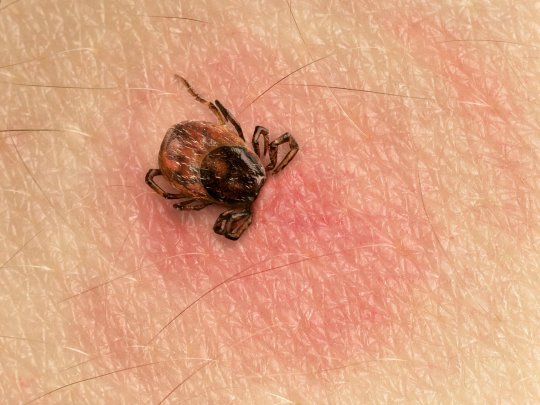
PRI_78195124Humans can contract Lyme disease if they are bitten by infected ticks (Picture: Getty)
Andrew was given blood thinning medication and eventually sent home, but seven days later, the same thing happened again.

He said: ‘The other half went numb. They said ‘you’ve had another stroke’. I thought ‘I might not survive this’.’

But after several tests and monitoring, doctors started to realise a stroke wasn’t behind the sudden numbness.

Instead, he was seen by neurologists, who began to suspect Andrew may have multiple sclerosis.

He said: ‘They did a lot of tests and MS was never explicitly mentioned but I knew what they were testing for.’

When the tests revealed swelling in his brain, Andrew was given the diagnosis he was dreading.

He said: ‘I was devastated. My sister-in-law had MS and I had watched her condition deteriorate. I knew that to be diagnosed as a man in my 40s probably meant it would come on quite rapidly.

‘I assumed the worst, saw myself incapacitated. Actually it made me very, very depressed.’

But the confusion continued when his medication for MS actually made him more ill and he was told he did not have the condition after all.

Andrew said: ‘When I was signed off treatment for MS I really thought I had nowhere else to go with this.

PRI_78195126If caught early enough, Lyme disease can be treated with antibiotics (Picture: Getty)

‘Eventually I went online and did research on my own and that led me to Lyme disease.

‘Up until that point, my symptoms had been treated individually by different doctors – there had been no communication or no linking of symptoms.

‘It suddenly became clear they were all connected.’

Official estimates put the number of cases of Lyme disease in the UK at around 2000 – but new research reveals the actual number of people with the disease could be closer to 8,000.

Lyme disease has been found in every region in the UK, particularly in Scotland and the south of England.

Researchers hope the new figures will increase awareness, as early intervention could prevent some of the long-term problems that Andrew now suffers.

He said: ‘If I have been diagnosed the very first time I went into hospital, I would have been given antibiotics and it would have gone away.’

IMG_0113-7e89-e1564585938771Andrew wrote semi-autobiographical fiction novel Anatomised in part to help raise awareness of Lyme disease (Picture: supplied)

Instead, he said not knowing what was wrong with him left him feeling suicidal.

He said: ‘I felt incredibly angry and frustrated, I felt a lot of resistance from my GP and the NHS in wanting to treat Lyme and find out more about it.’

Andrew still suffers with fatigue and has the constant feeling his hands are burning, taking strong medication typically prescribed to epilepsy sufferers every day to cope.

He spent four years writing a semi-autobiographical novel about his experience in the hope it would help others avoid the suffering he has faced.

The author said: ‘My main feeling is that I wanted people to know that being diagnosed with Lyme disease doesn’t mean your life is over.

‘I am so glad it has helped other people to find out more about the condition and helped other people with Lyme.

‘It’s all about raising awareness. We need to make as many people aware as possible as this is obviously a lot more common than first thought.’


The Lyme Wars: Major Organizations Aren’t Playing Nicely Together

https://www.forbes.com/sites/judystone/2019/08/02/the-lyme-wars-major-organizations-arent-playing-nicely-together/

The Lyme Wars: Major Organizations Aren’t Playing Nicely Together

Please go to above link for article written by Judy Stone.

Highlights:

  • There are three groups setting guidelines for diagnosing and treating Lyme
  • It’s close to impossible to make public comments on the 81 page draft and 203 page supplement.
  • The author was bit personally by a tick and points out she didn’t wait for it go grow to fit the 5 cm diameter to fit the case definition. She also points out that according to the IDSA a clinical diagnosis must occur in an endemic area (line 598) despite the knowledge ticks are spreading everywhere. So her case wouldn’t have fit the IDSA guidelines.
  • The IDSA also states that patients with ALS, MS, Parkinson’s, dementia, & psychiatric disease should NOT be tested for Lyme despite the fact many have been misdiagnosed with these diseases when in fact they were infected with Lyme/MSIDS.
  • The IDSA states that transmission of Lyme is rare if the tick was attached in under 24 hours, and to only recommend prophylactic treatment if it was attached more than 36 hours – yet research has shown that transmission has occurred in under 24 hours with one study finding it could happen in 6 hours and minimum attachment time for transmission has never been studied.
  • The IDSA is strongly opposed to tick testing.
  • She points out that while the IDSA recommends a single dose of doxycycline for those bitten in an endemic area, many feel this will do little and recommend 2-3 weeks of antibiotics.

There will be a part 2 coming up.