Online Practitioner Webinar on Saturday for Doctors Treating Lyme/MSIDS


As most of you are aware, there are numerous Lyme bills currently being voted on at the Wisconsin Capital: https://madisonarealymesupportgroup.com/2019/11/01/update-on-wisconsin-lyme-bills-please-contact-your-representative-on-ab-313/
Many of these are quite good as they address things like putting signage at park locations warning about the risk of ticks and Lyme disease and making bug spray available; however, there is one bill – AB 313, which poses a serious threat to patients & to the doctors who dare treat them.
Exact wording of the bill: Assembly Bill 313
AB 313, previously LRBs 1652 and 3362 – Establishes a sixteen-member Tick-Borne Disease Study Committee to create a report for the legislature on consensus-based recommendations for policy changes on awareness, prevention, surveillance, diagnosis, reporting, and treatment of Lyme Disease.
This bill would allow Governor Evers to appoint a 16 member advisory panel to offer recommendations on how doctors diagnose and treat Lyme disease.
Many of us have explained to our representatives about the potential for that bill to go side-ways since nothing about Lyme/MSIDS is agreed upon in the medical community as well as the fact that appropriate Lyme guidelines already exist.
This bill is huge government overreach – telling doctors how to diagnose and treat patients. All of the Lyme literate doctors I spoke with oppose this bill for numerous reasons – one of which is the fact this bill could seriously interfere with the way they currently treat patients as well as could increase scrutiny of their medical practice. They are already under severe scrutiny with many having to pay fines to the state medical board: https://madisonarealymesupportgroup.com/2012/03/04/dr-hoffmann-updated/ My own doctor spent over 50K to protect his practice against such a witch hunt.

Lyme literate doctors follow the ILADS guidelines as they take into account that people are often infected with numerous pathogens and that many of these pathogens are persistent, necessitating treatment to be overlapping in nature and often for an extended period of time. They also acknowledge that sexual and congenital transmission can occur.
The IDSA guidelines, followed by the majority of doctors, pretty much states that 21 days of doxycycline will cure this. They still deny the persistence of borrelia and other pathogens as sexual and congenital transfer.
The two guidelines couldn’t be more different yet we can not force doctors to follow one or the other. The old saying, “You can lead a horse to water but you can’t make them drink,” comes to mind. As much as we would love to force all doctors to follow the ILADS guidelines we shouldn’t. The practice of medicine is still, thankfully, up to the practitioner who underwent years of schooling to become a doctor. Doctors aren’t told how to treat cancer, diabetes, or a broken leg and they shouldn’t be told how to treat Lyme/MSIDS either.
Currently, patients need to see an experienced practitioner who is trained by ILADS. This requires doctors to have continuing medical education specifically in the treatment of tick borne illness. Mainstream medicine does not require this and most doctors are woefully educated; however, the choice to treat Lyme/MSIDS patients appropriately should be up to the practitioner.
Introduced by Representatives Mursau, Milroy, Anderson, Crowley, Edming, Gruszynski, Hesselbein, Kulp, B. Meyers, Ohnstad, Ott, Ramthun, Rodriguez, Sargent, Shankland, Sinicki, Snyder, Spreitzer, Tauchen, Thiesfeldt, Tusler and Rohrkaste; cosponsored by Senators Cowles, Miller, Hansen, Kapenga, Larson, Olsen, Petrowski, Ringhand, Smith and Tiffany
Letter regarding AB313
Dear Rep. Mursau
My name is Mike Nickel. I’m the past president of the Wisconsin Lyme Network {501 c3}, a statewide non-profit dedicated to the education of lyme disease and tick-borne illness to the general public and medical community of Wisconsin. We have liaison with medical professionals not only in Wisconsin, but nationwide as well as multiple Wisconsin support/patient groups as well as nationwide. The largest organization of MD’s in the country that deals exclusively with lyme disease and tick-borne illness is called ILADS. {International Lyme and Associated Disease Society of America}. www.ILADS.org
All of our organizations statewide and nationwide adamantly oppose AB313. It is our firm belief that the state legislature will greatly endanger lyme patient care and the practice of the state MD’s that provide that care by passing AB313. ILADS has already established lyme and tick-borne treatment guidelines which are utilized by ILADS trained practitioners nationwide.
Parts of the legislation are fine and some of the other Lyme bills are endorsed by us but AB313 recommending “guidelines’ can cause great harm to the patient community and even drive our lyme treating practitioners out of the state of WI.
Insurance companies and Medical boards can use any “recommendation of short-term antibiotics” as an excuse to sanction Doctor’s not treating to those specific guidelines. This would literally destroy effective treatment for the scores of lyme patients in this state and the 30,000 newly infected here annually.
On behalf of the Wisconsin lyme community we ask that you please pull this bill. I would be more than happy to meet with you personally and discuss how we could proceed with a bill that would be fully supported by the community and be of great help to patients. I and other advocates look forward to working with the Assembly on effective legislation to benefit our patients. Please let me know a date that would work for you.
Thank you for your consideration,
Mike Nickel
_____________________
My letter to the Wisconsin Representatives:
Address
Phone number
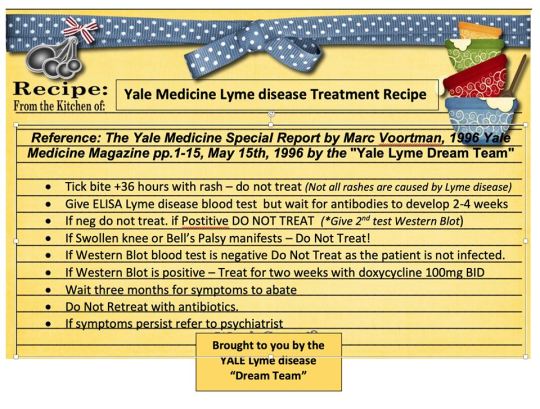
Courtesy: Microbiologist Tom Grier
Yes, you are reading this correctly – the boneheads at Yale state that you shouldn’t get treatment even if you have the EM rash (which is indicative of Lyme disease), and test positive on tests, and that you should just wait around on your laurels to get worse.
And while the EM rash is indicative of Lyme, many, many never get it. No one I work with gets the rash. The graph from Lyme Disease Organization shows those getting the rash range from 27-80% – hardly a sure thing. https://www.lymedisease.org/lymepolicywonk-how-many-of-those-with-lyme-disease-have-the-rash-estimates-range-from-27-80-2/

Thursday, October 10, 2019
 This image shows how the design of the mouth makes ticks generally difficult to remove once they’ve attached for a blood meal.NIAID
The incidence of reported cases of tickborne diseases in the United States has significantly increased in recent years. It is expected to continue to grow as tick species expand their geographical reach and new tick-transmitted pathogens emerge, raising the potential for serious human illness and death. A new strategic research plan from the National Institutes of Health aims to build on — and accelerate — new and existing research initiatives to improve scientific understanding of ticks and the pathogens they may transmit and to develop the necessary tools and strategies to better diagnose, prevent and treat tickborne diseases.
According to the U.S. Centers for Disease Control and Prevention, 59,349 cases of tickborne disease were reported in 2017 compared to 48,610 cases in 2016. Lyme disease accounted for the bulk (82%) of the cases. Recent CDC estimates suggest that Lyme disease is underreported and that the true incidence is likely 10 times higher. At least 20 different disease-causing bacteria, viruses and parasites are known to be transmitted from ticks to people. Depending on the disease, patients can experience symptoms that range from mild infections that resolve on their own to serious illness, extended disability, or death.
Many tickborne diseases have been discovered only recently. For example, in 2009, scientists reported a red-meat allergy, known as “alpha gal syndrome.” Growing evidence suggests that this reaction may be associated with the bite of a tick, but further research is needed to understand this connection. Newly identified tick-transmitted pathogens continue to be reported, raising concerns about missed diagnoses, inadequate treatment, and knowledge gaps related to tickborne diseases.
The new NIH Strategic Plan for Tickborne Disease Research focuses on five scientific priorities for advancing research and development over the next five years.
NIH intends to expand collaborations across its institutes and centers to promote a multidisciplinary approach to tickborne disease research, answer complex biological questions and encourage the application of state-of-the-art technologies used successfully in a range of scientific disciplines.
The new NIH strategic plan builds on the activities of the Department of Health and Human Services Tick-Borne Diseases Working Group, which issued a 2018 report to Congress outlining research recommendations. NIH sought input from the research and medical communities, patient advocacy groups, pharmaceutical industry, and the general public in developing this strategic plan.
NIH Strategic Plan for Tickborne Disease Research
Anthony S. Fauci, M.D., director of the National Institute of Allergy and Infectious Diseases, and Robert H. Carter, M.D., director of the National Institute of Arthritis and Musculoskeletal and Skin Diseases, both part of the NIH, are available to comment on the strategic plan.
NIAID conducts and supports research — at NIH, throughout the United States, and worldwide — to study the causes of infectious and immune-mediated diseases, and to develop better means of preventing, diagnosing and treating these illnesses. News releases, fact sheets and other NIAID-related materials are available on the NIAID website.
About the National Institutes of Health (NIH): NIH, the nation’s medical research agency, includes 27 Institutes and Centers and is a component of the U.S. Department of Health and Human Services. NIH is the primary federal agency conducting and supporting basic, clinical, and translational medical research, and is investigating the causes, treatments, and cures for both common and rare diseases. For more information about NIH and its programs, visit www.nih.gov.
__________________
**Comment**
I had to read this about twice in disbelief. I just hope it’s all true. Remember, these are the people that for 40 years have told us it’s “all in your head,” and to just take an anti-depressant.
https://www.wmtw.com/article/senate-bill-would-create-national-strategy-to-combat-rise-of-tick-borne-illnesses/29660201 News Video Here
WASHINGTON —A bill to create a national strategy to combat the rise in tick-borne illnesses passed out of a U.S. Senate committee Thursday and now goes to the full Senate for consideration.
The Kay Hagan Tick Act, sponsored by Maine U.S. Sen. Susan Collins, would provide $20 million annually for funding to states and health departments to improve public education and early detection and treatment.
Maine has the highest incidence of tick-borne illnesses in the country, Collins said in an interview with WMTW News 8.
In 2018, there were some 1,400 new Lyme disease cases in Maine. In 2010, the number was just 752.
“If tick-borne illnesses are caught early enough and treated early, often they have a very successful outcome,” Collins said. “But if they are not — which is often the case — they can produce lifelong health consequences.“
The bill is named after former U.S. Sen. Kay Hagan, who died this week from complications of the Powassan virus, which is spread by ticks.
Maine U.S. Sen. Angus King is a co-sponsor of the legislation.
__________________
**Comment**
Senator Hassan speaks of how she has watched friends suffer with a horrible form of dementia and who have lost their lives due to Lyme disease.
It appears word is finally getting to the politicians – now the word needs to wrap up the side of the heads of those in the CDC/IDSA/NIH.
The CDC has undermined everything done over the years at the State level: https://madisonarealymesupportgroup.com/2017/07/07/cdc-sabotages-state-laws-protecting-lyme-patients/
Word on the street is that doctor protection laws aren’t working as well as bills telling doctors they must tell patients that even though a Lyme test comes back negative, they could still be infected.
Please make it your personal goal to not allow your representative to rest until they know how wrong Lyme/MSIDS has been handled through the years. Tell them how you were treated and how they need to speak up and represent those too ill to represent themselves.


Written
on November 7, 2019