THE COVID-19 CRAZINESS PROVES THAT EINSTEIN WAS RIGHT
By Dr. Singleton
One of Albert Einstein’s many aphorisms, “three great forces rule the world: stupidity, fear and greed,” is particularly apt in the Covid era.
Our government’s duty is to warn the public of a possible pandemic and recommend precautions. However, the initial Covid tactic was to strike fear into our hearts and minds. The constant display of Covid “cases” on the nightly news suggested certain death awaited those who ventured out of their homes. (See link for article)
_______________________
Important excerpts:
Fear fuels stupidity. By June 2020, the World Health Organization (WHO) had announced that asymptomatic transmission of the SARS-CoV-2 virus is “very rare.”
And study after study after study have shown that cloth masks do not prevent transmission of SARS-CoV-2 and other similar viruses. When political pundits see unmasked people as a threat and a fully vaccinated physician Covid expert found it “psychologically hard” to dine unmasked with a vaccinated friend, masking has become not “following the science” but an obsession.
Greed knows no bounds. Hospitals are charging up to $1419 for a $50 test. Designer drugs are the new cash cow. Regeneron’s stock price was up more than 60 percent in 2020. Who would have thought Covid would be justification for a manufacturer to release TV ads for drugs that are not fully FDA approved?Regeneron’s ads instill fear, then present their drug as the solution. Covid diagnosis? Oh my! Isolate and call the doctor to get monoclonal antibodies (at $1,250 per dose).
Wall Street predicts that in 2021 Pfizer and Moderna will generate $32 billion in Covid-19 vaccine revenue. Thanks to vaccines, Moderna’s stock soared 700 percent in 2020.
The article asks the important question:
“Could we have avoided lockdowns with repurposed drugs, improved air circulation, and HEPA filters? Could we have saved millions of lives lost not only to Covid-19 but from suicide, overdoses, violence, and cancer?”
But these issues do not matter to our conflict-riddled public health ‘authorities’ who continue to push a false narrative so everyone will hastily and fearfully submit to their fast-tracked COVID injections which are proving to be extremely dangerous (and unneeded).
Yale public health professor suggests 60% of new COVID-19 patients have received vaccine
‘Clinicians have been telling me that more than half of the new COVID cases that they’re treating are people who have been vaccinated,’ said Dr. Harvey Risch.
12 COVID deaths in Belgian nursing home following vaccination
52 of the 55 residents who tested positive for the coronavirus in May had been vaccinated in January.
Wed Jun 23, 2021 – 10:45 am EST
June 23, 2021 (LifeSiteNews) — A nursing home for the elderly in Nivelles, Belgium, has lost 12 of its 121 residents to COVID-19 in less than a month, and two are still in critical condition. While 98 percent of the elderly inhabitants had been fully inoculated with both doses of the Pfizer experimental vaccine in January, no less than 55 of them tested positive in May for the coronavirus, and 52 of those were vaccinated. The home, “Nos Tayons” in the French-speaking part of Belgium, had not experienced previous waves of COVID contaminations since the beginning of the public health crisis last year.
According to press reports, all those who died had been vaccinated.
The numerous “breakthrough” contaminations and deaths — over 20 percent of those who tested positive did not survive — did not shake the confidence of the health care workers and managers of “Nos Tayons” in the vaccine. (See link for article)
______________________
Important quote:
She stressed that vaccination does not necessarily prevent catching or transmitting the illness.
But more and more reports in Belgium are suggesting a third dose of the “vaccine” might now be called for.
According to this study, 6% of all “break-through” cases result in death.
The Belgian nursing home demonstrates that this percentage will be much, much higher in the elderly.
Sadly, these patients could have been treated with cheap, effective, safe drugs, but these treatments are still highly censored and ignored.
Meanwhile, the barrel full of monkeys keeps rolling out on the dangers of these fast tracked injections which aren’t “vaccines“:
https://madisonarealymesupportgroup.com/2021/06/21/inventor-of-mrna-interviewed-about-injection-dangers-just-say-no/ Free SARS-CoV-2 spike protein is biologically active and causes severe problems.The spike protein also has reproductive toxicity, and Pfizer’s biodistribution data show it accumulates in women’s ovaries. Data suggests the miscarriage rate among women who get the COVID “vaccine” within the first 20 weeks of pregnancy is 82% We were warned about this a year ago by a GSK whistleblower.
Meanwhile the latest fear-mongering tactic involves pushing variants, despite the fact they are:
“unlikely to pose significantly differing risk to people with natural immunity compared to the original, as resistance is primarily based on your T cells, which have been shown to recognize and attack variants that are up to 80% dissimilar.SARS-CoV-2 variants are at most 0.3% dissimilar from the original, which means T cell immunity will easily recognize and protect against them.” Source
We’ve been warned by numerous experts that mass vaccination campaigns are actually driving these variants, yet you won’t hear this from our corrupt public health ‘authorities,” who profit from these injections.
AFTER A TICK BITE, HOW LONG FOR DISEASE TRANSMISSION?
A single tick bite can transmit several diseases. But investigators continue to debate how long a tick must be attached before it can transmit the Lyme disease bacterium. While many believe a tick must be attached for at least 36 to 48 hours before transmission can occur, others say it can happen within several hours.
People often ask: How long does it take for disease transmission to occur after a tick bite? According to investigators, Lyme disease may be transmitted faster if the tick previously fed on another host.
However, in animal models, Cook found, “transmission can occur in less than 16 hours, and the minimum attachment time for transmission of infection has never been established.”
Have you been bitten by a partially fed tick?
Investigators suggest that transmission time may be shorter if a tick has already fed on a host. A study by Shih and colleagues, found that, “Partially fed nymphal ticks transmit spirochetal infection more rapidly than do ticks that have never been attached to a host.”¹
So, how quickly a tick can transmit Lyme disease may depend on whether the tick had been partly fed BEFORE it attached to its second host.
Shih et al. demonstrated that partially fed nymphal ticks (84%) were capable of transmitting spirochetes to a non-infected mouse within 24 hours. The authors discovered it took less time for an infected nymphal deer tick to transmit Lyme spirochetes to a mouse if the tick was partially fed.
Ticks spontaneously detach from hosts
Individuals may mistakenly believe that once a tick bites it will remain attached throughout the entire feeding or until it is removed. But this isn’t the case.
In the mouse study, Shih found that ticks can spontaneously detach during the feeding process. And this action can profoundly impact the time it takes for spirochetes to infect the host.
“Virtually all nymphal ticks that previously had fed for 16 hours reattached efficiently.”¹
“We found that nymphs do detach spontaneously from free-ranging mice in the laboratory, perhaps as frequently as 15% of the time,” the authors report.
“Indeed, about [one tenth] of questing nymphs in nature seem to be distended, and reattachment by partially fed sub-adult ticks commonly occurs.”
In the laboratory, partially fed ticks would reattach to a second host and commence feeding. “Virtually all nymphal ticks that previously had fed for 16 hours reattached efficiently.”
What happens in partially fed ticks?
The tick attaches to a host, feeds and the Lyme bacteria multiply rapidly in the tick’s mid-gut. Normally, the tick eliminates all of the bacteria, leaving behind only those spirochetes that survive in the mid-gut before they molt into an adult.
But, in a partially fed tick, spirochetes multiply in the mid-gut and then move to the salivary glands.
If the tick bites again, the spirochetes residing in the salivary glands can be transmitted more quickly. “Partially fed nymphs [ticks] are able to reattach to another host and Lyme disease spirochetes may be transmitted by partially fed nymphs more rapidly than by nymphs that have not already fed.”
Pet owners: be wary
Their findings are particularly relevant to people who own pets. “These partially fed ticks may already have acquired spirochetal infection and avidly seek other hosts,” writes Shih.
“Pet ownership appears to be a risk factor for human Lyme disease, and this may reflect contact with ticks that have detached from a cat or dog within the household.”
If an unfed tick attaches it can take up to 36 hours to transmit the Lyme spirochetes to a mouse, Shih claims. “The chain of events that culminates in migration of the spirochetes from the gut of the tick to its salivary apparatus begins within the first day of attachment and requires at least another day for completion.”
Note: The study by Shih and colleagues was conducted only with mice and has not been replicated with humans.
UPDATED: June 22, 2021
References:
Shih CM, Telford SR, 3rd, Pollack RJ, Spielman A. Rapid dissemination by the agent of Lyme disease in hosts that permit fulminating infection. Infect Immun, 61(6), 2396-2399 (1993).
Lyme borreliosis: a review of data on transmission time after tick attachment: https://www.ncbi.nlm.nih.gov/pmc/articles/PMC4278789/ The claims that removal of ticks within 24 hours or 48 hours of attachment will effectively prevent LB are not supported by the published data, and the minimum tick attachment time for transmission of LB in humans has never been established.
There are about 5 to 10 percent of infected ticks that have a generalized infection, including salivary glands and saliva at the time of attachment. In such cases, transmission of spirochetes would and does occur immediately at time of attachment.” —Willy Burgdorfer
A new Pest Alert from the North Central IPM Center focuses on the Asian longhorned tick, which is native to East Asia. This tick targets livestock and can reproduce even in the absence of male ticks.
“A single individual tick has the potential to establish entire new populations almost anywhere in the US, but if we are vigilant, we may be able to eradicate this tick from new locations,” said Scott Larson, co-leader for the Public Tick IPM Working Group and assistant entomologist for the Metropolitan Mosquito Control District.
The Asian longhorned tick pest alert includes details about the tick’s life cycle, identification, and management options. These ticks are a threat to livestock because large tick infestations on one animal can lead to stress, blood loss and even death. There is also concern that these ticks may be able to spread disease as they feed on multiple hosts throughout their lives.
“We felt this pest alert was needed to increase awareness of the Asian longhorned tick” said Leah McSherry, community IPM coordinator at the IPM Institute of North America, Inc and member of the Public Tick IPM Working Group. “We are optimistic that increased awareness of the Asian longhorned tick will lead to increased management and better control.”
The Tick IPM Working Group formed in 2013 and works to support a network of experts and interested partners that cooperate to reduce tick populations and reduce tick-borne disease risk. More details about this team can be found on the Public Tick IPM Working Group website.
The Public Tick IPM Working Group produced this pest alert with support from the IPM Institute and the USDA National Institute of Food and Agriculture, Crop Protection and Pest Management Program through the North Central IPM Center (2018-70006-28883).
Contact ncipmmedia@gmail.com for free printed copies. Include in email: 1) Pest Alert name, 2) number of packs desired (only available in packs of 50) and, 3) the date they will be needed.
Contact northcentral@ncipmc.org for free printed copies. Include in email: 1) Pest Alert name, 2) number of packs desired (only available in packs of 50) and, 3) the date they will be needed.
Introduction
The Asian longhorned tick (ALT) is primarily a pest of concern in livestock (cattle, goats, sheep) and studies suggest there is a potential for the ALT to vector pathogens that cause Rocky Mountain spotted fever and other tick-borne illnesses. In its native range, the ALT can transmit Rickettsia japonica, which causes Japanese spotted fever, and the potentially fatal, severe fever with thrombocytopenia syndrome (SFTS) virus, among others.
Asian Longhorned Tick Facts
Females can reproduce without mating with a male, which makes male ticks quite rare.
Ticks have one blood meal during each life cycle stage.
Females can lay up to 2,000 eggs.
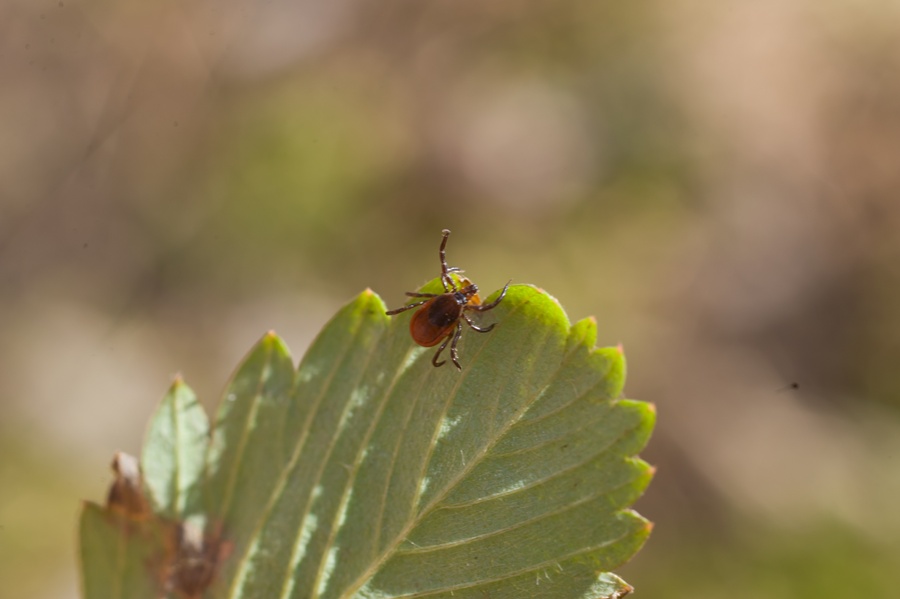
Asian longhorned tick (Haemaphysalis). Image by James Gathany.
Origin and Distribution
The ALT is native to East Asia, with established populations in China, Japan and South Korea, and is considered invasive in Australia, New Zealand and the United States. The ALT was first believed to be discovered in the United States in August of 2017 on a tick-infested female Icelandic sheep in New Jersey. An unidentified
tick specimen archived in Union County, New Jersey, now identified as an ALT, has moved the assumed introduction date to 2013. As of 2021, the ALT has been detected in primarily mid-Atlantic and southern states. For the current distribution, visit the USDA-APHIS website.
Size of Asian longhorned tick compared to a dime. Image by James Gathany at CDC.
Life Cycle
There are four life stages of the ALT. The ALT begins its life as an egg. The second life stage is the larval stage. At this point, the ALT is six-legged. The next life stage is an eight-legged nymph. The next and last life stage is the adult. Ticks take one blood meal as they transition to the next life stage. After each successful blood meal, the tick releases from its host, molts and then begins to quest for a new host. An interesting aspect of the ALT is that females can reproduce without mating with a male. This process is called parthenogenesis and as a result, male Asian longhorned ticks are rare.
Identification
The adult ALT resembles the adult brown dog tick shown below (Rhipicephalus sanguineus). To differentiate the two species, look for the presence of “eyes” on the sides of its body near the second row of legs, which is present on the brown dog tick.
Brown dog tick (Rhipicephalus sanguineus) with “eyes” on the sides of body. Image by Herlberto Verdugo M. & Darby S. Murphy.
Human Health Concerns
The first human ALT bite in the U.S. was reported in 2018 in Westchester County, New York, and did not result in the subject becoming ill. The ALT has not been found on rodents including white-footed mice, shrews and chipmunks, which are natural reservoirs for tick-borne pathogens. In one study, 120 ALTs were tested for pathogens that cause human disease including species in the following genera: Anaplasma, Babesia, Borrelia and Ehrlichia; all were found to be negative. In lab settings, ticks have been reported to transmit Rocky Mountain spotted fever.Further testing is necessary to determine the maintenance and transmission of this pathogen in nature.In a recent study, 263 ticks were tested, and one adult female was positive for Borrelia burgdorferi, a bacterial species that causes Lyme disease. Continued observation and testing of the ALT is imperative to monitor its threat to public health.
Animal Health Concerns
The United States Department of Agriculture and animal health officials have noted their concern about the ALT’s impact on livestock. The ALT is notorious for large-scale infestations with multiple ticks on one animal, which leads to stress on the animal and reductions in growth and production. A serious infestation can lead to death of the animal due to blood loss. The ALT has been linked to the death of five cows in Surry County, North Carolina, with one bull having over 1,000 attached ticks. Cattle tested positive for Theileria orientalis Ikeda at a Virginia farm where the ALT was found. The ALT is referred to as the “cattle tick” in New Zealand, where it has been linked to Theileria orientalis Ikeda outbreaks among cattle.
Integrated Tick Management Strategies
The strategies for avoiding the ALT are similar to techniques used for other tick species, including avoiding wading through the woods or grassy areas. If walking along a path, try to stay near the middle to avoid questing ticks along the grassy edges. It is also important to check clothes and pets after coming in from outdoors, especially after walking through wooded, brushy or grassy areas. Throwing clothes in the dryer on high heat for 10 minutes will kill any ticks that remain hidden on clothes. Check any items for ticks that cannot go in a dryer such as backpacks and shoes. The next suggested strategy is to take a shower and check your body for ticks. Be sure to inspect armpits, ears, bellybutton, back of knees, hair, between legs and waist. Lastly, Asian longhorned ticks can be avoided by purchasing and wearing permethrin-treated clothing or spraying clothes with an EPA-registered insect repellent such as DEET, picaridin, insect repellent (IR) 3535 or oil of lemon eucalyptus. If bitten by a tick, remove immediately by grabbing the tick by the head with a tweezers as close to the skin as possible and pull upwards. Be sure to clean the bite with soap and water or rubbing alcohol.
Integrated tick management strategies for livestock include trimming grass, weeds and branches in and around pastures and ensuring wooded areas are at least 10 feet from fences. Visually check for ticks on animals daily on their chest, jaw, belly, ears, eyelids and elbows and use your hands to feel for embedded ticks. If ticks become a problem, apply a low-risk, EPA-registered insecticide while closely following the label instructions. Area-wide acaricides are another management strategy used to reduce tick populations.
For more information on the Asian longhorned tick, visit the USDA-APHIS website.
Collaborators
Authored by the Public Tick IPM Working Group. For more information see: tickipmwg.wordpress.com
Funding
This work is supported by the USDA National Institute of Food and Agriculture, Crop Protection and Pest Management Program through the North Central IPM Center (2018-70006-28883).
For information about the Pest Alert program, please contact Jacqueline Pohl, communications specialist for the North Central IPM Center at northcentral@ncipmc.org.
April 2021
_______________________
**Comment**
According to this study, the ALT contributes minimally, if at all, to transmission of Lyme disease spirochetes in the United States.
Please remember they’ve said this exact same thing about other ticks.
Transmission can still happen and if you are the sorry sucker it happens to – it makes all the difference in the world. Here’s the deal – ticks are not your friends.Take each and every tick bite as seriously as a heart attack. Little is known about the Asian Longhorned tick but in Asia it’s bite KILLS 15% of those whom contract it. Don’t take this lightly.
Several other human pathogens have been detected in the ticks, but it’s not clear the Asian longhorned species are able to transmit them to humans. They include Anaplasma, Ehrlichia, Rickettsia, and Borrelia species. Lyme disease is caused by Borrelia burgdorferi bacteria.
She warned that the organisms are present in states where longhorned ticks have been found and that it’s possible that the tick—known to be an aggressive biter—might be able to transmit Heartland virus, given its close relationship to SFTS virus.
Pritt said it’s clear that the invasive species is here to stay for the foreseeable future, and next steps should include public awareness campaigns that incorporate the new information, easy-to-use resources for labs to identify the tick, and more research to understand the implications of the new findings.
One of The Highwire’s most decorated guests, world renowned pathologist Dr. Roger Hodkinson, sits down with Del to give his unique viewpoint of the handling of #Covid19 from tyrannical lockdowns to his fears of the long term catastrophic damage from the vaccine, especially in young people.
At 18:00 Hodkinson discusses the concerns of infertility in those getting COVID shots.
At 26:00 he discusses “vaccine” shedding or the “bystander” effect of the “vaccinated” potentially causing harm to the unvaccinated. It now has a new name which is called “contagious vaccinosis.” The results of a studysuggest that “SARS-CoV-2 readily infects sweat gland Krt7+ secretory luminal cells coexpressing ACE2 and TMPRSS2. The infection of vascular endothelia suggests that the virus might disseminate to the skin via blood vessels. The immune response of lymphocyte infiltration in skin is likely induced by SARS-CoV-2 infection. As with SARS-CoV11, the targeting of sweat glands by SARS-CoV-2 may lead to viral shedding via perspiration.”
At 32:00 a smoking gun occurred when Pfizer stated in their vaccine study protocol to be on the look-out for this shedding but don’t report it as a vaccine side-effect. They were told to separately report it to the trial coordinator. It appears they knew about this issue but didn’t want numbers recorded.
At 35:00 Hodkinson states that these safety studies should have been done before the injections were rolled out.
At 43:40 Hodkinson outlines what we can do moving forward. He mentions taking vitamin D and zinc as well as giving authorities demanding these injections “notice of liability.” Here is more information.
“This is the greatest hoax ever perpetrated on an unsuspecting public.
There is absolutely nothing that can be done to contain this virus other than protecting older more vulnerable people.It should be thought of as nothing more than a bad flu season. This is not Ebola, it’s not SARS.It’s politics playing medicine and that’s a very dangerous game.
I’m absolutely outraged that this has reached this level. It should all stop tomorrow.” Dr. Rodger Hodkinson
I highly, highly recommend this informative video. Hodkinson has a unique perspective as a pathologist and he is very clear that what has occurred globally due to out public health ‘authorities’ is catastrophic on many levels.