Author Archive

Holistic Healing From Lyme Disease

https://open.spotify.com/episode/6NrQSPu2G1mLXey82vETIY?si=38cLPjQXSsOvDcijvgNqcw&nd=1&dlsi=060f76815c2e45d7  Go here to listen on Spotify (Approx. 1 hour)

https://podcasts.apple.com/us/podcast/holistic-healing-from-lyme-disease-with-theresa/id1771868024?i=1000681031732  Go here to listen on Apple Podcasts

Holistic Healing From Lyme Disease

Theresa Haselmayer/Foundations Wellness

12/19/24

Co-host Dan Wagner sits down with the founder of Foundations Wellness, Theresa Haselmayer, R.N., to discuss her journey from patient to healer.  With over 33 years of varied clinical experience, Theresa trained for 4 years at the Uprooting Lyme Clinic in Hudson Valley NY, a hotbed of Lyme Disease.  She is currently one of dozens of highly knowledgable certified Uprooting Lyme practitioners nationwide.  Theresa is also a member of ILADS, the International 
Lyme and Associated Diseases Society, as well as ISEAI – The International Society of Environmentally Acquired Illness.  

For more:

Advances in Lyme & Babesiosis Research

https://www.globallymealliance.org/news/from-diagnostics-to-disease-mechanisms-advances-in-lyme-and-babesiosis-research?

Cutting-edge research funded by GLA advances diagnostics and insights into Lyme disease and babesiosis, identifying key biomarkers and genetic risk factors.

Three GLA-funded investigators have been making exciting progress. Dr. Rafal Tokarz’s team has been uncovering key insights into the immune response to specific proteins of Lyme bacteria, paving the way for more accurate diagnostics. Dr. Ben Mamoun has achieved an important milestone by developing the first diagnostic tests for detecting active Babesia duncani infections.  Dr. Klemen Strle’s research suggests that specific genetic factors may increase the risk of developing chronic Lyme arthritis. Meanwhile, Dr. Strle’s new findings are shedding light on how certain genetic factors may heighten the risk of developing chronic Lyme arthritis. 

Summary: 

GLA-funded research continues to shed light on key aspects of Lyme and tick-borne diseases, from diagnostic biomarkers to genetic factors influencing disease outcomes. 

Dr. Rafal Tokarz and his team at Columbia University used peptide arrays and machine learning to identify immune reactive proteins in Borrelia burgdorferi to differentiate between phases of Lyme disease. These insights could enhance the accuracy of antibody-based diagnostic tests by improving their sensitivity and specificity (Tokarz et al., 2024). 

At Yale University, Dr. Choukri Ben Mamoun and his team developed the first antigen detection tests for Babesia duncani, a parasite often responsible for severe babesiosis. These assays, validated with over 1,700 samples, can detect active infections with high sensitivity and specificity, paving the way for early diagnosis, reservoir animal screening, and improved blood safety (Chand et al., 2024).  

Research by Dr. Klemen Strle and his group at Tufts University identified genetic variations associated with chronic Lyme arthritis. These variations are linked to increased inflammation and autoantibody responses, suggesting that some patients may have a genetic predisposition to persistent arthritis in Lyme disease. These findings may guide future biomarker development to predict disease risk (Ehrbar et al., 2024). 

These studies reflect GLA’s unwavering commitment to support research that addresses critical challenges in diagnosing and managing tick-borne diseases. 

Publications: 

Tokarz, R., Guo, C., Sanchez-Vicente, S., Horn, E., Eschman, A., Turk, S. P., Lipkin, W. I., & Marques, A. (2024). Identification of reactive Borrelia burgdorferi peptides associated with Lyme disease. mBio, 15(10). https://doi.org/10.1128/mbio.02360-24   

Chand, M., Vydyam, P., Pal, A. C., Thekkiniath, J., Darif, D., Li, Z., Choi, J. Y., Magni, R., Luchini, A., Tonnetti, L., Horn, E. J., Tufts, D. M., & Ben Mamoun, C. (2024). A set of diagnostic tests for detection of active Babesia duncani infection. International Journal of Infectious Diseases, 147, 107178. https://doi.org/10.1016/j.ijid.2024.107178  

Ehrbar, D., Arvikar, S. L., Sulka, K. B., Chiumento, G., Nelson, N. L. J., Hernandez, S. A., Williams, M. A., Strle, F., Steere, A. C., & Strle, K. (2024). Variants in the late cornified envelope gene locus are associated with elevated T-helper 17 responses in patients with postinfectious Lyme arthritis. The Journal of Infectious Diseases, 230(Supplement_1), S40–S50. https://doi.org/10.1093/infdis/jiae164  

https://www.globallymealliance.org/news/decoding-chronic-lyme-investigating-epigenetic-signatures?

Pictured: Tanja Petnicki-Ocwieja, PhD, courtesy of Tufts University School of Medicine
Tufts University, with support from GLA, is leading research to uncover epigenetic mechanisms behind chronic Lyme disease. Dr. Tanja Petnicki-Ocwieja’s work could improve treatments and reveal commonalities with other post-infectious syndromes like long COVID.

By Mase Peterson

In the fight against Lyme disease, cutting-edge research is essential for advancing treatment and prevention strategies. Tanja Petnicki-Ocwieja, PhD, a research assistant professor at Tufts University School of Medicine, is a key contributor to this effort through her work with the Tufts Lyme Disease Initiative. This collaborative group of faculty, staff, and students is dedicated to eliminating the public health threat of Lyme disease by 2030.

Tufts is home to one of the world’s most comprehensive groups of tick-borne disease researchers. Led by co-directors Linden Hu, Paul and Elaine Chervinsky Professor of Immunology, and Robert P. Smith, a physician at Maine Medical Center and professor of medicine, the team recently secured a $20.7 million federal grant, further solidifying Tufts’ position as a global leader in Lyme disease research.

In this Q&A, part of a feature series spotlighting members of the Initiative, Professor Petnicki-Ocwieja discusses her research on the immunological and epigenetic mechanisms underlying chronic Lyme disease and its potential to transform patient outcomes…

Read the rest from Tufts School of Medicine

_____________

**Comment**

I’d love to be hopeful, but when the moniker PTLDS continues to be used it shows an inherent bias that ongoing infections aren’t to blame for people’s ongoing symptoms.  This must change.

For more:

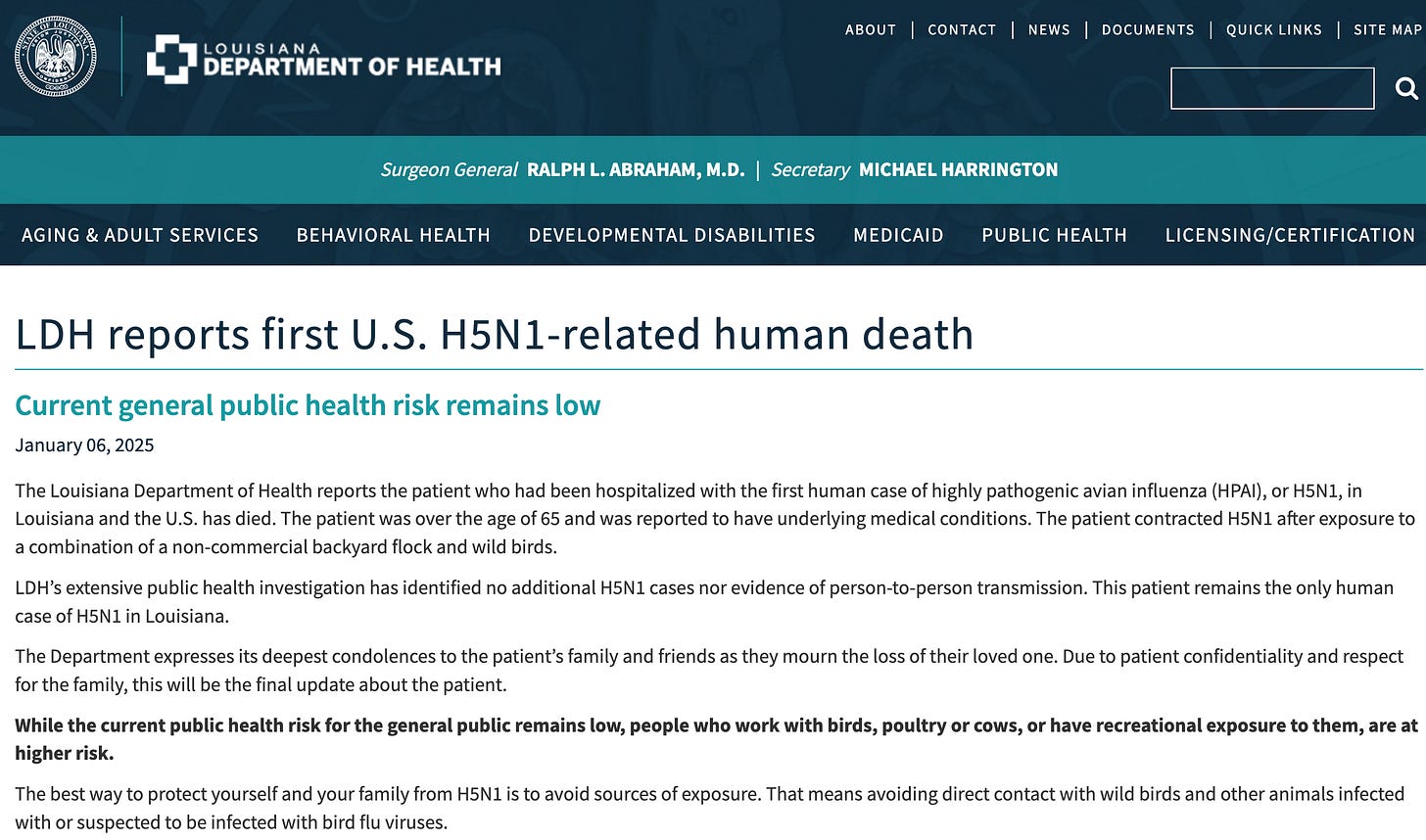
First Reported U.S. H5N1 Death, COVID Shot Brain Damage & Hundreds of Operational Biolabs

https://petermcculloughmd.substack.com/p/first-reported-us-h5n1-bird-flu-death?

First Reported U.S. H5N1 Bird Flu Death, COVID-19 ‘Vaccine’ Brain Damage, and Hundreds of Operational Biolabs

Epidemiologist Nicolas Hulscher on Brannon Howse Live

Please enjoy my interview on Worldview Tube with Brannon Howse, where we discuss breaking public health developments:

  1. The first H5N1 bird flu death ever reported in the United States: The Louisiana Department of Health should release more details — This patient was over 65 years old with multiple underlying health conditions. It’s entirely possible that these pre-existing conditions were the primary cause of death, rather than H5N1 itself. A few weeks ago, Labcorp launched an H5N1 bird flu PCR test in the U.S., now available for order through physicians. As a result, we can expect the Biopharmaceutical Complex to soon use falsely inflated PCR ‘case counts’ and the first reported death as tools to increase public fear of bird flu, driving higher demand for bird flu vaccinations.

  2. Catastrophic Neurological and Psychiatric Damage from COVID-19 ‘Vaccines’Increased risks of ischemic stroke, hemorrhagic stroke, transient ischemic attack, myelitis, myasthenia gravis, Alzheimer’s disease, cognitive impairment, depression, anxiety, and sleep disorders.

  3. Biolabs: We need a clean sweep of the hundreds of operational BSL3/BSL4 biolabs that possess modified pathogens with pandemic potential, most of which are located in dense population centers. Since 2001, there have been ~300 confirmed biolab pathogen leaks globally, with the vast majority (78.6%) occurring in the United States. State-sponsored bio-terrorism must be SHUT DOWN to prevent another man-made pandemic.

_______________

For More:

Despite Mounting Evidence & Data, COVID Shots Continue to Kill & Maim

Despite all common sense, repeated warnings, and:

they still have not been removed! 

And now world leaders in 10 countries have received ‘notice of extreme concern’ from a team of experts who are calling for the shots to be banned from public use.

https://lionessofjudah.substack.com/p/global-covid-vaccine-damage-estimates?

Global COVID ‘Vaccine’ Damage Estimates by Edward Dowd

“Killed: 7.5 – 15 million people, Disabled: 29 – 60 million people, Injured: 500 – 900 million people….Arrests made: ZERO”

Global COVID ‘vaccine’ damage estimates by ex-BlackRock executive, whistleblower, Ed Dowd:

Killed: 7.5 – 15 million people

Disabled: 29 – 60 million people

Injured: 500 – 900 million people

5 billion people received mRNA shot(s)

Arrests made: ZERO

Notice that the world appears to be in a constant wars, but in a matter of months every country magically agreed to use an untested, experimental ‘vaccine’ with lipid nanoparticles.

Source: EDWARD DOWD

https://petermcculloughmd.substack.com/p/vast-mrna-vaccine-biodistribution?

Vast mRNA ‘Vaccine’ Biodistribution, Persistence, and Adjuvant Toxicity Research Library Published

Over 100 peer-reviewed studies demonstrate serious safety concerns.

A comprehensive research library that contains over 100 peer-reviewed studies (n=130) documenting mRNA “vaccine” biodistribution, persistence, and adjuvant toxicity has just been published (Compiled by Dr. Martin Wucher, MSC Dent Sc (eq DDS), Dr. Byram Bridle, PhD, Erik Sass, et al). You can read it here.

Be sure to also check out their massive Spike protein Pathogenicity Research Library, which has now been updated to include 320 peer reviewed studies.

For those who still believe COVID-19 injections are safe, I encourage you to carefully review the over 400 peer-reviewed studies available in both libraries and then reassess your position.

Nicolas Hulscher, MPH

Epidemiologist and Foundation Administrator, McCullough Foundation

http://www.mcculloughfnd.org

_______________


Recently Steve Kirsch gave the following information:
There is no Autism in the Amish community as well as any of the other newer diseases such as ADD, autoimmune disease, PANDAS, PANS, epilepsy, etc.  The U.S. has been studying the Amish for decades, but there’s never been a public report.  The reason is it would show that if you don’t follow government guidelines you’re going to end up healthier.

Lyme Disease Research in Review: Triumphs, Trials, and the Path Forward

https://www.lymedisease.org/lyme-disease-research-review/

Lyme disease research in review: triumphs, trials, and the path forward

As always, the world of Lyme is complicated with both good news and bad. Looking back over the past year, I want to highlight a few of the biggest scientific advances that stand out in my mind.

Co-Infections

First I want to share something that science keeps validating—the majority of patients with persistent symptoms following a diagnosis of Lyme disease have co-infections.

This means they are infected with two or more pathogens (such as bacteria, viruses, or fungi) at the same time. These co-infections (including COVID-19) complicate the immune response and likely increase the chance of developing chronic Lyme.

As I wrote about previously, North America is “ground zero” for babesiosis, which is likely playing a much greater role in patients with chronic Lyme than we know. In the MyLymeData study, over 60% of patients report they were diagnosed with an additional tick-borne infection along with Lyme. For most of them, it’s Babesia.

In July 2024, researchers conducting a Lyme disease pilot study at North Carolina State University discovered that all seven participants were infected with Babesia, and six out of the seven were co-infected with at least one (sometimes two or more) species of Bartonella.

Babesia is a parasite, similar to malaria. It requires a separate test and special anti-parasitic medications outside of the standard tests and antibiotics used for Lyme disease alone.

Diagnostics

As I wrote about in December 2023, Borrelia (Lyme) has some unique features allowing it to hide from our immune system. That stealth technique, which keeps the number of bacteria low in the blood stream, also makes it difficult for standard blood tests to detect Lyme disease. In April of 2024, Dr. Michal Tal and her team published another clue as to how Borrelia hides from the immune system.

Right now, all eyes are on the six teams competing in the LymeX diagnostic challenge as they move forward with their innovations. These will hopefully result in a more accurate test becoming available to the public than the standard outdated test that has been around since 1994. (Note: Lyme X Phase 3 winners will be announced soon.)

While an accurate Lyme diagnostic is absolutely needed, I cannot ignore the fact that ticks in North America are known to transmit over 18 different pathogens.

In August of 2024, a team of biologists at City University of New York Graduate Center produced a genetic analysis of 47 different strains of Borrelia. This may pave the way for improved diagnosis, treatment, and prevention of Lyme disease.

I hope that with this new genetic mapping, we will finally be able to take advantage of the next-generation metagenomic testing which is capable of detecting multiple pathogens.

Treatment

One of the top priorities of patients with chronic Lyme disease is finding an effective treatment.

Two recent studies have shown that combination therapy for Lyme, and combination therapy for Babesia work better than monotherapy.

But not everyone responds favorably to pharmaceuticals. One reason for this, may be a condition called alpha-gal syndrome (AGS).

AGS is triggered by the bite of a tick and causes an allergy to anything derived from red meats including some medications. An estimated 450,000 people have AGS in the U.S., making it the tenth most common food allergen.

If enacted, the Alpha-Gal Inclusion Act would require the FDA to list alpha-gal as a major allergen and require labeling to include it as an ingredient.

Mast cell activation syndrome

Another complicating factor common in patients with chronic Lyme is mast cell activation syndrome (MCAS). MCAS can make patients extremely sensitive to certain types of chemicals, foods and additives.

In fact, MCAS is such an important topic, in 2024 we devoted an entire issue of the Lyme Times to Mast Cell Activation Syndrome which you can download and read for free.

Alas, there is nothing simple about treating complex medical conditions triggered by the bite of a tick. Many of the patients I know who’ve gotten better took years before they found the root cause of their misery followed by the right combination of treatment that worked.

In 2023 we devoted an entire issue of the Lyme Times trying to answer the question: What does it take to get better?

My hope is that we continue to see scientific progress in finding better diagnostics and treatment. And if you are struggling with a chronic illness, please do not give up hope.

LymeSci is written by Lonnie Marcum, a physical therapist and mother of a daughter with Lyme. She served two terms on a subcommittee of the federal Tick-Borne Disease Working Group. Follow her on X: @LonnieRhea   Email her at: lmarcum@lymedisease.org.

_______________

**Comment**

To my knowledge, treating this complex illness has hardly moved forward in over 40 years.  The medical industrial complex is myopically focused on ‘vaccines,’ which are big money makers for both Big Pharma and the government, which owns patents on many aspects of them.  As long as this remains the singular focus, patients will not be treated properly.  Further, as long as ‘consensus basedmedicine reigns, innovative doctors who dare to use their God-given brains to help patients will continue to be persecuted, leaving patients to suffer.  As it is, the only true help for Lyme/MSIDS is to get to an independent, trained, and experienced Lyme literate doctor.

For more: