Archive for June, 2019

Disulfiram in the Treatment of Lyme & Babesiosis: 3 Case Reports

https://www.mdpi.com/2079-6382/8/2/72

Disulfiram (Tetraethylthiuram Disulfide) in the Treatment of Lyme Disease and Babesiosis: Report of Experience in Three Cases

Health Quest System, Sharon Hospital, Sharon, CT 06069, USA
Antibiotics 2019, 8(2), 72; https://doi.org/10.3390/antibiotics8020072
Published: 30 May 2019
(This article belongs to the Special Issue Antibiotics Resistance of Borrelia)

|

PDF [248 KB, uploaded 30 May 2019]

|

Abstract

Three patients, each of whom had required intensive open-ended antimicrobial therapy for control of the symptoms of chronic relapsing neurological Lyme disease and relapsing babesiosis, were able to discontinue treatment and remain clinically well for periods of observation of 6–23 months following the completion of a finite course of treatment solely with disulfiram. One patient relapsed at six months and is being re-treated with disulfiram. View Full-Text

This is an open access article distributed under the Creative Commons Attribution License which permits unrestricted use, distribution, and reproduction in any medium, provided the original work is properly cited (CC BY 4.0).

Supplementary material

___________________

**Comment**

Please notice this is by Dr. Ken Liegner, an experienced Lyme literate doctor affiliated with ILADS.  The IDSA/NIH/CDC people are not doing work like this.  They are fixated on the acute phase leaving chronically infected people out to dry.

Thankfully, some good work is being done in the treatment area.  Some examples:

https://madisonarealymesupportgroup.com/2019/05/05/good-news-for-bartonella-patients-identification-of-fda-approved-drugs-with-higher-activity-than-current-front-line-drugs/

https://madisonarealymesupportgroup.com/2019/04/24/three-antibiotic-cocktail-clears-persister-lyme-bacteria-in-mouse-study/  I mention disulfiram in the comment section.

https://madisonarealymesupportgroup.com/2019/04/17/global-lyme-alliance-doing-kick-butt-research/  I mention disulfiram in the comment section.

https://madisonarealymesupportgroup.com/2019/02/22/why-mainstream-lyme-msids-research-remains-in-the-dark-ages/ Within this article is a link to an ILADS video Dr. Burrascano made recently. I highlight his video and explain his findings within his own practice of what worked for many patients, including a “cycling” approach to treatment as well as the fact blood levels of antibiotics are different for people. This treatment points are important because if the blood level isn’t high enough, pathogens will not be killed with a potential for them to mutate and become stronger in the future.


Be encouraged.  There’s some great stuff in the works.


What To Do When You Hit a Plateau In Treatment

https://globallymealliance.org/hit-plateau-treatment/?

By Kerry Heckman

My numbers won’t budge. Every month I go in for a blood test and every month I get an email from my doctor stating that my inflammatory markers are the same. The numbers are not so high to cause a panic, but they’re not low enough to signal any real improvement either. I’ve tried everything from meditation to medication, but nothing seems to work. Each month I pray the numbers will drop and I’m devastated when month after month they stay the same.

I’ve put in all the work; there’s been no stinting. I’ve been in treatment for three years. I’ve changed my lifestyle, my diet, and most difficult of all, my mindset. But I keep coming up short. There’s no doubt I’m better. My bedridden days are mostly in the past, and the pain that keeps me up at night (painsomnia, I call it) happens once or twice week instead of every day. Another marker of my improvement is after treatment my herxheimer reactions are greatly diminished. These are positive trends, but still I am not where I want to be. I want clinical proof that my recovery is real. I want to know unequivocally that I’m heading toward remission. I’ve  been at this dreaded plateau for months waiting to break free. I anxiously await the day when my inflammatory markers take a dramatic drop.

Your plateau may be different than mine. Maybe you, too, made big improvements in the beginning and now it’s tapering off, or maybe you’re stuck waiting for any minuscule improvement at all. Either way the lack of progress may be the hardest thing to bear.

All this was weighing heavily on me. Then one day I started thinking about actual plateaus in nature. Consider for a moment you are climbing up a mountain and reach a plateau. You’ve done the grueling work of going up the mountain and now you are walking on level ground. You are still moving forward, that hasn’t changed, but you’re not increasing your elevation. Maybe that’s what plateaus are in treatment—a leveling off that doesn’t feel like progress, because you aren’t climbing anymore. But you have achieved an incremental improvement in your recovery.

This bit of visualization changed the way I thought about my lack of headway, though  there were still some questions I needed to ask myself— questions you may need to  ask yourself as well:

Q: Have I really plateaued or is my progress just going slowly?

A: With Lyme disease the improvement can be slow . . . very slow. As they say, any progress is good progress. If you feel comfortable with your treatment protocol, you may need to practice patience and remember you are getting better. However, sometimes the progress is too slow and even if there is incremental improvement you may want talk to your doctor about exploring ways to speed up your treatment plan.

Q: Have you hit a plateau before? What helped jumpstart my healing?

A: If this has happened before, what was it that made the difference? Maybe it’s a new supplement or an increased dose of medication. Maybe your thyroid or adrenals are out of balance and need attention. Try to remember back to what helped you before and try it again. It may help to keep a journal about what you think is and isn’t working for you.

Q: Do I need to change my treatment or ride it out?

A: As I said, with Lyme getting better takes time. Ask yourself if you think your current treatment plan is sufficient to to get you better. This is a good place to use your intuition. If you feel skeptical every time you meet with your doctor that might be your body telling you something.

Q: If I plan to stay the course when will I know it’s time to adjust?

A: Give yourself a timeline—six months, nine months—for when you want to reevaluate. Verbalize your timeline to your doctor, so she or he knows what you’re thinking. Ask if there is a test that can be run at that time to compare where you were before to where you are now.

Q: Am I testing too often?

A: If you’re like me and your numbers aren’t budging, maybe it’s time to put more space between tests. This depends naturally on what is medically advisable. But I I did realize that the constant testing was causing me frequent disappointments, which weren’t good for my healing. I have since decided to go from once a month to once every other month for my bloodwork and focus on other things in the meantime.

Q: Is there something else I could do to move forward?

A: A plateau is the perfect time to reevaluate your habits. Perhaps it’s time to add more nutrients to your diet or increase detox. Have you always wanted to try a complementary therapy? Now may be the time. Or are there other options?

Q: Is this a good time for a healing pause?

A: Have no doubts, recovery from Lyme treatment is a full-time job. It seems like there’s always something else you can try, but is that the best thing for your body? This could be an indication that it’s time to take a break from all the intensity and let your body rest at the top of the mountain.

Take some time and ask yourself these questions. Get quiet and let your intuition speak. There are few doctors, medications, or therapies that can give us as much insight as our own common sense. Remember the image of the mountain and keep walking forward on the level ground of the plateau—the uphill slope may be only a few steps ahead.


kerry heckman

Opinions expressed by contributors are their own.

Kerry J. Heckman is a licensed therapist and author of the healing and wellness blog Words Heal. She was diagnosed with chronic Lyme disease in 2016.


______________________

**Comment**

Great article to begin meaningful dialogue.

  1.  Not sure what tests she keeps having done but I’ve heard mixed opinions about the CD-57 test which some docs swear by and others like my own say it’s a general, very basic indicator of immunity and unless you have the number before you were sick and then taken at regular intervals throughout treatment, it’s just a number. https://www.tiredoflyme.com/cd57.html
  2. Inflammation is a definite bad-boy.  One thing I discovered to eventually help me was MSM; however, I didn’t notice the help taking it while in treatment, only after treatment did it seem to really crush pain and inflammation:  https://madisonarealymesupportgroup.com/2018/03/02/dmso-msm-for-lyme-msids/.  This article also shows it’s good for the gut:  https://madisonarealymesupportgroup.com/2018/01/03/the-invisible-universe-of-the-human-microbiome-msm/
  3. Another thing that helped this inflammation/pain for me was systemic enzymes: https://madisonarealymesupportgroup.com/2016/04/22/systemic-enzymes/  There are many brands out there.  You might have to try a few to find one that works. I’ve tried different variations of Wobenzym as well as a brand my doctor sells. (I’m not affiliated with any companies)
  4. LDN was also a game changer:  https://madisonarealymesupportgroup.com/2016/12/18/ldn/ I use a compounded form with only olive oil as an additive.
  5. For many, Lyme/MSIDS causes imbalances and deficiencies in the body. Finding out what those are and supplementing can make all the difference.  For instance, most patients struggle with thyroid dysfunction (as well as other hormones) and magnesium deficiency (magnesium can help depression and 1,000 other things):  https://madisonarealymesupportgroup.com/2018/01/16/magnesium-an-invisible-deficiency/ (In the comment section I give the kind my LLMD sells in his office and it’s been particularly successful. Again – no monies are exchanging hands)  https://madisonarealymesupportgroup.com/2018/03/12/the-importance-of-vitamin-d-k-and-magnesium-for-lyme-msids-patients/ Most of us Northerners are deficient in vitamin D.
  6. I’ll never forget the ranger in the documentary, “Under Our Skin,” state that he never could have imagined that his greatest improvement would come AFTER three years of treatment.  This has been my experience and my husband’s as well.  I must add that after 4.5 years of treatment for us, and two relapses requiring 2-3 month stints of treatment, we got better EACH TIME we treated. This very well could be the “cycling” approached discussed by Dr. Burrascano here:  https://madisonarealymesupportgroup.com/2018/12/28/the-history-of-lyme-disease-dr-burrascano/  In brief:  he found that cycling 3-4 times typically worked for most patients. Ironically, the 3rd cycle yielded the worst herx.  Pam Weintraub wrote about this in, “Cure Unknown:  Inside the Lyme Disease Epidemic,” way back in the 90’s, yet few doctors do this. Cycling just means that after you are symptom-free for 2-3 months you quit ALL treatment.  If and when symptoms return, you hit hard with antibiotics until symptoms leave again. You do this 3-4 times.  Burrascano states his symptoms never returned and many of his patients had the same experience.
  7. Sometimes diet has made all the difference for some patients – like cutting out gluten or dairy or both. For some, herbs or treatments for inflammation made all the difference or help with sleep.  I’ve also known patients who got better only after they treated for worms/parasites: https://madisonarealymesupportgroup.com/2017/10/03/removing-parasites-to-fix-lyme-chronic-illnesses-dr-jay-davidson/
  8. When I hit a plateau after years of treatment yet still had symptoms, I called another LLMD I knew and asked if he’d be willing to do a phone consultation with me, not as a treating physician, but as a second ear to hear what I’ve done to give me ideas for any omissions he saw. That phone call was worth every penny as he carefully listened to what I’d done and gave me ideas for things to try.  Very helpful. I then took that knowledge to my LLMD and he was smart enough to implement them at my request based on another experienced practitioner’s wisdom.
  9. Lastly, I’ve found surrounding myself with experienced patients and doctors to be extremely helpful. You learn a lot by sharing your experiences and always come away with something you haven’t tried before.  Don’t let this information bog you down. Only try 1 thing at a time so you can track any changes. Support Group is a great place to do this.  Always run things by your practitioner as there might be drug interactions or things you need to consider or can’t try at all based on your specific issues/drug interactions.
I’ve learned the most from patients who are on the same journey. Don’t isolate yourself.

Dogs Help Spread a Dangerous Tick-Borne Disease (RMSF)

https://www.futurity.org/rocky-mountain-spotted-fever-mexicali-2074692-2/

DOGS HELP SPREAD A DANGEROUS TICK-BORNE DISEASE

May 30, 2019
By Amy Quinton-UC Davis
(Credit: Erik B/Flickr)

New research examines risk factors for Rocky Mountain spotted fever, one of the deadliest tick-borne diseases in the Americas, in Mexicali, Mexico.

In Mexicali, an uncontrolled epidemic of Rocky Mountain spotted fever has affected more than 1,000 people since 2008.

Researchers examined dogs, ticks, and surveyed households in 200 neighborhoods. Half of the neighborhoods in the study had diagnosed human cases of the disease. The team discovered that even though citywide only one in 1,000 ticks were infected, there were neighborhoods at very high risk where almost one in 10 ticks were infected.

“If you live in one of these high-risk neighborhoods and you get five brown dog tick bites, that means you have a pretty good chance of being exposed to Rocky Mountain spotted fever,” says lead author Janet Foley, with the department of medicine and epidemiology at the University of California, Davis, School of Veterinary Medicine.

The brown dog tick, which feeds on dogs and people, spreads Rocky Mountain spotted fever. The insect thrives in hot, arid climates. Previous studies have shown that poverty, numerous stray dogs, and brown dog ticks increased the risk of getting Rocky Mountain spotted fever. In Mexicali, risks were higher along the edges of poorer neighborhoods or outside of the city in rural areas.

Half of the 284 dogs the researchers examined were infested with ticks. Some dogs carried thousands of ticks.

Almost three-quarters of the dogs we tested had been infected with the agent of Rocky Mountain spotted fever at some point in their life,” says Foley. “That’s astronomical.”

People with Rocky Mountain spotted fever typically develop symptoms one to two weeks after an infected tick bites them. They can develop fever, nausea, headache, and muscle pain. As the bacteria infect blood vessel linings, blood begins to pool under the skin, resulting in a rash that can look like red splotches or spots. The longer people wait before seeing a doctor and starting treatment with antibiotics, the greater the chance of death.

The study, which appears in the American Journal of Tropical Medicine and Hygiene, also gauged people’s knowledge about Rocky Mountain spotted fever. It found 80 percent of residents had heard of the disease, but fewer than half used pesticides to prevent bites.

Foley says a Rocky Mountain spotted fever epidemic on the scale of that in Mexicali is not as likely in the United States as long as dog ticks are well managed. But as temperatures warm with climate change, there are concerns that the particular human-feeding brown dog tick strain will continue to move north, resulting in more human cases. Some studies have suggested the hotter it gets, the more active and aggressive the ticks become.

The binational research team included academic researchers, health workers, epidemiologists, veterinarians, agency officials, medical doctors and students, who aided in the need to communicate in Spanish and English, address canine and human disease, understand fundamental epidemiological patterns, and protect public health. The US Centers for Disease Control and Prevention, the UC Davis School of Veterinary Medicine, and the Autonomous University of Baja California funded the work.

Source: UC Davis

**Comment**

Ticks are marvelous ecoadaptors and can survive anything. Climate change has been disproven regarding tick proliferation and the spread of Lyme/MSIDS:  https://madisonarealymesupportgroup.com/2018/11/07/ticks-on-the-move-due-to-migrating-birds-and-photoperiod-not-climate-change/

“For blacklegged ticks, climate change is an apocryphal issue.” – John Scott M.Sc. Research Scientist
“The comments that an increase in tick numbers is ‘spurred on by climate change’ is strictly bias; this point is clearly unfounded.” John Scott

Why are we STILL talking about climate change?

PLEASE SPREAD THE WORD THAT CLIMATE DATA WILL NOT HELP PATIENTS ONE IOTA.

For an excellent interview with John Scott:   https://madisonarealymesupportgroup.com/2017/08/14/canadian-tick-expert-climate-change-is-not-behind-lyme-disease/ (He also explains the bogus Lyme vaccine as well)


Petition Update: Nearly 19,000 Have Signed So Far Against Eugene Shapiro Being on the TBDWG – Also, Updates

https://www.change.org/p/tick-borne-disease-working-group-keep-eugene-shapiro-off-the-federal-tbdwg?

Go to link for more information as well as to sign the petition if you haven’t already.

Also:  https://madisonarealymesupportgroup.com/2019/05/19/if-true-shapiro-on-tbd-working-group-will-outrage-lyme-community/  In Comment section you can listen to Shapiro in action on a youtube video. The man is clearly mad, deceived, or evil.

For more on the TBDWG:  https://madisonarealymesupportgroup.com/2018/12/14/tbdwg-on-surveillance-in-humans/

https://madisonarealymesupportgroup.com/2018/12/11/tbdwg-reviews-over-700-public-comments-uses-zero/

https://madisonarealymesupportgroup.com/2018/07/27/tbdwg-draft-report/

https://madisonarealymesupportgroup.com/2018/05/12/tweets-of-tbd-working-group-may-10-2018-meeting/

https://madisonarealymesupportgroup.com/2018/05/16/summary-of-may-15-tbd-working-group-meeting-in-tweets/

https://madisonarealymesupportgroup.com/2018/12/18/gla-counters-idsa-criticisms-of-tbdwg-report/

Please sign if you haven’t already and send a clear message to HHS.

Recently Dorothy Kupcha Leland came out with the following article:  https://www.lymedisease.org/what-gives-tbdwg/

In short, she states, “Things are getting weird with the TBDWG,” because HHS was supposed to come out with the names of new members of the group by April but all that happened was an announcement by the IDSA finally on May 15 that Dr. Eugene Shapiro, had been named to the Working Group. When asked for confirmation from TBDWG staff, they said no decision had been made.

Her following questions deserve answers:

  • did the IDSA hallucinate Shapiro’s appointment—or
  • were they privy to decisions that have not been made public? 
  • why did the IDSA feel sure enough to enshrine this revelation on its website?
  • if not true, why wouldn’t HHS ask them take it down? It’s been sitting there for the world to see, for two weeks.

For Lorraine Johnson’s (Lymedisease.org) letter to the TBDWG in advance of it’s June 4, 2014 meeting:

https://www.lymedisease.org/effective-representation-tbdwg/

LYMEPOLICYWONK: Will patients be effectively represented on Working Group?


How to Remove a Tick

https://articles.mercola.com/how-to-remove-tick.aspx?

How to Remove a Tick

removing a tick from skin

STORY AT-A-GLANCE

  • A tick may take anywhere from a few minutes to 36 hours to transmit diseases to humans, so it’s important that you remove it as soon as you find out you’ve been bitten by one
  • There are several tick-removal tools available in the market, such as tick tweezers, tick-removal cards and hook-like instruments. But if you don’t have any of these tools on hand, normal fine-tipped tweezers will work just fine
  • You can lower your risk for tick bites by repelling these parasites using essential oils, diatomaceous earth and garlic

Often mistaken for insects, ticks are small, eight-legged parasites that belong to the arachnid family, along with spiders, scorpions and mites.1 They survive solely by feeding on the blood of their host. They’re known to be resilient, with records suggesting that they existed 65 to 146 million years ago.2

Ticks are more active during warmer months, usually between March and November, living in warm and moist places like bushes, grasses and shrubs. Animals and humans can acquire ticks while walking through these areas.3 There are around 850 tick species in the world, which come in a variety of colors and sizes, but only a select few are known to bite humans.4

When a tick gets on your body, it’s not likely to bite right away. Rather, it will crawl around your body to look for a suitable place to feed, often choosing the soft and moist spots of skin such as on your ears, hairline, waistline, armpits and groin.

A tick will latch onto your body by piercing your skin with its mouth, inserting a feeding tube into the wound and feeding on your blood until it’s full. If not removed, the tick will eventually fall off on its own after it’s engorged — this could take anywhere from a few days to two weeks.5,6

Since tick bites are often painless, it can be hard to tell if you’ve been bitten or not. Some of the minor symptoms that tick bites cause include redness, swelling, itchiness and soreness on the bitten area.7While tick bites are often harmless, some can transmit serious diseases such as:8

  • Lyme disease
  • Rocky Mountain spotted fever
  • Colorado tick fever
  • Tularemia
  • Ehrlichiosis
A tick may take anywhere from a few minutes to 36 hours to transmit diseases to humans, so it’s important that you remove it as soon as you find out that you’ve been bitten by one.9

How to Remove a Tick Safely

How to Remove a Tick Safely

A tick that has burrowed its way into your skin can be difficult to remove because of its barbed feeding tube,10 which also acts as its anchor to your body.11 There are several tick-removal tools available in the market, such as tick tweezers, tick-removal cards and hook-like instruments. But if you don’t have any of these tools on hand, normal fine-tipped tweezers will work just fine. If you’ve been bitten by a tick, follow this step-by-step guide to remove it safely:12,13,14

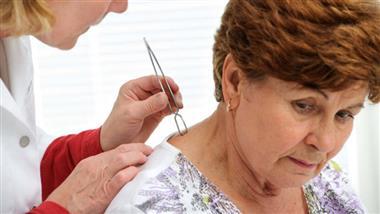
  1. Grasp the tick with clean tweezers as close to your skin’s surface as possible — this helps you grab the tick as close as possible to its head.
  2. Pull the tick out gently and with steady pressure. Avoid twisting or jerking it, as this can cause its head to break off and stay embedded in your skin. You should also avoid squeezing the tick, since this could squeeze the infectious fluid out of it.
  3. After the tick has been removed, thoroughly clean the bitten area with soap and water. Temporarily put the tick in a sealed container, so you can show it to your physician in case you develop other symptoms after a few days.

How to Remove a Tick Head

It’s not uncommon for a tick head to remain stuck in the skin despite careful removal. Here’s how to tell if a mouthpart of a tick is still stuck in your skin and what you should do to properly remove it:15,16

  1. After pulling out a tick, inspect the bitten area for a small black dot. This is an indicator that the tick head is left behind.
  2. Using pointed tweezers, try to remove the remaining part.
  3. After removing the tick head, clean up the bite area with soap and water.

If you can’t get rid of a lodged tick head, contact your physician to have it removed. Although the tick head will eventually be expelled from your body as the wound heals, it’s still best to have it removed to reduce your risk for infections.17

3 Natural Tick Repellents

To avoid being bitten by ticks, use these natural repellents to keep them at bay, especially during the summer months:

  1. Essential oils — Some of the essential oils that have been found to be effective at repelling ticks include citronella, lemongrass, rose geranium, peppermint and citrus oil.18 These oils can be applied on clothing, lawns and gardens.19 You can also use them on your skin, provided that you dilute them with a carrier oil like coconut oil.20
  2. Food-grade diatomaceous earth (DE) — DE absorbs the oils and fats from the exoskeleton of ticks, causing them to die of dehydration.21 If you want to get rid of ticks around your home, sprinkle this white powder in places where ticks may nest, such as in moist and shaded areas. Be sure to limit its use to places where ticks may hide, as DE can also kill beneficial insects.22
  3. Garlic According to a study published in the Journal of Medical Entomology, multiple applications of garlic juice-based products on a residential landscape may help suppress tick activity.23

Aside from using the natural tick-repellents mentioned above, you can also reduce your risk for tick bites by simply avoiding areas where ticks are likely to be found, such as tall grasses, shrubs and leaf litter. Wearing protective clothing such as long sleeves, closed shoes and pants tucked into your socks also helps keep ticks from making their way to your body. You should also check your body for ticks every time you come in from the outdoors and while you’re showering.24

What Not to Do When You’re Bitten by a Tick

There are many misconceptions regarding the proper removal of ticks. Some recommended methods are ineffective and will only increase your risk for an infection or injury, so they’re best avoided. These include applying petroleum jelly, nail polish, toothpaste or glue to the tick in an attempt to suffocate it, as well as using sharp forceps, squeezing the tick’s body, or poking it with a hot match or nail.25

Frequently Asked Questions (FAQs)

Q: What do you do if you pull a tick out and its head stays in?

A: You can either remove the stuck tick head on your own or you can have it removed by a doctor.26


Q: What happens if the tick’s head stays in?

A: Stuck mouthparts are often harmless, but they can sometimes cause inflammation or increase the risk for infections, so they’re best removed as soon as possible.27,28


Q: How do you tell if a tick’s head is still embedded in your skin?

A: If a tick head is left behind in your skin, you will see a small black dot on the bite site.29


Q: How do I remove an embedded tick head?

A: You can try to pull out a stuck tick head using a pair of pointed tweezers.30 However, if you can’t remove it easily, do not try to dig it out. Instead, contact a medical professional so they can safely remove it for you.31


Q: Can a tick head regrow its body?

A: No, a detached tick head won’t be able to regrow its entire body. Ticks can only regenerate lost body parts like their legs.32


Q: Do ticks fall off on their own?

A: Yes. If not discovered and removed manually, ticks will continue to feed on their host until they’re full, after which they fall off on their own.33


Q: When should you consult your doctor about a tick bite?

A: Contact your doctor if you develop a rash on the site of the tick bite and if you experience flu-like symptoms. You should also seek immediate medical attention if you experience severe headache, difficulty breathing, paralysis or heart palpitations after being bitten by a tick.34

__________________

**Comment**

Fairly accurate article.  A few considerations:

  1. Keep the tick not only to show your doctor but also if you are considering having the tick tested. Many states have free tick testing (WI doesn’t). If you develop symptoms it may be well worth your while to find out what the tick could have transmitted to you.  Wisconsin IS a part of the Tickapp program and you can register here:  https://madisonarealymesupportgroup.com/2018/05/31/tick-app-wi-tick-chats-testing/  They aren’t testing ticks for pathogens but they are tracking them.  From the website: “You can send the image of your tick or tick to us, but we are not testing them. Even if a tick is tested for pathogens and none were detected, that does not mean that there is zero chance of you developing a disease.”  Important disclaimer.
  2. For identification and testing:
  3. The article recommends the “wait and see” approach which hasn’t worked for over 40 years. Everyone agrees that prompt diagnosis and treatment is essential yet they continue to promote a lazy approach. In my opinion, particularly if you live in an endemic area, start prophylactic treatment for Lyme disease if you’ve been bitten by a black-legged tick. A month’s worth of doxycycline is far cheaper and less risky than the potential for needing antibiotic treatment for years and years. Don’t even waste your time and money on testing if you were recently bitten.  CDC-2 tiered serology testing has missed up to 86% of all cases in one study.
  4. To date, the following are 19 diseases (they keep adding to) are transmitted by ticks:
  • Babesiosis
  • Bartonellosis
  • Borrelia burgdorferi (Lyme)
  • Borrelia miyamotoi
  • Bourbon Virus
  • Colorado Tick Fever
  • Crimean-Congo hemorrhagic Fever
  • Ehrlichiosis/Anaplasmosis
  • Heartland Virus
  • Meat Allergy/Alpha Gal
  • Pacific Coast Tick Fever: Richettsia philipii
  • Powassan Encephalitis
  • Q Fever
  • Rickettsia parkeri Richettsiosis
  • Rocky Mountain Spotted Fever
  • STARI: Southern Tick-Associated Rash Illness
  • Tickborne meningoencephalitis
  • Tick Paralysis
  • Tularemia

4.  Only natural tick repellants are listed here, which unfortunately haven’t been tested by the EPA for effectiveness.  Here’s more natural options, which I have no idea about effectiveness:  https://madisonarealymesupportgroup.com/2015/05/28/meetings-and-repellents/.  Here’s a more thorough approach to tick prevention as it encompasses far more than sprays:  https://madisonarealymesupportgroup.com/2019/04/12/tick-prevention-2019/ If you have pets, they contribute greatly to your tick of exposure. Please discuss options with your veterinarian as they are up on the latest products. My only warning is that the Lyme vaccine has caused the same adverse reactions in dogs as in people: https://madisonarealymesupportgroup.com/2018/08/30/how-to-spot-the-symptoms-of-lyme-disease-in-dogs/  there is evidence for glomerulonephritis (a kidney condition) as well as developing Lyme disease itself (similar to the human vaccine).

5. Recently I gave a presentation to the local high school health occupations class on all things Lyme/MSIDS.  I was amazed at how little they knew.  People STILL aren’t educated on a disease(s) that can kill them or make them want to die. Spread the word.  Educate others as this isn’t going away.

6.  https://madisonarealymesupportgroup.com/2019/05/25/help-ive-been-bitten-by-a-tick-now-what/  A great list of what to do if you’ve been bitten.  Copy this and stick it on your frig. so if it happens you don’t freak out.  Steady and calm wins the day.