https://www.newhaven.edu/news/blog/2020/eva-sapi-research.php

University of New Haven Professor Makes Great Strides in Lyme Disease, Cancer Research

An internationally recognized expert on Lyme disease, Eva Sapi, Ph.D., has made groundbreaking discoveries in the lab that have shed light on the bacteria that cause the disease, as well as a possible link between Lyme disease and another largely unknown and increasingly common illness: breast cancer.

SEPTEMBER 15, 2020
By Renee Chmiel, Office of Marketing and Communications

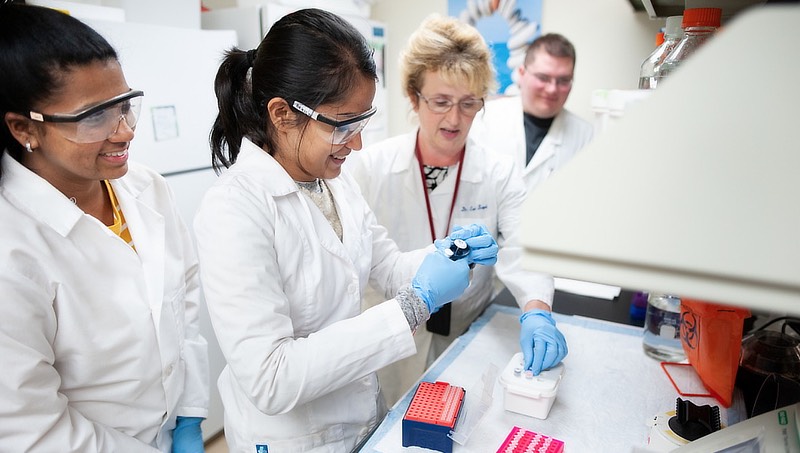
Dr. Eva Sapi with students.
Dr. Eva Sapi’s students have been an integral part of her research.

Eva Sapi, Ph.D., has long been on the front lines in the search for a cure for Lyme disease – a disease that she herself contracted several years ago.

Director of the University’s Lyme Disease Research Group, Dr. Sapi is an internationally recognized expert on the disease, which the Centers for Disease Control and Prevention say is the most common vector-borne disease in the United States. It is caused by the bacterium Borrelia burgdorferi, and it is typically spread by ticks.

Dr. Sapi has spoken with media across the country, including CNN, warning of a “perfect storm” this year for Lyme disease, given the COVID-19 pandemic and the mild winter that, she says, contributed to a “bad year for ticks.”
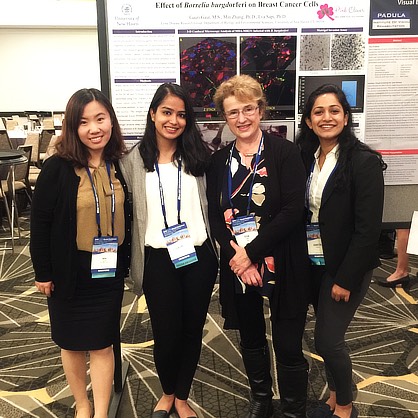
Eva and students at a research conference
Left to right: Min Zhang ’20 M.S., Gauri Gaur ’20 M.S., Eva Sapi, Ph.D., and Ankita Chavan ’22 M.S.

A trained breast cancer researcher, Dr. Sapi spent 15 years conducting breast and ovarian cancer research at Yale University before shifting her focus to Lyme disease. These two research areas may be linked more closely than previously thought, and she is currently exploring a possible link between breast cancer and Lyme disease.

“I’d heard about people who suffered from Lyme disease and then received a breast cancer diagnosis soon after,” said Dr. Sapi, coordinator of the University’s graduate program in cellular and molecular biology. “I wondered if the Borrelia bacteria were in breast cancer tissue. My research group examined slides with several kinds of breast cancer, as well as healthy tissues. The normal breast tissues were completely negative for the bacteria, and we have found evidence that they are present in breast cancer tissues. Furthermore, when we introduced Borrelia to cancer cells, we found they start to invade very quickly.”

‘Presenting at the conference was a great experience’

Although the etiology of breast cancer is still unknown, it is believed to be caused by a combination of genetic and environmental factors – one of which, Dr. Sapi believes, may be bacterial infection. She and her students, who have been an integral part of her research, are focusing on Borrelia. When examining more than 400 invasive breast cancer tissues, they found that a significant number of samples were positive for Borrelia, suggesting that the bacteria may play a role in breast cancer development and metastasis.
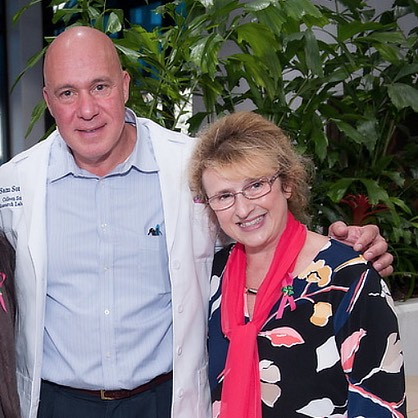
Eva Sapi and Sam Sorbello.

Dr. Sapi and several of her students – including Min Zhang ’20 M.S. and Gauri Gaur ’20 M.S. – presented their research examining a possible breast cancer/Lyme disease link and developing a novel model system for Borrelia at last year’s International Lyme and Associated Diseases Society conference.

Recent graduates of the University’s graduate program in cellular and molecular biology, Gaur and Zhang worked closely with Dr. Sapi as part of the Lyme Disease Research Group. Gaur was the leading graduate student in the breast cancer project, while Zhang developed a zebrafish model for the Lyme disease bacteria.

“The zebrafish model allows for rapid, non-invasive, and real-time analysis of Lyme disease bacteria,” she said. “This animal model shows the potential to extend our understanding of the interplay between bacterial virulence factors and host defense mechanisms in the pathogenesis of Borrelia. Presenting at the conference was a great experience, and it enabled me to get feedback from professional peers.”

‘I hope this research puts a different perspective on all cancer’

Dr. Sapi and her students’ pilot study was supported by Pink Clover, the Colleen Sorbello Breast Cancer Foundation, which was founded by University benefactor Sam Sorbello in honor of his late wife, Colleen. The University’s Colleen Sorbello Research Laboratory in Dodds Hall also bears the name of Colleen, who died of breast cancer.

“Cancer is so heterogenous,” said Dr. Sapi. “If you kill one population, another comes back. This reminds me of bacteria – you may kill most of them, but you have to take an antibiotic for ten days or they will come back. There are so many parallel lines here. I hope this research puts a different perspective on all cancer – not just breast cancer.”

Dr. Sapi’s goal is to identify antibacterial agents that are effective in killing all forms of the bacteria. She found Borrelia can form a protective layer – a biofilm – around themselves, enabling them to resist antibiotics. She and her students also discovered that liquid whole-leaf stevia extract reduced the biofilm mass by about 40 percent, and they continue to explore that as a possible lead.

‘Science can be fun and fascinating’

Dr. Sapi spent five years conducting research with an expert at Columbia University, assisting with a study that focused on a woman from New York who tested positive for Lyme disease and received antibiotic therapy for 16 years. Despite taking many combinations of antibiotics, the woman had serious complications, including seizures, and, ultimately, died from the disease. The researchers sequenced everything in her tissue, finding Borrelia and confirming that the bacteria can form a biofilm, enabling them to resist antibiotics. Dr. Sapi’s research was published in the journal Antibiotics.

In addition to her work on the front lines of Lyme disease and breast cancer research, Dr. Sapi is eager to share her passion for research with her students, and to teach and inspire the researchers of the future.

“I always make sure that students’ projects will get them excited and passionate about science,” she said. “I know they’ll be in the lab for long hours, and I want them to want to be there. As mentors, we need to be encouraging, and we need to show them that science can be fun and fascinating.”

_____________________

**Comment**

We owe a debt of gratitude to Sapi. You would think her work would rock the world, unfortunately, because her research consists of smaller case studies, our public health ‘authorities’ and mainstream medicine sniff at it and just flatly ignore it.  Until they see large randomized controlled trials (RCTs) they aren’t impressed.  This will likely never happen due to lack of funding, abysmal testing, and the wide variability in patients and how they present with differing symptoms.  What little money there is is typically ear-marked with the moniker “Climate change,” which has been proven to be a moot point, yet clung to:  https://madisonarealymesupportgroup.com/2018/11/07/ticks-on-the-move-due-to-migrating-birds-and-photoperiod-not-climate-change/

It’s also interesting to note that other researchers are studying a link between Bartonella (a common coinfection with Lyme) and cancer. 

Regarding the work on stevia – it’s all been done in a test-tube and uses a special formulation which to my knowledge has not been divulged.  I used it with zero effect, but you can read about it here:  https://madisonarealymesupportgroup.com/2015/11/19/stevia-and-bb/

I assure you, it’s not a cure:  https://madisonarealymesupportgroup.com/2017/08/11/stevia-clinical-trial-underway/

Many Lyme doctors; however, use it as a biofilm buster along with other antimicrobials:  https://madisonarealymesupportgroup.com/2016/02/13/lyme-disease-treatment/

https://madisonarealymesupportgroup.com/2018/03/30/lyme-biofilm-efflux-pumps-dr-christine-green/

https://globallymealliance.org/have-you-heard-of-the-tick-borne-disease-babesiosis/

deer tick on grass

LYME DISEASE ISN’T THE ONLY ILLNESS YOU CAN GET FROM A TICK BITE

Babesiosis, a tick-borne infection caused by the parasite Babesia (most commonly, Babesia microti, though there are other species like Babesia duncani and Babesia divergens), is a malaria-like infection of the red blood cells. A 2019 report by the American Academy of Pediatrics states,

“Although cases of tickborne babesiosis have been diagnosed in the U.S. since 1966, this disease only became nationally notifiable in 2011. A report of the first five years of babesiosis surveillance from the Centers for Disease Control and Prevention (CDC) shows an alarming increase in incidence.”[i]

In his book Why Can’t I Get Better? Solving the Mystery of Lyme & Chronic Disease, Richard I. Horowitz, M.D. speaks to this alarming prevalence: “Other studies are now showing evidence of a worldwide epidemic of babesiosis: It is now spreading to parts of the United States, Europe, and Asia…the scientific literature has shown that the number of positively diagnosed cases of babesiosis in New York state alone has increased twenty times.”[ii]

While increased Lyme literacy has improved awareness of babesiosis, many people still look at me like I have three heads when I say I have this infection. The name is indeed strange and difficult to pronounce; one of my graduate school professors said, “Can we just call it babelicious? That’s easier.” Whether you refer to it as babesiosis, Babesia, babelicious, or, as my friends have adopted, babs, it’s important that you understand what this illness is, how it is transmitted, what the symptoms are (and what they actually feel like), and what treatment options are available.

Babesia microti as seen in infected red blood cells via microscope

The tiny parasite Babesia is most commonly transmitted by a tick bite—meaning you can get Lyme and babesiosis, as well as other co-infections, all from the same tick. However, you do not have to have Lyme disease to get Babesiosis. Babesia can also be transmitted via blood transfusion or from mother to fetus. It depletes the red blood cells of oxygen, causing patients to experience air hunger, lightheadedness, weakness, shortness of breath, and post-exertional fatigue akin to what marathon runners describe as “hitting a wall”. Other common symptoms include high fever, night-sweats, headaches, chills, and hypoglycemia. Dr. Horowitz writes that babesiosis can also cause “a hemolytic anemia (due to red blood cells breaking down), jaundice, thrombocytopenia (low platelet count), congestive heart failure, and renal failure.”ii

What does it actually feel like to have babesiosis? While every case is different and not all patients experience every symptom, I can share my own 20+ year battle with this infection. After finding a splotchy red rash on my arm in the summer of 1997, the first symptom I experienced was hypoglycemia. After a busy morning teaching water-skiing, swimming, and canoeing at the summer camp where I worked, I collapsed in the dining hall from what I thought was dehydration but was actually low blood sugar. Beyond testing for diabetes, no one thought to look into the cause of my sudden hypoglycemia or to test for tick-borne infections. Instead, I continued to suffer low blood sugar reactions and sudden lightheadedness for years, and learned to always carry a snack with me.

As the tick-borne infections Lyme, babesiosis, and ehrlichiosis ran through my body unchecked over the next eight years, I developed smashing migraines that left me nauseous and crying on the bathroom floor. I now know that my brain was not getting properly oxygenated, causing my extreme pain. I lived in Colorado at the time, so doctors told me I had altitude sickness.

Babesiosis can exacerbate Lyme and other infections; not knowing I had any of them, they all were getting worse, the symptoms overlapping and manifesting more frequently. Flu-like symptoms, coupled with intense bouts of fatigue, came on-and-off for years. Despite being a gym rat and a life-long skier, I could no longer keep up with my friends on the slopes, experiencing low blood sugar, dehydration, and fatigue that would sometimes send me to bed for a day or two afterwards. By the end of my second year in Colorado, I’d developed asthma and needed to use an inhaler.

In 2003, I got mononucleosis that slipped into chronic Epstein-Barr virus—I couldn’t fight it because of the underlying tick-borne diseases—and in 2005 those diseases were finally diagnosed. By that point I was experiencing fevers that could have been associated with any of those illnesses, and occasional nightsweats.

Once I started treatment for babesiosis (along with antibiotics for Lyme and ehrlichiosis), those nightsweats increased, but that was a good sign. It was a form of Jarisch-Herxheimer reaction; my body was sweating out the dead parasites. I often woke in a puddle, my pajamas fully soaked, and sometimes had to change sheets twice a night. At my worst point, I couldn’t ride thirty seconds on a stationary bike without “hitting a wall”.

While Lyme Literate Medical Doctors (LLMDs) have varying opinions about the treatment and prognosis of babesiosis infections, the general consensus I heard at the International Lyme and Associated Diseases Society (ILADS) conference in 2019 was that there is no cure. Some doctors are having great luck, with patients reporting complete eradication of symptoms for both babesiosis and Lyme disease, with the antimicrobial drug Disulfiram (commonly known as Antabuse); however, more research is needed, and the drug has serious side effects. More commonly, doctors use anti-malarial drugs such as Mepron, Malarone, or Coartem to treat babesiosis, often pulsing these treatments over weeks or even months as the patient’s Babesia load decreases. Still others supplement these medications with homeopathic remedies such as artemisinin or cryptolepsis.

This is not a complete list of babesiosis treatments; Dr. Horowitz talks about others in his book, and your LLMD may have other ideas. I have been on different anti-malarial medications, paced at different intervals, and on different homeopathic drops, throughout my journey. Unfortunately, it doesn’t help for me to share my protocol, because it is ever-changing, and because no two cases of tick-borne illness are alike. Here’s what I can tell you for sure: babesiosis symptoms can get better. If you are being treated for Lyme disease and haven’t been tested for babesiosis or other co-infections, you may only be fighting half the battle. Whether you have a known or suspected case of Lyme, it’s critical that you talk to your doctor about other tick-borne diseases, too.

[i] http://dx.doi.org/10.15585/mmwr.ss6806a1.

[ii] Why Can’t I Get Better? Solving the Mystery of Lyme & Chronic Disease. Horowitz, Richard I., MD. New York: St. Martin’s Press, 2013 (135, 136).

Related Posts:
Differentiating Between Babesia and COVID-19 Air Hunger
New test for Babesia approved by the FDA
What is Air Hunger, Anyway?
Tainted Transfusions: Why Screening Blood is More Important Than Ever


jennifer crystal_2

Opinions expressed by contributors are their own.

Jennifer Crystal is a writer and educator in Boston. Her memoir about her medical journey is forthcoming. Contact her at lymewarriorjennifercrystal@gmail.com.


________________________

**Comment**

Another great example that Lyme is just the “tip of the spear” for many patients and the CDC’s mono therapy of doxycycline will NOT work for many, particularly if you are coinfected and/or have had Lyme for any length of time.

For more on Babesia:  https://madisonarealymesupportgroup.com/2016/01/16/babesia-treatment/

More on Disulfiram:  https://madisonarealymesupportgroup.com/2019/10/15/disulfiram-psychosis-update/

https://madisonarealymesupportgroup.com/2020/06/26/new-treatments-for-lyme-disease-on-the-horizon/

https://madisonarealymesupportgroup.com/2020/05/26/potential-patient-reported-toxicities-with-disulfiram-treatment-in-late-disseminated-lyme-disease/

https://www.medpagetoday.com/meetingcoverage/painweek/88593

New Guidelines Issued on Medical Cannabis for Chronic Pain

Shutterstock

— International task force shares recommendations for dosing, administering

Chronic pain patients can be treated with medical cannabis following one of three protocols based on patient characteristics, according to an international task force at the virtual PAINWeek meeting.  (See link for article)

__________________

Among their recommendations:

  • Treat the majority of patients along the “routine” scale. This means starting patients with 5 mg of cannabidiol (CBD) twice daily. Tetrahydrocannabinol (THC) should only be introduced if patients do not respond to at least 40 mg of CBD daily, starting with 2.5-mg daily THC doses. THC doses should be capped at 40 mg daily.
  • Frail and elderly patients, and those with severe co-morbidity or polypharmacy should be treated via a conservative route. This means starting the THC dosses at 1 mg daily and titrating up the THC more slowly.
  • Patients suffering from severe pain and those who have significant prior cannabis consumption can follow the rapid protocol. This mean starting with a CBD-THC balanced dose of between 2.5-5 mg per each compound once or twice daily.
A task force member admitted there is a major barrier to overcome due to a knowledge gap regarding medical cannabis.


https://www.medpagetoday.com/infectiousdisease/covid19/886

CDC: More Than Half of Pregnant Women With COVID-19 Lacked Symptoms

— Two studies found high prevalence of asymptomatic infection
A close up of a mother wearing a protective mask holding her newborn in the hospital
More than half of pregnant women admitted to the hospital with COVID-19 were asymptomatic, researchers found.

Of 598 hospitalized pregnant women with COVID-19, about 55% were asymptomatic, while 16% of symptomatic pregnant women were admitted to the intensive care unit (ICU), about 9% required mechanical ventilation, and two women died, reported Miranda Delahoy, PhD, of the CDC, and colleagues, writing in an early edition of the Morbidity and Mortality Weekly Report (MMWR).

Of 458 women who completed pregnancies at hospital discharge, 448 were live births, with 10 pregnancy losses, which occurred among both asymptomatic and symptomatic women. However, there were no ICU admissions, mechanical ventilation, or deaths among asymptomatic women, the authors noted.  (See link for article)

____________________

For more:  https://madisonarealymesupportgroup.com/2020/07/01/quarantine-killed-more-seniors-than-covid-is-harming-childrens-mental-health-who-finds-no-covid-in-breastmilk-yet-pregnant-women-targeted-for-covid-vaccine/  WHO finds no COVID in breast milk yet pregnant women are targeted for COVID vaccine.

Earlier today I posted Dr. Popper’s video admitting that COVID-19 testing is ‘uncertain,’ yet we learn that they want to test newborns not once but twice (despite the fact most pregnant women are asymptomatic):  https://madisonarealymesupportgroup.com/2020/05/29/cdc-recommends-newborns-be-tested-for-coronavirus-twice-separate-from-mothers-with-confirmed-or-suspected-covid-19/

Here’s a great example of how many can test negative, then positive, then negative.  https://madisonarealymesupportgroup.com/2020/08/09/gov-mike-dewine-of-ohio-tests-positive-then-negative-for-coronavirus/


http://  Approx. 16 Min.

Testing, Government Assessment of Testing, & Consequences of Testing

Sept. 17, 2020

Starting at 1:43 Dr. Popper reads straight from the Australian Public Health Website.  In it we learn that the reliability of COVID-19 testing is “uncertain.”  

For anyone reading this website, this is not new news; however, civil rights are being taken away due to this abysmal testing.

For more on testing and how it’s being used to take away our freedom:  https://madisonarealymesupportgroup.com/2020/07/01/us-scientist-manufactured-pandemic-testing-people-for-any-strain-of-coronavirus-not-specifically-covid-19/

https://madisonarealymesupportgroup.com/2020/08/09/gov-mike-dewine-of-ohio-tests-positive-then-negative-for-coronavirus/  (Many more links within on faulty testing as well as the fact his abysmal testing is what is being used by ‘contact tracers’ right here in Wisconsin as part of Governor Evers ‘Badger Bounce Back’ Program.)  Please alert your representatives of this fact.

Fast forward the video to 5:15 and we learn the results of this “uncertain” testing.
  • We learn that schools are having virtual classes due to COVID testing, despite the fact most young people are not severely affected by the virus.
  • A 17 year old New York High School student is protesting the coronavirus regulations put in place due to testing.  This student was arrested for “irresponsible behavior and selfish behavior” for a publicity stunt where he was arrested trying to go to school. Despite his suspension he then showed up later prompting a police response.
  • In Quebec city, it has been announced they will isolate uncooperative citizens in a secretive COVID facility.  Evidently patrons of a bar were ordered to wait for the results of the “uncertain” COVID testing, but they left the premises.  Due to this and the fact some have violated home quarantine, they are also tracking down people and taking them to this secretive facility. There is no mention of these people being ill.  
  • Closer to home in Houston, TX it has been announced that residents will be randomly selected and visited in their homes by city officials and paramedics (wearing “Better Together” T-shirts), asked to fill out questionnaires and then get a blood draw.  The City of Houston is partnering with the CDC, Baylor College, and Rice University. They admit the blood test does not replace the nasal swab or oral testing. They also want to know if you’ve been around anyone diagnosed with COVID (determined from the same ‘uncertain’ testing) so they can isolate them too.
  • A Canadian flight was cancelled due to a 3 year old not wearing her face-mask. The father asked if she could finish her snack first so he could “ease her into it,” but this wasn’t good enough for the West Jet airline’s zero tolerance policy.  The 3 year old was so hysterical she vomited. The airline then announced the family had to leave or face getting arrested and prison time.  West Jet accused them of non-compliance yet a video showed the child had her mask on when authorities entered the plane.

Popper states the obvious:

We’ve lost all compassion for anyone other than those with COVID.  We share a planet with many people.
Time to stop this nonsense that is all based upon “uncertain testing.”