https://www.lymedisease.org/new-york-upstate-tick-testing/

New York’s Upstate Tick Testing Program tracks alarming trend

https://mywisconsinwoods.org/2020/05/27/how-to-co-exist-with-wisconsins-ticks/

By Denise Thornton

If you plan to be out in the woods or live next to woods, don’t be too quick to trade long pants and long sleeves for shorts and a tee shirt as the weather warms. You need to protect yourself from the ticks that are starting to emerge. Tick bites are possible year-round, but ticks are most active April through September.

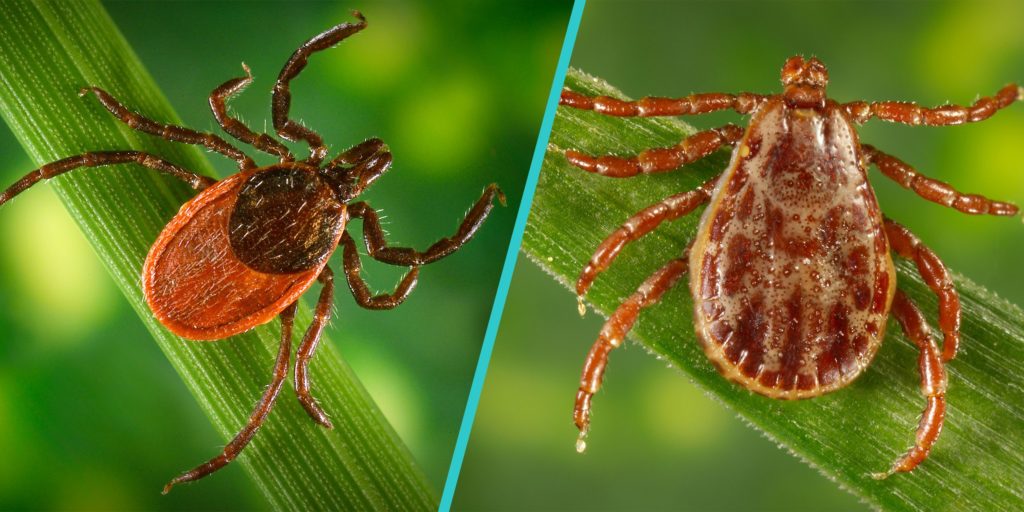
Many types of ticks never feed on people. In Wisconsin, the two most common ticks that do are the wood tick, which is not a health concern here, and the black-legged tick (Ixodes scapularis), commonly known as the deer tick, which can transmit several serious diseases including Lyme disease and, more recently, anaplasmosis, which can start with symptoms like fever and nausea and in some cases, progress to organ failure.

Deer tick (left) and Wood tick (right). Photo courtesy of prevention.com

Wisconsin is Tick Heaven

The Upper Midwest and the northeastern states are hardest hit by Lyme disease, and the numbers in Wisconsin are rising. According to the Wisconsin Department of Health Services, Wisconsin had 3,105 estimated cases in 2018.

Once considered to be a north woods hazard, deer ticks are now found in every county of the state. Deer are an important blood source for adult ticks, and in 2018 overwinter deer densities in the state varied from three to over 60 per square mile. The abundant woodlands interspersed with agriculture throughout much of central and southwestern Wisconsin creates high quality deer habitat.

“There’s been a change in the past 25 years,” says Dr. Susan Paskewitz, chair of the UW-Madison Department of Entomology. Ticks thrive in moist, shady forested environments, and love our increasingly mild winters. “We find them in pine forests, mixed forests and deciduous forests.”

Paskewitz has sampled along the woody edges and out into the yard in neighborhoods in Eau Claire and near Delton.

“Of 90 houses tested, by the end of June, 80 percent of them had at least one deer tick in the area we were sampling. Most were within three to six feet of the woods,” Paskewitz continued, “but a few were found in bright, open, mowed lawn. I don’t think they live long there, but they were making their way out there, so if you are walking out to get your mail without your shoes on, you might pick up that particular tick.”  (See link for article)

____________________

**Comment**

They say a picture‘s worth a thousand words.  The picture of this tick in the gum line in the mouth of a dog shows how durable and tenacious ticks are.

A few points for consideration:

  • Migrating birds, rodents, deer, lizards, and human movement are transporting ticks everywhere.  For far too long doctors have been looking at maps to diagnose people.  Trust me, ticks are virtually everywhere and adapt to weather conditions quite easily.
  • If I’ve written this once, I’ve written it 1,000 times – many people never see the tick or the rash and research shows the rash is highly variable – certainly not a sure thing.  
  • For more on tick prevention:  https://madisonarealymesupportgroup.com/2019/04/12/tick-prevention-2019/  I’m happy to report I saw some controlled burning in ditches as I was driving North today.  This has proven to reduce tick populations significantly.  I wish more of this was happening.
  • Regarding the section on if you find a tick bite: while it’s true that removing the tick as soon as possible is step #1, step #2 is getting prompt treatment as the “wait and see” approach has doomed patients to decades of suffering.  Demand immediate prophylactic treatment for each and every tick bite.  Trust me – whatever mild side effects and inconvenience a month or two’s worth of doxycycline can cause is nothing compared to the pain and suffering of a chronic, relapsing infection.
  • Testing for all tick-borne illnesses is abysmal.  Lyme is just the tip of the spear.  Ticks are literal garbage cans full of numerous pathogens they can transmit in just one bite.  The only infections listed in this article were Lyme disease, Anaplasmosis, and Babesia, when there are 19 and counting infections ticks can transmit.  Research has shown being infected with more than one pathogen causes more severe illness for a longer duration.  It is imperative that treatment includes medications that focus on each pathogen.  For the mounting list of tick-borne pathogens:
    • Babesiosis
    • Bartonellosis
    • Borrelia miyamotoi
    • Bourbon Virus
    • Colorado Tick Fever
    • Crimean-Congo hemorrhagic Fever
    • Ehrlichiosis/Anaplasmosis
    • Heartland Virus
    • Meat Allergy/Alpha Gal
    • Pacific Coast Tick Fever: Richettsia philipii
    • Powassan Encephalitis
    • Q Fever
    • Rickettsia parkeri Richettsiosis
    • Rocky Mountain Spotted Fever (RMSF)
    • SFTS: Severe Fever with Thrombocytopenia Syndrome
    • STARI: Southern Tick-Associated Rash Illness
    • Tickborne meningoencephalitis
    • Tick Paralysis
    • Tularemia
  • While the wood tick and deer tick are the most common ticks in Wisconsin, they are hardly the only ticks we must be concerned about.  Go here for more on the various types of ticks and the diseases they carry. The Lone Star tick has been found in Wisconsin and one allergist in MN states he diagnoses approximately 1 patient per month with Alpha-gal allergy – some patients hailing from WI.  Wisconsin is a hot-spot for Powassan virus, and we recently had our first death due to Rocky Mountain Spotted Fever. It would be a huge mistake to believe you only have to worry about Lyme, Anaplasmosis, and Babesia in Wisconsin.  Nearly every patient I work with also has Bartonella – a tenacious pathogen that isn’t even on most doctors’ radars, and Mycoplasma is very common.
  • Most articles such as these don’t tell you what to do once you’ve become infected. Optimally, you would be prepared before this ever happened by finding the Lyme literate doctors (LLMD) in your state.  The best way to do this is to contact your local Lyme support group. There is also a tab on the right side of this website called, “Find a Lyme Support Group.”  There is also another tab slightly down from that in which you can contact ILADS directly for doctors in your area.  Read this if you don’t know what a LLMD is.  LLMDs are specially trained in tick-borne illness and know how to diagnose patients clinically.  This is crucial because current 2-tiered CDC testing misses anywhere from 70-85% of cases or more.  You truly can not trust testing.  They also know how to treat this complex illness that typically is far more than just Lyme.

https://thenewamerican.com/is-fauci-killing-americans-dallas-doctor-asks-senate-why-no-official-treatment-protocol-for-covid/

Is Fauci Killing Americans? Dallas Doctor Asks Senate: Why No “Official Treatment Protocol” for COVID?

Is Fauci Killing Americans? Dallas Doctor Asks Senate: Why No “Official Treatment Protocol” for COVID?
AP Images

“Something has gone off the rails in the world” with the treating of COVID-19. For one thing, despite our being more than a year into the pandemic, there’s still no “official treatment protocol” for the virus. This is a failure of the health establishment — and one that’s costing thousands of lives.

So laments Dr. Peter McCullough, vice chief of internal medicine at Baylor University Medical Center (BUMC), chief of cardiovascular research of the Baylor Heart and Vascular Institute, and program director of the cardiovascular disease fellowship program at BUMC.  (Go to link for article)

______________________

**Comment**

*Update* A bill has been introduced in the House to #FireFauci.

“Few People Have Earned Their Termination More Visibly”

The article points out that Dr. McCullough is an internist with the same qualification as Dr. Fauci, but who actually treats patients.

When McCullough spoke with his Italian colleagues about COVID they told him:

“‘this [COVID-19] is like a cold, except, the immune system goes crazy in the middle part of it, and then there’s blood clotting and thrombosis.’ …That’s what kills you.”

“‘So we take an edge off the viral replication early,’” the doctor continued, quoting the Italians on their treatment efforts. “‘We treat the immune system ‘dis-regulation,’ and then we manage the blood clotting, [and] we can get people through the illness’” (video below).

The article exemplifies the fact most doctors/hospitals ‘toe the line’ and are unlikely to use “unofficial” treatments out of fear.  This is also a great example and clearly evident in the world of Lyme disease.  Doctors that treat outside the CDC’s unscientific and antiquated “guidelines” that rule like the iron curtain, are hunted down by State Medical Boards and persecuted.  This form of bullying sends a loud and clear message to all other doctors: “follow the narrative, do what you are told, or you’re next.”

What is truly bizarre (but not, when you understand the corrupt CDC and their MO) is the fact this organization would rather see people die than give them appropriate treatment.

This is also clearly seen in the world of Lyme. Despite a plethora of research showing Lyme and most of the other infections ticks transmit are persistent, relapsing, and are not completely eradicated with treatment, our public health ‘authorities’ just simply deny it, hold their ground, and repeat the mantra that Lyme is hard to get and easy to treat.

The article told the story of an elderly friend with COVID who was given no treatment and then died.  This is presently happening all over the world.

But, I have personally learned an unbelievable story:

An elderly man from Wisconsin called the ER due to health spiraling down due to a suspected COVID infection.  They showed up at his house donned in hazmat suits, declared they wouldn’t touch him and informed him he would need to get himself upon the gurney.  From there he was taken to the local hospital where again, he was treated like a leper, and nobody would touch him.  They called Medflight and took him to a larger hospital where the only treatment that was offered was the ventilator, which thankfully was refused as the elderly gentleman understood that the ventilator has killed many patients early on in the ‘pandemic.’  The doctor simply looked down at him and announced he’d be dead in 5 days.

I tell you this story because this is needless neglect/slaughter when effective treatments are available but highly censored and kept from the public – including doctors.  

I’m happy to report that this elderly Wisconsinite is quite alive and defied them all, despite their refusal to treat him.

The article discusses Dr. McCullough’s Texas Senate testimony and the fact 85% of COVID patients given a multi-drug treatment recovered from it and developed complete natural immunity.  Further, he states that thousands could be saved if this suppressed treatment was freely given (which could also be said of Lyme/MSIDS).

Sadly, McCullough cannot get papers published on this treatment as all information is scrubbed and sanitized to fit the accepted narrative (and is also experienced in Lyme-land).

McCullough states Fauci is “the greatest mass killer of our generation.”  

But the bought-out media feeds the public a continual narrative of how great Fauci is, despite the fact the creator of the PCR, Kary Mullis, called him a liar and an ass_ _ _ _, and many others have pointed out his severe conflicts of interest and sordid history as mafia overlord of NIAID for 7 presidencies.

For more on effective COVID treatments:

If you you suspect you are infected with COVID but live in an area where doctors are kowtowing the accepted narrative and refuse to treat you, go here:  https://www.americasfrontlinedoctors.org/covid-19/how-do-i-get-covid-19-medication

It’s unconscionable people have to do this but completely understood in Lyme Land where you must often travel great distances to get to a Lyme literate doctor experienced in treating tick-borne illness.

**Comment**

Tuttle brings up many valid questions you may want to consider if you are planning on writing HHS on how best to address Lyme disease.

  • It needs to be understood that this complex illness started out historically through the myopic lens of a rheumatologist and has never expanded to include the many and varied symptoms that are experienced in reality and demonstrated through research.
  • Conflict if interest riddled public health ‘authorities’ still have not admitted the potential of sexual transmission and they still state that congenital transmission is ‘rare’ despite the fact nobody’s counting.  
  • They also continue to ignore the importance of other pathogens that research has shown cause more severe illness for a longer duration of time, and that require different medications.
  • Research has also demonstrated the different forms of borrelia that mainstream medicine continues to ignore, that also require different medications.
  • There is a sordid back-story (in which they took out the most specific band for Lyme) on current CDC-2 tiered testing which tests for ONE strain of borrelia, which misses a majority of cases.  They aren’t even looking for or testing for other pathogens.
  • They falsely continue to state that 60-80% obtain the EM rash, when research shows it’s highly variable and between 0-80%.  Only 25% had the rash in the first ever patient group.  The CDC has received a formal complaint on this false statistic in 2019.  Crickets.
  • Since obtaining a positive test and having the EM rash are requirements to enter research studies, it’s obvious that a HUGE subset of patients are not being studied.  This has been going on for over 40 years and needs to change.
  • The CDC also falsely states that only 10-20% go on to suffer persistent symptoms.  This only includes patients who were diagnosed and treated early.  There is a larger group of 40-60% of patients that are diagnosed and treated late. When you combine the two groups, perhaps over 60% of infected patients are chronically infected and struggle with severe symptoms. This distinction is extremely important because CDC statistics downplay the significance of the problem. Also, research dollars are limited and typically go to issues affecting the most people.

https://www.change.org/p/the-us-senate-calling-for-a-congressional-investigation-of-the-cdc-idsa-and-aldf/u/

Inquiry to IDSA President Barbara D. Alexander, MD

MAY 4, 2021 — 

Additional information to be shared with the public originating from the monthly NH Lyme Study Commission

Study Commission Website:
http://www.gencourt.state.nh.us/statstudcomm/details.aspx?id=1515&rbl=1&txtbillnumber=hb490

I do not expect a response to the inquiry below so feel free to send a personal note to Dr. Alexander to remind her to answer my three questions.

———- Original Message ———-
From: CARL TUTTLE <runagain@comcast.net>
To: “alexa011@mc.duke.edu” <alexa011@mc.duke.edu>
Cc:  All members of the NH Lyme Study Commission
Date: 05/02/2021 8:19 AM
Subject: Inquiry to IDSA President Barbara D. Alexander, MD

May 2, 2021

Infectious Diseases Society of America
4040 Wilson Boulevard Suite 300
Arlington, VA 22203
Attn: Barbara D. Alexander, MD, MHS, FIDSA, President

Dear Dr. Alexander,

As a member of NH Governor Chris Sununu’s Lyme Disease Study Commission, I am forwarding the following three highlighted questions that were brought up during last month’s Zoom meeting. I am hoping that you can answer these questions which came to light after State Epidemiologist, Dr. Ben Chan reviewed your IDSA Lyme Treatment Guideline.

Question #1 refers to Lyme patients in wheelchairs as there doesn’t seem to be a section in your guideline focused on treating the disabled Lyme patient population.

I would also like to call attention to a statement from Dr. Ying Zhang, professor at the Department of Molecular Microbiology and Immunology at the Johns Hopkins Bloomberg School of Public Health:

Standard antibiotic treatment for Lyme disease does not kill persistent Borrelia bacteria.
http://droopyyoupi.blogspot.com/2015/08/standart-antibiotic-treatment-for-lyme.html

Excerpt:

-What has tuberculosis and Borrelia burgdorferi in common? In the late stage of the disease occurs persistent (tolerant) bacteria, which essentially means that the bacteria lasts and lasts and lasts. They protect themselves against antibiotics and are difficult to treat.

– Both Borrelia burgdorferi and tuberculosis is relatively easy to cure in the early stages, even with the use of one antibiotic. In the late stage it is impossible to cure the disease with the same type of treatment in the acute phase, said Dr. Ying Zhang when he visited the year NorVect conference.
________________

Kindly hit “reply all” so all members of the NH Lyme Study Commission will see your response.
Respectfully submitted,
Carl Tuttle
Hudson, NH
 
Three highlighted questions that were brought up during last month’s Zoom meeting:

———- Original Message ———-
From: CARL TUTTLE <runagain@comcast.net>
To: All Members of the NH Lyme Study Commission
Date: 04/28/2021 11:04 AM
Subject: April 23rd meeting minutes

Rep Marsh and Commission members,
For the record here is a copy of the questions I asked during the last Zoom meeting which should be summarized in the minutes.

Question #1 Stages of Lyme disease 
Stage 3: Months later; Arthritis (from the March 2th minutes)

I would like to call attention to the 43-page document I sent to all members prior to the start of this study commission. [1] On page two of that document under the topic “Severity of Lyme Disease” (cases that actually made headlines) there are references to Lyme patients in wheelchairs, along with Dr. Neil Spector requiring a heart transplant after his Lyme went untreated for four years.

Untreated strep throat can progress to rheumatic fever, causing irreversible heart damage. Untreated syphilis leads to progressive disability and dementia, and untreated HIV infection progresses to AIDS with significant disability and death. So what happens to a patient with Lyme disease who goes months, years, or decades before diagnosis because of a false-negative serological test result, missing bulls-eye rash, misdiagnosis etc., etc.?

Why isn’t the disabling stage of Lyme disease recognized? I have never seen a public Service Announcement informing the public that you could become horribly disabled or die from Lyme disease yet we have all this evidence nationwide that Lyme is destroying lives, ending careers while leaving its victim in financial ruin.

Question #2 IDSA Treatment Guidelines discourage routine testing for Lyme disease in patients who have been diagnosed with the chronic diseases of our time. 

On page 5 of that 43-page document I sent to the group there is a link to the 5min extended trailer for the documentary “Under our Skin” From the Lyme patient interviews;

I was misdiagnosed with:

-Chronic Fatigue Syndrome
-Lupus
-MS
-Fibromyalgia
-ALS

We also know that Kris Kristofferson was being treated for Alzheimer’s disease only to find out it was Lyme all along.

The 2020 IDSA Lyme treatment guidelines strongly recommend against “routine” testing for disease in patients with:

Typical amyotrophic lateral sclerosis (ALS),
Relapsing-remitting multiple sclerosis (MS),
Parkinson’s disease,
Dementia, or cognitive decline,
New-onset seizures,
Psychiatric illness, and
Children with developmental disorders.

Who in their right mind would not want to make sure that these patients are not suffering from an untreated Lyme infection; especially in a state with one of the highest rates of Lyme in the country?

Question #3 There are no references to failed treatment in the IDSA Guidelines so no acknowledgment of persistent infection. 

My letter to the editor published in the BMJ last June had a short list of failed treatment references; there are actually hundreds so why is the IDSA refusing to recognize this serious problem which is leaving hundreds of thousands if not millions worldwide in a debilitated state?

Letter to the editor of the BMJ:

Lyme borreliosis: diagnosis and management
https://www.bmj.com/content/369/bmj.m1041/rr-1

Carl Tuttle
Hudson, NH

Reference

1. 43-page document I sent to all members prior to the start of this study commission
https://www.dropbox.com/s/cfgrq6m1y645q3b/NH%20House%20Bill%20490%20Lyme%20Disease%20Commission%20Oct%203%202020.pdf?dl=0


https://www.lymedisease.org/comments-hhs-lyme-disease/

Give your comments to HHS on how best to address Lyme disease