In a follow-up on the report of a Heartland virus casereported in a Kankakee County, Illinois resident last year, the Illinois Department of Public Health (IDPH) collaborated with the Illinois Natural History Survey Medical Entomology Laboratory (INHS MEL) and Kankakee County Health Department to conduct the first environmental health investigation to a novel tickborne disease case and found Heartland virus was detected in Lone Star ticks collected from Kankakee County.
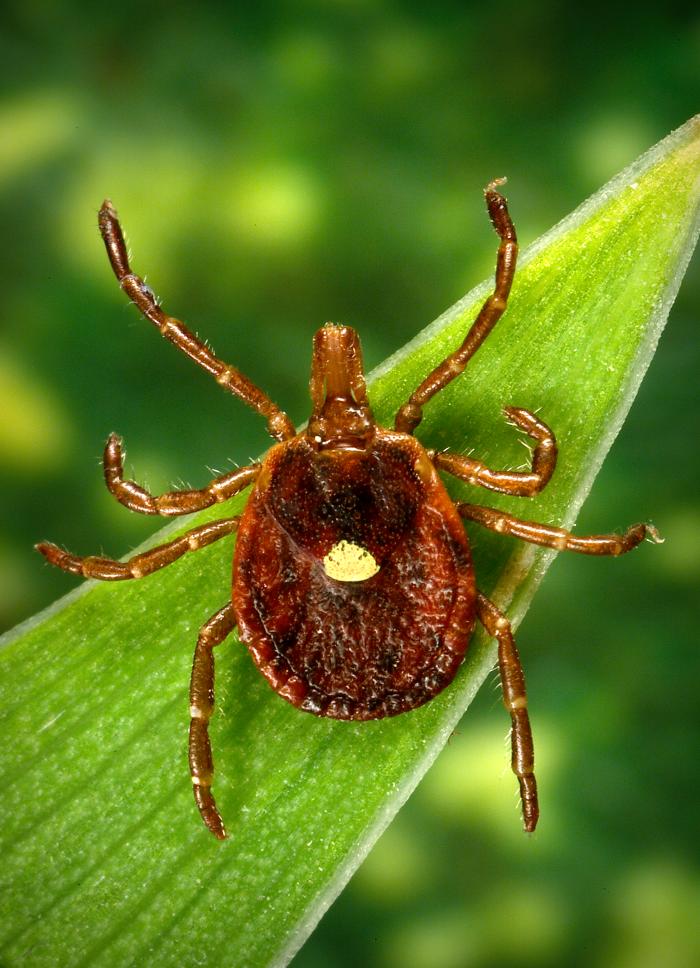
Amblyomma americanum–The Lone Star Tick/CDC
“Bites from Ticks can result in multiple types of infections, which can cause serious illness in some people,” said IDPH Director Dr. Ngozi Ezike. “It is important to take precautions and protect yourself from tick bites by using insect repellent and checking regularly for ticks when in wooded areas or high grass.”
Heartland virus was first identified in 2009 when two Missouri farmers who had been bitten by ticks were admitted to a hospital. Heartland virus is a viral disease that can be spread to people through the bite of an infected Lone Star tick. Reported cases of Heartland virus disease are relatively rare, however almost all individuals with Heartland virus have been hospitalized. Although most people infected have fully recovered, a few have died. There are no vaccines to prevent Heartland virus infections.
Signs and symptoms of infection are similar to those of other tickborne diseases and can include fever, headaches, fatigue, muscle aches, and diarrhea. Most people have reported becoming sick about two weeks after being bit by a tick. And while there is no treatment, doctors can treat some of the symptoms. If you have been bitten by a tick and think you may have Heartland virus or another tickborne illness, visit a health care provider. Other tickborne illnesses Illinois residents have been diagnosed with include Lyme disease, Rocky Mountain Spotted Fever, Ehrlichiosis, and tularemia. Health care providers should consider Heartland virus in patients who have compatible symptoms and are not responding to other treatments.
Ticks are commonly found on the tips of grasses and shrubs. Lone Star ticks are found throughout Illinois. Ticks crawl―they cannot fly or jump. The tick will wait on the grass or shrub for a person or animal to walk by and then quickly climb aboard. Some ticks will attach quickly and others will wander, looking for places like the ear, or other areas where the skin is thinner.
Simple tips to avoid tick bites include:
Wear light-colored, protective clothing—long-sleeved shirts, pants, boots or sturdy shoes, and a head covering. Treat clothing with products containing 0.5 percent permethrin.
Walk in the center of trails so grass, shrubs, and weeds do not brush against you.
Check yourself, children, other family members, and pets for ticks every two to three hours.
Remove any tick promptly by grasping it with tweezers, as close to the skin as possible and gently, but firmly, pulling it straight out. Wash your hands and the tick bite site with soap and water.
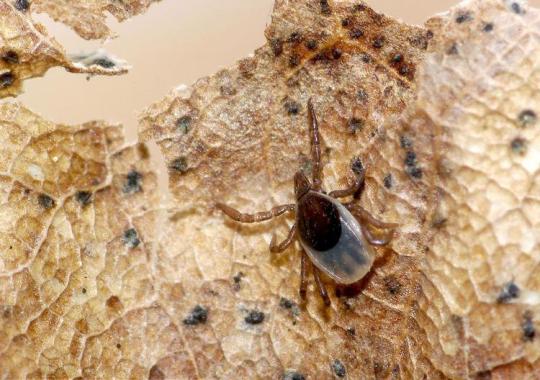
Ticks spread the widest variety of diseases that are harmful to humans, including Lyme disease. This is an image of a blacklegged (deer) tick nymph. Courtesy of Graham J. Hickling, University of Tennessee
Congress has had over six months to review a federal report on tick-borne diseases, which includes action items for prevention, diagnosis and treatment, and both doctors and researchers are frustrated that nothing has been done so far.
The report was written by a working group under the U.S. Department of Health and Human Services to address the growing number of tick-borne diseases in the United States. It was delivered to Congress in December.
The diseases, especially Lyme disease, are wreaking havoc on the Northeast and New York. About 400,000 new cases of Lyme disease are reported nationwide annually.
About one-fourth of those cases are from New York alone.
Despite the trend in New York, lawmakers did not put funding in this year’s state budget for tick-borne illness research, either.
The $1 million the state Senate had put back into the budget for studying Lyme disease and other tick-borne illnesses is no longer there.
The seemingly lack of action by state and federal lawmakers has frustrated advocates like Holly Ahern, an associate professor of microbiology at SUNY Adirondack. Ahern was also on the testing and diagnostic subcommittee of the federal tick-borne disease working group.
She was approached by the New York State Academy of Family Physicians, and Ahern and the academy’s director, Barbara Keber, wrote an op-ed column for Newsday, calling for a multi-billion dollar “national public-private partnership — an initiative that must address more than just Lyme disease and must go beyond the current low-impact strategy of telling the public to beware of ticks, wear white socks or shower after being outdoors.”
“This wasn’t just a ‘sit around and do a report’ kind of body,” Ahern said about the working group, in a phone interview Thursday. “This was, ‘Do a report and make recommendations and do what you find.’ … With that in mind, there’s accountability there. We sent the report to Congress, and Congress should take that report and should be acting on that.”
The modern history of Lyme disease starts with an outbreak in the early 1970s in Lyme, Connecticut of a mysterious illness that afflicted chil…
It isn’t often that physicians and advocates work together when it comes to Lyme disease, Ahern said. She was a bit surprised when the New York State Academy of Family Physicians reached out to her with similar frustrations about the lack of action.
Keber, who is a physician at Glen Cove Hospital, said doctors face many challenges when it comes to diagnosing and treating tick-borne illnesses.
One challenge, she said, is that there are people who are continuously bitten by ticks, and thus continuously contracting Lyme disease. Pumping a person with antibiotics could cause other negative side effects, making it difficult to treat someone with chronic Lyme.
There’s also not a good test for detecting Lyme disease. Blood tests, Keber said, are only useful about 50% of the time.
“I think another challenge for us is prevention, in either the geriatric age group, or the pediatric age group, because there are some kinds of repellents that are really not recommended in those age groups,” Keber said. “We need to really develop safer preventive measures and really, really what’s needed in terms of Lyme in particular, is a good, safe vaccine that really works.”
Vito Grasso, executive vice president of the academy, said there is new science around tick-borne illness research that needs to be explored.
“We would like to see investment in the development of one or more vaccines to address the various forms of tick-borne diseases, and we think that that’s feasible and that would be a very good investment,” Grasso said.
Ahern is less keen on a Lyme vaccine.
With a number of other tick-borne illnesses like borrelia miyamotoi and Powassan infecting people, Ahern would like to see a vaccine that’s more anti-tick than anti-Lyme.
Keber hasn’t heard of any anti-tick vaccines in the works, and said something like that would be difficult. But she talked about how, in the 1990s, a Lyme disease vaccine called LYMErix was introduced.
Some people had negative side effects, and it was pulled from distribution.
There is a Lyme disease vaccination in trials now, Keber said, but she hopes it will go through even more trials to make sure it’s completely safe before it hits the market.
Keber and Ahern are also focused on educating the public, including physicians, about the symptoms of different tick-borne illnesses and the changing recommended treatments.
The other challenge, Keber continued, is that often symptoms of these diseases are similar to the flu, or are more low-key like aches and pains.
Amidst all the challenges, advocates, researchers and physicians are joining forces in the hopes of moving the needle on funding this research. For Ahern, it was exciting to see the academy on board.
“This is a really large medical society saying we need more action, we need more help,” Ahern said. “They recognize the patient voice. They recognize the importance of the involvement of the patient voice, and whatever happens moving forward is key.”
For the first time in six years, Massachusetts state health officials report a confirmed Eastern Equine Encephalitis (EEE) virus infection in a human. The patient is a male over 60 from southern Plymouth County.
Massachusetts/National Atlas
The risk level in nine communities has been raised to critical as a result–Carver, Lakeville, Marion, Middleborough, Rochester, and Wareham in Plymouth County and Acushnet, Freetown, and New Bedford in Bristol County.
“Today’s news is evidence of the significant risk from EEE and we are asking residents to take this risk very seriously,” said Public Health Commissioner Monica Bharel, MD, MPH. “We will continue to monitor this situation and the impacted communities.”
Aerial spraying began August 8 in specific areas of Bristol and Plymouth counties to reduce the mosquito population and public health risk and is expected to continue throughout the weekend during evening and overnight hours.
Eastern Equine Encephalitis (EEE) is spread to horses and humans by infected mosquitoes, including several Culex species and Culiseta melanura.
Symptoms of EEE disease often appear 4 to 10 days after someone is bitten by an infected mosquito.
EEE is a more serious disease than West Nile Virus (WNV) and carries a high mortality rate for those who contract the serious encephalitis form of the illness. Symptoms may include high fever, severe headache, stiff neck, and sore throat. There is no specific treatment for the disease, which can lead to seizures and coma.
The institute, which has about 900 employees, studies germs and toxins that could be used to threaten the military or public health. It also investigates disease outbreaks and carries out research projects for government agencies, universities and drug companies, which pay for the work.
Interestingly, the following from the list are transmitted by ticks:
Coxiella burnetii (Q fever)
Crimean-Congo hemorrhagic fever virus
Francisella tularensis (Tularemia)
Tick-borne encephalitis complex viruses
Brucella abortus, melitensis, and suis http://www.cfsph.iastate.edu/Factsheets/pdfs/brucellosis.pdf“brucellae including B. melitensis and B. abortus have been detected in some blood-sucking arthropods, B. abortus was transmitted to guinea pigs via tick bites in the laboratory, and transovarial transmission of B. melitensis was reported in ticks.“
It is interesting the lab is suddenly closing down at the exact time an amendment passes the House telling the Department of Defense to investigate tick bioweaponization….
Burgdorfer, the discoverer of the Lyme bacterium, was a key member of this project team. He worked on weaponizing ticks and teamed up with fellow tick expert James Oliver at the Ft. Detrick bioweapons headquarters to develop ways to mass produce infected ticks so that they could be dropped from airplanes on enemy territory. These claims are backed up by interviews with these scientists, as well as with extensive government documentation from multiple reliable sources, all listed in BITTEN…(the book by Kris Newby).
The Asian longhorned tick, first found in the U.S. in 2010, is now established in 11 states along the East Coast. The female is capable of laying 2,000 eggs without mating and an infestation may kill livestock from the blood loss
While ticks are known vectors of disease, thus far this species has not transmitted disease in the U.S. It is known to carry thrombocytopenia syndrome virus triggering human hemorrhagic fever, responsible for killing 15% of those the tick bites in Asia
The number of ticks and range in which they live have been expanding dramatically. Tickborne illnesses include Lyme disease, infecting 300,000 each year in the U.S., Rocky Mountain spotted fever, babesiosis, Powassan virus and Bourbon virus
As Lyme disease rates skyrocket, it’s important to do a quick check each time you come back inside after being in a grassy area or near trees and bushes; Lyme disease may be successfully treated when caught early. Your risk of infection is lower if you effectively remove the tick as soon as possible
While you might have thought a tick is an insect, it really belongs to the arachnid family, along with spiders, scorpions and mites.1 A tick survives by feeding on the blood of a host, growing from the size of an apple seed before food and swelling to more than double their size after feeding.2
Ticks are more active during the summer months, between March and November in the northern hemisphere. Most enjoy living in warm moist places, such as bushes, tall grasses and shrubs. Animals and humans get ticks while walking through these areas.3
Of the 899 species of ticks found throughout the world, only 90 reside in the U.S.,4 and just a select few are known to bite humans.5 After a tick gets on you, it doesn’t usually bite right away but will crawl around to find an acceptable place to latch on and feed. They look for soft, moist areas, including near your ears, hair, underarms and groin. They also like to settle under the waistband of your pants.6
After piercing your skin with its mouth, the tick inserts a tube to feed on your blood until it’s full. This may take up to two weeks.7Tick bites are often painless so it may be difficult to tell if you’ve been bitten.
First new tick species in US in 50 years
In the past decade the U.S. has become home to a new species, the Asian longhorn. Dr. Gregory Poland from the Mayo Clinic says this tick represents the first time in 50 years a new species has made its way to the U.S.8 Because it is an emerging threat in the U.S. the CDC recommends that surveillance should include testing for pathogens.9
Ticks are associated with diseases in humans and animals. The Asian longhorn tick is known to carry human hemorrhagic fever caused by thrombocytopenia syndrome virus10 in Asia.11 This species has been found in 11 states, including:12
Arkansas
Connecticut
Kentucky
Maryland
North Carolina
New Jersey
New York
Pennsylvania
Tennessee
Virginia
West Virginia
However, while it appears to be spreading across the eastern U.S., the CDC has reported there is currently no evidence these ticks have transmitted disease to humans or animals.13 Asian longhorned ticks in Asia carry a virus responsible for killing 15% of those they bite.14
In recent years, this population has spread to several Pacific Islands, Australia and New Zealand. Although some experts warn against extrapolating information to the Asian longhorn tick carrying serious viruses in the U.S.,15 this species also represents additional dangers to livestock and other animals.16
North Carolina State veterinarian Dr. Doug Meckes sent out information17 reminding farmers and pet owners to be vigilant with preventive measures to avoid ticks in their animals. Five cows in Surry County, North Carolina, recently died due to acute anemia triggered by a tick infestation.18
Asian tick sounds like something from a horror film
Samples from the cows confirmed the ticks were Asian longhorn. According to Meckes, this was the fourth confirmed case since 2018 and the first in 2019.19 One young bull presented to the diagnostic lab for necropsy had 1,000 ticks. As described in this short video, the ticks are aggressive biters, feeding on both animals and humans.
The first identified case, in 2010, involved a white-tailed deer from West Virginia.20 In other reports the tick was found in New Jersey in 201721 when a woman discovered them on her sheep.22
The first recorded human bite was reported by a 66-year-old man from Yonkers, New York, in June 2018. He removed the tick from his leg and subsequently took it to the Lyme Disease Diagnostic Center in Westchester County for testing.23 After confirmation that it was the Asian longhorned tick, sampling was done near his home and nearby park, finding 90 ticks.24
A unique characteristic of this species is its ability to reproduce quickly and prolifically without mating.25 The female does not need a male to lay as many as 2,000 eggs at a time.26 The threat to livestock may be significant. A dairy cow may experience a 25% drop in milk production after becoming a host.27
As the species continues to multiply and spread, it is conceivable millions of animals could be exposed.28 A study published in the Journal of Medical Entomology29 developed a model demonstrating the wide area of North America where favorable conditions for the Asian longhorned tick may exist.30
Study author Ilia Rochlin, Ph.D., is a professor at Rutgers University. She believes the adaptability of this species means it has the potential to spread across the U.S. and southern Canada.31 The ability of the tick to reproduce without mating may make it extremely hard to control. Rochlin said,32 “In practice, it’s impossible to eradicate this species.”
Tick population rising, along with the diseases they carry
The number of all ticks and the range in which they live have both increased. According to the CDC,33the lone star tick has expanded from the southeastern U.S. into the northern and Midwestern states. The range of the black-legged tick, responsible for many cases of Lyme disease, has more than doubled in the past 20 years. Between 1993 and 2012, the number of counties in the U.S. at high risk for Lyme disease rose by more than 300%.34
Although the Asian longhorned does not yet carry disease, many other ticks do. The CDC announced it will begin monitoring the population and diseases ticks carry as the number of people diagnosed with diseases carried by ticks has more than doubled. Anna Perea, from the CDC’s Division of Vector-Borne Diseases, commented on the new monitoring:35
“For the first time this year, the CDC is funding states to conduct widespread surveillance of ticks and the pathogens they can transmit, in addition to funding human disease surveillance and education and prevention. Taken together, the data can help define areas where ticks are spreading, the infectious pathogens that they carry, and where risk of tick-borne disease is increasing.”
Tick-borne diseases may include Lyme disease, suspected to affect nearly 300,000 people each year.36 Rocky Mountain spotted fever, anaplasmosis, ehrlichiosis and babesiosis are also spread by ticks. New infections have also been detected, including the Bourbon virus, Heartland virus37 and Powassan virus.38 Ticks spread disease by virtue of the way they find nutrients.
In order to transition through life stages, ticks must have a blood meal to survive.39 Through the process of hatching from the egg, going through the larvae, nymph and adult stage, they may live up to three years. If unable to find a suitable host, they die.40 As they ingest blood, they also suck up any pathogens from the host and spread it to their next host.
Lyme disease rates skyrocketing
The rising number of ticks and their spreading habitat has meant an increase in the number diagnosed with tick-borne diseases. Lyme disease is the most prevalent of those conditions. CDC41data show that in 1997, there were 12,801 confirmed cases which more than doubled to 29,513 confirmed and 13,230 probable cases in 2017.
Data also show more males than females are affected, with the age group of 5 to 9 years having the greatest number affected. The disease is most frequently diagnosed in the months of June and July.42One study from researchers at Carnegie Mellon University43 called the rising epidemic of Lyme disease a “Ticking Bomb.”
These researchers found a relationship between rising temperatures and the incidence of Lyme disease, predicting the number of people diagnosed may rise by more than 20% by midcentury.44 In addition to temperature playing a role in the rising number of tickborne illnesses, researchers find smaller patches of forest may also increase the number of Lyme carrying ticks.
White-footed mice, also known to carry Lyme disease,45 are often the first blood meal for the larval tick.46 In smaller forest fragments measuring less than 5 acres, the mice are abundant because smaller areas of forest support fewer predators.47
Felicia Keesing from Bard College, New York, and other researchers have found an average of three times the number of ticks in a three-acre forest fragment than in larger areas. As many as 80% of the arachnids in the smallest patches were infected.48
Challenges of diagnosis and treatment for Lyme disease
Although the disease has been around for thousands of years, the medical community only began describing it in the 1970s. An autopsy of a 5,300-year-old mummy found the presence of the bacteria and a German physician first wrote about symptoms more than 130 years ago.49
Lyme disease is caused by a bacterium, which when left untreated may spread to the joints, heart and nervous system. The bacterium, Borrelia burgdorferi, may be treated successfully when found early.50 However, while commonly acknowledged now, Lyme disease has historically been a challenge to diagnose.
CNN reported51 on a U.S. Air Force enlisted man, Ruben Lee Sims, who was voted the “top enlisted management analyst of the year” in 1977. Only seven years later he was discharged and labeled a hypochondriac when the military was unable to diagnose Lyme disease. Misdiagnosed for more than three decades, he now shares his story to help others.
Early symptoms resemble the flu and the bullseye rash is not always recognized.52 Within 30 days of being bitten, you may experience fever, chills, fatigue and muscle and joint aches. Up to 80% of those infected will have a rash resembling a bull’s-eye target at the site of the tick bite, which gradually reaches 12 inches or more across.53
Later on, signs of infection may include severe headache and neck stiffness, a spreading rash on other areas of your body, severe arthritis pain and swelling, facial palsy, heart palpitations and possibly an irregular heartbeat.54 If left untreated, you may develop inflammation of the brain and spinal cord. This can lead to pain, numbness and tingling in the hands and feet as well as problems with short-term memory.55
Some people have seen multiple physicians and undergone a plethora of tests before being given a correct diagnosis.56 Early tests may not detect antibodies to the bacteria as it may take several weeks to rise to detectable levels.
Since early treatment is most effective57 some physicians begin treatment before offering a definitive diagnosis.58 The Lyme antibody test looks for exposure to the bacteria, but it may take your immune system several weeks to produce measurable levels. This can result in a false negative test with early testing.59
You’ve found a tick — now what?
Anytime you’re out in grassy areas or around trees and bushes do a quick skin check when you get back inside. Look for small brown to black spots or crawling, eight-legged arachnids. If the tick is unattached to your skin and has not fed, slip a sheet of paper under it and seal it in a container with alcohol.
However, if it’s become attached to your skin, it’s important to remove it to lower your risk of infection. While there are several tools on the market you may want to consider, a set of fine-tipped tweezers will also do the job. According to the CDC you should:60
Grasp the tick close to the skin’s surface.
Using steady and even pressure, pull the tick upward. Twisting or jerking may cause the mouth parts to remain in the skin. If the mouth parts are left behind, try to remove them with clean tweezers. If you are unable to remove them easily, allow the skin to heal.
Clean the area and your hands thoroughly with rubbing alcohol or soap and water.
Do not crush the tick as this forces blood and pathogens into your body.61
Avoid using techniques such as painting the tick with nail polish or covering it with petroleum jelly. This will not suffocate it. Likewise, poking it or using heat to make it detach are not recommended.62
Once a tick has been safely removed drop it in a sealed container with alcohol and take it to your health department or Lyme disease center for identification. Keep an eye on the area for the next several weeks. If you develop a rash or flu-like symptoms, see a doctor who’s experienced in treating Lyme disease.
_________________
**Comment**
A few points for consideration:
While human infection from the Asian Long-horned tick has not been documented in the U.S., it may still be happening. Remember, in Asia, it causes illness that KILLS 15% of those whom contract it. Don’t take this lightly.
Regarding what to do when you find an attached tick – again – insanity is doing the same thing over and over and expecting different results. Since everyone admits catching this early makes all the difference, why are people still telling people to “wait and see?” No, do NOT wait and see! By that point it will be TOO LATE! Treat this as seriously as a heart attack and treat it prophylactically if you are bitten by a tick. It’s not worth the risk, trust me. A month’s worth of cheap antibiotics are worth it. Take probiotics, avoid sugar, and live to see another day, or take your chances, spend $15K a year for potentially ever, and hope you can keep working to keep the lights on, as well as keep your family intact. People STILL are not “getting” the seriousness of this. Here’s better advice on what to do if you are bitten: https://madisonarealymesupportgroup.com/2019/05/25/help-ive-been-bitten-by-a-tick-now-what/ and go here for better info on prevention: https://madisonarealymesupportgroup.com/2019/04/12/tick-prevention-2019/