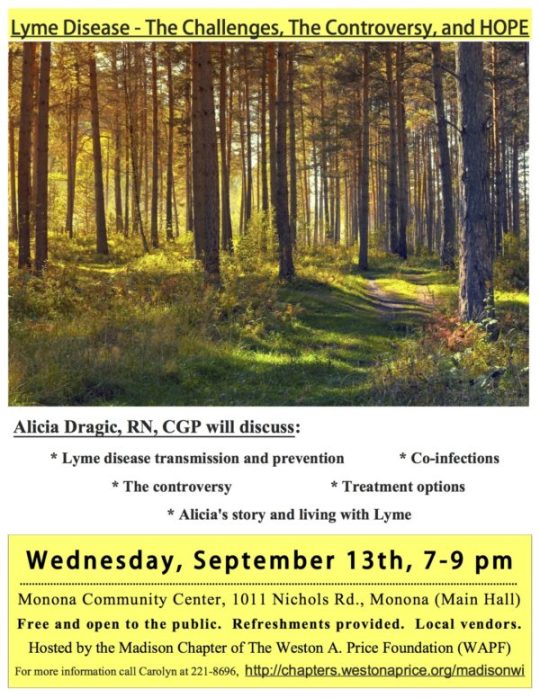
Lyme Disease – The Challenges, The Controversy, and HOPE – Sept. 13th, 7 pm
* Watch prior meeting topics on the: WAPF Madison youtube channel
Future Topics:
Oct. 11 – Dr. Steven Wilke, Chiropractor
Nov. 8 – Holistic Approach to Fat and Cardiovascular Health – Katy Wallace, ND
Dec. 13 – Holiday Party
Jan. 10 – Kefir – Bill Lensmire
Soy in the Diet of Humans & Animals
Nourishing Our Children DVD
Heart Disease / Cholesterol / Statins
High Lysine / Low Arginine Diet
Soil Health – Symphony of the Soil – film screening
Epigenetics
Cookware
Growing Cities film screening
Natural Parenting
Natural Birth Options
Our Immune System and Vaccines
Drinking Water
Chronic Pain
Autoimmune Diseases
Fat-Soluble Vitamins and Minerals
Your Idea For a Topic and/or a Speaker!
If you want more information, or have a suggestion for a future meeting topic, please email us: wapfmadison@gmail.com
Many Lyme/MSIDS patients deal with Interstitial Cystitis (IC). Recently, Dr. Rawls wrote a great article on the topic found here: https://madisonarealymesupportgroup.com/2017/08/26/interstitial-cystitis-and-lyme-disease/ Dr. Rawls believes that IC could be triggered by Lyme or Mycoplasma and that herbs could be of great benefit as it hasn’t responded well to antibiotics.
The following article supports the use of myofascial therapy, “a manipulation technique that is both internal and external to the pelvic floor (focusing specifically on abdominal, pelvic, and hip girdle muscles and other tissue).”
INTERSTITIAL CYSTITIS: THE ROLE OF MYOFASCIAL THERAPY
February 11, 2016 In Women’s Health
Rosia Parrish, Jennifer Pilon, Daeyon JooRi Jun, Kris Somol, ND
The American Urological Association defines Interstitial Cystitis (IC)/Pelvic Bladder Syndrome as an unpleasant sensation perceived to be related to the urinary bladder that is associated with lower urinary tract symptoms greater than 6 weeks’ duration, in the absence of infection or other identifiable causes.1 The condition is 5 to 10 times more common in women than in men. In the absence of clear diagnostic criteria, this condition is underdiagnosed, with an estimated prevalence of 3 to 8 million women in the United States.2
The treatment of IC is a clinical challenge. As a diagnosis of exclusion without a clear etiology, first-line treatment strategies for IC are varied and tend to focus on food-trigger avoidance, stress reduction, and bladder retraining. However, these therapies remain ineffective for some patients, warranting implementation of second-line therapies. These include pelvic floor physical therapy, amitriptyline, antihistamines, and intravesical drug combinations.3
The question of whether myofascial physical therapy (MPT) is an effective treatment for IC is a particularly relevant question for naturopathic doctors, many of whom are trained in and practice a variety of hands-on myofascial therapies. When choosing from among these second-line treatments, naturopathic philosophy would suggest that manual physical therapy would be more effective than conventional treatments in treating the cause of the condition, particularly in cases where somatic abnormalities of the pelvic floor are contributing to the syndrome. The goal of this literature review is to investigate the following clinical question: In female patients with a diagnosis of interstitial cystitis, does the use of myofascial physical therapy decrease symptoms of urinary urgency, urinary frequency, and pelvic pain when compared with conventional treatments?
LITERATURE SEARCH
A search of PubMed and Embase was performed, including combinations of the following terms (designated medical subject headings and other relevant terms): physiotherapy, interstitial cystitis, therapeutics, complementary therapies, physical therapy modalities, alternative medicine, massage, pelvic floor rehabilitation, electrostimulation, and physiatrics. The original searches were done without limiting them to randomized controlled trials (RCTs), in order to accurately assess the current state of the research and identify possible directions for other searches. Combinations of the terms interstitial cystitis, physical therapy modalities, therapeutics, and massage revealed studies that were the most relevant to our clinical question. In the final analysis, only English language RCTs conducted within the last 10 years that were available as free, full-text articles through Bastyr University were considered for review. Complete detail of searches and results is shown in Table 1 (Please see link above for Table 1).
There were 3 English-language RCTs that fulfilled our final search criteria. Of note, there were no studies that directly compared MPT with conventional drug treatments for IC. One particular study was ultimately chosen for review because it was most relevant to the clinical question being asked and to the scenarios which we would be likely to encounter in naturopathic practice.4 This study was performed solely on women (as opposed to other studies which included both women and men with painful bladder syndrome), who had not experienced relief with at least 1 course of conventional first-line management for IC. This is relevant to the fact that almost all patients experiencing IC symptoms are female. Additionally, it is consistent with how many patients seek out naturopathic medicine after experiencing a lack of success with conventional treatments. In a primary care practice, adult women may present with IC within a wide range of ages. This clinical reality is reflected in the study, which included women aged 18-77. Finally, the outcomes measured in this study not only included specific frequency of symptoms, but also a global, subjective measure of improvement as determined by the patient. This contributed to our choice of study, since including this outcome may better reflect changes in quality of life post-treatment than symptom-based questionnaires alone.
STUDY METHODS
The study chosen for review4 sought to answer whether females aged 18-77 with a clinical diagnosis of IC or painful bladder syndrome (PBS), using a standardized myofascial physical therapy protocol (MPT) as compared to a standardized Western global therapeutic massage (GTM) program, show improvement of overall symptom picture and/or specific symptoms of pain, frequency, urgency, and sexual function. Participants were recruited from July of 2008 through May of 2009 across 11 academic clinical centers across North America, and the study lasted 12 weeks. Physical therapists (PTs) providing the MPT were trained in a standardized protocol to minimize variability between therapists. The protocol was not described in the paper chosen, but has been described in detail in a feasibility study conducted by the same authors.5
There were 2 arms of the study: MPT and GTM. MPT is a manipulation technique that is both internal and external to the pelvic floor (focusing specifically on abdominal, pelvic, and hip girdle muscles and other tissue). GTM, in contrast, is a full-body therapeutic massage. Those patients in the GTM treatment group had a series of 10 one-hour massages.
The inclusion criteria included clinical diagnosis of IC/PBS, average recorded ratings for bladder pain, frequency, and urgency of at least 3/10, and present for a minimum of 3 months and a maximum of 3 years. Furthermore, pelvic floor tenderness on vaginal examination, identified by the study’s physician and confirmed by a PT, was required for study inclusion. There were no significant differences in demographics between the MPT and the GTM groups at baseline. Demographic factors assessed were age, ethnicity, education level, employment status, and annual family income; demographic factors were listed in the feasibility study cited in this article.5 Of note, no other specific prognostic factors relating to their clinical diagnosis were assessed, including smoking. Most of the patients were Caucasian, and the exclusion of women without pelvic pain on vaginal examination eliminated a significant number of IC sufferers for whom this treatment might be beneficial. For this reason, the results are difficult to generalize to the population at large.
Patient assignment to treatment groups was randomized. Physical examiners and nurses collecting data were blinded to treatment assignment, but there was no indication of whether investigators were blinded from the process of randomization. Outcome assessors and all study coordinators were also blinded to the group allocation. Randomization process occurred via a pre-specified sequence distributed in a series of sealed envelopes to receive MPT or GTM. Patients were analyzed in the groups to which they were randomized; there was no crossover between the groups. Even though the patients were not told outright what group they were assigned to, given the differences between MPT and GTM, it is likely that they were aware of the group to which they were assigned.
Outcomes were measured with the 7-point Global Response Assessment (GRA) scale, the O’Leary Sant IC Symptom and Problem Index, a 24-hour urinary voiding diary, the 2000 Female Sexual Functioning Index, and the 12-Item Short-Form Health Survey.
Of the 81 patients recruited, 78 (96%) were able to complete the full 12-week duration of the study (including initial follow-up at the completion of treatment phase at 12 weeks, and additional follow-up for 3 months after the 12-week follow-up). Of these 78 participants, 72 (92%) completed at least 7 of the 10 treatments that were assigned to them during the 12 weeks: In the MPT group 55% completed all 10 treatments, and in the GTM group 38% of the GTM group finished 100% of their 10 treatments. The 3 who withdrew from the study had received <5 treatments. During the follow-up phase of the study, the retention rate was smaller, with 77% of the MPT, and 67% of the GTM, participating. Because many of the study’s subjects did not participate in the final follow-up session, it is difficult to draw conclusions about durability of treatment.
STUDY OUTCOMES
The primary outcome of this study was that 59% of the MPT group, compared to 26% in the GTM group, reported moderate or marked improvement (p=0.0012) on the GRA scale. Within the GTM group, 43% reported no change in symptoms, compared to only 18% of the MPT group reporting no change. Both treatment groups reported improved symptoms via the O’Leary Sant IC Symptom and Problem Index of pain, urgency, frequency; there were also reported improvements in quality of life as well. No statistical significance was noted among these secondary symptom outcomes of the study. The Mantel-Haenszel test was employed to take into account the need to control variability at the 11 sites. The Number-Needed-to-Treat to determine 30% effect was 88, and only 81 were recruited; however, this study was still significantly powered.
Adverse events (AE) were also reported. Bladder or pelvic pain was the most commonly reported AE, reported in 14% of the participants. There was no statistical significance in the number of AEs reported by each treatment group. The authors conjectured that the AEs reported, especially that of pain, in part had to do with the intermittent nature of the disorder and was not necessarily related to treatment intervention. Other AEs reported were infection (reported by 12% of the patients), constitutional symptoms like fever (11%), and digestive symptoms (10%).
The age range of subjects in the study (18-77) and the duration of their symptoms (3 months to 3 years) are similar to patients who would potentially be seen in naturopathic medical clinics. It is feasible for naturopathic physicians to determine pelvic floor tenderness during a vaginal exam and to discern suitable candidates for this treatment option. It would also be feasible to refer patients to physical therapists for co-management. However, determining the optimal elements of an effective MPT regimen and finding PTs who can deliver effective pelvic floor MPT might be an obstacle.
DISCUSSION
The study reviewed here answered the question of whether the use of MPT can improve symptoms associated with IC, including but not limited to urinary urgency, urinary frequency, and pelvic pain. However, the paper did not compare the effects of MPT to conventional treatments, such as food-trigger avoidance, bladder retraining methods, or pain medications. In fact, the study did not disclose whether subjects were concurrently using any other treatment modalities while participating in the study, potentially biasing the results.
Further questions raised by the literature review process and the results of this paper include whether the results of the study can be generalized to the IC patient population at large. For example, it is questionable whether MPT would also be beneficial to patients who do not demonstrate pelvic tenderness on examination. This also points to the currently inadequate understanding we have about the relationship between somatic abnormalities and IC. Another aspect of whether the study could be generalizable centers around the fact that study participants were primarily Caucasian.
A future study examining the durability of subjects’ improvement with this therapy would make the results more clinically meaningful. Due to the loss to follow-up at 3 months post-treatment, the question of how long the beneficial effects of MPT last, remains. It would be very exciting, indeed, to investigate whether the effects are long-lasting and could potentially be a cure of sorts to the unending suffering experienced by patients with interstitial cystitis.
Finally, developing an effective training program for physical therapists and other providers would be critical so that this therapy would become accessible to a large number of patients.
CONCLUDING COMMENTS The evidence from the study reveals that MTP is indeed beneficial for improving symptoms of IC, suggesting that physical therapy is an important modality to consider in a treatment plan for a patient suffering from the disease. It adds credibility to the idea that there are specific pelvic somatic abnormalities involved with IC, as the study showed the treatment effect was not merely due to general therapeutic touch.
The process of finding a robust paper to review to answer our question yielded only 1 study that fit the aforementioned criteria. This points to the lack of research available on myofascial physical therapies to treat IC.
However, even with the limited evidence, considering the strength of the paper reviewed and the fact that no serious adverse events were reported, MPT can be considered a safe and potentially effective therapy for IC that could be recommended and provided to patients. The question as to whether it is more effective than other first- and second-line treatments still remains and requires further research.
The story of 5-year-old Brielle Reznik illustrates the challenges of getting help. But there is hope, too.
COLTS NECK – Brielle Reznik was an active, fun-loving toddler until she got bit by a tick.
Then her world came crashing down.
It started with leg pain. Next came staph infections, ear infections, migraines and anemia. There were fine motor delays; she couldn’t draw with crayons or cut with scissors. She also suffered seizures and bladder problems.
For two years, no one could pinpoint why.
“It’s the worst nightmare for a parent,” said Robyn Reznik, her mom. “Your child is sick, and you go to countless doctors who don’t know what’s wrong with her.”
At various junctures, Brielle was diagnosed with autism and diabetes. Twice, Robyn Reznik said, her daughter was referred to a child psychologist. But moms have good instincts and Robyn, who is a psychotherapist, kept searching for answers until she found someone who connected the dots.
It turns out Brielle has chronic Lyme disease, a condition that much of the medical establishment generally declines to acknowledge.
“If you have a child with Lyme disease, trying to find somebody to treat it is so, so difficult,” Reznik said. “I’ve never seen such discrimination against an illness.”
She’s not alone. The fight to recognize long-term Lyme, waged for years by advocates like the Wall-based Lyme Disease Association (LDA), is on the brink of a breakthrough. In December, Congress established a working group to examine the issue.
For now, suffering continues.
“People will often ask me to recommend a hospital to go to. There aren’t any,” said LDA president Pat Smith, who raised two children stricken by chronic Lyme. “None of them want to do anything about Lyme.”
Brielle’s story, which the Asbury Park Press verified with two different doctors and documentation of lab results, serves as a cautionary tale and — maybe — a sign of light at the tunnel’s end.
‘He saved Brielle’s life’
Lyme disease affects more than 300,000 people per year in the U.S., and New Jersey ranks second behind Pennsylvania in the number of reported cases. For many who are diagnosed promptly, the standard month-long course of antibiotics mitigates the illness. But detection is difficult, and for thousands of folks, the symptoms continue for months or years.
To date, the influential Infectious Diseases Society of America has declined to recognize chronic Lyme in its clinical practice guidelines. So sufferers are left to find a “Lyme-friendly” doctor, which is not easy.
“Doctors disagree about the long-term treatment,” said Dr. Rosario Trifiletti, a Ramsey-based pediatric neurologist who diagnosed Brielle. “That’s largely because we have lousy tests for it.”
The tick that bit Brielle, Trifilleti concluded, unleashed not only Lyme but Bartonella (a common Lyme co-infection) and PANS (pediatric acute-onset neuropsychiatric syndrome). He prescribed a long-term dose of oral antibiotics, which yielded only marginal results. So in August, he put her on 30 days of intravenous antibiotics.
“It’s made a huge difference,” Robyn Reznik said. “On day two she put her own pair of shoes on, which she had never done before.”
Brielle, who is now 5 years old, has a PICC line in her left arm. Each day, Robyn administers IV antibiotics. The treatment takes about an hour. Last week Trifiletti prescribed a second 30-day cycle, with the hope of getting the young lady attending kindergarten by mid-October.
“With the IV, she has made a complete turnaround,” Trifiletti said. “A kid like this 10 years ago would have been called autistic and would have been treated just with symptomatic medication. So this is a completely different way to look at a child who has problems like this.”
Reznik puts it more bluntly.
“He saved Brielle’s life,” she said.
A story worth telling
The backyard at the Reznik home in Colts Neck features plenty of trees. Newly invigorated, Brielle loves playing back there with her younger sister Arielle. Their parents take precautions, spraying them with tick repellent and checking their skin for bugs.
With its high concentration of woods and people, Monmouth County is a hotbed for Lyme. In New Jersey, only Morris County reported more cases in 2015. Yet Robyn Reznik said her dealings with local doctors and hospitals left her feeling like she was crazy for mentioning the condition.
“It’s gotten to the point where longtime Lyme patients, if they go into the hospital for something, many of them do not even bring their Lyme up,” the LDA’s Smith said. “This is sad and probably very dangerous. You can sort of understand it when a disease comes out; there is so much confusion that nobody knows what to do about it. But for heaven’s sake, this disease has been around for 43 years.”
Smith hopes Congress, whose interest was initiated by Rep. Chris Smith, can turn the page with a formal recognition of chronic Lyme. In the meantime, Reznik pays out of pocket for Brielle’s IV antibiotics. It’s $600 per month for the medication. Her insurer, she said, “told me by that by their standards, she doesn’t have Lyme disease.”
According to the Lyme Disease Association, 30 percent of Lyme patients are children. There are a lot of Brielles out there. That’s why Reznik is telling her story.
“I don’t want other parents to go through what we went through,” she said. “No one should have to go through that.”
The Lyme Disease Association’s annual conference takes place Sept. 23-24 in Philadelphia. It’s open to health professionals, researchers and the general public. For more information visit www.lymediseaseassociation.org.
Carino’s Corner appears Mondays in the Asbury Park Press. Contact Jerry at jcarino@gannettnj.com.
—————————————————————————————————————
**Comment**
Here is yet another Lyme/MSIDS patient who made a complete turn around with the use of IV antibiotics. There are many, many other such instances and yet the CDC wants to scare doctors into not using them due to five case reports of patients who didn’t do well:https://madisonarealymesupportgroup.com/2017/06/21/ilads-rebuttal-to-mmwr-article/
The MMWR article located in the above link is what the CDC/IDSA has been doing for decades – using their power to wage war against patients and the doctors who dare to treat them. And yes, this is a conspiracy of the greatest sort involving collusion, vested interests, money, power, and corruption of the deepest kind.
Recently there has been a panel discussion through Contagion Live with both sides of the Lyme disease controversy at the table. Dr. Shor, Dr. Bransfield, and advocate Pat Smith present the ILADS side while Dr. Sigal presents the CDC/IDSA side. Dr. Sigal seemingly can not fathom this “conspiracy,” and yet: https://madisonarealymesupportgroup.com/2017/09/02/lyme-disease-and-long-term-antibiotics-contagion-live/This is the same man that is an active player and appears in journalist, Pam Weintraub’s book, Cure Unknown Inside the Lyme Epidemic. (Excellent book)
In the link I give the specific pages were Sigal is skeptical of chronic Lyme – choosing to diagnose patients with things like fibromyaliga instead, believes that Lyme isn’t a problem but that anxiety over it is, represents insurance companies and directly consults against patients for hefty fees,headed the clinical Lyme vaccine trial, and has written in publications that patients are not actually sick with Lyme but a strange psychiatric malaise.
The conspiracy is in action with many, many more Sigals out there.
Panelists Peter L. Salgo, MD; Robert C. Bransfield, MD, DLFAPA; Leonard Sigal, MD; Samuel Shor, MD, FACP; and Patricia V. Smith share their thoughts on what needs to happen before a consensus can be reached in Lyme disease.
Peter L. Salgo, MD: Moving to consensus: yes or no? The first step, if you’re going to make the diagnosis and treat it, is 2 to 4 weeks of antibiotics to kill the spirochete. Yes, no, what?
Robert C. Bransfield, MD, DLFAPA: No.
Peter L. Salgo, MD: No. Bob, why not?
Robert C. Bransfield, MD, DLFAPA: Well, I think I’ve seen some people for whom that works, but I think there’s always the outlier in the bell curve. There are some people where a few weeks do not work for some reason. Maybe they have a complex infection. There’s more than one pathogen.
Peter L. Salgo, MD: I said first step, would that be the first step for most people?
Robert C. Bransfield, MD, DLFAPA: Yes, I think that would be.
Leonard Sigal, MD: That would depend on the manifestation though. If somebody comes to you with meningitis, you’re not going to give them 2 weeks of doxycycline.
Robert C. Bransfield, MD, DLFAPA: No.
Samuel Shor, MD, FACP: No, but you’re not going to give them more than 8 weeks probably.
Leonard Sigal, MD: But my point being is that it depends.
Robert C. Bransfield, MD, DLFAPA: You’re right, it depends.
Samuel Shor, MD, FACP: Yes.
Peter L. Salgo, MD: OK. Consensus or not—my guess is going to be no, by the way—what do we do for the subset of patients who continue to experience symptoms after this 2 to 4 to 6 weeks of antibiotics?
Samuel Shor, MD, FACP: Careful differential diagnosis and careful empathetic review of their clinical picture.
Leonard Sigal, MD: And not telling them that it’s all in their head.
Samuel Shor, MD, FACP: Right, and being supportive.
Leonard Sigal, MD: Absolutely.
Samuel Shor, MD, FACP: With the recognition that there are going to be those of us who feel a greater percentage of patients probably have active infection as opposed to another group of people who do not, such that the recommendations coming out of that review is going to be different.
Leonard Sigal, MD: And to reiterate, looking for other potential explanations.
Samuel Shor, MD, FACP: Differential diagnosis.
Leonard Sigal, MD: Absolutely.
Robert C. Bransfield, MD, DLFAPA: And don’t just give antibiotics to treat the symptoms as well. We need to do both.
Peter L. Salgo, MD: Let’s boil it down. I’m trying to get at least some clarity, here, for the rationale for or against using a longer course of antibiotics in patients who have persistent symptoms.
Samuel Shor, MD, FACP: If you feel that there is a threshold that you’ve achieved and that there is active infection—and we’ve all discussed what that means, and that threshold is different for individuals. If you feel that’s the case, then by not doing that, you potentially run the risk of not having adequate therapeutic gains. The other component—and this goes to the MS patients. A number of them, actually all 3 of them, were recommended by the neurologists to be on immune-suppressive drugs, which could have made their conditions worse had they not been identified as having an infection.
Peter L. Salgo, MD: Now, we’ve had an awful lot of bomb-throwing here today. There’s an awful lot of grenades flying through the air out there. What do we need to reach a better consensus on the issues that we’ve discussed?
Samuel Shor, MD, FACP: Better testing.
Peter L. Salgo, MD: Better testing. What kind of testing are we looking for?
Leonard Sigal, MD: Let’s back up for a second. We need better science, looking at clinical markers, biomarkers as you were saying; looking at better testing; and looking at what the sensitive questions are that we can ask. I don’t mean sensitive in the sense of, “I’m caring for you,” that’s important, too, but sensitive in the sense of statistics. I think what we need to do is put down the grenades, put down the bombs, stop accusing each other of somehow having nefarious interest, and let’s have a civil conversation. I realize this is the United States in the year 2017, so the word civil has been thrown out the door. But maybe in this microcosm, we can be civil, have a conversation about this, and make the best of everybody’s talents and experiences.
Robert C. Bransfield, MD, DLFAPA: One solution is having more programs like this. This is great. I think when it’s face-to-face and collegial, we can help to reconcile these differences and iron them out. We’re coming at it from very different angles.
Leonard Sigal, MD: Yes.
Samuel Shor, MD, FACP: Right.
Robert C. Bransfield, MD, DLFAPA: I think this is very useful and I think better disease definition is critical.
Patricia V. Smith: I was just going to say that, over the years, many times, we have asked to have more dialogue. We’ve contacted the IDSA, we’ve tried to sit down with them. We actually had them at our LDA Columbia CME Conference several years ago. It was the first time they were on the same stage. Believe it or not, we’ve advocated for that for decades, to get people together to have a discussion. But, unfortunately, there’s been unwillingness, and I was very happy that Dr. Sigal agreed to come in today and sit at the same table as us, because it doesn’t happen very often.
Leonard Sigal, MD: But it goes the other way around, you know.I’ve invited people.
Patricia V. Smith: Excuse me, but who?
Leonard Sigal, MD: I’ve invited clinicians in New Jersey, who see hundreds of patients with Lyme disease, to sit down with me to come up with research studies that would allow us to understand what’s going on in those people, understand how they respond to antibiotics, and understand what biomarkers might be useful. And the last time I saw them was when they walked out the door. They didn’t follow through on their interest.
Patricia V. Smith: The reason for that may be because, for a number of decades, our physicians have been gone after by medical boards just for treatment, long-term, of patients with Lyme disease. That has been very problematic, and we have a number of physicians who have had sanctions and so on, so a climate of fear has existed. If they’re really the practicing physicians, they don’t want to put themselves out there, because they are brought up on charges.
Leonard Sigal, MD: Well, I’m not sure that’s the explanation. The BME, the Board of Medical Examiners in the state of New Jersey, has looked at many, many clinicians.
Patricia V. Smith: I know what they look at.
Leonard Sigal, MD: Yes, you know, unfortunately. But what I was asking was, “If you see these patients, let’s do a clinical study so we can understand what’s going on with these patients,” and they were never forthcoming. All I can do is invite and, in a civil manner, try to encourage them to be part of a scientific trial.
Patricia V. Smith: I think part of the problem is also that when there have been clinical trials—and sometimes the treating physicians have supported those trials, and they have said to patients, “Maybe you should enter those trials”—those trials always end up that the patients are basically not being helped by antibiotics. Again, broad brush conclusions. And so, those physicians and those patients don’t want to even participate in those trials.
Peter L. Salgo, MD: Let me see if I understand that point. There are trials that are undergoing, that are underway, and patients get enrolled in these trials, but the results are that antibiotics may not be the right answer. They didn’t give you the answer you wanted. Does that mean that the trial was bad?
Patricia V. Smith: No, that isn’t the situation. The conclusions that were drawn in some of these studies, in the 4 from the NIH—and Sam alluded to 2 of them before—were broad brush. It should have said that in this subset of patients who were in this trial, with these particular antibiotics for this duration of therapy, the antibiotics maybe did not help them—or in 2 cases antibiotics actually did, but they said that they didn’t. So, that is the broad brush.
Leonard Sigal, MD: One of the criticisms that I’ve heard of the “long-term” antibiotic trials is that the duration was insufficient, and had there been a longer trial of antibiotics, there might have been a better outcome. I’ve heard this from other people. I’m not putting words in your mouth, Sam. I just want to ask you about it.
Samuel Shor, MD, FACP: And that is a potential, but there are other confounding variables, such as in the Klempner study. Most people were sick for between 4-and-a-half and 5-and-a-half years, many of whom had gone through the very protocols that were used in the study, so you’re self-selecting failure. And it’s also a matter of not identifying treatment of co-infections.
Leonard Sigal, MD: See, you’re taking issue with the design of the study.
Samuel Shor, MD, FACP: Yes.
Leonard Sigal, MD: Had the study been a little bit more real-world oriented…
Samuel Shor, MD, FACP: Right. The problem is that you’ve got to control your variables, and there are so many variables that you’ve got to control.
Robert C. Bransfield, MD, DLFAPA: And PCR-positive patients were excluded from the study. They should have been the ones that were studied.
Leonard Sigal, MD: I agree with you.
Peter L. Salgo, MD: It sounds to me—not being involved in the creation of these studies, not being at the table—that if everybody got together and agreed a priori on the construction of the study and the goals and endpoints, everybody might agree better when they got the data.
Samuel Shor, MD, FACP: We’re in the process of actually doing that. There’s a work group of about 15 of us who are trying to put that together.
Leonard Sigal, MD: If I can be of assistance, let me know.
Peter L. Salgo, MD: I just want to point out, I haven’t seen this since the United Nations was formed.
Leonard Sigal, MD: In the pharmaceutical industry.
Samuel Shor, MD, FACP: Both schools of thought are involved.
Leonard Sigal, MD: In the pharmaceutical industry—and that’s not a dirty word—when you have a study of say a drug for rheumatoid arthritis, you have to come up with entry criteria that bring in patients who are as homogenous as possible, because you’re going to be randomizing them. If you randomize them and they’re not homogenous, you stand a chance of asymmetric distribution of patients and your study goes up in smoke.
Samuel Shor, MD, FACP: Right.
Leonard Sigal, MD: I’m not defending anybody’s study design, by the way. I’m just saying that when you do a study, you have to be really rigorous about bringing in as homogenous a population as possible. Now, for some reason, they decided to exclude PCR-positive patients. I don’t know what the reasoning was there. But the idea is to not make the entry criteria so small that you can’t get the real world in, but not so broad as to make it a garbage study. There has got to be some middle ground.
Multiple sclerosis is a terrible and debilitating disease where the body’s immune system is directed against the central nervous system. When that happens, according to the National MS Society:1
Within the CNS, the immune system attacks myelin — the fatty substance that surrounds and insulates the nerve fibers — as well as the nerve fibers themselves.
The damaged myelin forms scar tissue (sclerosis), which gives the disease its name.
When any part of the myelin sheath or nerve fiber is damaged or destroyed, nerve impulses traveling to and from the brain and spinal cord are distorted or interrupted, producing a wide variety of symptoms.
Currently, there is no cure. Medication can often help make symptoms like double vision, blindness, as well as psychological or muscle issues more bearable but ultimately it robs people of their lives and shortens life expectancies. But that may all be changing.
Dr. Su Metcalfe believes that the attack on the nerve cells can be stopped thanks to a new medical development her company LIFNano has created. 2
She said in an interview:
“Some people get progressive MS, so go straight to the severe form of the disease, but the majority have a relapsing or remitting version.
It can start from the age of 30, and there’s no cure, so all you can do is suppress the immune response, but the drugs that do that have side effects, and you can’t repair the brain. The cost of those drugs is very high, and in the UK there are a lot of people who don’t get treated at all.” 3
Using the stem cell particle LIF, which is a part of the immune cell and is able to control and confine the attack on our bodies, she found a “small binary switch” which is able to regulate itself INSIDE the immune cell to NOT attack our body. However, it can attack when it needs to.
She went on to say,
“That LIF, in addition to regulating and protecting us against attack, also plays a major role in keeping the brain and spinal cord healthy. In fact it plays a major role in tissue repair generally, turning on stem cells that are naturally occurring in the body, making it a natural regenerative medicine, but also plays a big part in repairing the brain when it’s been damaged.” 4
Much more research needs to be done but this breakthrough seems quite promising and the team has set their sights on having found the cure by 2020.
Dr. Metcalfe also believes she and her team might be able to tackle dementia as well because LIF is a “major health factor for the brain.”5 Therefore, if they can get into the brain and protect it, it serves that they could prevent dementia.
**Comment**
This is indeed great news for Lyme/MSIDS patients due to the fact many with MS, dementia, and Alzheimer’s are initially misdiagnosed with those labels but are actually infected and vice versa. All in all, many autoimmune diseases will potentially benefit from this treatment.
Iowan, Jack Gordon, is a case discovery of 2 diseases NEVER found together before on 11.22.2015: Lewy Body Dementia, causing violent hallucinations, and Lyme Disease/MSIDS. Using his medical files, he was bitten by a tick 35 yrs. ago, but the doctors never acknowledged it by diagnosing or treating him.