Archive for the ‘Treatment’ Category

LD on the Rise – An Expert Explains Why & I Give Rebuttal

I put my **comments** within article.

https://www.ucsf.edu/news/2018/05/410401/lyme-disease-rise-expert-explains-why

Lyme Disease is On the Rise – An Expert Explains Why

By Nina Bai on May 16, 2018

May marks the beginning of the summer season when black-legged ticks that spread Lyme disease are more prevalent – even in California.

Earlier this month, the U.S. Centers for Disease Control and Prevention (CDC) reported that cases of tickborne diseases had more than doubled from 2004 to 2016, from 22,000 to 48,000, and that Lyme disease accounted for 82 percent of tickborne diseases.

Moreover, due to underreporting, the actual number of Lyme disease cases is estimated to be significantly higher – likely more than 350,000 in 2016.

 

chiu-charles_1

Charles Chiu, MD, PhD

We talked to infectious disease expert Charles Chiu, MD, PhD, about the rise in Lyme disease cases, better diagnostic tests on the horizon and what you need to know to protect yourself from infection. Chiu is an associate professor of laboratory medicine and medicine and director of the UCSF-Abbott Viral Diagnostics and Discovery Center.

How common is Lyme disease in California? And why have rates been increasing?

In terms of reported cases, there are about 80 to 100 a year in the state. Residents in or travelers to the northwestern coastal counties – Trinity, Humboldt, and Mendocino – are at highest risk. But because of underreporting, the actual number of Lyme disease cases likely exceeds 1,000 cases a year, simply because most cases of Lyme disease are not reported.

**Comment**  “Exceeds 1,000 cases a year” could mean anything.  California has not been considered an endemic state for decades with patients suffering miserably.  For a great read on why:  https://madisonarealymesupportgroup.com/2018/05/19/infected-ticks-in-california-its-complicated/

There are several potential reasons why rates have increased in California and nationwide. One is globalization. People travel extensively, and for instance, someone could get infected while on the East Coast and come back with Lyme disease.

Another reason is climate change, in that the geographic range of the tick vector, which is the Ixodes or black-legged tick, has expanded westward from the northeast United States as well as southward year after year. For ticks to be maintained in nature, they need to have what we call an animal reservoir, essentially a mammal such as a squirrel or rodent that can harbor Borrelia burgdorferi – the bacterium in the tick that causes Lyme disease. Therefore, expansion of the animal reservoir is also another reason for increasing Lyme disease rates. On the East Coast, the reservoir is the white-footed mouse. In California, the Western gray squirrel harbors the bacterium. Lizards, while not a reservoir for Borrelia burgdorferi, are common hosts for the black-legged tick in California so increase the risk of infections to humans by maintaining the tick population in the wild.

**Comment**  Nope.  According to independent tick expert and researcher, John Scott, climate change has zippo to do with increased infection rates and in fact is part of a nefarious plot to keep monies going toward climate change issues that won’t help sick patients in the least.  Ticks are marvelous ecoadaptors and will be the last species on earth – except for cockroaches & the IRS:  https://madisonarealymesupportgroup.com/2017/08/14/canadian-tick-expert-climate-change-is-not-behind-lyme-disease/

How is Lyme disease transmitted, and is it contagious between humans?

Borrelia burgdorferi causes asymptomatic infection in these small mammal reservoirs. When the ticks feed on mammals carrying Borrelia burgdorferi, these ticks get infected. They can then transmit the infection to humans.

However, humans are considered a dead-end host because the efficiency of transmitting the bacterium to other humans is extremely low. The period during which you can find the bacterium in blood is very brief, generally a few days at most, and blood-borne transmission of Borrelia burgdorferi, such as by transfusion, has never been reported. Borrelia burgdorferi is also not excreted in other body fluids such as sweat, urine, saliva, or respiratory secretions. Lyme disease is therefore not considered contagious.

**Comment**  This is the type of circular reasoning we’ve been dealing with for 40 years.  It was declared in Arkansas that Lyme “wasn’t there” because there weren’t any reports when a mother took her kids to the doctor with every symptom of Lyme known to man.  She wouldn’t let it go and finally they admit that NOW due to this case, Lyme IS in Arkansas:  https://madisonarealymesupportgroup.com/2016/09/24/arkansas-kids-denied-lyme-treatment/.

Also, regarding excretion in bodily fluids, he’s just flat-out wrong.

https://madisonarealymesupportgroup.com/2017/02/24/pcos-lyme-my-story/Bb has been found in semen and vaginal secretions & via milk.  While it’s true they haven’t “conclusively” proven transmission, there has been little research, but many couples claiming to have been infected by their spouse.  To just proclaim it isn’t spread via STD is extremely foolish.

http://www.researchfraud.com/fetal-lyme-borreliosis/

http://www.lymerick.net/Transmission-Bb-contact.htm  Bb found all over the place in animal studies.

http://www.samento.com.ec/sciencelib/4lyme/Townsendhowens.html  Researchers at the University of Wisconsin have reported that dairy cattle can be infected with Bb, hence milk could be contaminated. Bb can also be transmitted to lab animals by oral intake such as food.

https://madisonarealymesupportgroup.com/2018/02/06/lyme-in-the-southern-hemisphere-sexual-transmission/

Compared to other infections, is Lyme disease more difficult to detect and diagnose?

It does appear that Lyme disease is harder to diagnose, and it’s because the Borrelia burgdorferi very rapidly leaves the blood and disseminates into the lymph nodes and into tissues. As a result, blood tests for early Lyme disease have low sensitivity.

Why is it important to accurately diagnose Lyme disease?

Timely and accurate diagnosis of Lyme disease can help prevent potential complications, which include encephalitis, a brain infection; myocarditis, a heart infection; or endocarditis, a heart valve infection.

Is it true that it takes at least 24 hours for a tick to transmit Lyme disease to you?

Yes, this is true. The CDC recommends that patients who notice the tick and remove it within 24 hours do not need antibiotic prophylaxis with doxycycline to prevent Lyme disease transmission. The tick typically needs to be on you, basically sucking your blood and attached to you for 36 to 48 hours, during which the Borrelia burgdorferi migrates from the tick gut to its salivary glands, before it can transmit the Lyme pathogen.

**Comment**  Nope again. For a great read on transmission time:  https://madisonarealymesupportgroup.com/2017/04/14/transmission-time-for-lymemsids-infection/  Only one study done on mice and NO studies on minimum transmission time.  NONE!  Quit stating this as a fact!  In the link you will see a little girl got bit by a tick and within about 6 hours COULDN’T  WALK OR TALK.

So it’s definitely important to find the ticks early and get them off you.

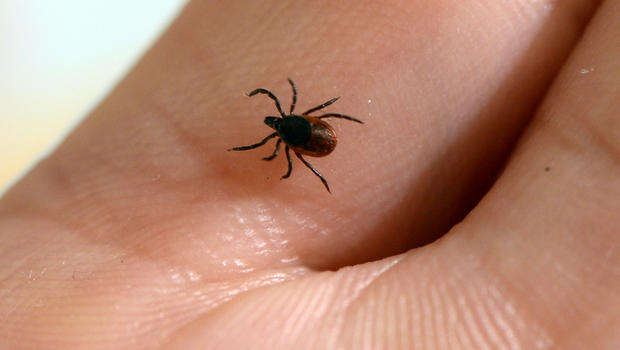
Yes, I recommend that after you go hiking or camping or are otherwise potentially exposed to ticks, that you always do a tick check. The ticks that are most likely to transmit the bacterium are young nymphal ticks. They’re about the size of a poppy seed, so they’re extremely small.

Ticks do not jump or fly. What they do is called “questing,” which means that they wait at the ends of grass or foliage and when you brush by, they’ll immediately latch onto your leg or onto your clothing. But you really need to conduct a tick check all over your body because you won’t necessarily get bitten by the tick where the grass contracted your leg. Ticks can crawl to your armpit or groin and bite there, for instance.

**Comment**  No ticks can’t jump or technically fly but they can drop down from trees.  Birds and rodents land on trees and leave ticks behind. Where do those ticks go?  They can also blow in the air due to strong winds, a lawnmower and/or leaf blower.  They’ve also been found on rocks, underneath picnic tables/benches, and even in caves: https://madisonarealymesupportgroup.com/2017/03/13/ticks-found-on-rocks/  and   https://madisonarealymesupportgroup.com/2017/10/27/israeli-kids-get-lyme-disease-from-ticks-in-caves/ and  https://madisonarealymesupportgroup.com/2018/04/23/tick-borne-relapsing-fever-found-in-austin-texas-caves/

A friend told me ticks blew into their swimming pool from nearby overhanging trees.  I personally had a farmer blow ticks onto my basement screens from his lawnmower.  Some made their way into my house and were crawling on the walls.  Researchers need to quit sounding so “all knowing” and admit there’s much we don’t know.  This TV News anchor got bit at a garden party on a deck with overhanging trees:  https://madisonarealymesupportgroup.com/2017/07/13/tv-anchor-speaks-out-about-lyme-disease/

What percentage of black-legged ticks carry Lyme?

It can be fairly high, anywhere from 2 percent to 15 percent among nymphal ticks in California, depending on the geographic location and season.

**Comment**  A lot more work needs to be done here before just spewing out numbers that sound insignificant.  Let’s put it this way – all it takes is one tick bite to side line you and even kill you.  Take each tick and each bite as seriously as a heart attack.

  • Ticks in California
    The western black-legged tick has been found in 56 of the 58 counties in California.
  • It is common in the humid north coastal areas and on the western slope of the Sierra Nevada range.
  • Ticks prefer cool, moist areas and can be found on wild grasses and low vegetation in both urban and rural areas.
  • Adult ticks climb to the tip of vegetation along trails and wait for a host to brush against them.
  • Nymphs are found in low, moist vegetation such as leaf litter and on logs.
  • Adults are most active from fall through early spring and the nymphs are active primarily in the spring and early summer months.
    Source: California Department of Public Health
How accurate are the current diagnostic tests for Lyme disease? And why do many cases remain undiagnosed?

The current approved testing for Lyme disease is a two-tier serologic test that looks for the generation of antibodies in response to the infection.

But the key limitation of the serologic test in early Lyme disease is that typically an infected individual may take several weeks before he or she is able to mount an antibody response. Therefore, in early Lyme disease, the test sensitivity is only about 30 to 40 percent.

Now after a person generates antibodies after three to four weeks, then the two-tiered serologic test tends to be very sensitive and is good for determining whether a patient was infected.

**Comment**  According to one of the most experienced LLMD’s in Wisconsin, some of the sickest patients NEVER test positive with two-tiered testing and due to the genetic variations, strains, etc., no test will ever be able to pick up all these pathogens infecting us.  Lyme/MSIDS is a clinical diagnosis and doctors need to wake up and become educated on this world-wide scourge.  They can start here:  https://madisonarealymesupportgroup.com/2017/09/05/empirical-validation-of-the-horowitz-questionnaire-for-suspected-lyme-disease/ and

https://madisonarealymesupportgroup.com/2018/06/06/lyme-education-for-healthcare-professionals/ and

https://madisonarealymesupportgroup.com/2018/02/19/calling-all-doctors-please-become-educated-regarding-tick-borne-illness-heres-how/

The take-home message is that we do not have an accurate test for early Lyme disease, and this is why the diagnosis is generally made clinically by a physician and also why there is so much underreporting.

**Comment** None of the testing for Lyme/MSIDS is good.  None.

If a patient presents with fever, a bull’s-eye rash, and during tick season with tick exposure, this, according to CDC criteria, is enough to make a diagnosis of Lyme disease. Part of the reason why laboratory testing isn’t an essential criterion for the diagnosis of Lyme disease is that we simply don’t have a test that is conclusive.

**Comment** There are so many who do NOT present with these symptoms it’s not even funny.  Again, become educated on symptoms and quit relying on outdated and unscientific information.

Your lab is working on better diagnostics for Lyme disease. How is your new test different?

The big area of clinical need is the ability to diagnose early Lyme disease before you can reliably detect it by antibody testing. Usually that window is zero to one month following the tick bite.

About two years ago, we did RNA sequencing of blood samples from patients with Lyme disease to look at the human host response. We looked at the pattern of gene expression in patients following infection, comparing the gene signature of Lyme disease to that for control patients. And we found that Lyme disease, interestingly enough, has a very distinct pattern of human gene expression in response to the infection.

We used this data in a follow-up study – which is currently unpublished – to develop a test with more than 90 percent accuracy in diagnosing early Lyme disease in patients presenting have a fever and rash, generally seven to 10 days after the tick bite.

It’s really a completely new category of diagnostic tests made possible because of advances in sequencing over the past several years.

What is currently the best standard of care for treatment of Lyme disease?

The standard of care for early uncomplicated Lyme disease recommended by the CDC is 10 to 21 days of doxycycline, which is an oral antibiotic that you take twice a day. Patients admitted to the hospital with severe complications of disseminated Lyme disease, such as meningitis or endocarditis, typically receive a two- to four-week course of an intravenous antibiotic such as ceftriaxone.

**Comment**  The question was what is the “best” standard of care?  This is like asking to demonstrate brain surgery in 3-easy lessons.  There is no best standard of care.  This complex illness presents differently on nearly everyone and the exact same drugs will NOT work for some.  People are infected with different things.  Lyme is just the rock star we know by name.  There are many other pathogens involved.  This is NOT a one pathogen one drug illness.  It’s a hodgepodge of things all working together synergistically.  Again, clinical diagnosis, and clinical treatment based on the individual should be the best standard of care.  Anyone saying otherwise is selling something.  The CDC has its head in the sand.

If you get Lyme disease once, can you get it again?

Yes, you can, because protective antibody immunity can wane after several years and you may also be infected by a different strain of Borrelia burgdorferi.

There’s a Lyme disease vaccine for dogs, why isn’t there one for humans?

There actually was a vaccine called LYMErix that was approved by the FDA in 1998. But four years later, it was withdrawn from the market. At the time, there were questions involving the safety of the vaccine, concerns raised by anti-vaccine groups, cost, burdensome vaccination schedule (three doses a year), uncertainty regarding efficacy and need for boosters, and low public demand.

**Comment**  These concerns were not raised by “Anti-vaxxers,” but by patients and doctors over legitimate, documented blow-back the vaccine directly caused. https://madisonarealymesupportgroup.com/2018/04/16/vl15-lyme-vaccine-another-fraud/ THIS VACCINE CAUSED 229 DEATHS, INCLUDING 43 SUICIDES

https://madisonarealymesupportgroup.com/2017/01/26/lyme-vaccine-to-be-tested-on-humans/  The biological mechanism hypothesis was that the outer surface protein A (OspA), which was the antigenic component of the LYMErix vaccine, induced autoimmunity in genetically susceptible individuals, including high levels of autoantibody to OspA in their synovial fluid.

Dr. Stricker states:
Another Lyme OspA Vaccine Whitewash
The meta-analysis by Zhao and colleagues comes to the conclusion that “the OspA vaccine against Lyme disease is safe and its immunogenicity and efficacy have been verified.” The authors arrive at this sunny conclusion by excluding 99.6% of published articles that demonstrate potential problems with the OspA vaccine.  Furthermore, the authors ignore peer-reviewed studies, FDA regulatory meetings and legal proceedings that point to major problems with OspA vaccine safety (1-3). This whitewash bodes ill for future Lyme vaccine candidates because it fosters disregard for vaccine safety among Lyme vaccine manufacturers and mistrust among potential Lyme vaccinees.

https://madisonarealymesupportgroup.com/2018/01/28/the-secret-x-files-the-untold-history-of-the-lymerix-vaccine/
https://madisonarealymesupportgroup.com/2018/04/16/vl15-lyme-vaccine-another-fraud/  Since 2008, more has come out about the ability of vaccines to reactivate latent infections: https://madisonarealymesupportgroup.com/2016/04/24/gardasil-and-bartonella/
https://madisonarealymesupportgroup.com/2017/12/02/scottish-doctor-gives-insight-on-lyme-msids/
This is an extremely important point to acknowledge as mainstream medicine STILL hasn’t even accepted the fact Lyme/MSIDS patients are often infected with far more than Lyme (Borrelia) to begin with. The current news that vaccines can activate even latent infections muddies and troubles the waters further and frankly spells doom to Lyme/MSIDS patients.  Personally, every single Lyme/MSIDS patient I know who has undergone vaccination has relapsed. That’s kind of a big deal.
This issue of problems with vaccines has exploded in recent years with new discoveries of contamination: https://madisonarealymesupportgroup.com/2017/10/15/vaccines-and-retroviruses-a-whistleblower-reveals-what-the-government-is-hiding/

I think that there are now some efforts underway to bring back either this vaccine or other vaccines onto the market, especially given the rise of Lyme disease. This is a disease that infects more than 300,000 people a year, so it’s certainly something for which a vaccine would be really helpful.

**Comment**  RUN AWAY, RUN FAR AWAY!  

Why do some patients with Lyme disease show persistent symptoms, even after being treated for the disease with antibiotics?

A small percentage of patients with Lyme disease – depending on the study, 5 to 15 percent – exhibit persistent symptoms after treatment, which can include chronic fatigue, muscle and joint pain, headaches, episodes of “dizziness” or blackouts, cognitive difficulties and/or arthritis. After six months, given significant impairment in quality of life, these patients may be diagnosed with PTLDS (post-treatment Lyme disease syndrome).

We don’t know the cause of PTLDS, or why some patients develop this. Some hypotheses are that the Borrelia burgdorferi bacterium causes persistent infection somewhere in the body or that the symptoms are due to an aberrant immune response to Lyme infection, such as autoimmune disease.

**Comment**  This 5-15% is a number that has been pulled out of thin air.  Everyone I work with has chronic symptoms:  https://madisonarealymesupportgroup.com/2018/02/24/one-million-predicted-to-get-lyme-in-2018-in-the-u-s/   Davidsson writes in his conclusion:
“I am convinced that the history books in the future will describe controversy that exists today regarding chronic Lyme disease as one of the most shameful affairs in medicine.”

As for this persistence “hypothesis,” there’s over 700-peer reviewed studies showing borrelia persistence:  http://www.ilads.org/ilads_news/wp-content/uploads/2015/09/EvidenceofPersistence-V2.pdf

https://madisonarealymesupportgroup.com/2018/04/13/chronic-lyme-post-mortem-study-needed-to-end-the-lyme-wars/

What do you see as the next step in Lyme disease research?

Part of the reason why we haven’t been seeing clinical trials, vaccines, or drugs for Lyme disease is that we don’t have an accurate diagnostic test, and we would have no way of monitoring, for instance, effectiveness of a prospective vaccine or drug therapy in a clinical trial. We really need the diagnostic test to guide our potential treatments or prevention methods for the bacterium. I think it’s really going to be the development of better diagnostics that will drive potential therapies forward.

A second critical next step is identifying why is it that a proportion of patients with Lyme disease exhibit persistent symptoms that can last for months to years. We need to identify both the cause of PTLDS and identify potential treatments.


Candida Summit – FREE

https://candidasummit.com/  (Go here to register and to see video)

Candida is a naturally occurring, yet “opportunistic” fungus.

With the right conditions, there’s no limit to where it will spread and, when rampant, it can cause intense sugar cravings, brain fog, bloating, depression, anxiety, digestive issues, low energy or worse…

…chronic diseases.

Learn to overcome candida and reclaim your health at The Candida Summit

WHY ATTEND?
Even though candida is an important part of your digestive process, if unchecked, it can cause serious damage to your health.

Certain lifestyle choices and/or illness can deplete the “good” bacteria in your body to create room for candida growth:
• Use of antibiotics
• A high sugar diet
• Allergies
• Years of drinking alcohol
• An immunosuppressive illness
• Use of NSAIDs
• Birth control

Evan Brand, your host, also suffered (and healed!) from candida, parasite infections and bacterial overgrowth. In his health practice, upwards of 95% of his clients have some degree of candida overgrowth — time and time again, he sees debilitating and mysterious symptoms disappear once candida overgrowth is addressed. Join us to learn more!

Learn to overcome candida and reclaim your health at The Candida Summit

The Candida Summit is online and FREE from July 9-15, 2018!


Study Conforms Permethrin Causes Ticks To Drop Off Clothing

https://www.cbsnews.com/news/tick-repellent-permethrin-clothing-really-works-study/?ftag=CNM-00-10aac3a

By AMY NORTON HEALTHDAY May 25, 2018, 11:49 AM

Study confirms this method of repelling ticks really does work

Tick bites can transmit Lyme disease.

BERTRAND GUAY / AFP/GETTY IMAGES

Outdoor enthusiasts: Here’s a bit of good tick-fighting news just in time for Memorial Day weekend and the unofficial start of summer. A new U.S. government study confirms that insecticide-treated clothes marketed for preventing tick-borne ills do, in fact, thwart the pests.

In lab tests of clothes bought from one manufacturer, researchers found that the garments either quickly caused ticks to fall off, or rendered them unable to bite.

The study involved three types of ticks that, in the United States, are major carriers of disease — including Lyme disease, Rocky Mountain spotted fever, and what’s known as southern tick-associated rash illness, or STARI.

The clothes were pretreated with permethrin, a synthetic form of an insect-thwarting compound from the chrysanthemum flower. It’s used in insecticide sprays and shampoos and creams that treat lice and scabies.

Several companies already market permethrin-treated shirts, pants, socks and other clothing, as a way to ward off disease-transmitting pests. The new study adds to evidence that the garments are indeed toxic to ticks, according to senior researcher Lars Eisen, of the U.S. Centers for Disease Control and Prevention.

“All tested tick species and life stages experienced the ‘hot-foot’ effect after coming into contact with permethrin-treated clothing,” Eisen said.

https://www.cbsnews.com/amp/embed/video/?v=d4e4a4f57f075b1307e6934846008d5f35c4c637#vVdrb9vGEv0rC35ov2glvkRSAgLDtZ2mSZqodl73RoWw5A7FjUgus7u0pBj%2B750lKSt2k5vitg1gg9Q%2BzsycefLGuRYcpDO%2FcXirmBGyduazYORUze4S8l%2B4M3cuvOfl6UfYvKqjD%2F4bFdbvzqrLp9Gz84%2F%2F2X98eZY6I8cUbZXWTJR4vDCm0fPlZDnJUl3DVvtjfBHaIHo2zmS1nBRtupyI5UQtJ77rJcuJG%2BIb%2Frs8DuMozakXujENvSmjSZhllLsRhDnkPPHd5eRO2nIShe4uiHDNj5PEzwFglscxn8ZZksQhTHkUxTxxg9TK8ENaACtNQVGTjaau2%2F3NqD%2Bj2oiydF2PetNpMHMTOiCPPzRra6BsRFazCtDAJx3GYXHBFNTmqmzX1vbDFjRCS46nvZGjgWlLq%2BM59se6wvP9hsos8UWp7SMVBh1gr7iuO3IaYbl%2FCefF%2Ft314nlw%2Bc5K3DdWA3tj5LTqQHfHtmgYRzMUsErU6%2FFAfk94BVwwfDS7h4x7vpf4Uzdw48TzepJWvRWrjqRVz8ds5f7PzXEVtIlzO7Kqra6ZEqw2q6aQNXzVtN3zT9tQ%2Fvfy8vStd8%2B0B%2Fe%2Ft6Gd1C%2FaY1hagvmqQW9mL39eXLLsQu0uvmzQAPC9LerF3pmkTNXcMyLGWD%2Ba8Vqt3n68arOE12%2BOZnSXDorfVKwWOWgzr5GrW7vXJ3wzS4IoGANfQ57pcQ1mOZE1BzzPl5MT1priEVr3AxN58%2Bga0%2B0HXWJleHTTPRYKcrG7vUmRiM1tv%2FZYlLBgprgdePi%2FKIhX8SwaV034APNoRx5Wt3fuGPin18WYbVjFRMF7Uz4tJz3CfG5UC%2FOclRpux5mubC06gI0R7IiMrP8FZPENZG1AdQ68A761rtyKXNx3pfXknSvjy9Pf3sW%2FXC52LzdHV3aX%2FhSDXG7rUjL%2BD0cfUh%2B6lvqHySTN1zNppz49O3%2BWPo1%2B%2Bu3sy5lkb3%2FvNEKZdzkUrO8p79%2BjfRFd1OfiyZ4pXx7VD9bfkXT%2FQDrqqttUZ0qkwM9kbbrmc4NtH7a2LDhdvH12SDl98I0coSMXicwVq7NCaLi3cbFD0%2B%2BthAnmr4UdVjvJTaNAY3ur27Ic9bOGEcaKdS4wqMmpRneSTneSKvQa6c0hSugNMZK8Hl%2BN7%2FHWjxbb7fY%2BZx30coKt1lBmQYce34Ee2r4FpUbSlurlxDbjvmv%2F5UtWkbZzcT4Nwzj2Ehom3pSGPGZ0BtGUxrPExYHFDb1g6gwGc9jgjVOCyhLdQCZAE5l3RpOCod0ANW5geAEnoiYv8NxTUBr2JJeKmAJILhSSZUQFI4KllMCuAWU0wdmDZLLOQNV41xTMEGFwpS05yZhSe8IIZ%2FUalGw1uRaq1WPy9uynK%2FrqzY%2BaXGDFAfJYoH%2BJgkYi5PigdaNkJQvoBsAdOi37ppfQ4Vjg5aJke2eOyYABkm3wsA03oS9qG278EG9MIVwJp9gRpLJj5nvHj1kIM9%2BlEUtS6nng0xn3fJzRvCSHhLlu6jq%2FP7j6opvJ3jsnJydk3WJd%2FOxEN72yMJxFQchpmGcRDdPYpwzRaJDkLvNw4PTATrDDlUWbnncZ7djEo%2B6U%2BlPiTefhbB5Oj8deDTGsTcv31gPooEqjA4QmFaBe3HoYKYWytHT11GFhKss94RIDYCvV5jO8vkRkfX6uhlXc55hR2WGbg97gzOnYfDuHa6skvjdsfThg02ElDFQ2tvH5RNh0fn8YS3%2FvV68g6%2Bf847hqlwcMzNdG1lpcA9l2zHRTbkdlkoRRErmMxtOEf81Bw4XeL0cJrQY1SGA4NOBKurlCqRY4CAIMl1JUAktTeEfKlWxVdgThGFZ4C6sRxxAzmBpVp9VQBlbWhtWRIvtzUGI40dFZybViTSGyZ7DXlpsPMn3c1j0jI%2FvrDP2%2FlsoKEzVvsZ%2FYVywyTYtNeKFkLjCF6%2Bywyur9lfhknbUGHHWU9eoafsaMa7oTbW0RkHuDZoi2sunQWJTyM92stvazobZexV1us6nLw9f%2FSuXLrBNExspvwts3%2FORCSNrHMwYoxepjwxwl0KyUGPYoqY9uagNb0y4xOkk2PP9dISe5YetHZy9%2BtV9znstYFrBB8BAAf98KoZ9gDb3rd12HXkj0GobNENZQYYfFhvsH

That, he explained, made the ticks drop off of “vertically oriented” clothes — which would simulate a pair of pants when a person is standing.

In addition, Eisen said, when the ticks were in contact with the clothes for up to five minutes, they lost their ability to move normally — and to bite.

There are still questions, he noted, including what types of clothing offer the best protection in the real world.

The CDC already recommends permethrin as one tactic for avoiding tick bites. It says that people can “treat clothing and gear, such as boots, pants, socks and tents, with products containing 0.5 percent permethrin.”

The agency further says that “pretreated clothing is available and may be protective longer.”

Thomas Mather is director of the University of Rhode Island’s Center for Vector-Borne Disease and its TickEncounter Resource Center.

He said the new findings, published May 24 in the Journal of Medical Entomology, offer more support for the tick-fighting garments.

“This can be a pretty effective way to stop ticks,” said Mather, who was not involved in the study.

In his own research, Mather found there are benefits even with permethrin-treated summer clothes that leave some skin uncovered — shorts, T-shirts, socks and sneakers.

His team had a group of brave volunteers watch a movie while allowing lab-raised, disease-free ticks to crawl on their bodies. Some wore regular clothes, some wore clothes with permethrin — either pretreated or with the insecticide added using home kits. Those wearing either kind of treated clothing ended up with far fewer live ticks on their bodies by the end of the movie.

https://www.cbsnews.com/amp/embed/video/?v=d4e4a4f57f075b1307e6934846008d5f35c4c637#zVdtb9u2Fv4rhD7sk2nrzZJsoAiapC9blzRN2mJtfWFQIiWxlkSVpGI7Qf77DinZjrsWu7i72xogkEXyvD3POYdH984tp0w483uHdpJoLhpn7kXByKnbzTXLf6bO3Nm%2B%2BXX2c0mvP5zzF3rzOnjz22V38apOMvfFM3YeR87I0WVXpw3hFRwvtW7VfDFZTLJUNWytgjH84EqD%2BmyciXoxKbt0MeGLiVxMfNdLFhN3Cv%2B%2BectJ6ns%2BTtyM4DD3I5zGXoynMaM5C6Yu8ePFZG9tMYlCdxNE7mIS01kynUW5T3Lfi%2BKIxknsUj8J83jKgllubLg%2BznSNayFF2hWpkA2jXDGi2BeCGyK7imBvOp0lboAHxePPbWHiEy3PGlIziO%2Fs9Aa9LblCF6CAN%2FvtKyJZo2%2BqroBDEDHWcMgYGw6xlitBQYM3coxRA7XjOealqEGy35CZIaOslHmkXAMpIDJ1zd%2FIabkhZEXW6%2Bbu%2Fe0XenpprG9b45eRGTmd3HFgKeAtoVhpyUgNXowHRnoWaoiewKPdfE2D5%2FvBLAingZcESY%2Fc8uztxfLi9fXr0644Ncid98i9ebq8tMgte%2BTiJfj6P4iM66BLnIeRCWN5SyQnjV62pWjYERDeIxiuNy%2FLZf2Lv9TnyyMYvpL%2FEUCxnnwzRk3SiunvBuneUu4tf0mffvzIvx3koOBHiLJ3ZR%2Bm1HV7FFgMVXUIbXtBL1evni8%2FiFAdQrNCu2Dua9LwnCk9bwC%2FB7PXd5Z2lgRRMGa0YHmmxg3Ti4loKIPzdDE5IZ0un0DEPxGet09uXdf7SVXQgp7c28eVZDnfPNynAM7qoV97zit2RXT5MGDzf4PFXcazaFy34Vd2DrHlYf2wp23gCd%2BWY7IiNeEl7cO7W0x6DfO5lh2b56RS7GGcqdo0wp2yMSg7aAYm%2FgvN%2FE80K82kJXWv%2BMHQu%2BY5P6Y3fNylruMPHr27Jpwm8YFeK%2FSHXKVi3VSC0H8gS4GO0DV0mBCC4igA%2FyiAdx837uy9%2F%2F56GweHAILiX3bfP7j%2FuA0I%2Ff0mUiv3bvNM3EZXNPp2EzHSP0IHAT%2BG9gHhqS5VmeQpo2ei0faKvIeBha1Nm3Fsrj46JJ0%2BcUcOV5ELHueSNBncwexo49kGADpaCRPoB0btsGott61kCi7hpquqUT8laa6NWeeUlbyhSJcMqU4WDPEGDXOEQgrkCEXpFtVCfem4FkyNEEw%2BK3jkFRw6wrkflNbr9TG61t5iklpLMEgwbC1h3uCdJdxbwukWHyxhawhbO4uJmS36ceQvKTIOdzaPqOf6Uz8mOJj5UxxmNMMzmuc4j0CBFzCSuSa%2FrPeUrUDiKYKg0Nn5GZKsFVIrlIMjyoLXwBTHJBI5aploK4bWpUAF00iBbZRLUe8x7BFE0NwthgiyHLDmO7ghO5EkkOvVdowuecOs1W9wwhvFMg1M8CarOiv3ka%2BIVQypsuqaomu2ZITWTLLBZQY2hbQe51wqDa7UlnOz8m58M0bncozeEklQn8zoswA7aPGHSXHhIC2MW1mnFCrF2ry2UmjwCW1FJxWr8vEOQNioRckM7lA22I6rj2IyNJoeAFeduKrI1plDuUNqZyszbkKhcPWsMYVCd5VCJIBYsadwNwppJvtPDnAZspnv4ogkKfY85gOhMH7DhZnkLCGum7rOf74SvbRz8Cfn5OQEFR3cBo9O2A8GEoazKAgpDPBZhMM09jEBbThIcpd4Lo09ljp7kasuPbcdyzF9BLtT7E%2BRN52Hs3k4PRx7O1Sf0h3dokw0QEZtEgnwrRn4RU0mAWWsqgyvNoHhnVTVFlFIabQWcvVIX98Es76zLIdV2KfQC7LdNmVqBdO9YzrFObs1TsLvlhS7A6Zml5CNtSk2eL7kphF9ckowrEuDjFm9AYbtt9VuvV8edECnaUWj%2BC2UgEXGfk9YKJMkjJLIJTieJvR7BA0CPS8HC51icrBAYHyClXR1A1aN4iAIIF0qXnNoquEelBtIwuyghEJagRT0UQoppqEMauvV0KuWJoblASLzOjgxnLBw1qKA4ix59optlcHms0ifd02PyMi8nQH%2FhZDGGHSHDq4c8xM6YdvB6HElRc4zzppst0qa7Q2%2FM2QVDIY%2BaVgt2Asputae6BqjAbDXEAbvalMOrdFSPfLNeGs%2ByxrDKuxSU0228t79Y%2B05M8TwjFR%2FatL8gi9fkMd9jkPS4pZJk%2FoS7GaVgFJoCtxnPDbJDk6YYrGWTMr%2BvUZOck2KJ2eXF5Cc2HMJyQIyGB6S4q9HwdVLJsX%2B9rZDyJUAJiGVhlRncKkAlQ%2B%2FAw%3D%3D

While people can use permethrin on their regular clothes, the pretreated garments hold up to many more washings, according to Mather — up to 70.

Some people may be wary of chemically treated clothes. But, Mather said, the amount of permethrin in clothing is very low: A solution containing only 0.5 percent of the pesticide is “dried into” the fabric.

According to the U.S. Environmental Protection Agency, research indicates that permethrin is “poorly absorbed” through the skin, and there’s no evidence that treated clothing could be harmful to children or pregnant women.

U.S. military members have been using permethrin-treated uniforms since the 1990s, the EPA noted. According to Mather, the garments may also be a good bet for people whose jobs keep them outdoors — or for gardeners or anyone else who spends time in places where tick exposure is a concern.

Eisen pointed to some other CDC-recommended ways to cut the risk of tick-borne ills:

  • Avoid wooded and brushy areas with high grass and “leaf litter”;
  • walk in the center of outdoor trails;
  • use EPA-registered repellents containing ingredients such as DEET, picaridin or oil of lemon eucalyptus;
  • thoroughly check your body and clothes for ticks after being outdoors; and
  • shower within two hours of coming back indoors.

Lyme in California – What You Need to Know

http://bakersfieldnow.com/news/local/lyme-disease-in-california-what-you-need-to-know

Lyme disease in California: What you need to know

by Emma Goss, Eyewitness News

f844e6d4-2904-45f8-b034-69a372b5db19-large16x9_ESPINOZA_LYMEDISEASE_0027_frame_5778

Bakersfield City Councilman Chris Parlier has been battling Lyme disease for almost 20 years. (KBAK/KBFX)

BAKERSFIELD, Calif. (KBAK/KBFX) – Lyme disease, widely thought to be an east-coast illness, is widespread across California, and growing rapidly.

The disease often gets misdiagnosed and goes under reported, but researchers say Californians and doctors need to be aware.

Chris Parlier is a Bakersfield City Councilman, and father of two. He has been battling Lyme disease for almost 20 years.

A former cop and special agent for the California Department of Justice, Parlier went investigating a suspected meth lab in the mountains of Tick Canyon between Santa Clarita and Palmdale in the late 1990’s.

“I thought that if I was ever going to get injured in the line of duty, maybe I’d get shot, a car wreck, some sort of exposure at a methamphetamine lab,” Parlier said. “But never in my wildest dreams would I think that a tick would get on me and cause such a horrific illness.”

A few weeks later, he came down with what seemed like the flu. When he noticed a rash on his upper thigh, he visited a Bakersfield doctor.

Observing the Erythema Multiforme rash, often called the “bull’s-eye rash”, and Parlier’s other symptoms of muscle and joint pain, Parlier was diagnosed with Lyme disease.

“It started with losing feeling in parts of my limbs, my left side of my body, especially my left leg, my left arm. I started getting involuntary muscle response, my hand would move by itself sometimes, and my leg would do that too. And it got to the point my speech started being impaired and my walking started to be impaired,” Parlier said.

Parlier sought treatment from a specialist at UCLA, and after a year of aggressive antibiotics and protracted therapy, his strength came back. Parlier considers himself lucky to have caught it.

Fewer than half of Lyme disease cases ever show the bull’s-eye rash, and the symptoms of the disease mimic other diseases that lead to frequent misdiagnosis.

There are over 100 strains of the bacteria that cause Lyme disease, but the standard test doctors give won’t detect all of them, and researchers say as many as half of Lyme cases go undetected.

“The testing that we have is fairly antiquated, it’s an old technology,” Dr. Sunjya Schweig, co-founder and co-director of the California Center for Functional Medicine, said. “No better than flipping a coin.”

Lyme disease infects 300,000 Americans a year, and it’s thought to be most prevalent in the Northeastern United States, according to the Center for Disease Control. But it’s a rapidly growing threat in California, where tick season isn’t just in spring and summer, it’s all year round.

“The real number in our state that has 40 million people, is probably in the thousands,’ Dr. Raphael Stricker, a Lyme disease specialist and medical director of Union Square Medical Associates, said.

Lyme disease cases have been found in 56 out of 58 counties in California. Kern county only has 21 reported cases, but its proximity to Los Angeles, San Diego, and Sonoma, all hot spots for Lyme disease, put Kern residents at a higher risk.

Why the sudden uptick? Experts suggest that people living in closer proximity with nature and building homes in more areas that used to be rural are factors leading to more humans exposed to ticks.

To protect yourself, doctors recommend frequent tick checks after spending time outdoors, using tick repellents, and choosing light-colored clothing that doesn’t expose your skin to ticks.

Anyone worried that they already have Lyme disease but haven’t gotten a confirmed diagnosis should ask for more thorough testing for other bacteria, and ask a doctor to test for other tick-borne infections.

The International Lyme and Associated Diseases Society encourages doctors to begin antibiotic treatment for patients they suspect could have Lyme disease based on a clinical assessment of their symptoms, even if they don’t test positive for the disease.

Parlier still gets an immunoglobulin injection every month to support his immune system, but lives a relatively normal, active life, serving the Bakersfield community.

“I realize that the illness may never go away completely,” Parlier said. “But there will still be joy in my life.”

______________

More on Lyme in California:  https://madisonarealymesupportgroup.com/2018/05/19/infected-ticks-in-california-its-complicated/

https://madisonarealymesupportgroup.com/2017/08/07/california-lyme-cases-get-no-respect/

https://madisonarealymesupportgroup.com/2018/02/02/miyamotoi-in-ixodes-pacificus-in-california/

https://madisonarealymesupportgroup.com/2018/02/15/b-miyamotoi-in-ca-ticks-for-a-long-time/

https://madisonarealymesupportgroup.com/2018/02/14/borrelia-miyamotoi-in-ca-serodiagnosis-is-complicated-by-multiple-endemic-borrelia-species/

https://madisonarealymesupportgroup.com/2017/10/09/bb-in-california-chipmunk-and-squirrels/

https://madisonarealymesupportgroup.com/2011/09/25/putting-lyme-behind-you-questions-and-answers-with-california-lyme-doctors/

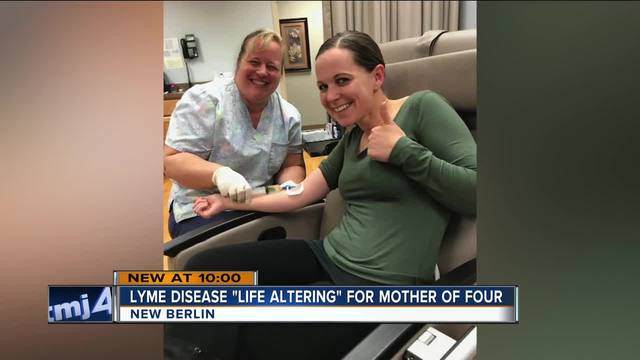
New Berlin Mom Given “Life-altering’ Lyme Disease Diagnoses After pregnancy

https://www.tmj4.com/news/local-news/new-berlin-mom-given-life-altering-lyme-disease-diagnoses-after-pregnancy  (Go here for News Video)

New Berlin mom given ‘life-altering’ Lyme Disease diagnoses after pregnancy

“My right knee will hurt and sometimes my right wrist will lock up,” said Mabry.

All her symptoms could be explained away. Mabry was in the middle of writing a children’s book, “Hi It’s me! I have ADHD” and she was about to have her fourth child.

“I said, ‘I’m exhausted because I’m pregnant. My knee hurts because I did too much today,'” said Mabry.

But the reality was much more serious. After her son was born she found out she had Lyme Disease, a bacteria transmitted through tick bites that could lead to swelling of the brain and heart.

“Internally you feel like something is eating away at you. You feel like you have the flu, you just ran a marathon. You’re fatigued. Like right now I’m experiencing hot and cold,” said Mabry.

Her doctor thinks Mabry got it last summer, likely from the forest preserve by her house. And she’s not alone. Since 2004, Lyme Disease has tripled. Latest numbers show Wisconsin ranks fourth in reported cases. Mabry’s diagnosis means daily antibiotic IV treatments.

“It’s life-altering,” said Mabry.

Though there is a chance her pain and other symptoms might never go away.

“I’m generally a positive person. And I am trying so hard to stay positive but when you feel awful so often it’s hard sometimes,” said Mabry.

Experts recommend that you wear long sleeves and pants if you are going to be out in long grass or in wooded areas where ticks are likely to be. They also suggest you use an insect repellant with at least 20 percent DEET.

For more information about how to prevent tick bites, visit the CDC’s website.

_______________

**Comment**

There are numerous things about this article that I’m thankful to see:

  1. Many don’t see the tick or rash.  In fact, fewer than 50% recall a tick bite or a rash:  http://www.ilads.org/lyme/about-lyme.php
  2. It’s quite normal for patients to blame previous injuries, stress, and other things for their symptoms, only the symptoms progress and worsen.  Never let a doctor discount your symptoms.  Be your own advocate.  Lyme/MSIDS is the great imitator and looks like 300 different diseases.
  3. It is common for pregnancy to worsen symptoms.  While the CDC/IDSA/NIH deny sexual or breast milk transmission, they admit it can infect the placenta and cause possible still-birth.  There is actual science on congenital transfer: http://www.researchfraud.com/fetal-lyme-borreliosis/  (Two listed below but this link as a gad-load more)

However, there are some things that need to be addressed.

We need “experts” to start acknowledging and factoring in coinfections and that patients are rarely infected with just borrelia, the causative agent of Lyme Disease:  https://madisonarealymesupportgroup.com/2017/07/01/one-tick-bite-could-put-you-at-risk-for-at-least-6-different-diseases/  (The actual number is 18 and counting…..)

We desperately need transmission studies on virtually everything.  I’m so tired of hearing “experts” repeat ancient, 30 year old mantras that Lyme is not spread in any other way than the dastardly black legged tick.  There’s just too much evidence to the contrary!

Willy Burgdorfer, the discoverer of Lyme, stated:  “… now we had found a spirochete capable of spreading transplacentally to the organs of the fetus, causing congenital heart disease and possible death of the infant [42] ;  REVIEWS OF INFECTIOUS DISEASES • VOL. 8, NO.6· NOVEMBER-DECEMBER 1986

and

“We report the case of a woman who developed Lyme disease during the first trimester of pregnancy. She did not receive antibiotic therapy. Her infant born at 35 weeks gestational age, died of congenital heart disease during the first week of life. Histologic examination of autopsy material showed the Lyme disease spirochete in the spleen, kidneys, and bone marrow. An autopsy of the infant showed widespread congenital cardiovascular abnormalities. … There was no evidence of inflammation …”  Schlesinger PA et al.  Ann Intern Med 1985;103:67-8

As to sexual transmission, Dr. Rawls, OBGYN states it’s possible:  https://rawlsmd.com/health-articles/can-lyme-be-sexually-transmitted

As to sexual, congenital and transmission via breastmilk, Dr. Howenstein states:  http://www.samento.com.ec/sciencelib/4lyme/Townsendhowens.html  “There is compelling evidence that Lyme disease (LD) can be spread by sexual and congenital transfer. One physician has cared for 5000 children with LD: 240 of these children were born with the disease. Dr. Charles Ray Jones, the leading pediatric specialist on Lyme Disease, has found 12 breastfed children who have developed LD. Miscarriage, premature births, stillbirths, birth defects, and transplacental infection of the fetus have all been reported. Studies at the University of Vienna have found Bb in urine and breast milk of LD mothers.

Researchers at the University of Wisconsin have reported that dairy cattle can be infected with Bb, hence milk could be contaminated. Bb can also be transmitted to lab animals by oral intake such as food.”

Also read:  https://madisonarealymesupportgroup.com/2017/02/24/pcos-lyme-my-story/

Researchers need to quit clamoring about climate change and start doing legitimate, current, transmission studies!  

https://madisonarealymesupportgroup.com/2017/08/14/canadian-tick-expert-climate-change-is-not-behind-lyme-disease/  “The climate change range expansion model is what the authorities have been using to rationalize how they have done nothing for more than thirty years. It’s a huge cover-up scheme that goes back to the 1980’s. The grandiose scheme was a nefarious plot to let doctors off the hook from having to deal with this debilitating disease. I caught onto it very quickly. Most people have been victims of it ever since.” This quote was given by none other than independent tick researcher, John Scott.