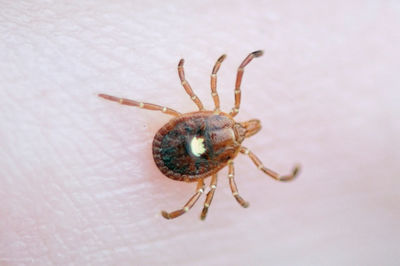
Archive for the ‘Transmission’ Category

Webinar Series to Highlight Tick Problems and Solutions for Pennsylvania

https://news.psu.edu/story/624662/2020/07/01/impact/webinar-series-highlight-tick-problems-—-and-solutions-—-pennsylvania

Webinar series to highlight tick problems — and solutions — for Pennsylvania

Tick webinars
Penn State Extension is hosting a 10-part webinar series on ticks.

IMAGE: PENN STATE

Kelly Jedrzejewski
July 01, 2020

UNIVERSITY PARK, Pa. — Did you know that Pennsylvania is ranked No. 1 in the nation for Lyme disease cases? As part of Penn State Extension’s efforts to educate and share information, educators will be hosting a 10-part webinar series on ticks and disease prevention starting July 9 and running through Sept. 17.

Erika Machtinger, assistant professor of entomology, is part of the extension team that will be hosting the webinar series.

“Since ticks are a major concern in the commonwealth, the idea is that folks will get a basic and understandable foundation for how to protect themselves, their families and their animals from vector-borne diseases,” she said.

Penn State Extension piloted a workshop for vector-borne diseases in the fall that was successful. Machtinger explained that an in-person workshop was scheduled for May but had to be canceled due to concerns about the coronavirus pandemic.

“We wanted to continue the series because of the prevalence of vector-borne diseases in Pennsylvania,” she said. “We also thought it was fitting because people might be spending more time outside.”

In Pennsylvania, several species of ticks are of concern to both people and animals, and several pathogens are associated with those ticks. Along with native ticks, there are concerns about an invasive tick species and its impact on cattle.

“We’ve put together a great team to deliver this series, from insect taxonomists to integrated pest management specialists to wildlife biologists,” said Machtinger. “We’ll be delivering the spectrum of information from many angles.”

Each webinar is one hour and will take place at 2 p.m. and 6 p.m. on the scheduled dates. The webinars, which will be recorded for later viewing, include ample time for moderated question and answer sessions.

To register, visit http://extension.psu.edu/tick-webinars.

Dates and topics are as follows:

–July 9: “Vector-borne Disease Basics.”

–July 16: “Ticks of Pennsylvania.”

–July 23: “Protecting Pets from Tick-borne Diseases.”

–July 30: “Tick Biology.”

–Aug. 6: “Tick Protection Around the Home.”

–Aug. 13: “Protecting Yourself from Tick Bites.”

–Aug. 27: “Lyme Disease and Other Tick-borne Diseases in Pennsylvania.”

–Sept. 3: “Tick Risks for Pennsylvania Cattle.”

–Sept. 10: “Protecting Your Horses from Tick Bites.”

–Sept. 17: “Hunters and Vector-borne Diseases: A Tick-ing Time Bomb.”

“Education on vector-borne diseases is an incredibly powerful tool to help protect people and animals,” Machtinger said. “Understanding the tools that you need to have in your toolbox to prevent tick and mosquito bites can reduce anxiety about being outdoors and make a difference in reducing vector-borne disease risk.”

MEDIA CONTACTS


Interrupted Blood Feeding in Ticks: Causes and Consequences

https://pubmed.ncbi.nlm.nih.gov/32560202/

Interrupted Blood Feeding in Ticks: Causes and Consequences

Affiliations expand

Free article

Abstract

Ticks are obligate hematophagous arthropods and act as vectors for a great variety of pathogens, including viruses, bacteria, protozoa, and helminths. Some tick-borne viruses, such as Powassan virus and tick-borne encephalitis virus, are transmissible within 15-60 min after tick attachment. However, a minimum of 3-24 h of tick attachment is necessary to effectively transmit bacterial agents such as Ehrlichia spp., Anaplasma spp., and Rickettsia spp. to a new host. Longer transmission periods were reported for Borrelia spp. and protozoans such as Babesia spp., which require a minimum duration of 24-48 h of tick attachment for maturation and migration of the pathogen.

Laboratory observations indicate that the probability of transmission of tick-borne pathogens increases with the duration an infected tick is allowed to remain attached to the host. However, the transmission time may be shortened when partially fed infected ticks detach from their initial host and reattach to a new host, on which they complete their engorgement.

For example, early transmission of tick-borne pathogens (e.g., Rickettsia rickettsii, Borrelia burgdorferi, and Brucella canis) and a significantly shorter transmission time were demonstrated in laboratory experiments by interrupted blood feeding.

The relevance of such situations under field conditions remains poorly documented.

In this review, we explore parameters of, and causes leading to, spontaneous interrupted feeding in nature, as well as the effects of this behavior on the minimum time required for transmission of tick-borne pathogens.

____________________

**Comment**

Partial feeding is not rare and needs to be taken into account. Unfortunately, authorities have followed a tightly controlled narrative when it comes to transmission times – which has only served to hurt patients for decades.

There are cases where Lyme (borrelia) has been transmitted within hours:  https://madisonarealymesupportgroup.com/2016/12/07/igenex-presentation/

Excerpt:

Bob Giguere of IGeneX states a case by Dr. Jones of a little girl who went outside to play about 8:30a.m. and came inside at 10:30 with an attached tick above her right eye.  By 2 o’clock, she had developed the facial palsy.  At the hospital she was told it couldn’t be Lyme as the tick hadn’t been attached long enough.  They offered a neuro-consult…..

By 4pm she couldn’t walk or talk.

Do not believe what the “experts” tell you about transmission times!

Authorities also talk about ticks having a “grace period” before they transmit which is hog-wash:  https://madisonarealymesupportgroup.com/2020/03/10/grace-period-for-ticks-nope/

For more:  https://madisonarealymesupportgroup.com/2017/04/14/transmission-time-for-lymemsids-infection/

https://madisonarealymesupportgroup.com/2019/04/26/three-strains-of-borrelia-other-pathogens-found-in-salivary-glands-of-ixodes-ticks-suggesting-quicker-transmission-time/

https://madisonarealymesupportgroup.com/2019/11/14/study-shows-ticks-can-transmit-rickettsia-immediately/

https://madisonarealymesupportgroup.com/2017/06/28/powassan-can-kill/


RMSF Rare in NJ But Spreading Elsewhere

https://www.sciencedaily.com/releases/2020/06/200625124939.htm

Dangerous tick-borne bacterium extremely rare in New Jersey

The mystery behind the rise in spotted fever cases continues

Date:  June 25, 2020
Source:  Rutgers University
Summary:
There’s some good news in New Jersey about a potentially deadly tick-borne bacterium. Researchers examined more than 3,000 ticks in the Garden State and found only one carrying Rickettsia rickettsii, the bacterium that causes Rocky Mountain spotted fever. But cases of tick-borne spotted fevers have increased east of the Mississippi River, and more research is needed to understand why.  (See link for article)

______________________

**Comment**

Important quote:  

“CDC researchers recently found that the invasive Asian longhorned tick, like the American dog tick and lone star tick, is an efficient vector of Rickettsia rickettsii in the lab,” said senior author Dina M. Fonseca.

I’m surprised they didn’t mention that the brown dog tick has outbreaks in Mexico.

This is worrisome because the brown dog tick is more likely to bite people and it adapts easily to living in a house.. Researchers worry it may be spreading to California and the Southern U.S.  It also appears to transmit a more virulent form of RMSF: https://madisonarealymesupportgroup.com/2018/08/16/new-tick-causes-epidemic-of-rmsf/

For more:  https://madisonarealymesupportgroup.com/2020/05/05/asian-longhorned-tick-able-to-transmit-rmsf-in-lab-setting-also-transmitted-within-ticks-through-ova/

https://madisonarealymesupportgroup.com/2019/07/25/kentucky-more-than-two-dozen-rocky-mountain-spotted-fever-cases-reported-in-grayson-county/

https://madisonarealymesupportgroup.com/2020/06/30/rocky-mountain-spotted-fever-can-be-deadly-how-to-prevent-diagnose-treat-it/

Bourbon Virus? New Tick-borne Disease May Be in North Carolina

https://www.journalnow.com/news/local/bourbon-virus-new-tick-borne-disease-may-be-in-north-carolina/article_

Bourbon virus? New tick-borne disease may be in North Carolina

HCQ Breakthrough: ICMR Finds It’s Effective in Preventing Coronavirus, Expands Its Use

https://theprint.in/health/hcq-breakthrough-icmr-finds-its-effective-in-preventing-coronavirus-expands-its-use

HCQ breakthrough: ICMR finds it’s effective in preventing coronavirus, expands its use

Three studies find that hydroxychloroquine reduces chances of contracting Covid, so ICMR allows more frontline workers to take it as a preventive drug.

22 May, 2020 

New Delhi: The Indian Council of Medical Research (ICMR), the country’s apex body in the field, has found that consuming the drug hydroxychloroquine reduces the chances of getting infected with Covid-19.

As a result, ICMR released an advisory Friday to expand the usage of HCQ — an anti-malarial drug — as a preventive treatment against the novel coronavirus.

The conclusion has been drawn on the basis of three studies conducted by the ICMR.

The advisory suggests surveillance workers, paramilitary and police personnel, as well as medical staff working in non-Covid hospitals and blocks to start consuming the pill as “preventive therapy”.  (See link for article)

____________________

For more:  https://madisonarealymesupportgroup.com/2020/06/06/fraudulent-hcq-covid-19-study-in-lancet-exposed/

https://madisonarealymesupportgroup.com/2020/06/01/rebuttal-on-huge-hcq-study-in-lancet/

https://madisonarealymesupportgroup.com/2020/05/22/new-study-hcq-zinc-greatly-reduces-covid-19-health-risk/

https://madisonarealymesupportgroup.com/2020/04/24/dr-oz-interviews-dr-didier-raoult-on-hydroxychloroquine-study-for-covid-19/

https://madisonarealymesupportgroup.com/2020/05/11/podcast-evidence-supporting-hcq-azithromycin-for-covid-19/

https://madisonarealymesupportgroup.com/2020/03/27/the-truth-about-hydroxychloroquine-plaquenil-in-the-treatment-of-covid-19/