There are very few headlines that catch my eye. This one was surprising but not unexpected, since ticks are known to spread via travel on birds (and air travel has become more expensive these days, as I just found out after booking several flights). Here is the news release that made me pay more attention:
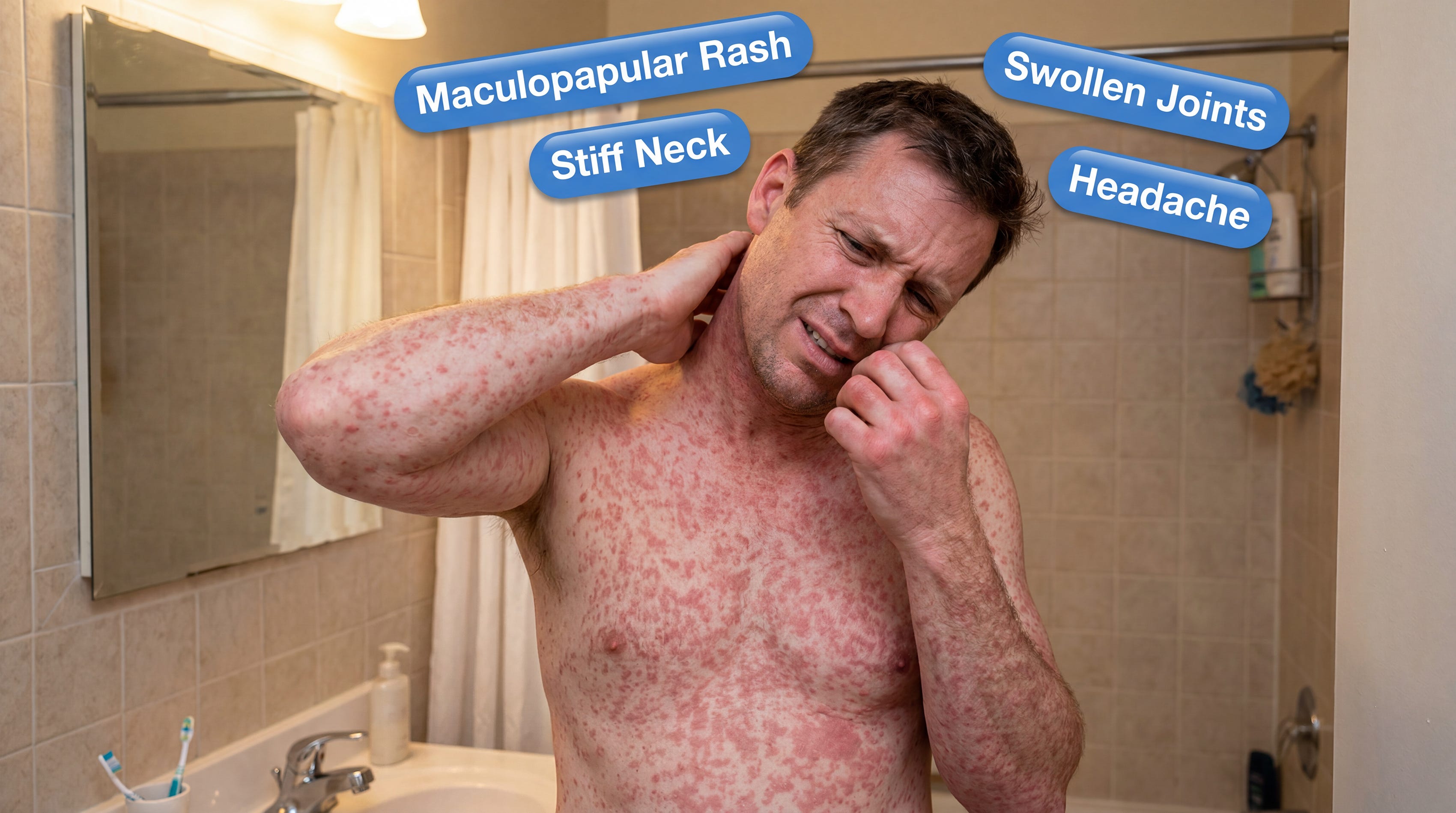
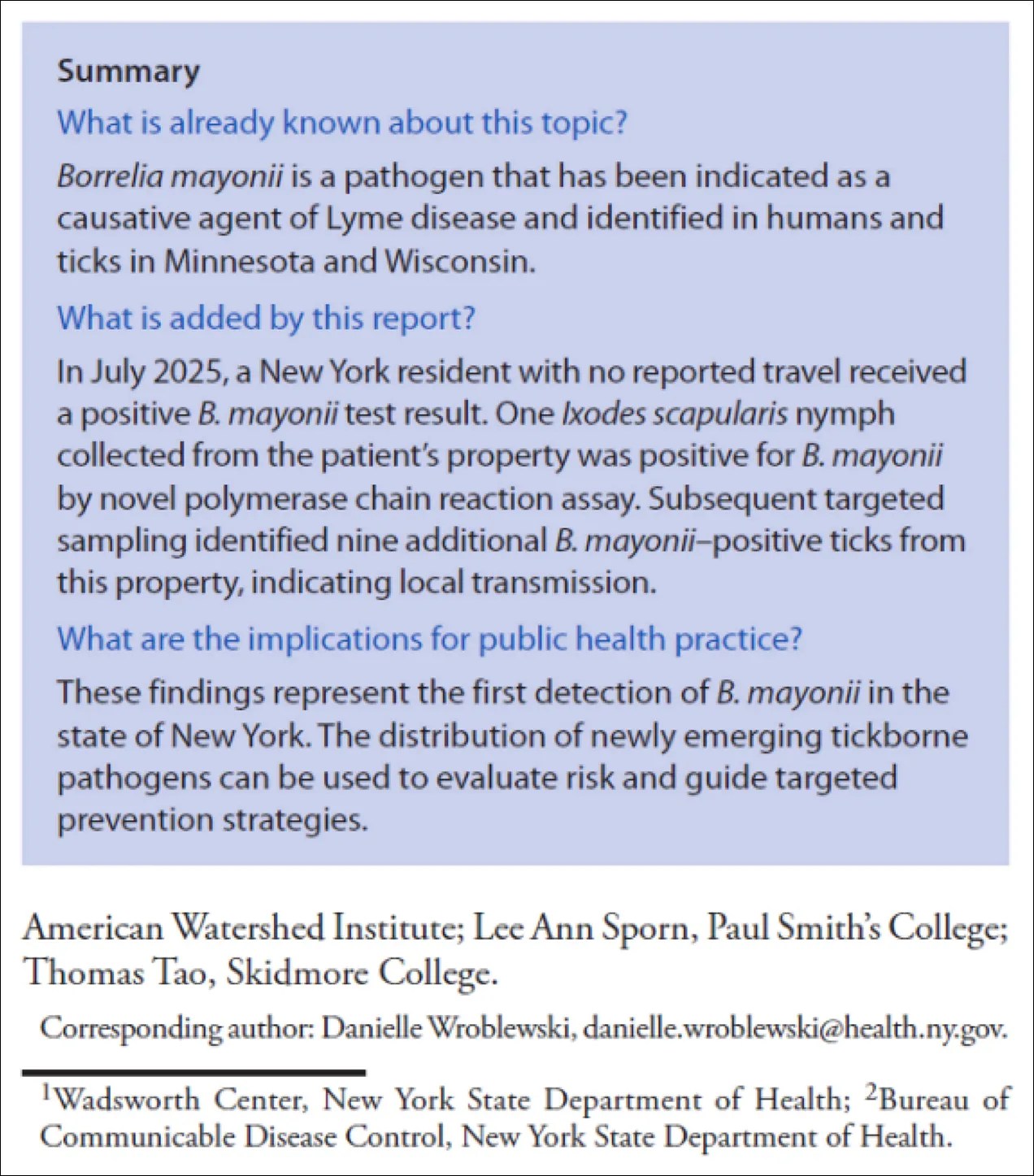
So what exactly is the ‘new type of Lyme disease (LD)’? It’s a strain of LD that is not normally found in NY State. Its Borrelia mayonii. The CDC just reported on it in their MMWR report. Here is a brief summary:
[From: Nafiz TN, Prusinski MA, Gubbala S, et al. Notes from the Field: Borrelia mayonii Lyme Disease — New York, 2025. MMWR Morb Mortal Wkly Rep 2026;75:271–272. DOI: http://dx.doi.org/10.15585/mmwr.mm7521a2]
This is an important case study, because B. mayonii clinically presents differently than an infection with Borrelia burgdorferi (Bb), so we need to understand how to properly diagnose and treat it if it is being found in new areas. (See link for article)
________________
**Comment**
Dr. Horowitz points out that the rash with B. mayonii is not the ‘classic’ rash seen with Bb, which isn’t so classic either, and highly variable – although it’s completely diagnostic, proving infection – no testing even required. If you have the rash, you are infected, period.
But there is concern for more severe systemic illness with B. mayonii due to a high level of spirochetes in the blood.
Nicolas Hulscher is an epidemiologist and administrator at the McCullough Foundation. He earned a Master of Public Health degree with a specialization in epidemiology at Michigan School of Public Health. He has contributed to the publication of more than 25 scientific studies, advancing understanding of COVID-19 vaccine injuries, childhood vaccine injuries, cancer treatments, SARS-CoV-2, and H5N1 avian influenza. Follow at https://x.com/NicHulscher
Dr. Kelly Victory is Chief of Emergency & Disaster Medicine at The Wellness Company. A trauma and emergency specialist with over 30 years of experience, she served as Chief Medical Officer for Fortune 500 companies and is an alumna of Harvard’s National Preparedness Leadership Initiative. She is a contributing author of “Toxic Shot: Facing the Dangers of the COVID Vaccines.” Find more at https://x.com/DrKellyVictory
Scroll to about 22 minutes to hear about Alpha Gal.
1:01:17 – Big Pharma Flags Highly Popular Cancer Research Study
GMO Mosquitoes, Weaponized Ticks & Brain Chips: The 6G Control Grid Exposed w/ Nicolas Hulscher
Google just filed to release 64 million bacteria-infected mosquitoes across California and Florida, alpha-gal syndrome has surged 10,000% since 2013 making people violently allergic to red meat, and 6G, the network being quietly built right now, is designed to interface directly with brain chips inside the human body. In this episode, epidemiologist Nicolas Hulscher of the McCullough Foundation connects all of it: engineered insects, tick-borne bioterrorism, the Gates Foundation’s fingerprints across both, and the transhumanist control grid being assembled in plain sight.
https://madisonarealymesupportgroup.com/2025/02/07/cancer-disappeared/ True to form our public health authorities not only banned ivermectin for COVID, which also just happens to be working against cancer, they now are currently ignoring it for screwworms – which are parasitic worms – exactly what ivermectin is used for globally on both animals and humans.
Dr. Nicolas Hulscher, epidemiologist, discussed how lone star ticks cause alpha-gal syndrome, an allergy to red meat, and suggested “serious investigations” be conducted.
Hope stems from the fact HHS announced a new public private collaborationwith ILADS – the only physician organization that recognizes Lyme can be a chronic, persistent infection. This group also trains doctors and connects patients with experienced providers.
HHS Deputy Assistant Secretary Dr. Stephanie Haridopolos never answered the question in the second video about ticks being dropped all over farms as many on social media are reporting. Crickets……
Just to be clear, our government has a long sordid history of experimenting on ticks, stuffing them with numerous pathogens, and then dispersing them out of airplanes:
COVID forced the public to ask whether a pandemic could come from a lab. Now, years later, Congress is hearing testimony about a COVID lab-leak coverup, and Tulsi Gabbard is reportedly investigating more than 120 U.S.-funded foreign biolabs.
Experts Warn Lab Leaks ‘Surprisingly Common’ After NIH Confirms Possible Exposure to Deadly Virus at Montana Lab
An employee at Rocky Mountain Laboratories in Montana was potentially exposed to Crimean-Congo hemorrhagic fever following a personal protective equipment breach in November 2025, according to the National Institutes of Health. The incident highlights the lack of a centralized federal system to track all laboratory incidents across agencies and institutions.
This article was originally published by The Defender — Children’s Health Defense’s News & Views Website.
A Rocky Mountain Laboratories employee in Hamilton, Montana, may have been exposed to Crimean-Congo hemorrhagic fever (CCHF) in November 2025 after an accidental breach of personal protective equipment, according to the National Institutes of Health (NIH).
The incident was reported to NIH in February 2026, according to internal communications referenced in documents shared by White Coat Waste.
NIH officials said the employee did not become infected, and no transmission occurred.
“The employee was immediately isolated and monitored under appropriate care at a specialized medical facility before it was confirmed that no actual exposure or transmission had occurred,” NIH said in a statement. “At no time was there any risk to the public or to other staff.”
What is Crimean-Congo hemorrhagic fever?
CCHF is a rare but potentially fatal viral disease spread primarily through infected tick bites or contact with the blood and bodily fluids of infected animals or people, according to the Centers for Disease Control and Prevention (CDC).
The disease, which is most common in parts of Africa, Asia, the Middle East and Eastern and Southern Europe, can cause high fever, severe headache, vomiting, internal bleeding and hemorrhaging. The CDC reported that up to 50% of hospitalized patients may die from the illness.
The Food and Agriculture Organization of the United Nations said veterinarians and healthcare workers, and people who work closely with livestock, face an elevated risk of infection, while human-to-human transmission can occur through exposure to contaminated blood, medical equipment or bodily fluids.
There is no approved cure or available vaccine for CCHF, according to the World Health Organization.
Incident occurred at high-containment NIH lab
Rocky Mountain Laboratories, a Biosafety Level 4 (BSL-4) facility operated by NIH, conducts research on high-consequence infectious diseases, including tick-borne and emerging viral pathogens.
The facility is designed to study “confounding health issues, such as coronavirus, influenza, prion diseases, and antibiotic-resistant bacteria.”
It is part of the National Institute of Allergy and Infectious Diseases. It has historically focused on vector-borne and infectious conditions, including Lyme disease, Rocky Mountain spotted fever and other pathogens.
Lab leaks ‘surprisingly common’
Lab leaks involving dangerous pathogens occur more often than widely understood, according to some biosafety researchers.
Richard Ebright, Ph.D., a molecular biologist at Rutgers University in New Brunswick, New Jersey, said lab accidents that result in laboratory-acquired infections or releases are “surprisingly common.”
“The CCHF incident … was just one of an average of five such events that occur every week in the U.S., Canada and the U.K.,” he said.
Dr. William Schaffner, an infectious disease specialist and professor at Vanderbilt University Medical Center in Nashville, Tennessee, said these types of dangers are treated with vigilance.
“When there is a leak there is a response,” he said. “The general track record is an affirmation that this system is working around the world.”
‘Not mandatory’ to report all leaks
Oversight of high-containment biological research laboratories in the U.S., however, remains fragmented, without a centralized federal system to track all laboratory incidents across agencies and institutions.
“There is no national database because it’s not mandatory to report all leaks,” said Alina Chan, Ph.D., a vector and genetic engineering specialist.
However, reporting of accidents, exposures and potential containment breaches in the U.S. has “no federal accounting of incidents” beyond a narrow set of regulated pathogens and “no official registry” for many high-containment laboratories.
Korol’s analysis contrasted the U.S. system with Canada’s centralized Laboratory Incident Notification Canada program, which requires mandatory national reporting of biosafety incidents. She warned that inconsistent documentation and oversight can hinder transparency, risk assessment and coordinated responses to potential lab leaks.
‘Continual improvement’ needed
A 2024 scoping review in The Lancet documented 309 lab-acquired infections involving 51 pathogens and 16 reported accidental pathogen escape incidents between 2000 and 2021.
The authors concluded that “continual improvement” in biosafety management and reporting standards is essential, noting that underreporting and inconsistent oversight likely obscure the true scale of the problem.
Researchers said stronger reporting systems and root-cause investigations are necessary to reduce future incidents and improve laboratory accountability worldwide.
The authors wrote that “the question is not if a pathogen will escape, but rather which pathogen will and what measures are in place to contain an escape with serious consequences.”
Baric Published Traceless Coronavirus Genome Engineering Platform Just Days Before the 2002 SARS-CoV-1 Pandemic Began
NIH-funded project describes how to digitally assemble, manipulate, and reconstruct full coronavirus genomes while removing visible engineering fingerprints from the final sequence.
In November 2002—the same month Chinese officials later said the first SARS cases began appearing in Guangdong Province—a team led by University of North Carolina coronavirologist Ralph Baric published a paper describing a programmable, full-length coronavirus genome assembly system capable of reconstructing coronavirus genomes while removing visible assembly fingerprints from the final construct.
The paper, published November 1, 2002, in the Journal of Virology, was titled “Systematic Assembly of a Full-Length Infectious cDNA of Mouse Hepatitis Virus Strain A59” and described a new reverse-genetics platform for assembling an entire coronavirus genome from modular DNA fragments.
The work was financed by American tax dollars in the form of research grants from the National Institutes of Health (NIH): “AI23946 and GM63228 to R.S.B., AI26603 to M.R.D., and AI17418 to S.R.W.”
The timing raises obvious questions about whether the emergence of sophisticated government-backed coronavirus engineering systems and the beginning of the SARS era were truly independent events.
Important excerpt:
Years later, Baric would outline and patent how to engineer coronaviruses with SARS-CoV-2’s defining traits—a furin cleavage site (PRRA) insertion at the S1/S2 junction, targeted human-optimizing mutations throughout the receptor-binding domain (including the critical Q498 residue), and the two-proline (V1060P/L1061P) substitution to stabilize the spike protein in its prefusion conformation—just months before the COVID-19 pandemic began.
(See link for article)
**Comment**
It’s important to update history when facts become known.
The reason it’s important to link Baric’s paper and work done on SARS is because the work led to COVID. It’s important to emphasize the bit about ‘removing visible assembly fingerprints.’ This simply means it was manipulated purposely to be invisible – a lot like Lyme/MSIDS.
Just to refresh your memory, President Trump declared a national emergency in March 2020, which consolidated power into the executive branch, placing COVID as a military operation and effectively declaring a medical martial law. According to Attorney Todd Callender, all federal legal cases regarding COVID crimes were dismissed because the military was prosecuting a war during a declared national emergency. This can happen again at any time.
An HHS-funded study published this month says that scientists have lab-engineered brand-new reassortant “Frankenstein” bird flu viruses said to carry genetic components from the 2024 dairy cow H5N1 outbreak and a purportedly fatal 2025 Washington H5N5 case, creating pathogens the paper warns may possess enhanced immune-evasion potential in humans.
The study, published in Nature Communications, was conducted by researchers from the University of Pennsylvania, Children’s Hospital of Philadelphia, and the University of Chicago.
The paper repeatedly warns that the bird flu constructs like the ones these researchers engineered may pose an increased risk to humans because much of the population possesses weak or nonexistent immunity against them.
The experiments align with published gain-of-function definitions involving enhanced immune evasion, altered host range dynamics, and pandemic-preparedness research.
“This project was funded in part with federal funds from the National Institute of Allergy and Infectious Diseases, National Institutes of Health, Department of Health and Human Services, under contract no. 75N93021C00015 and grant number R01AI08686.”
The disclosure section also states lead author Scott E. Hensley:
“is a co-inventor on patents that describe the use of nucleoside-modified mRNA as a vaccine platform.”
The paper further states Hensley received consulting fees from:
Sanofi
Pfizer
Lumen
Novavax
Merck
(See link for article)
According to investigative journalist Jon Fleetwood, newly released H.R. 8595, which readies $3.35 BILLION for future global health threats, keeps Bill Gates’ ‘vaccine’ syndicate GAVI plugged into the U.S. funding pipeline.
the bill is not merely funding emergency humanitarian aid.
It’s funding the continued buildout of international public health infrastructure capable of coordinating surveillance systems, outbreak-response mechanisms, immunization campaigns, emergency-response networks, and foreign health-crisis operations across multiple nations.
The legislation also explicitly authorizes programs tied to: “disaster preparedness training for health crises” and: “programs to prevent, prepare for, and respond to unanticipated and emerging global health threats.”
Health and Human Services Secretary Robert F. Kennedy Jr. has invoked the controversial PREP Act to shield FUJIFILM Toyama Chemical from legal liability for favipiravir (Avigan), an antiviral drug that is not approved for hantavirus treatment in any country and has never received FDA approval in the United States.
The declaration, signed May 22, 2026, provides broad liability protection to the Japanese manufacturer, distributors, and healthcare providers using the drug on people said to have been exposed during the MV Hondius cruise ship outbreak and their close contacts.
This PREP Act declaration, in effect through July 18, 2026, limits lawsuits for injuries or deaths caused by the drug.
The move raises major health freedom concerns involving informed consent, bodily autonomy, pharmaceutical liability shielding, experimental countermeasure deployment during a publicized outbreak event, and the use of emergency powers to protect manufacturers and administrators from accountability if Americans are injured or killed by the drug.
You can contact HHS here to voice opposition to the use of emergency powers to shield experimental hantavirus countermeasures and pharmaceutical manufacturers from legal liability. (See link for article)
Important Excerpts:
According to the official Japanese regulatory documents from the Pharmaceuticals and Medical Devices Agency (PMDA), preclinical animal studies have shown that favipiravir has the risk of teratogenicity and reproductive toxicity in experimental animals, including findings indicative of birth defects in mice, rats, rabbits, and monkeys, along with decreases in live fetal body weight and in the number of live fetuses.
The official Japanese product label for favipiravir warns that the drug can cause serious hepatic dysfunction and jaundice, including clinically significant elevations in liver enzymes (AST/GOT, ALT/GPT, γ-GTP), which may progress to life-threatening liver injury.
A July 2025 Pathogens publication confirms the U.S. military funded experiments aerosolizing hantavirus pathogens (making them airborne) with a 30% fatality rate.
Less than a year after the publication, the Andes hantavirus cruise ship outbreak would be declared.
Moreover, NIAID’s $70 million PROVIDENT program actively funded and operated a large-scale hantavirus preparedness initiative that engineered vaccine platforms, mapped Andes hantavirus structures in unprecedented detail, developed rapid-response countermeasure systems, and prioritized hantaviruses as future pandemic targets in the run-up to the 2026 international Andes hantavirus outbreak.
The Andes hantavirus genome was built from human blood at the infamous U.S. military biolab Fort Detrick.