Archive for the ‘Ticks’ Category

Mom Got Rocky Mountain Spotted Fever While Picking Pumpkins

https://www.yahoo.com/news/mom-shares-horrifying-photo-legs-135946290.html?soc_src=mail&soc_trk=ma

Mom shares horrifying photo of legs after trip to pumpkin patch

Alex Lasker, AOL.com
 pumpkin patch

A California mother is speaking out to remind autumn revelers across the country of a common danger that may be lurking in pumpkin patches.

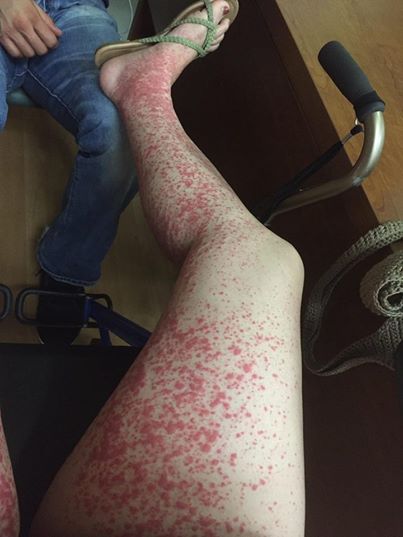
Jennifer Velasquez, who lives in San Diego, took to Facebook on October 13 to share a horrifying photo of her leg taken in 2015 after she was bitten by a tick while visiting a pumpkin patch with her family.

“After seeing all the cute pictures of families at the pumpkin patches, this is a reminder for everyone,” she wrote. “When you go to these pumpkin patches and petting zoos and all those fun fall activities, wear pants, long socks and shoes!”

“Make sure you check for tics! This was me 2 years ago after being bit by a tick and contracting Rocky Mountain spotted fever at a pumpkin patch,” she continued. “I Couldn’t walk, my whole body was in pain, my hair fell out, and I almost died.”

Although Velasquez’s injury happened two years ago, experts have warned that 2017 would be one of the worst tick seasons in years due to a boom in the mouse population and last year’s warm winter — and it isn’t even over yet.

While tick season normally peaks from April through September, this year’s unusually warm fall weather may result in heightened tick activity throughout the upcoming months.

Hopefully, Velasquez’s warning, which has been shared over 10,000 times, can serve as a reminder that ticks don’t stop biting when summer ends.

“I’m still healing from all this,” she wrote. “Don’t be dumb and wear flip flops like me. CHECK FOR TICKS!”

RELATED: Learn how to prevent tick bites: 


Nearly 30% of Ticks on Italian Dogs Found to be infected with Tick-borne Pathogens

http://online.liebertpub.com/doi/10.1089/vbz.2017.2154

Vector-Borne and Zoonotic Diseases

Molecular Survey on Rickettsia spp., Anaplasma phagocytophilum, Borrelia burgdorferi sensu lato, and Babesia spp. in Ixodes ricinus Ticks Infesting Dogs in Central Italy

Morganti Giulia, Gavaudan Stefano, Canonico Cristina, Ravagnan Silvia, Olivieri Emanuela, Diaferia Manuela, Marenzoni Maria Luisa, Antognoni Maria Teresa, Capelli Gioia, Silaghi Cornelia, and Veronesi Fabrizia. https://doi.org/10.1089/vbz.2017.2154

Online Ahead of Print: October 12, 2017

ABSTRACT

Dogs are a common feeding hosts for Ixodes ricinus and may act as reservoir hosts for zoonotic tick-borne pathogens (TBPs) and as carriers of infected ticks into human settings. The aim of this work was to evaluate the presence of several selected TBPs of significant public health concern by molecular methods in I. ricinus recovered from dogs living in urban and suburban settings in central Italy.

A total of 212 I. ricinus specimens were collected from the coat of domestic dogs. DNA was extracted from each specimen individually and tested for Rickettsia spp., Borrelia burgdorferi sensu lato, Babesia spp., and Anaplasma phagocytophilum, using real-time and conventional PCR protocols, followed by sequencing.

Sixty-one ticks (28.8%) tested positive for TBPs; 57 samples were infected by one pathogen, while four showed coinfections. Rickettsia spp. was detected in 39 specimens (18.4%), of which 32 were identified as Rickettsia monacensis and seven as Rickettsia helvetica. Twenty-two samples (10.4%) tested positive for A. phagocytophilum; Borrelia lusitaniae and Borrelia afzelii were detected in two specimens and one specimen, respectively. One tick (0.5%) was found to be positive for Babesia venatorum (EU1).

Our findings reveal the significant exposure of dogs to TBPs of public health concern and provide data on the role of dogs in the circulation of I. ricinus-borne pathogens in central Italy.


For more:  https://madisonarealymesupportgroup.com/2017/10/04/droplet-digital-pcr-shows-60-bb-infection-rate-in-ticks-and-over-50000-spirochetes-per-adult-tick/

https://madisonarealymesupportgroup.com/2016/11/05/infected-ticks-in-ontario/

https://madisonarealymesupportgroup.com/2017/08/17/of-birds-and-ticks/

https://madisonarealymesupportgroup.com/2017/09/20/night-at-the-blood-sucking-creature-museum/

https://madisonarealymesupportgroup.com/2017/09/19/tbis-in-australia/

Lost Link – ALS & Lyme

https://huib.me/en/blog/item/92-the-lost-link-between-als-and-lyme-disease  by Huib Kraaijeveld, October 2017

The lost link between ALS and Lyme disease

Knowledge about emergent diseases normally increases over time. Lyme Disease seems to be an exception to this rule. Claims that governments and scientists made around 1990, seem to have been forgotten. This article explores the lost link between ALS and Lyme. ALS is also known as Motor Neurone Disorder (MND) or as Lou Gehrig’s Disease, after the famous Yankee baseball player who died from it in the 1940’s. It is still claimed there is no known cause nor cure for it. 


A few weeks ago I visited a friend to admire her new house. She wasn’t as happy as I’d expected. She told me that a good friend of hers (46) was just diagnosed with ALS. ALS is considered a progressive and lethal disease, without a known cure for it.

Two months earlier, her friend had sudden deterioration of her memory, impairment of cognitive function and lost the use of the muscles in one arm. I’m not medically trained myself, but found this to be a peculiar combination of symptoms for ‘ALS’.

Some clinical tests for other illnesses were checked off, no blood work was done and she was basically sent home to write her will and say goodbye to her young child and husband. Memory loss and the sudden inability to think straight were not included in the diagnosis process.

My friend asked me for some sources about a potential link between Lyme and ALS. I’d like to share these sources with you as well in this current article, as a timely example how knowledge can somehow be ‘forgotten’.

Media coverage

There is a specific reason to write this article now. This week, on October 18, a highly disputed broadcast by Zembla International called ‘deceit or Borrelia‘ seems to be repeated on Dutch TV.

It attacked a specialized German lab, using the edited stories of Danish Lyme patients, who could not get help in their own country.

The patients did not give their consent for the broadcast, and when they realized where the broadcast was heading, they found that they were unable to withdraw their cooperation. This led to a ‘counter’ documentary of their own making, which you can see below.

Tabitha, the first lady who you can see in this documentary, was also told that she would live another six months at most and should say goodbye to her young daughter. Her diagnosis was also ALS.

She found that Lyme was likely the cause of her deterioration in health, got treated for it and stopped the progression of the ‘ALS’. She’s still alive now, although hardly after the damage the original documentary had done to her care plan.

Differential diagnosis

A differential diagnosis is what specialists call ‘detective work’. Clinicians look for symptomatic and laboratory clues, have hunches, order testing and perform exams, and then rule diagnoses in or out, especially when one or more illnesses have similar symptoms or even lab findings.

Part of that detective work is simply doing diagnostics by way of treatment. If a patient does not respond to a treatment for a specific disease, too bad, but then you can exclude it. But if they do, great news! Wouldn’t you think, in case of a lethal condition?

Allan Sheppard’ story, which was featured by the BBC, tells another tale. After the UK medical system NHS kept him in Intensive Care for two years with alleged ‘ALS’ and refusing his daughter to get a Lyme test from another specialized German lab, he is now improving while being treated for Lyme. Despite the UK government trying to stop her.

The story of Eivind Markhus is even more sinister. After he was told he would die from ALS, he had an American lab test his blood and found Lyme to be the real cause of his problems. He also improved after initial treatment and the progression of his ALS symptoms stopped.

Yet instead of spending 150,000 dollar on Lyme treatments, he spent that amount on legal cases, because his Norwegian government forbade him to get treated. He lost both the lawsuit and his life.

Recently, a male Dutch ALS patient (34, with three little children), who had been previously tested – with the standard unreliable serological test – for Lyme in a so-called (ALS) ’Expert Center’, had to learn from a chronic Lyme patient and a Lyme Literate US doctor how to improve the diagnostics.

By buying antibiotics online in New Zealand and taking them for a few days, his body started to produce antibodies for Lyme. So suddenly the test was positive in another (Lyme) ‘Expert Center’, where they apparently don’t know how to do this.

He is now crowdfunding to undergo an experimental treatment, which his insurance refuses to cover as it is not considered ‘evidence based’.

The story of Dr. Martz, who is featured in the award-winning documentary ‘Under Our Skin’ is the icing on the cake. He was told he would die of ALS as well, but found out by coincidence that he actually had Lyme and a co-infection, was treated for both of them and recovered so much he could give lectures in 2011.

Ice buckets

A relationship between ALS / MND and Lyme makes sense, looking at the findings of the 1990 research that was published in the article ‘Immunological Reactivity against in Borrelia burgdorferi in Patients with Motor Neuron Disease’ by Halperin et al.

This study showed that in almost 50% of the 19 people diagnosed with ALS, Lyme was the cause. Once treated, several of these patients improved. In that same year, 1990, the CDC published its first definition about Lyme and described the complex, systemic, multi-symptom and sometimes devastating chronic disease experienced by many Lyme patients – then and still today.

Did anyone ever do a follow-up on this promising research? No. It was simply hidden away and Halperin chose to become a co-author of the 2006 IDSA Lyme Guidelines instead, which maintain that ‘Lyme is a mild disease that is hard to get, easy to treat and hardly ever becomes a chronic condition’. Any possible connection with ALS or any other of the serious and previously acknowledged debilitating or even deadly conditions was no longer mentioned. Any long-term health issues are reasoned away, using semantics rather than ‘evidence based’ science.

These 2006 IDSA Lyme Guidelines have become worldwide policy, even though they were removed from the National Guidelines Clearinghouse and named as a case of bad ‘evidence based’ guidelines by the Institute of Medicine in 2011. To this day, both the CDC and WHO wholeheartedly support them, regardless of the hundreds of scientific publications that dispute them.

Today, 27 years after the Halperin study, people with ALS are routinely not (properly) tested nor treated for Lyme. Instead, friends and families are encouraged to empty ice buckets over each other’s heads to collect money for new research for a new cure for ALS.

The patient stories mentioned above will simply be discarded as ‘anecdotical’ by both mainstream scientists, doctors and policymakers. So will the fact that Lou Gehrig actually owned a house in Old Lyme, Connecticut.

Yet, if these stories are not shared anyway, the knowledge in them will be lost and so is hope for other people like Eivind, Allan, Tabitha, my friend’s friend and their children.

Choices of media channels such as the BBC or Zembla are decisive which knowledge is made available to the public. I asked the editors of Zembla to reconsider broadcasting it again, but have not yet received a reply.

An intellectual ice bucket

Most of these diagnoses are simply words on a form, which either best fit the symptoms or simply fit the codes of the insurances. Almost all of them are based on clinical diagnoses only and can mean a life-sentence to the patients.

Yet they need to prove with 100% certainty that Lyme is the actual cause? How can they do so, with blood tests that produce over 500 times more false negatives than the current HIV tests? Even the ‘experts’ now state that they should no longer be used. 

The intellectual ice-bucket is that one disease (causative agent) can show up as many different ‘disease images’, fooling doctors, patients, immune systems and statistics alike. Although it happened before in history, with Syphilis, many people seem to find this idea hard to grasp.

In this current article I only used ALS, which is considered a lethal and incurable disease to all afflicted, as an example to open up your imagination. Yet I could have also used any of the other 364 known potential misdiagnoses of Lyme as well.

Odds are about 100% that you personally know people who suffer from several of these illnesses, as the list includes MS, Parkinson, Alzheimer, ME, Fibromyalgia, ADHD and so on.

This is why I wrote my book for people like my friend, as it’s much easier for her to see the scope and possibilities than for the people like her friend, who are disabled and so frightened that will tend to believe their medical ‘death sentence’.

Is Lyme always the cause? Most likely not, as with anything in life, but without a 100% reliable test we will never know for sure in how many cases it is. Can it be? Of course it can, in the current climate of ‘lost knowledge’. Here are just a few more examples.

In 1988, the Canadian Department of Health reported several cases of congenital Lyme infection. In 2017: silence.

In 2012, the WHO stated in an instruction about blood donation (p.84) that Lyme Borrelia infection can “occur after the bite of a tick, mosquito or horsefly and can survive blood storage temperatures“.

Did you know? Does your doctor? Not if they don’t stumble upon it in their private lives, as retired MD Dr. Al Miller did. He recently discovered his daughter-in-law (43) was wrongly diagnosed with – again – ALS and that her health improved, after she was (properly) tested and treated for Lyme. Dr. Miller has become very vocal about it.

Change?

Using normal human, scientific or professional logic does not really help to understand the current bias against Lyme as a potential cause for many different illnesses. It simply does not fit the current model.

So change will not come from ‘above’. Throughout history, it never has, because ‘above’ has no interests in changing a status quo. Both the CDC and the WHO are political organizations.

The main insight you may need to fully understand why a severe and widespread disease – or rather pandemic – is so systematically ignored, downplayed or simply denied to exist in the first place, is to appreciate what it means that Lyme is called a ‘political disease’.

This quote might give you a hint: “a patient cured is a customer lost”. That is why a paradigm shift entails more than just ‘finding a cure for ALS’ (or those 364 other diseases) and emptying a next bucket of ice cubes; no matter how well-intended the gesture is.

References

Neurodegenerative and Fatiguing Illnesses, Infections and Mitochondrial Dysfunction: Use of Natural Supplements to Improve Mitochondrial Function. Garth L. Nicolson, Robert Settineri and Rita R. Ellithorpe. Functional Foods in Health and Disease 2014; 4(1):23-65 (page 23 of 65)

Lyme disease-induced polyradiculopathy mimicking amyotrophic lateral sclerosis. Burakgazi AZ1. Int J Neurosci. 2014 Nov;124(11):859-62. doi: 10.3109/00207454.2013.879582. Epub 2014 Feb 7.

Chronic or Late Lyme Neuroborreliosis: Analysis of Evidence Compared to Chronic or Late Neurosyphilis. Judith Miklossy. The Open Neurology Journal. 2012; 6: 146–157.

Dr. Richard Horowitz has a section in his second book ‘How Can I Get Better?‘ (page 282) where he says “Yet, if Lyme disease, co infections and environmental toxins are the sole causes of ALS, I would expect to see even more of these patients coming in with the disease.”

Huib Kraaijeveld

Author of ‘Shifting the Lyme Paradigm‘, chairman of the On Lyme Foundation and founding member of the Ad Hoc Committee for Health Equity in ICD

____________

**Comment**

Bravo Huib!

Dr. Miller:  https://madisonarealymesupportgroup.com/2017/05/11/dr-al-miller-lyme-disease-series/

https://madisonarealymesupportgroup.com/2017/10/13/dr-miller-a-new-perspective-on-lyme-disease/

The CDC Needs a Good Dictionary

https://www.lymedisease.org/touchedbylyme-cdc-occur/ by Dorothy Kupcha Leland

TOUCHED BY LYME: Misinterpreting the word “occur” on the CDC website

I’ve long been exasperated by a particular sentence in the Lyme disease section of the CDC’s website:

“This disease does not occur nationwide.”

In a recent blog on the topic, I noted: “Even using the CDC’s own highly restrictive Lyme surveillance criteria, there are cases on the east coast, cases on the west coast, and cases in the middle. So, what about that scenario is NOT ‘nationwide’?”

This is much more than a question of semantics. The CDC position is often used to deny patients a diagnosis. (“Well, the CDC says Lyme is not found nationwide–actually only in certain states–so you couldn’t possibly have Lyme disease….”)

People outside those magic 14 states can have a devil of a time getting diagnosed and treated. They lose the opportunity for early treatment—which offers the best outcome—and may have trouble EVER getting what they need from their doctors.

Well, apparently “this disease does not occur nationwide” also rankled Lyme activist Bruce Fries of Maryland. And he did something about it. He filed a complaint via a formal administrative process with the CDC’s Office of the Associate Director for Science (OADS), Office of Science Quality.

Here’s the complaint he filed:

_____

INFORMATION QUALITY REQUEST FOR CORRECTION

Complainant
Bruce Fries, Patient Centered Care Advocacy Group

Pursuant to the HHS Guidelines for Ensuring and Maximizing the Quality, Objectivity, Utility, and Integrity of Information Disseminated to the Public, the Patient Centered Care Advocacy Group, a patient advocacy organization with members and supporters throughout the United States, makes the following request for correction of inaccurate information.

Information to be Corrected
The CDC website page for Lyme Disease Data and Statistics contains the following statement in the Fast Facts section:

“Lyme disease is the most commonly reported vector-borne illness in the United States. In 2015, it was the sixth most common Nationally Notifiable disease. However this disease does not occur nationwide and is concentrated heavily in the northeast and upper Midwest.”

The statement “this disease does not occur nationwide” is inaccurate.

According to CDC surveillance reports, Lyme disease has been reported in every U.S. state except Hawaii, and the black-legged tick that transmits Lyme disease has been found in 45 percent of U.S. counties.

Impact
In addition to being a violation of HHS guidelines for information quality, the statement that Lyme disease does not occur nationwide has potential to harm patients in states with low incidence rates who are misdiagnosed and denied treatment when doctors rule out Lyme disease because of inaccurate information from CDC that Lyme disease does not occur nationwide.

Recommended Action
To correct the inaccuracy delete the following sentence:

“However this disease does not occur nationwide and is concentrated heavily in the northeast and upper Midwest.”

_____

Lo and behold, Bruce actually got a response, and the offending sentence has been removed from the CDC website!

Dr. Lyle Petersen is director of the Division of Vector-Borne Diseases in the CDC’s National Center for Emerging and Zoonotic Infectious Diseases. He sent Bruce a letter, which said in part:

“We agree that the term ‘occur’ is subject to misinterpretation and that the sentence can be clarified.”

Really? What else might “occur” mean, other than…occur? I’d personally leave the word “occur” right where it is and change the words around it like this: “Although Lyme disease is concentrated heavily in the northeast and upper Midwest, it can occur nationwide.”

But the CDC chose its words differently. Here’s what the website says now:

The website’s amended text is marginally better, since it now allows the possibility of a few more states. But the information is still inaccurate. Take this sentence:

“Infected ticks can also be found …in some areas of Northern California, Oregon and Washington.”

Why just Northern California? According to the California Department of Public Health, infected ticks have also been found in central and southern parts of the state. So, why not just say “California”?

And what’s with this next sentence?

“Although Lyme disease cases are occasionally reported from most other states, this does NOT mean that infection was acquired in those states.”

Why is the CDC hellbent on minimizing this disease? As Lorraine Johnson pointed out in a recent Lyme Policy Wonk blog, other sources of information indicate much more exposure to infected ticks than the CDC is willing to admit. (please see link in comment section about the Canine Maps predicting LD better than the CDC)

Why? Why? Why?

Despite the imperfections of the new language on the website, Bruce Fries deserves kudos for using the administrative process to force the CDC to make some changes.

And the CDC deserves whatever the opposite of “kudos” is, for the unsatisfactory way they “fixed” this problem.

Stay tuned. It won’t be the end of the story.

Join LymeDisease.org
TOUCHED BY LYME is written by Dorothy Kupcha Leland, LymeDisease.org’s VP for Education and Outreach. She is co-author of When Your Child Has Lyme Disease: A Parent’s Survival Guide. Contact her at dleland@lymedisease.org

**Comment**

This article is a perfect example of why all things related to Lyme/MSIDS has hardly budged in over 40 years.  When Polly Murray of Connecticut first noticed all the families around her were ill and reported it to the CDC who then identified a chunk of kids with “juvenile arthritis,” a disease primarily of the joints (rheumatology) and skin (dermatology) this narrative has been powerfully protected by the folks who came up with it in the first place – the very people with patents on the organism as well as test kits and other pharmaceuticals that also obtain hefty payments as “experts” for insurance companies who weigh in against patients who are trying to obtain health care coverage.  https://madisonarealymesupportgroup.com/2017/08/29/research-challenges-in-lyme-disease-contagion-live/  (See comment at end of article for such shenanigans)  

All the research, led by the Lyme Cabal, has focused on this initial narrative that refuses to budge, allowing for different findings in the worldwide literature which has shown this disease to defy about everything they initially said about it.  https://madisonarealymesupportgroup.com/2017/01/13/lyme-science-owned-by-good-ol-boys/ , and now one pathologist is suing the CDC for their stranglehold on testing due to their own collusion:https://madisonarealymesupportgroup.com/2017/09/25/speaking-of-fake-science-fifty-seven-million-anti-trust-lawsuit-against-cdc-lyme-tests/

The CDC has controlled the narrative of Lyme/MSIDS like the iron curtain, and still doesn’t recognize Lyme/MSIDS in the South or California:  https://madisonarealymesupportgroup.com/2016/09/24/arkansas-kids-denied-lyme-treatment/, https://madisonarealymesupportgroup.com/2017/08/07/california-lyme-cases-get-no-respect/

Going all the way back to the 80’s, here’s a story of one Southern doctor who fought the CDC narrative:  https://madisonarealymesupportgroup.com/2017/10/06/remembering-dr-masters-the-rebel-for-lyme-patients-who-took-on-the-cdc-single-handedly/

It’s taking scientists who have Lyme/MSIDS to come up with answers:  https://madisonarealymesupportgroup.com/2016/10/25/hope-for-southerners/

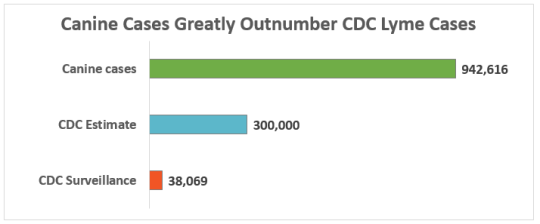
And if the CDC would ever get its head out of the sand, even Canine Maps predict LD better than the ancient and dusty CDC proclamation:  https://madisonarealymesupportgroup.com/2017/08/24/canine-maps-better-than-the-cdcs-in-predicting-lyme-disease/  Between 2011 and 2015, IDEXX collected nearly 12 million Lyme disease test results from US veterinarians on a county-by-county basis. The data indicates that Lyme disease is present in abundance in every state in the US.  The number of canine positive test reports is vastly greater than the number of human cases reported by the Centers for Disease Control (CDC). There are close to one million canine positive test results annually in the US, compared to 38,069 cases included in CDC surveillance reports.

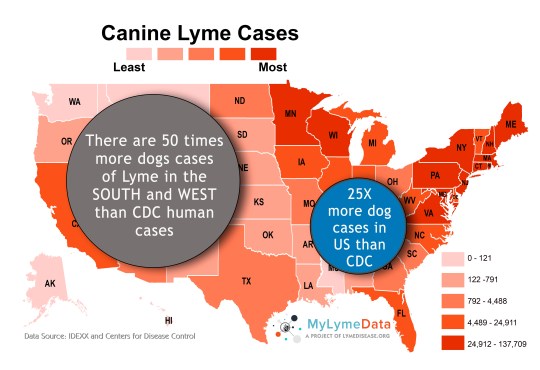
The discrepancy between CDC and canine cases is even more pronounced in the western and southern states. In the West and the South, there are 104,104 cases in dogs annually, compared to 2,342 CDC-reported cases. In other words, there are roughly 50 times more canine cases than CDC surveillance cases.  

The following graphs from Lymedisease.org spell it out perfectly

LPW-canine-chart-2.png

Map-Canine-with-Circles.jpg

Michael Yabsley, a parasitologist at the University of Georgia, and Christopher McMahan, an assistant professor of mathematical sciences at Clemson University, have used the IDEXX canine data to develop a risk forecast map for the predicted Lyme disease prevalence — the percentage of dogs who are likely to test positive — by county in each of the 48 contiguous states. Yabsley explains the predictive relationship:

“Dogs really are the canary in the coal mine for human infection. Our research team has evidence that the relationship between canine disease and human disease is strong. Because dogs are being tested for exposure during annual exams, these data are available on a national scale, something that is difficult to get when studying the ticks and environment directly.”

Someone, please send the CDC a good dictionary so they can look up the word, “occur.”

Rob Thomas on Marisol’s 14-Year MSIDS Battle: ‘It’s Like a Weird Alien Inhabited My Wife’

http://www.etonline.com/exclusive-rob-thomas-marisols-14-year-lyme-disease-battle-its-weird-alien-inhabited-my-wife-87787?

EXCLUSIVE: Rob Thomas on Marisol’s 14-Year Lyme Disease Battle: ‘It’s Like a Weird Alien Inhabited My Wife’

By 
rob_thomas_marisol_thomas_gla_101316_getty_images_614394704.474104268_highres.jpg
Photo: Global Lyme Alliance / Getty Images

Rocking out, side of stage, while her husband, Matchbox Twenty frontman Rob Thomas, performed in Chula Vista, California, Marisol Thomas may have appeared a gorgeous picture of health and happiness as she sang along to the band’s hit, “Disease.” But behind the smiles, the scene was a rare moment of reprieve from a debilitating 14-year fight against a disease which Rob says has transformed his perspective on life, robbed any thoughts of having more children and “inhabited” parts of his wife.

 “It’s crazy how normal something abnormal can become,” Rob tells ET, during a rare interview with Marisol to promote Global Lyme Alliance’s 3rd Annual New York Gala — where he will perform and Marisol is an honoree for her advocacy work for Lyme and other tick-borne diseases. “It’s like if one day you woke up and there was an alien living in your house and the first couple of weeks you’d be f**king freaked out, but after a while you’d name it and it would just be there. This sickness has been like this weird alien that’s moved into our life and inhabited my wife. Sometimes she’s just not herself. Watching the person you’re closest to become someone other than herself is so [hard].”
The couple has grappled with Marisol’s health battles for more than a decade, during which she visited countless specialists, desperate for accurate diagnosis and treatment. Showing symptoms of autoimmune disease, she was told she had Multiple Sclerosis one minute, Lupus the next and at one point, while lying in a hospital for days, she believed she had pancreatic cancer.Rob frustratingly recalls one specialist exploring the possibility of Lyme (a potentially fatal illness spread by ticks) years ago, but the common diagnostic test is inaccurate more than half the time.However, after undergoing surgery to remove a lesion from her brain in 2015, doctors suspected and tested for the illness, eventually diagnosing eight tick-borne diseases — including late stage Neurological Lyme Borreliosis, Babesiosis and Bartonella — all of which induce different symptoms and require various treatments and doctors. The infections are also believed to have triggered Hashimoto’s disease and Lupus-like symptoms, as well as Atypical Trigeminal Neuralgia, nicknamed the “suicide disease,” because it attacks facial nerves and “makes you wish for death.”

“After brain surgery, everyone went, ‘You’re on the road to recovery — you’re doing great,’” reflects Marisol, 41. “But that was actually the easiest part. The real battle began when we finally figured out what was going on with me.”

While Lyme can be cured with antibiotics if caught early, Marisol’s late-stage diagnosis and presence of multiple infections means it’s harder to manage. Her treatment is constantly tweaked according to which infection is flaring up most, and involves a mixture of pharmaceutical meds and holistic therapies, some of which are not easily obtainable due to being commercially unviable.

Once a driven “A-type,” who thrived in co-managing Rob’s career and passionately running their Sidewalk Angels Foundation, which assists animal rescue groups, she says Lyme has “stolen” her life and frequently traps her on the tour bus with symptoms including visual disturbance, numbness, seizures and constant pain. Being correctly diagnosed means she has better treatment, fewer seizures and more hours of feeling “semi-functional,” but the former model says there’s still a “long road ahead.”

“It’s like you’re standing still unable to participate as everything keeps going on without you, then you wake up the next day and the same thing happens,” she explains. “I don’t consider what I’m doing living. I’m existing … and fighting to hopefully one day live again. That’s a horrible place to be in and I have support to pursue it, but I know there are people who don’t. You become so sick of being sick and want nothing more than a moment away from it, so if I have a [good] moment I run with it. My mom and I call them happy moments and I do more in those hours than I ever would’ve before!”

Currently traveling with Rob on Matchbox Twenty’s “A Brief History of Everything” tour, such escapism has included visiting the California Mid-State Fair and hanging with actor pal Wilmer Valderrama.

Although the couple relish those precious periods of respite from Marisol’s physical symptoms, the mental toll of the illness is an ongoing battle, largely thanks to the “stigma” attached to Lyme, an illness which has increased 25-fold since national surveillance began in 1982, with more than 329,000 new cases each year in the U.S. alone. Marisol notes how Lyme sufferers often get accused of “exaggerating, faking or needing psychiatric help,” which has triggered some to consider or commit suicide.

Despite harsh comments and being accused of sharing her story for attention, she continues to advocate for tick-borne diseases and will be honored alongside menswear designer Joseph Abboud at Global Lyme Alliance’s Oct. 11 gala at Cipriani, 42nd Street, where fellow Lyme sufferers Yolanda Hadidand Aly Hilfiger are Honorary Event co-chairs. Rob, who performed at last year’s gala, will once again hit the stage alongside Chris Daughtry.

For Rob, watching his wife of almost 18 years somewhat vanish into a daily health battle has been a harrowing journey, which inspired powerful solo hits like 2009’s “Your Diamonds” and the poignant 2016 ballad “Pieces.”
The ongoing struggles have come with significant personal costs, like sacrificing family hopes, social lives and holidays.

Once contemplating having children together, Rob — who has a 19-year-old son, Maison, from a previous relationship — admits all thoughts of having more kids were long ago swallowed by illness. “For so long now, we’ve told ourselves that we never really wanted kids together that we don’t know if that’s even true,” he admits. “We’ve known for the last decade that because of Mari’s health, that was something we couldn’t do and you just resign yourself to the fact. If we can have Mari back healthy and she can have a normal life, then we don’t need a family to complete us because we have so much time to make up for.”

“The real personal cost has been [little things] like one of our dearest friends visiting us on the road last night and she couldn’t get off the bus to see him,” he continues. “She loves hanging with everyone, but she’s always one door away unable to be part of it. Or there’s holidays she has to let go by. I’ve never seen anybody love Christmas like this girl loves Christmas, so to watch it pass [is tough]. These little things make a year suddenly go by without us realizing.”

While Rob, 45, remains deeply dedicated to Marisol — halting his 2015 solo tour after learning she needed surgery — he admits the helplessness and guilt that comes with being her spouse can be arduous. Some relationships don’t survive the perils of the disease, with Hadid stating in her new book (Believe Me: My Battle With the Invisible Disability of Lyme Disease) that her sickness contributed to the collapse of her seven-year marriage to David Foster.

Rob often feels “survivor’s guilt and remorse,” for being healthy. “Often their day-to-day life makes you feel selfish just by doing normal things,” he says. “l’ll say, ‘Man, I had the worst show,’ then realize who I’m talking to and go, ‘I’m sorry, that’s the stupidest thing to say!’ You get perspective. I don’t think I have anything to complain about because I’ve seen how bad it can get for someone. The great thing about going to the Global Lyme Alliance benefit last year was seeing we’re not alone. People talk about their health struggles and what the family goes through and it’s normal to hear someone say, ‘I can’t tell you how much I thank my family for not just killing me!’ — and think, ‘I totally get that.’”

“For public record, I’m not going to kill my wife!” he adds. “But they spend so much time trying to get better that, as a caretaker, you pick up the slack on everything else in their life. I get tired and frustrated, then I see a glimpse of Mari and we talk, recognize it, then keep going.”

Rob adds that having Marisol on tour has been a blessing because he’s always nearby, while still able to fulfil his duties with Matchbox Twenty.

The GRAMMY-nominated group, whose debut album Yourself or Someone Like You turns 21 next month, have loved being reunited following guitarist Kyle Cook’s brief fallout with Rob and departure from the band. Rob says the group is now stronger than ever.

“I don’t know that we’ve ever gotten along as well as we are now,” he shares. “We hashed everything out and have taken it to another level, where we enjoy each other’s company on and off stage. We’re constantly in communication, and even today, on a day off, we’re writing stupid, little things to each other. I have a solo record I’ve almost finished writing and will put out next year, but because of this tour, we know after that, we’re going to record new music and want to tour again.”

And, when that tour rolls around, Marisol naturally hopes to be side of stage for as many shows as she can. “On my good days, I make sure I’m there — it’s my favorite thing!” she says. “We always kid how I’m a road chick from way back … music and touring has been a huge part of my life, so having moments where I can stand side of stage and see Rob do his thing and be better than ever is amazing. Those are my happy moments.”

See ’80s-singing icon and new Dancing With the Stars contestant Debbie Gibson talk about her fight against Lyme disease in the video below.