Archive for the ‘Testing’ Category

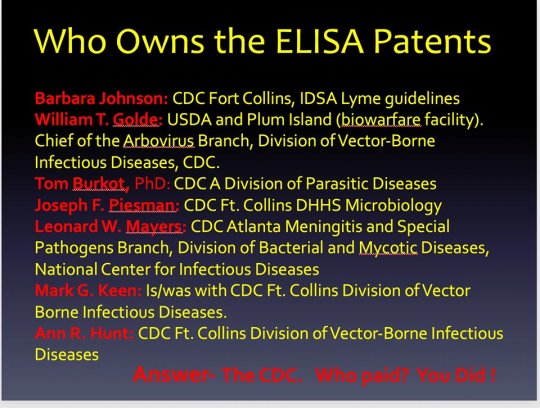
Who Owns the ELISA Patents…

64357008_10217935576008450_2638357839671721984_n

Credit: Tom Grier https://www.facebook.com/thomas.grier1

“I am Barbara Johnson. I am a biochemist by training and I am speaking today on behalf of the Centers for Disease Control and Prevention concerning serodiagnosis of Lyme disease. Specifically, my statement is in support of (the) IDSA recommendation in the guidelines to use two-tiered serology (an ELISA screening test followed by Western Blots if ELISA positive) to support the diagnosis of Lyme disease in patients who have manifestations other than acute erythema migrans.  – IDSA Lyme Disease Review Panel Hearing, July 30, 2009

For more dirty deeds done dirt cheap: ConflictReport


Lyme Disease Cases Are Exploding. And It’s Only going to Get Worse

https://elemental.medium.com/lyme-disease-cases-are-exploding-and-its-only-going-to-get-worse-5d3c3a2de5c5

Lyme Disease Cases Are Exploding. And It’s Only Going to Get Worse.

Climate change and human sprawl have triggered a pandemic

By Alex Bhattacharji

**Comment**

Glad they mentioned “co-feeding” and the probability they are spreading more pathogens into us more quickly, increasing prevalence. 

Glad they state this is a pandemic and the increase of ticks is everywhere making maps a joke. Throw them away. They’ve been used against patients from the get-go.

Although Lyme disease has been around forever, tinkering with it in a lab and making it more pathogenic isn’t a “theory,” it’s what bioweaponization means, and it’s far more than just Lyme. I’d say the experiment has been highly successful.

The Lymerix vaccine was a complete fail:  https://madisonarealymesupportgroup.com/2018/07/01/lyme-vaccine-fail-safety-ignored/ Both dogs and humans have been given Lyme symptoms due to the vaccine. That’s a big deal. Shame on them for underplaying it.

They briefly mention the role of birds but fail once again by bringing the climate into it. Out of one side of their mouth they state ticks are marvelous ecoadaptors and then out of the other side of their mouth they blame the climate. You can’t have it both ways. Please note the DOD, DARPA, & the EPA are funding the supposed “link” between ticks & climate change….that is quite telling. They would rather blame the weather than take responsibility for tweaking ticks in a lab that perhaps gave them the ability to live on stucco & in dirt and be more aggressive….hmmm. Yeah, blame the climate.

Having the EM rash is highly variable from 25%-80%.  It should not be used as criteria for entrance into research studies nor as a required sign by doctors for diagnosis as so many do not get it. If you do have it – you have Lyme, but if you don’t, you could still have Lyme.

This article as actually quite a treatise on “Why nothing has been done to fix the Lyme/MSIDS problem.” For more:  https://madisonarealymesupportgroup.com/2017/08/14/canadian-tick-expert-climate-change-is-not-behind-lyme-disease/  Excerpt:  

“The authorities have been using tick expansion and climate change to get research dollars. Climate change is a popular topic right now, and that is a great source of funding for related research. However, any research on ticks and climate change is inconclusive––in essence, there is no validity. The long-range, futuristic projections and statistical models are bogus science because blacklegged ticks have already been found in northern Canada. In fact, we documented blacklegged ticks on migratory songbirds in northern Alberta dating back to 1998. Any allocation of government funding for ticks and climate change research is a complete waste of taxpayers’ money. It will not help Lyme disease patients one iota.” John Scott

Ouch. 

An independent Canadian researcher who doesn’t have strings attached to his work points out all the marionettes on strings in the research world, who by the way, refuse to even acknowledge his work…..and even advocates are guilty of jumping on a Bandwagon built upon faulty science. 

Let us never stoop as low as the enemy who has twisted science to suit their purpose from the beginning.
For more:  https://madisonarealymesupportgroup.com/2019/02/22/why-mainstream-lyme-msids-research-remains-in-the-dark-ages/

Lastly, please note the TBDWG has taken a supposed new turn and is leaving patients out of the process. Is this really shocking when you read the above issues?

For more on the bioweaponization issue: https://madisonarealymesupportgroup.com/2019/07/19/biological-warfare-experiment-on-american-citizens-results-in-spreading-pandemic/

https://madisonarealymesupportgroup.com/2019/07/21/got-15-minutes-the-officially-ignored-link-between-lyme-plum-island/

https://madisonarealymesupportgroup.com/2018/12/19/its-1984/Excerpt from interview:

. . .I am a biologist, so that’s where I started working on ticks and mosquitoes—how to produce a lot of them. Drop them out of airplanes. Everything was very hush-hush, very secret. I’m still leery talking about it, because I think they might put me in jail because I’m delivering secrets. [Laughs.] It was a crazy time.

We would run all kinds of distribution tests on where these things go when you release them and what were the factors that would cause the migration. Can we drop them out of airplanes and how do we get the bugs to the enemy? That was the thing we did. – James Oliver

https://www.lymedisease.org/lymepolicywonk-questioning-governments-role-lyme-disease-make-conspiracy-theorist/

https://madisonarealymesupportgroup.com/2019/07/27/lyme-biowarfare-4-video-series/

Emerging Babesia sp. Similar to Babesia Motasi in 1st Human Case & Ticks in Korea (Asian Long-horned & Haemaphysalis Flava)

https://www.ncbi.nlm.nih.gov/pubmed/31179860

2019;8(1):869-878. doi: 10.1080/22221751.2019.1622997.

Detection and characterization of an emerging type of Babesia sp. similar to Babesia motasi for the first case of human babesiosis and ticks in Korea.

Abstract

Babesiosis is a tick-transmitted intraerythrocytic zoonosis. In Korea, the first mortalities were reported in 2005 due to Babesia sp. detection in sheep; herein we report epidemiological and genetic characteristics of a second case of babesiosis. Microscopic analysis of patient blood revealed polymorphic merozoites. To detect Babesia spp., PCR was performed using Babesia specific primers for β-tubulin, 18S rDNA, COB, and COX3 gene fragments. 18S rDNA analysis for Babesia sp., showed 98% homology with ovine Babesia sp. and with Babesia infections in Korea in 2005. Moreover, phylogenetic analysis of 18S rDNA, COB, and COX3 revealed close associations with B. motasi. For identifying the infectious agent, Haemaphysalis longicornis (296) and Haemaphysalis flava (301) were collected around the previous residence of the babesiosis patient. Babesia genes were identified in three H. longicornis: one sample was identified as B. microti and two samples were 98% homologous to B. motasi.

Our study is the first direct confirmation of the infectious agent for human babesiosis. This case most likely resulted from tick bites from ticks near the patient house of the babesiosis patient. H. longicornis has been implicated as a vector of B. microti and other Babesia sp. infections.

_______________

**Comment**

Everyone’s been waiting with bated breath on what the Asian Long-horned tick is transmitting.  We know it’s transmitting numerous pathogens in Asia but has yet to be found to transmit pathogens here in the U.S., although the tick itself is spreading geographically like wildfire. This is the tick that clones itself and drains cattle of its blood. https://madisonarealymesupportgroup.com/2018/03/12/asian-tick-found-in-new-jersey-can-kill-cattle-by-draining-them-of-blood/

https://www.liebertpub.com/doi/full/10.1089/vbz.2018.2298  This article shows the ticks and transmittable diseases in South Korea.

The full-length article tells the unfortunate story of an elderly men’s death 36 hours after hospitalization due to an emerging type of Babesia due to a tick bite. 

A blood sample was obtained from the jugular vein in the patient that presented with dizziness and general weakness. 

No microorganisms were isolated from the blood culture.

Microscopy revealed the following:

Upon light microscopic examination, variable intraerythrocytic parasites as ring forms, pear-shaped forms, paired pyriforms, pleomorphic ring forms, and multiple-infected parasites and clusters of extracellular rings were detected in Giemsa-stained blood smears. The percentage of parasitaemia was 1.8% (Figure 1). Maltese cross forms comprising four masses in an erythrocyte that are often described as a characteristic of B. microti infection were not detected in most blood smears (Figure 1).

Please note that the patient would have failed a simple blood test and even microscopy revealed atypical findings as well as the fact parasitemia was less than 2%.

Yet, 2% was enough to kill a man.

Tick collections were performed by dividing the area around the patient’s residence and the findings were:

A total of 597 ticks were collected around the patient’s residence, including 296 H. longicornis (186 adult, 41 nymphs, and 68 larvae) and 301 Haemaphysalis flava (1 adult and 300 larvae) (Table 2). Among these, 94% of the ticks were collected in both the front yard of patient’s residence (442 ticks) and associated hill III (124 ticks). Based on the results of the amplification of Babesia genes in each tick, 2 (0.3%) were positive for 18S rDNA of Babesia species, 1 (0.2%) for COB and COX3, and 1 (0.2%) for β-tubulin gene of B. microti. While the nymph of H. longicornis yielded a positive result for only 18S rDNA, one female tick of H. longicornis yielded positive results for 18S rDNA, COB, and COX3 gene fragments. Also, one female tick of H. longicornis only yielded positive results for β-tubulin gene of B. microti (Table 3).

Please note two things: the high amount of ticks found right in his yard and the low incidence of infected ticks – yet, it only took one to kill him.

The Discussion section reveals some interesting things:

Previously, seven different Babesia spp., B. microti, B. divergens, B. bovis, B. canis, B. duncani, B. venatorium, and a novel Babesia sp. similar to ovine babesias were reported to cause human babesiosis...Human babesiosis (KCDC-1) in 2017 was the second case identified in Korea and the sequence of Babesia sp. was very closely related to that of KO1 and Liaoning, China. These large Babesia are clearly distinct from other agents of human babesiosis based on their shape and phylogeny. These results suggest that the causative agent in their case of babesiosis is a novel large Babesia parasite infecting humans and may be highly fatal….

the identified Babesia parasites (in the patient) might be B. motasi, and this is the first study to detect B. motasi in human babesiosis and H. longicornis in Korea.

____________________

For more on Babesia:  https://madisonarealymesupportgroup.com/2016/01/16/babesia-treatment/

https://madisonarealymesupportgroup.com/2019/04/01/bb-new-strain-of-babesia-found-in-tick-on-a-tropical-bird-in-canada/

https://madisonarealymesupportgroup.com/2018/12/11/babesia-widespread-in-canada-its-high-tolerance-to-therapy/

https://madisonarealymesupportgroup.com/2019/02/21/could-it-be-babesia/

https://madisonarealymesupportgroup.com/2018/10/05/variable-clinical-presentations-of-babesiosis/

https://madisonarealymesupportgroup.com/2019/05/22/babesiosis-in-pregnancy-an-imitator-of-hellp-syndrome/

https://madisonarealymesupportgroup.com/2019/05/26/fda-recommends-testing-for-tick-borne-illness-in-donated-blood-a-big-duh/

https://madisonarealymesupportgroup.com/2018/10/11/transfusion-transmitted-babesiosis-one-states-experience/

 

BBC Video ‘My Life is Dominated by Lyme Disease’

https://www.bbc.com/news/av/uk-scotland-48636858/my-life-is-dominated-by-lyme-disease  (Video Here)

June 17, 2109

‘My life is dominated by Lyme Disease’

One tiny tick under the skin can cause chronic illness but GPs can be slow to diagnose and to give treatment for Lyme Disease.

“Disclosure: Under The Skin” meets sufferers who feel let down by the health service and asks what more can be done to combat this debilitating disease.

The programme was aired on BBC One Scotland on Monday 17 June, 2019.

Updates in the Diagnosis & Treatment of Resistant Lyme & Chronic Disease – Dr. Horowitz

https://chrissmith.house.gov/uploadedfiles/richard_horowitz_presentation.pdf

Updates in the Diagnosis and Treatment of Resistant Lyme and Chronic Disease

(Used with permission from Dr. Horowitz)

Lyme & TBD Congressional Town Meeting

May 29, 2019

Dr. Richard Horowitz

_____________________

**Comment**

The above link of a pdf by Dr. Horowitz is chuck-full of information.  For those of you who are just beginning this journey, this Lyme/MSIDS treating doctor has written numerous books I highly recommend.  He has many ideas & suggestions for why many do not get better.  He also is the one who came up with the MSIDS questionnaire, which you can access here:  https://madisonarealymesupportgroup.com/wp-content/uploads/2016/01/symptomlist.pdf

The questionnaire is validated & does a much better job of diagnosis than current 2-tiered testing: https://madisonarealymesupportgroup.com/2017/09/05/empirical-validation-of-the-horowitz-questionnaire-for-suspected-lyme-disease/(This link also has other links with information Dr. Horowitz given including his research on mycobacterium drugs)


This is the first item I recommend to patients suspecting tick-borne illness.  I tell them to print it off, fill it out, and take it to their doctor appointment.