Archive for the ‘research’ Category

Bartonella and Neuroretinitis

Bartonella can harm the eyes 20 ways, and can also harm the heart and mental state and emotions.

https://insights.ovid.com/pubmed?pmid=28700390

Retin Cases Brief Rep. 2017 Jul 11. doi: 10.1097/ICB.0000000000000612. [Epub ahead of print]

BARTONELLA HENSELAE NEURORETINITIS ASSOCIATED WITH CENTRAL RETINAL VEIN OCCLUSION, CHOROIDAL ISCHEMIA, AND ISCHEMIC OPTIC NEUROPATHY.

Ghadiali Q1, Ghadiali LK, Yannuzzi LA.

Abstract

We describe a healthy 37-year-old man with Bartonella henselae (B. henselae) neuroretinitis with concurrent central retinal vein occlusion and ischemic optic neuropathy resulting in optic atrophy and choroidal ischemia.

RESULTS:
A 37-year-old man presented with unilateral decreased vision and a fundus examination consistent with neuroretinitis. Further imaging review supported a concurrent diagnosis of central retinal vein occlusion.
Although initially negative, repeat serological testing for B. henselae infection was positive. Multimodal imaging displayed severe outer retinal disruption, ischemic optic neuropathy, and choroidal ischemia.
The patient demonstrated near complete resolution of fundus findings and restoration of outer retinal architecture. Residual findings included optic disk pallor and ischemic choroidopathy.
DISCUSSION:
B. henselae neuroretinitis may be associated with concurrent retinal vascular occlusive disease and ischemic optic neuropathy. Central retinal vein occlusion and choroidal ischemia leading to optic nerve atrophy are additional sequelae further expanding the clinical spectrum of this entity.

Transmission time for Borrelia Mayonii by Nymphal Ticks – Mouse Model

https://academic.oup.com/jme/article-lookup/doi/10.1093/jme/tjx089

Transmission of the Lyme Disease Spirochete Borrelia mayonii in Relation to Duration of Attachment by Nymphal Ixodes scapularis (Acari: Ixodidae)
Marc C. Dolan Nicole E. Breuner Andrias Hojgaard Karen A. Boegler J. Charles Hoxmeier Adam J. Replogle Lars Eisen
J Med Entomol
Published: 05 July 2017

Abstract
The recently recognized Lyme disease spirochete, Borrelia mayonii, has been detected in host-seeking Ixodes scapularis Say ticks and is associated with human disease in the Upper Midwest. Although experimentally shown to be vector competent, studies have been lacking to determine the duration of time from attachment of a single B. mayonii-infected I. scapularis nymph to transmission of spirochetes to a host. If B. mayonii spirochetes were found to be transmitted within the first 24 h after tick attachment, in contrast to Borrelia burgdorferi spirochetes (>24 h), then current recommendations for tick checks and prompt tick removal as a way to prevent transmission of Lyme disease spirochetes would need to be amended. We therefore conducted a study to determine the probability of transmission of B. mayonii spirochetes from single infected nymphal I. scapularis ticks to susceptible experimental mouse hosts at three time points postattachment (24, 48, and 72 h) and for a complete feed (>72–96 h). No evidence of infection with or exposure to B. mayonii occurred in mice that were fed upon by a single infected nymph for 24 or 48 h. The probability of transmission by a single infected nymphal tick was 31% after 72 h of attachment and 57% for a complete feed. In addition, due to unintended simultaneous feeding upon some mice by two B. mayonii-infected nymphs, we recorded a single occasion in which feeding for 48 h by two infected nymphs resulted in transmission and viable infection in the mouse. We conclude that the duration of attachment of a single infected nymphal I. scapularis tick required for transmission of B. mayonii appears to be similar to that for B. burgdorferi: transmission is minimal for the first 24 h of attachment, rare up to 48 h, but then increases distinctly by 72 h postattachment.

Discussion

We report here that transmission of B. mayonii appears to be associated with presence of spirochetes in the saliva of the feeding tick (Table 4). Although this finding is not surprising, it provides evidence to support the salivary route of transmission for this Lyme disease spirochete, similar to transmission of B. burgdorferi (Ribeiro et al. 1987, Ewing et al. 1994). Additional studies are needed to explore the dynamics of how B. mayonii spirochetes, as well as B. burgdorferi and the relapsing fever group spirochete Borrelia miyamotoi, disseminate within I. scapularis ticks and multiply within the salivary glands during attachment, resulting in subsequent passage to mammalian hosts via the saliva of a feeding tick.

**Comment**

Transmission Time research, similarly to geographical maps of tick populations, has been used against patients for decades.  Please read all transmission time studies with healthy skepticism, realizing many patients have become infected in under the oft quoted 24-72 hours.  Thankfully, the CDC is now telling doctors to treat patients empirically, without waiting for test results, if they suspect tick borne illness.  https://madisonarealymesupportgroup.com/2017/07/12/start-treatment-if-tbis-are-suspected/

https://madisonarealymesupportgroup.com/2017/04/14/transmission-time-for-lymemsids-infection/   Bob Giguere of IGeneX states a case of a little girl who went outside to play about 8:30a.m. and came inside at 10:30 with an attached tick above her right eye. By 2 o’clock, she had developed the facial palsy. At the hospital she was told it couldn’t be Lyme as the tick hadn’t been attached long enough. They offered a neuro-consult…..(not treatment)

This story plays out again and again with doctors not believing patients, often times even refusing to test them, and send theming packing when they have a serious infection(s) that will fester for years until a correct diagnosis is made. 

By then there can be irreversible damage.

https://madisonarealymesupportgroup.com/2017/06/08/review-of-tick-attachment-time-for-different-pathogens/


Bell’s Palsy Despite Treatment

http://www.ijidonline.com/article/S1201-9712(17)30182-0/pdf

Progression of Lyme disease to Bell’s Palsy despite treatment with doxycycline

Luis A. Marcos, Zengmin Yan

International Journal of Infectious Diseases, online first July 10, 2017

Highlights

* Treatment of choice for Lyme disease remains controversial.
* Bell’s palsy developed despite being on doxycycline.
* Progression of disease may be related to a strong host immune response.
* Prompt clinical response to minocycline needs further investigation.

Abstract

A 54 year-old healthy woman presented to the emergency department with a right sided facial paralysis. About 3 weeks ago, she woke up and noticed an attached engorged tick in her right lower extremity. A week later, she noticed a mild to moderate right jaw pain which progressed to a severe right facial pain so she visited her doctor. On physical, II to XII cranial nerve examination was unremarkable.

Doppler ultrasound did not show any vascular abnormalities in temporal artery. Her inflammatory markers were within normal limits (C-reactive protein:0.3 mg/dL; sedimentation rate:6 mm/h). Further brain imaging by MRI reveled no abnormalities. Lyme serology (antibodies against purified VlsE-1 and PepC10 antigens) was negative (index value 0.6; ≤ 0.90 negative). Complete blood count and metabolic panel were within normal limits. Only objective physical finding was a right erythematous ear canal (red and inflamed) so the patient was prescribed a 7-day course of amoxicillin/clavulonic acid.

Two days later, the rash in right leg increase in size. It was described as 4 cm rash circular with erythematous edges, clearing and central erythema consistent with erythema migrans (EM) (bull’s eye). She was prescribed doxycycline 100 mg orally twice a day. Five days later went to see a neurologist due to worsening right facial shooting pain. Patient had minimal gastrointestinal side effects from the antibiotic and continued taking it every 12 hours without interruption. Physical exam revealed face symmetric, numbness in right chin in nerve distribution. She was diagnosed with possible Lyme cranial neuritis. Doxycycline was continued and pregabalin was started.

On day #10 of doxycycline, she woke up and noticed that her right face was paralyzed and unable to close the right eye so she went to the local emergency department. The EM was improved from 4 to 2 cm residual rash. Because of her headaches, a lumbar puncture and brain MRI were recommended. Cerebrospinal spinal fluid analysis revealed only 3 WBCs, protein 30.2 g/dL, glucose 62 mg/L, Lyme serology pair CSF fluid O.D. = 0.114 (borderline), serum Lyme serology pair O.D. = 0.409 (reactive), serum IgM western blot was positive (bands present: 23 and 41 kDa), serum IgG western blot was indeterminate (bands: 41,58 and 93 kDa), CRP remained less than 0.1 mg/dL. MRI of brain showed new increased enhancement involving right facial nerve.

She was discharged on minocycline 100 mg orally twice a day for 21 days. Two days later, her right side headaches improved significantly. The facial paralysis completely resolved after 1 week. At 3 months follow-up, she recovered completely without any complications.

**Lessons Learned**

*If you are bit by a tick, DO NOT WAIT AROUND!  Even the CDC is NOW stating suspected Tick borne illness to be treated empirically:  https://madisonarealymesupportgroup.com/2017/07/12/start-treatment-if-tbis-are-suspected/  That NEW official word has not reached the public or many main stream doctors so it’s up to you to educate people.

*The ER folks and her doctor had their heads in the sand.  When she presented with facial palsy and told them she was bit by a tick – BOOM – treatment should have started that very minute.  Do NOT wait around for lab results!

*Mainstream doctors will prescribe antibiotics for a possible ear infection, but they take a “wait and see” approach with Lyme disease.  Unfortunately amoxicillin isn’t a great drug for LD so it didn’t help this patient.  Few die of ear infections.  Many die of TBI’s.

*Doctors still follow the CDC’s ludicrous and arbitrary EM measurement.

*LD can progress to stage 3 (central nervous system involvement) quickly.  Here’s another case that literally went to stage 3 within hours:  https://madisonarealymesupportgroup.com/2016/12/07/igenex-presentation/

*Minocycline is a fantastic antibiotic that crosses the blood brain barrier:  https://madisonarealymesupportgroup.com/2017/06/04/minocycline-for-ms-and-much-more/

*Had the doctor and the ER treated her empirically, doxycycline probably would have done the job.

*This shows why doxy alone often doesn’t work.  Time is of the essence. 

*Hopefully this patient was not co-infected.  There is also the possibility of the non-cell wall form of borrelia to lie dormant to reemerge later.  The patient needs follow-up.

For more on Lyme disease treatment:  https://madisonarealymesupportgroup.com/2016/02/13/lyme-disease-treatment/


Clinical Association: Lyme Disease and Guillain-Barre

According to this abstract in The American Journal of Emergency Medicine, http://www.ajemjournal.com/article/S0735-6757(17)30559-4/fulltext  the authors state an association between GBS and Lyme is rare; however, the following article states that Epstein-Barr, also known as Mono, is an infection that triggers Guillain-Barre as well as mycoplasma and cytomegalovirus.  http://www.webmd.com/brain/tc/guillain-barre-syndrome-topic-overview#1

Dr. Garth Nicolson states that Mycoplasma is the most common co-infection with Lyme (borrelia).  https://madisonarealymesupportgroup.com/2016/02/07/mycoplasma-treatment/  Cytomegalovirus (herpes virus family) is also a coinfection to LD.  https://www.envita.com/lyme-disease/cytomegalovirus-a-chronic-lyme-disease-coinfection-and-cancer-causing-agent

Which leaves EBV.

In Dr. Waisbren’s book, Treatment of Chronic Lyme Disease, the majority of his 51 cases of chronic Lyme had high EBV titers.  He also states,

“As will be seen in other cases, the Epstein-Barr virus may be a candidate for a co-infection associated with LD.”  

Waisbren often treated this co-infected patients that had EBV with 1000mg of Valtrex three times a day with good success.  He also used gamma globulin (4cc twice a week).

I think this is another great example of proclaiming something is rare when little research has been done.  Until Lyme patients are routinely tested for GB, I think it unwise to assume a connection is rare.  Researchers need to tread carefully in all things related to TBI’s, understanding that their words have been used against patients for decades.

Time to admit there’s a lot we frankly just don’t know.


Wolbachia – The Next Frankenstein?

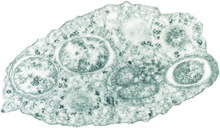
Transmission electron micrograph of Wolachia within an insect cell

Credit:  Public Library of Science/Scott O’Neill

The latest in the effort for world domination over bugs and the diseases they carry is Wolbachia, a Gram-negative bacterium of the family Rickettsiales first found in 1924 and in 60% of all the insects, including some mosquitoes, crustaceans, and nematodes (worms). For those that like numbers, that’s over 1 million species of insects and other invertebrates. It is one of the most infectious bacterial genera on earth and was largely unknown until the 90’s due to its evasion tactics. It’s favorite hosts are filarial nematodes and arthropods.

Wolachia obtains nutrients through symbiotic relationships with its host. In arthropods it affects reproductive abilities by male killing, parthenogenesis, cytoplasmic incompatibility and feminization. However, if Wolbachia is removed from nematodes, the worms become infertile or die. These abilities are what make it so appealing for insect control – cytoplasmic incompatibility, which essentially means it results in sperm and eggs being unable to form viable offering.

http://www.slideserve.com/babu/wolbachia  (Nifty slide show here)

It also makes it appealing for use in human diseases such as elephantiasis and River Blindness caused by filarial nematodes, which are treated with antibiotics (doxycycline) targeting Wolbachia which in turn negatively impacts the worms. Traditional treatment for lymphatic Filariasis is Ivermectin but they also use chemotherapy to disrupt the interactions between Wolbachia and nematodes. This anti-Wolbachia strategy is a game-changer for treating onchocerciasis and lymphatic filariasis.  https://www.sciencedaily.com/releases/2017/03/170316120451.htm

Lyme/MSIDS patients often have nematode involvement.

https://microbewiki.kenyon.edu/index.php/Wolbachia, https://www.psychologytoday.com/blog/emerging-diseases/200902/tick-menagerie-lyme-isnt-the-only-disease-you-can-get-tick  Both Willy Burgdorfer, the discoverer of the Lyme bacterium, as well as Richard Ostfeld, an animal ecologist found nematode worms in ticks. Since then, some provocative research involving nematodes, Lyme/MSIDS, dementia, and Alzheimer’s has been done.

https://madisonarealymesupportgroup.com/2016/06/03/borrelia-hiding-in-worms-causing-chronic-brain-diseases/, https://madisonarealymesupportgroup.com/2016/08/09/dr-paul-duray-research-fellowship-foundation-some-great-research-being-done-on-lyme-disease/, https://madisonarealymesupportgroup.com/2016/07/10/greg-lee-excellent-article-on-strategies-for-neurological-lyme/, https://madisonarealymesupportgroup.com/2015/10/18/psychiatric-lymemsids/

https://www.scientificamerican.com/article/how-a-tiny-bacterium-called-wolbachia-could-defeat-dengue/  Yet, according to many, Wolbachia is the next eradicator of Dengue Fever and possibly Malaria, chikungunya, and yellow fever because it stops the virus from replicating inside mosquitoes that transmit the diseases. The approach is also believed to have potential for other vector-borne diseases like sleeping sickness transmitted by the tsetse fly.  Evidently, Wolbachia does not infect the Aedes aegypti mosquito naturally, so researchers have been infecting mosquitoes in the lab and releasing them into the wild since 2011. The article states it hopes that the method works and expects infection rates in people to drop and hopes that the mosquitoes will pass the bacterium to their offspring, despite it disappearing after a generation or two of breeding and needing to “condition” the microbes to get them used to living in mosquitoes before injecting them. They also state Wolbachia is

“largely benign for mosquitoes and the environment,” and “To humans, Wolbachia poses no apparent threat.”

Their work has shown that the bacterium resides only within the cells of insects and other arthropods. They also state that tests on spiders and geckos that have eaten Wolbachia mosquitoes are just fine and show no symptoms. An independent risk assessment by the Commonwealth Scientific and Industrial Research Organizatioin (CSIRO), Australia’s national science agency, concluded that,

“Release of Wolbachia mosquitoes would have negligible risk to people and the environment.”

Interestingly, trials are underway in Vietnam, Indonesia, and now Brazil.

They state that scaling up operations to rear enough Wolbachia mosquitoes is too labor-intensive and in Cairns they are going to put Wolbachia mosquito eggs right into the environment. Evidently, other researchers are wanting to release genetically modified (GMO) mosquitoes that carry a lethal gene, and they’ve done it, and it’s causing an uproar:   http://america.aljazeera.com/articles/2013/11/9/genetically-modifiedmosquitoessetoffuproarinfloridakeys.html

http://www.naturalnews.com/2017-07-25-googles-sister-company-releasing-20-million-mosquitoes-infected-with-fertility-destroying-bacteria-depopulation-experiment.html  As of July 14, 2017, Google’s bio-lab, Verily Life Sciences,  started releasing Wolbachia laced mosquitoes in California as part of project, Debug Fresno to reduce the mosquito population.

http://www.greenmedinfo.com/blog/research-exposes-new-health-risks-genetically-modified-mosquitoes-and-salmon  Numerous studies show unexpected insertions and deletions which can translate into possible toxins, allergens, carcinogens, and other changes.  Science can not predict the real-life consequences on global pattens of gene function.

Even the European count decides CRISPR plants are GMOS and should be subjected to the same controls:  https://www.technologyreview.com/the-download/611716/in-blow-to-new-tech-europe-court-decides-crispr-plants-are-gmos/

“It means for all the new inventions … you would need to go through the lengthy approval process of the European Union,” Kai Purnhagen, an expert at Wageningen University in the Netherlands, told Nature.

So, why question the use of Wolbachia as a bio-control?

For Lyme/MSIDS & chronically ill patients, 3 words: worms and inflammation.

Dogs treated for heart worm (D. immitis) have trouble due to the heart worm medication causing Wolbachia to be released into the blood and tissues causing severe Inflammation in pulmonary artery endothelium which may form thrombi and interstitial inflammation. Wolbachia also activates pro inflammatory cytokines. Pets treated with tetracycline a month prior to heart worm treatment will kill some D. immitis as well as suppress worm production. When given after heart worm medication, it may decrease the inflammation from Wolbachia kill off.
http://www.critterology.com/articles/wolbachia-and-their-role-heartworm-disease-and-treatment

The words worms and inflammation should cause every Lyme/MSIDS patient to pause. Many of us are put on expensive anthelmintics like albendazole, ivermectin, Pin X, and praziquantel to get rid of worms and are told to avoid anything causing inflammation due to the fact we have enough of it already. We go on special anti-inflammatory diets and take systemic enzymes and herbs to try and lower inflammation.   https://madisonarealymesupportgroup.com/2016/04/22/systemic-enzymes/

Seems to me, many MSIDS/LYME patients when treated with anthelmintics, will have Wolbachia released into their blood and tissues causing wide spread inflammation, similarly to dogs.

And that’s not all.

According to a study by Penn State, mosquitoes infected with Wolbachia are more likely to become infected with West Nile – which will then be transmitted to humans.

“This is the first study to demonstrate that Wolbachia can enhance a human pathogen in a mosquito,“ one researcher said.

“The results suggest that caution should be used when releasing Wolbachia-infected mosquitoes into nature to control vector-borne diseases of humans.” “Multiple studies suggest that Wolbachia may enhance some Plasmodium parasites in mosquitoes, thus increasing the frequency of malaria transmission to rodents and birds,” he said.

The study states that caution should be used when releasing Wolbachia-infected mosquitoes into nature. https://www.sciencedaily.com/releases/2014/07/140710141628.htm

So besides very probable wide spread inflammation, and that other diseases may become more prevalent due to Wolbachia laced mosquitoes, studies show Wolbachia enhances Malaria in mosquitos. Lyme/MSIDS patients are often co-infected with Babesia, a malarial-like parasite that requires similar treatment and has been found to make Lyme (borrelia) much worse. It is my contention that the reason many are not getting well is they are not being treated for the numerous co-infections.  Some Lyme/MSIDS patients have Malaria and/or Babesia as well as Lyme.

Regardless of what the CDC states, all the doxycycline in the world is not going to cure this complicated and complex illness.

Lastly, with Brazil’s recent explosion of microcephaly, the introduction of yet another man-made intervention (Wolbachia laced mosquitos) should be considered in evaluating potential causes and cofactors. And while the CDC is bound and determined to blame the benign virus, Zika, there are numerous other factors that few are considering – as well as the synergistic effect of all the variables combined. Microcephaly could very well be a perfect storm of events.
https://madisonarealymesupportgroup.com/2016/12/21/how-zika-got-the-blame/, https://madisonarealymesupportgroup.com/2016/03/04/health-policy-recap/, https://madisonarealymesupportgroup.com/2016/03/08/fixation-on-zikapolio/

I hate bugs as much as the next person, but careful long-term studies of Wolbachia are required here.

https://www.ncbi.nlm.nih.gov/pubmed/20394659  “Despite the intimate association of B. burgdorferi and I. scapularis, the population structure, evolutionary history, and historical biogeography of the pathogen are all contrary to its arthropod vector.”

In short, borrelia (as well as numerous pathogens associated with Lyme/MSIDS), is a smart survivor.

While borrelia have been around forever with 300 strains and counting worldwide, epidemics, such as what happened with Lyme Disease in Connecticut are not caused by genetics but by environmental toxins – in this case, bacteria, viruses, funguses, and stuff not even named yet.

Circling back to Wolbachia.

Hopefully it is evident that many man-made interventions have been introduced into the environment causing important health ramifications: Wolbachia laced mosquitoes and eggs, GMO mosquitoes including CRISPR, and in the case of Zika in Brazil, whole-cell pertussis vaccinations (DTap) for pregnant women up to 20 days prior to expected date of birth, a pyriproxyfen based pesticide applied by the State in Brazil on drinking water, as well as aerial sprays of the insect growth regulators Altosid and VectoBac (Aquabac, Teknar, and LarvX, along with 25 other Bti products registered for use in the U.S.) in New York (Brooklyn, Queens, Staten Island, and The Bronx) to combat Zika. “We feel it’s critical that the scientific community consider the potential hazards of all off-target mutations caused by CRISPR, including single nucleotide mutations and mutations in non-coding regions of the genome … Researchers who aren’t using whole genome sequencing to find off-target effects may be missing potentially important mutations. Even a single nucleotide change can have a huge impact.”  http://articles.mercola.com/sites/articles/archive/2017/06/13/crispr-gene-editing-dangers.aspx?utm_source=dnl&utm_medium=email&utm_content=art3&utm_campaign=20170613Z1_UCM&et_cid=DM147520&et_rid=2042753642

All of this is big, BIG business.

Is the introduction of Wolbachia another puzzle piece in the perfect storm of events causing or exacerbating human health issues?

BTW:  Since 2017, ZAP Males® which are live male mosquitoes infected with the ZAP strain, a particular strain of the Wolbachia bacterium have a time-limited registration allowing them to be sold for five years in the District of Columbia and the following 20 states: California, Connecticut, Delaware, Illinois, Indiana, Kentucky, Massachusetts, Maine, Maryland, Missouri, New Hampshire, New Jersey, Nevada, New York, Ohio, Pennsylvania, Rhode Island, Tennessee, Vermont, and West Virginia.

Infected males mate with females, which then produce offspring that do not survive. (Male mosquitoes do not bite people.) https://www.ncipmc.org/connection/?p=4065

The jury’s still out, but it’s not looking good – particularly for the chronically ill.