Archive for the ‘research’ Category

Study Shows Tick Infection & Transmission Potential for Both DTV & WNV

https://www.liebertpub.com/doi/abs/10.1089/vbz.2017.2224#utm_source=ETOC&utm_medium=email&utm_campaign=vbz

Generation of a Lineage II Powassan Virus (Deer Tick Virus) cDNA Clone: Assessment of Flaviviral Genetic Determinants of Tick and Mosquito Vector Competence

Kenney Joan L. , Anishchenko Michael , Hermance Meghan , Romo Hannah , Chen Ching-I , Thangamani Saravanan , and Brault Aaron C.
Published Online:1 Jul 2018https://doi.org/10.1089/vbz.2017.2224

Abstract

The Flavivirus genus comprises a diverse group of viruses that utilize a wide range of vertebrate hosts and arthropod vectors. The genus includes viruses that are transmitted solely by mosquitoes or vertebrate hosts as well as viruses that alternate transmission between mosquitoes or ticks and vertebrates. Nevertheless, the viral genetic determinants that dictate these unique flaviviral host and vector specificities have been poorly characterized. In this report, a cDNA clone of a flavivirus that is transmitted between ticks and vertebrates (Powassan lineage II, deer tick virus [DTV]) was generated and chimeric viruses between the mosquito/vertebrate flavivirus, West Nile virus (WNV), were constructed. These chimeric viruses expressed the prM and E genes of either WNV or DTV in the heterologous (from one species to another) nonstructural (NS) backbone. Recombinant chimeric viruses rescued from cDNAs were characterized for their capacity to grow in vertebrate and arthropod (mosquito and tick) cells as well as for in vivo vector competence in mosquitoes and ticks.

Results demonstrated that the NS elements were insufficient to impart the complete mosquito or tick growth phenotypes of parental viruses; however, these NS genetic elements did contribute to a 100- and 100,000-fold increase in viral growth in vitro in tick and mosquito cells, respectively. Mosquito competence was observed only with parental WNV, while infection and transmission potential by ticks were observed with both DTV and WNV-prME/DTV chimeric viruses. These data indicate that NS genetic elements play a significant, but not exclusive, role for vector usage of mosquito- and tick-borne flaviviruses.

________________

**Comment**

I’m no microbiologist and without the full article and better understanding of what this NS backbone is, 

The study shows 4 things:

  1.  The NS elements gave a 100 fold “test tube” increase in viral growth in tick cells.  These organisms are extremely fastidious and difficult to study in a lab.  It’s even tougher to figure out how this plays out in the human body.
  2. INFECTION & TRANSMISSION potential by ticks was observed with both DTV and WNV.  Read that sentence again.
  3. Why didn’t this make the news?
  4. Mosquitoes are nasty but ticks are a whole other monster.  Mosquito research gets all the money.  Why?

http://www.dutchessny.gov/CountyGov/Departments/Legislature/2017Auerbach.pdf  This pdf by Lyme Advocate Jill Auerbach shows that while there were only 5,700 cases of WNV in 2012, research dollars were $29 million, whereas, Lyme cases in 2012 were 312,000 but received only $25 million.  While the number of the infected continue to soar the research dollars for Lyme are radically reduced in successive years:

Disease New Cases (annual) NIH Funding
 

Hepatitis C 2012


1,300


$112 million

West Nile Virus 2012

5,700

$29 million

HIV/AIDS 2012

56,000

$3 billion (11% total NIH budget)

Influenza 2012

73,000

$251 million

Lyme disease 2012

312,000

$25 million

Lyme disease 2013

363,070

$20 million

*Lyme disease 2004             198,040                                  $34.4 million

Disease

      New Cases 2015

CDC funding 2016

Lyme Disease

           380,690  (10 x 38,069)
2016 numbers not yet available

 $10 million

This does NOT include other Tick-borne diseases

Houston, we have a problem.


Rocky Mountain Spotted Fever (RMSF)

Since the recent death of a Wisconsin resident due to Rocky Mountain Spotted Fever (RMSF) it’s important we understand this pathogen as it’s in our neck of the woods:  https://madisonarealymesupportgroup.com/2018/07/10/first-rmsf-death-in-wisconsin/

The following article by doctors Lapenta (father & son) explains how devastating this particular tick borne illness is and what you need to know about it.

http://dermagicexpress.blogspot.com/2018/05/the-rocky-mountain-spotted-fever-and.html?m=1

THE ROCKY MOUNTAIN SPOTTED FEVER AND THE NEW PLAGUE OF THE 21ST CENTURY, THE TICKS
rocky

ABSTRACT

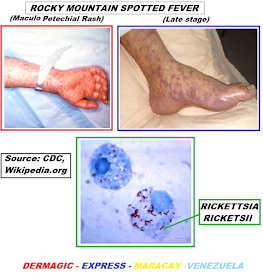
In this publication we bring you another disease caused by the bite of several TICKS; it is the ROCKY MOUNTAIN SPOTTED FEVER, which is caused by a bacterium called Rickettsia Rickettsii, and also another recently discovered the Rickettsia Parkeri. This disease, described since the 1900s, is disseminated in North America, from Canada to South America. The purpose of this publication is to know the main vectors of the disease, how it is transmitted, its symptoms, treatment and to give warning to the world once again that these parasites, ticks are the new plague of the 21st century.

Key words: Rocky Mountain Spotted Fever, spotted fever, Typhus by ticks, Black measles, Dermacentor Andersoni, Dermacentor Variabilis, Rhipicephalus Sanguineus, Rickettsia Rickettsii, Rickettsia Parkeri.

INTRODUCTION

Hello friends of the network, today DERMAGIC EXPRESS brings you another interesting topic about the TICKS and the diseases they transmit, in this case it is the ROCKY MOUNTAIN SPOTTED FEVER (RMSF), which as I said is transmitted by the a tick bite and disseminated not only in the United States, has also been described in the AMERICAS under the name of “Sao Paulo fever” or “Fever maculosa” in BRAZIL; In MEXICO “Spotted fever” and “tick Typhus” or “Tobia Fever” in COLOMBIA. Cases have also been described in Costa Rica and Panama. [1-5]

This disease is produced by the BACTERIA called Rickettsia Rickettsii; gram-negative intracellular cocobabicil considered the most pathogenic strain of the Western Hemisphere and a small part of the Eastern Hemisphere. It belongs to the Rickettsiaceae Family, Order: Rickettsiales, Class: Alphaproteobacteria, Domain: Bacteria, Genus: Rickettsia and species: Rickettsia rickettsii. The disease extends from CANADA to SOUTH AMERICA, and is the most frequent rickettisial disease in the United States. [6-11]
rocky4

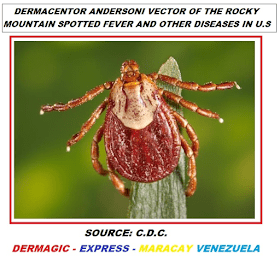
The main TICK transmitter of this bacterium are the ticks of the DERMACENTOR genus, Family Ixodidae, known as “HARD TICKS” which, in addition to transmit the Rickettsia rickettsii, are transmitters of other diseases such as: TICK PARALYSIS (neurotoxin); the POWASSAN virus (Powassan encephalitis); THE FEVER Q (Coxiella burnetii); ANAPLASMOSIS in cattle and humans (Anaplasma Marginale and Anaplasma spp.); TULAREMIA (Francisella tularensis) and the BABESIOSIS in  equine (piroplasmosis) and humans  (Babesia Caballi and Babesia spp.). [12-18]

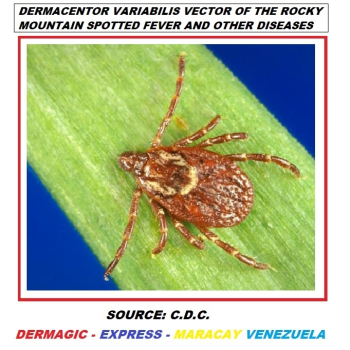
The DERMACENTOR genus of ticks belongs to the Ixodidae Family and has more than 34 described species and the most involved in the ROCKY MOUNTAIN SPOTTED FEVER are DERMACENTOR ANDERSONI (Rocky mountain tick) and DERMACENTOR VARIABILIS (American dog tick), second main vector causing this disease.
rocky1

Of this “hard tick” (DERMACENTOR VARIABILIS) I can say to you that in addition to transmit the ROCKY MOUNTAIN SPOTTED FEVER, it is transmitter of TULAREMIA (Francisella tularensis). They can also be carriers of the Anaplasma phagocytophilum that causes the HUMAN GRANULOCYTIC ANAPLASMOSIS, and Ehrlichia chaffeensis, causal agent of the HUMAN MONOCITIC EHRLICHIOSIS; and in addition they can produce TICK PARALYSIS when introduce a NEUROTOXIN when  are feeding with human blood.

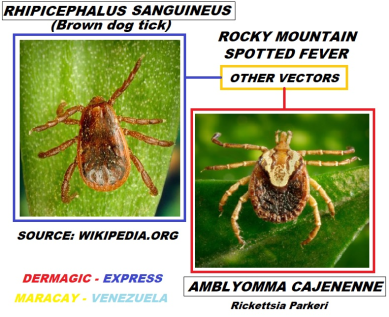
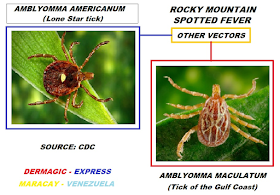
In addition to the DERMACENTOR VARIABILIS and ANDERSONI TICKS as vectors of the ROCKY MOUNTAIN SPOTTED FEVER (RMSF), other species have been described: RHIPICEPHALUS SANGUINEUS (brown tick of the dog), AMBLYOMMA CAJENNENSE (Cayena tick) which is disseminated in South and Central America, AMBLYOMMA AMERICANUM (Lone Star Tick) and AMBLYOMMA MACULATUM (Tick of the Gulf Coast) involved in the transmission of this disease. [1-22]
rocky2

On the other hand, it was discovered in the year 2002 and confirmed in 2013 another species of Rickettsia, the Rickettsia Parkeri in the tick AMBLYOMMA MACULATUM and recently in the tick AMBLYOMMA AMERICANUM capable also of transmit the ROCKY MOUNTAIN SPOTTED FEVER (RMSF).

In addition, it has been demonstrated in the tick DERMACENTOR VARIABILIS AND RETICULATUS antibodies against BORRELIA BURGORFERI which is the causal agent of the already described LYME DISEASE or ERITHEMA MIGRANS, but they are not considered vector of it.
rocky3
HISTORY

The disease ROCKY MOUNTAINS SPOTTED FEVER, is also known under the name “TYPHUS BY TICKS”, and “BLUE DISEASE” and was described in the years 1800 and 1900 in the Valleys of Montana United States, (US), known at that time as “Black measles” for its clinical characteristics. Later it was discovered that the ticks were the vector of the same one and it was in the year 1906, when the scientist Howard T. Ricketts discovered the causal agent, described as an agent “smaller than a bacterium and longer than a virus”; it was called RICKETTSIA RICKETSII in honor of its name. [22-30]

We must remember that Willy Burgdorfer is intimately linked to the ROCKY MOUNTAIN SPOTTED FEVER and study of the Rickettsias; In fact, between 1967 and 1978, he was investigating the Rickettisial Zoonoses in Egypt and then he was sent by the WHO (1976-1986 – World Health Organization) to Montana, United States, and in the course of his investigations he discovered the FEARED ESPIROCHETE BORRELIA, in the year 1981, which carries in its honor the surname BURGODERFERI.

These ticks are the NATURAL HOSTS and they serve as RESERVOIRS AND VECTORS, they transmit the RICKETTSIA through the bite to vertebrates mammals and man, and unlike other diseases they only need to be attached 2 hours to the skin to achieve the transmission of the disease, so that it is a ZOONOSIS, transmitted from animals to man. It can also be transmitted through fluids, tick feces and contaminated tissues of the same.

SYMPTOMS

Symptoms of the disease appear after an incubation period of 1 to 2 weeks, (can affect children and adults) and include threee stages:

1.) INITIAL phase: fever, headache, nausea, vomiting, loss of appetite, mumps,

2.) SECONDARY phase: characterized by maculous and petechial rash, abdominal pain, conjunctivitis and joint pain.

3.)  POSTERIOR or LATE stage: the  Rickettsia may invade the brain, heart, eyes, lungs, kidneys, gastrointestinal tract, and other organs causing definitive sequel such as: deafness, ataxia, blindness, and loss of bladder and bowel control; in extreme cases amputation of limbs by gangrene. Mortality in severe cases: 30-80%

The “CLASSICAL TRIAD” of this disease in terms of symptoms is: 1) FEVER, 2) MACULOUS AND PETECHIAL ERUPTION AND 3) THE PRECEDENT OF TICK BITE; it should be noted that only 35 to 60% of patients manifest the complete TRIAD, and 40% do not present the TYPICAL rash of the disease; it is presented in a centripetal form, from the extremities to the trunk. [1-32]

TREATMENT

The treatment of choice for THE ROCKY MOUNTAIN SPOTTED FEVER (RMSF) is the  DOXYCYCLINE (tetracycline antibiotic), the same used in the LYME disease and EHRLICHIOSIS, which is administered for a period of 10 to 14 days, and in some cases may be more longer. The other antibiotic that shows effectivity against Rickettsia is  the CHLORANPHENICOL, but this should be used with caution as it has many side effects.

With this I want to tell you in a simple way how seven (7) TICKS are capable of transmit nine (9) diseases:

Including the ticks of the Family ixodidae: IXODES SCAPULARIS or the black legged tick.

1) ROCKY MOUNTAIN SPOTTED FEVER (Rickettsia Rickettsii).

2) POWASSAN ENCEPHALITIS (Powassan virus, flavivirus).

3) TICK PARALYSIS (neurotoxin).

4) EHRLICHIOSIS (Ehrlichia chaffeensis, Ehrlichia ewingii).

5) HUMAN GRANULOCYTIC ANAPLASMOSIS (Anaplasma spp)

6) BABESIOSIS IN ANIMALS AND HUMANS (Babesia spp).

7) FEVER Q (Coxiella burnetti).

8) TULAREMIA (Francisella tularensis).

9) LYME DISEASE (Ixodes Scapularis). 1-32]

“… perhaps other diseases …. Today not well documented or simply man has not discovered yet.”

CONCLUSIONS

On the web you can find thousands of articles about the ROCKY MOUNTAIN SPOTTED FEVER, HISTORY AND SYMPTOMS, but for us the main objective of this publication is to make you UNDERSTAND the following:

1) These TIICKS are distributed practically in the entire PLANET.

2) Transmit parasitic diseases with risk of MORTALITY if the diagnosis and treatment is not made in time.

3) Some of the transmitted diseases are RESISTANT to treatment such as LYME disease, leaving permanent sequel in the body, being able to confine the patient to a wheelchair for life.

4) Apart from fighting for the human rights of the unassisted for diseases such as LYME, the final destination is to fight against the TICKS and their HOSTS.

5) THE CODES ICD-11 (International Classification of Diseases, year 2018) for this disease, Rocky Mountain Spotted Fever have been recognized by the World Health Organization (WHO) a long time ago, but  in some cases as the Lyme disease, the scientific society and affected population awaits its inclusion.

6) The new plague of the 21st century is not the mosquitoes (Dengue, Zika and Chikungunya), they are TICKS. [33-38]

“… Humanity is not going to be extinguished by atomic bombs thrown into the air, atomic bombs walk in the earth attached to animals, mice, rats, birds, coyotes, deer, dogs, cats, cattle, goats, camel sheep, rabbits, etc, or the humans, feeding on his blood, contaminating and spreading vertiginously, slowly creating a incapacitated society … “

Greetings to all.

Dr. José Lapenta R Dermatologist
Dr. José M. Lapenta MD.
__________________

For more on RMSF:  https://madisonarealymesupportgroup.com/2017/10/21/mom-got-rocky-mountain-spotted-fever-while-picking-pumpkins/

https://madisonarealymesupportgroup.com/2015/08/13/severe-case-of-rmsf-had-to-remove-patients-arms-and-legs/

https://madisonarealymesupportgroup.com/2018/08/16/new-tick-causes-epidemic-of-rmsf/

https://madisonarealymesupportgroup.com/2018/06/12/georgia-mom-warns-others-after-son-contracts-rocky-mountain-spotted-fever-after-tick-bite/

https://madisonarealymesupportgroup.com/2018/08/19/monster-ticks-found-in-germany-threaten-europe-with-deadly-disease-crimean-congo-fever/  Please note the last quote of the story – that they proved a tropical form of tick typhus in one of tropical ticks found in Germany. Typhus, a bacteria, is making a comeback, particularly in the South. Common in the U.S. in the 40’s, and normally attributed to lice, now it’s been proven to be in a tick. In other words, another disease and a tick found where they supposedly shouldn’t be.
Typus is a rickettsial infection with ticks carring numerous species including rickettsia, ehrlichia, and anaplasma. Rocky Mountain Spotted Fever is also considered a tick-borne typhus fever. https://www.health.ny.gov/diseases/communicable/rocky_mountain_spotted_fever/fact_sheet.htm  Divided into the typhus group and the spotted fever group, disease is transmitted through ectoparasites (fleas, lice, mites, and ticks). Inhalation and inoculating conjunctiva with infectious material can also cause disease. The good news for most is that doxycycline is a front-line drug for it. Broad-spectrum antibiotics aren’t helpful.


 

Tickborne Relapsing Fever in Austin, TX

https://www.ncbi.nlm.nih.gov/pubmed/30160650

Emerg Infect Dis. 2018 Nov 17;24(11). doi: 10.3201/eid2411.172033. [Epub ahead of print]

Detection of Tickborne Relapsing Fever Spirochete, Austin, Texas, USA.

Abstract

In March 2017, a patient became febrile within 4 days after visiting a rustic conference center in Austin, Texas, USA, where Austin Public Health suspected an outbreak of tickborne relapsing fever a month earlier. Evaluation of a patient blood smear and molecular diagnostic assays identified Borrelia turicatae as the causative agent. We could not gain access to the property to collect ticks. Thus, we focused efforts at a nearby public park, <1 mile from the suspected exposure site. We trapped Ornithodoros turicata ticks from 2 locations in the park, and laboratory evaluation resulted in cultivation of 3 B. turicatae isolates. Multilocus sequencing of 3 chromosomal loci (flaB, rrs, and gyrB) indicated that the isolates were identical to those of B. turicatae 91E135 (a tick isolate) and BTE5EL (a human isolate). We identified the endemicity of O. turicata ticks and likely emergence of B. turicatae in this city.

_______________

**Comment**

For decades there has been complete denial of Lyme in the South.  Dr. Masters fought this tooth and nail:  https://madisonarealymesupportgroup.com/2017/10/06/remembering-dr-masters-the-rebel-for-lyme-patients-who-took-on-the-cdc-single-handedly/

https://madisonarealymesupportgroup.com/2018/05/31/no-lyme-in-the-south-guess-again/

https://madisonarealymesupportgroup.com/2016/10/25/hope-for-southerners/

https://madisonarealymesupportgroup.com/2018/08/18/lyme-found-in-all-50-states/

TBRF has been found in Austin, TX caves:  https://madisonarealymesupportgroup.com/2018/04/23/tick-borne-relapsing-fever-found-in-austin-texas-caves/

Thankfully more and more is coming out revealing that in fact these poor patients and the doctors who dare to treat them are not delusional but are in fact dealing with tick borne illness.  The Lyme-like illness that for all intents and purposes looks, smells, and acts just like Lyme, is caused by something that needs to be identified.  We need to quit focusing on the red herring of climate change and start identifying these bugs so people can get better.

Bartonella isn’t even on the radar yet it is a HUGE player:  https://madisonarealymesupportgroup.com/2016/12/29/cardinal-state-bartonella/

https://madisonarealymesupportgroup.com/2018/05/07/fox-news-bartonella-is-the-new-lyme-disease/

https://madisonarealymesupportgroup.com/2016/01/03/bartonella-treatment/  Various strains have been found in eye fluid, the heart (myocarditis and endocarditis), and cysts, and can infect by nearly anything puncturing the skin and exchanging bodily fluids – including needles. Evidence also suggests congenital transmission.…. Symptoms are largely associated with where the blood flow is compromised. The reason many have pain in the soles of their feet is due to inflammation caused by microvascular trauma. It has been known to cause cysts around dental roots leading to chronic and hard to diagnose head and face pain as well as root canals. This microvascular trauma is also to blame for brain issues causing psychological issues such as anxiety, anger, and suicidal thoughts, since the small vessel disease affects executive function. A cog is literally caught in the wheel. As neurotransmitters become depleted due to overstimulation, depression rears its ugly head. A vicious cycle ensues.  Due to the cyclical nature of Bartonella and that it exists in very low amounts in human blood, blood tests are unreliable. It also has a long division time between 22-24 hours and requires a special growth environment. There is a Triple Draw through Galaxy which collects blood over 8 days to maximize the test, stating a 90% reduction in false negatives.


Personal Costs of Lyme Disease to Americans

https://shoutout.wix.com/so/87MNE-P__?cid=3be50b05-a5b9-47a1-a8f8-c12174cf82c1&region=cb36eb27-d7d9-4cca-8fce-c3400909d73a#/main

CIC Tick-borne Illness Preliminary Survey Results

Initial data from the Climate Impact Census contains some striking numbers on the personal costs of Lyme disease to Americans.

Some preliminary findings from our tick-borne illness survey include:

  • More than half reported having spent at least $30,000, and one-third at least $75,000, on medical-related expenditures over the course of their illness. A little over 10% reported spending more than $200,000


  • In addition to these high out-of-pocket medical expenses, the most common hardships from tick-borne illnesses reported were debt (credit card, friends, family or others); liquidated assets (e.g. homes, retirement savings); terminated or interrupted careers; lost relationships; and reliance on public assistance (e.g. disability, unemployment)


  • 60% reported suffering at least two of these hardships; 40% at least three; and 15% at least four.


  • More than half reported becoming in debt as a result of their illness


  • 40% had sold off assets (e.g. homes), liquidated some or all of their retirement savings, or liquidated some or all of their children’s college funds.


  • 45% lost their careers, and over 60% experienced some form of career loss or interruption.


And the press is paying attention. A recent Op-ed in the science publication, Undark, recently used the Climate Impact Census to illustrate the depth of financial harm to individuals caused by Lyme disease, and called for more research funding. You can read the article here:  https://madisonarealymesupportgroup.com/2018/09/11/as-the-threat-of-lyme-disease-rises-why-hasnt-research-funding-followed-suit/

You can also hear the two directors of the Climate Cost Project interviewed about the project and the importance of getting more data on the personal costs of Lyme disease on WHMP radio here:  https://soundcloud.com/whmp/estimating-the-cost-of-lyme-disease

If you have any friends or family who have been affected by Lyme disease, please help spread the word by sending them the survey:

https://www.climatecostproject.org/cic-individual

_________________

**Comment**

This survey has revealed what all of us out here in Lyme land know – Lyme/MSIDS costs us nearly everything we have.  If you have not taken the time to fill out the survey, please do.  The more data, the more accurate the picture.

According to independent tick researcher, John Scott, ticks and Lyme are NOT propelled by climate.

For more on this:  https://madisonarealymesupportgroup.com/2018/08/13/study-shows-lyme-not-propelled-by-climate-change/

Scott and his wife Kit have been infected for decades and have everything to gain from getting to the bottom of this mess.  The article points out many other factors such as light (photo period) and migrating birds.

He also explains how the climate issue is not innocent.

https://madisonarealymesupportgroup.com/2017/08/14/canadian-tick-expert-climate-change-is-not-behind-lyme-disease/  John explains, “The climate change range expansion model is what the authorities have been using to rationalize how they have done nothing for more than thirty years. It’s a huge cover-up scheme that goes back to the 1980’s. The grandiose scheme was a nefarious plot to let doctors off the hook from having to deal with this debilitating disease. I caught onto it very quickly. Most people have been victims of it ever since.”

“This climate change ‘theory’ is all part of a well-planned scheme. Even the ticks are smarter than the people who’ve concocted this thing,” he says.

“Climate change has nothing to do with tick movement. Blacklegged ticks are ecoadaptive, and tolerate wide temperature fluctuations.


Lyme Testing Problems & Solutions

https://www.linkedin.com/pulse/lyme-testing-problems-solutions-malia-mcclean/

Lyme testing problems and solutions

storm

Published on

The testing validity measures sensitivity and specificity are both referred to with regard to testing and depending on which you are speaking about what is said about the test may sound very different and confusing. In this case I am talking about the C6 Elisa test and when I speak of the validity of the test I basically mean does the test accomplish what it sets out to do (i.e. is it an accurate test).
Sensitivity is simply a reflection of how many patients with the disease test positive.
So with the C6 Elisa its around 50% sensitive (in the context of the two tiered testing system on its own it has a sensitivity of 75%) because it misses about half of true positive cases. Meaning 50% of the people tested who do have Lyme will test negative. So your odds of testing positive are about 50%. Not great at all, about the same as flipping a coin.
Specificity is a measure of your false positive rate.
So with the C6 Elisa it has a Specificity 98.5%, it is very specific and only comes up with a false positive result 1.5% of the time. Meaning if you do happen to test positive for Lyme it is highly probable that you do in fact have Lyme because the test doesn’t often make a mistake of identification. – Excellent.
So you can see if you are talking about the C6 Elisa Specificity you will say it’s excellent but if you are talking about it’s Sensitivity you could say its terrible and both would be true. Sensitivity and Specificity are relative terms so ideally for a test to be very valid you would want it to have both high Sensitivity and Specificity.
Also keep in mind that these numbers are not taking into consideration the large percent of Sero Negative patients who would have been excluded at the outset of analytical testing making these numbers in reality much lower. These numbers are just to give you an idea of the state of testing but it is important to note that the case definition needs to be changed first to encompass all of us with lyme in order for any change in testing to be of real value. If the samples being used to validate the testing are only from people with the HLA genes (the people who test positive on traditional testing) you can see how this would skew all the results so its paramount that the case definition be changed to include all sero negative cases as well as as describing Neurological Lyme as it truly is first and then to move on to testing).


I find parables helpful so this is an example I made up to help clear it up (Keep in mind this is just an illustration to help you visualize the difference between Specificity and Sensitivity).

So say there are 6 people fishing in a pond full of bug-eyed-brown fish. All 6 fishermen are trying to catch this specific type of fish. They have heard that the bug-eyed brown is very attracted to the flint worm and has great success in getting the bug-eyed-brown to bite. So imagine the flint worm on the hook is the test and we want to know if the test is valid and if it does what it intends to do (in this case lure bug-eyed-browns to bite the worm/hook). After an hour of fishing 3 of the 6 fisherman hooked the right fish the bug-eyed-brown and the 3 others hooked nothing. The specificity is 100% because it only attracted the right kind of fish each time it managed to hook one and never attracted the wrong kind of fish (so 0% false positives) but the sensitivity is only 50% because 3 of the 6 times the flint worm wasn’t able (or sensitive) enough to catch it at all (so missed 50% of true positives).

Problematic areas of Lyme testing

First Tier ELISA:

As stated above the Elisa has terrible sensitivity and misses at least half of true cases of lyme. This is a big problem, and this fact alone should exclude it from being used as a screening test because screening tests are to have 95% accuracy and it is far from that. The fraud comes in when you look at why this validity measure uses 5 standard deviations above baseline noise for a positive when the standard for testing measures is 3. The idea is to capture the lowest level of the analyte in question, not the highest. They have purposely increased the cut off to miss everyone who has neurological lyme (the 85%). This test is only good for people who have an autoimmune HLA link to Lyme disease (approx 15%) as these people are genetically predisposed to produce more antibodies and therefore do not get the immune suppression and neurological symptoms the rest of us get. The people who test positive are ironically the ones who really aren’t sick other than a bad knee (Lyme arthritis). This is how after the Dearborne conference, where the case definition was fraudulently changed to a very narrow set of criteria that lyme came to be associated with arthritis, namely an arthritic knee, when in reality that is the very least of the symptoms most lyme patients encounter.

https://www.ncbi.nlm.nih.gov/pubmed/11532615 These results suggest that the presence and or lack of production of specific antibody to Bb infection may be associated with particular HLA specificities of the Class II.

Nine out of the 22 seropositive LD patients (40.9%) had HLA-DRB1*0701, *0703, *0704 (HLA-DR7); only 1 out of the 18 seronegative LD patients (5.6%) had HLA-DR7 (odds ratio (OR)=11.8, P=0.0126). HLA-DRB1*01021 and HLA-DRB1*0101, *0104, *0105 (HLA-DR1) contributed negatively to anti-Bb antibody production. Seven of 18 seronegative LD patients had HLA-DR1, only 1 of 22 seropositive LD patients had HLA-DR1 (38.9% vs. 4.5%, OR=13.4, P=0.0138). These results suggest that the presence and or lack of production of specific antibody to Bb infection may be associated with particular HLA specificities of the Class II.

In addition, most doctors give this test right away when someone arrives with a tick bite and the body requires weeks to create the antibodies needed to pop a positive on this test so this is a big problem as well. The rationale they use with the two tiered system for adding in the Western Blot is that it will reduce the false positives (people testing positive who don’t have the disease) as you can see the problem with the Elisa is the opposite, that is has a high rate of false negatives (telling people they don’t have lyme when they in fact do) so this in my opinion is a fraudulent scientific message as well when you consider that there is a 50% chance of a false negative and only 1.5% chance of a false positive.

Second Tier Western Blot:

As you can see the Western Blot also has many problems with sensitivity at all stages but especially within the first month and again later on the more chronic it becomes. If you take the terrible sensitivity of both tests in the two tiered system you will start to see how testing positive consecutively on both is very unlikely, mathematically improbable and biologically almost impossible unless you are in the HLA autoimmune group which is comparatively rare. The other bit of insanity with antibody tests like this is that within 10 days of infection the germinal centres where B cells are assigned an immune duty have been shut down. B cells normally mature into antibody secreting cells, however in the presence of lyme they do not mature properly and therefore are functionally unable to produce the amount of anitbodies required to pop a positive. Quote below taken from Suppression of Long-Lived Humoral Immunity Following Borrelia burgdorferi Infection ttps://doi.org/10.1371/journal.ppat.1004976

"Germinal centers (GC) are main immune response outcomes that usually develop in secondary lymphoid tissues after infections. They are required for development of long-lived plasma cells, which provide ongoing protection by continuous antibody secretion. They also induce recirculating memory B cells, which respond quickly to reinfection with differentiation and production of high affinity antibodies [23]. Germinal centers do form in Bb-infected lymph nodes at around two week after infection, but then rapidly involute over the next two weeks [22].

Here we tested the functionality of the GC responses to B. burgdorferi. We demonstrate that following infection of mice with Bb, GC are structurally abnormal and long-lived plasma cells and B cell memory, normal outputs of GC responses, fail to develop for months after infection rendering mice susceptible for reinfection with the same strain of Bb. When mice were infected with Bb, vaccination with influenza antigens failed to induce protective anti-viral immunity, revealing that Bb-infection actively inhibits long-term humoral immune response development"  https://journals.plos.org/plospathogens/article?id=10.1371/journal.ppat.1004976

Additionally due to antigenic variation the bands, which are protein antigens, are able to change their outer surface once the immune system is on to their presence, so the bands are always changing in an attempt to elude the immune system, which means western blotting bands will be different at any given period. How can you test someone using a static measurement criteria such as the CDC criteria for something that is constantly in flux? You can’t!

I liken the two tiered testing for lyme to giving a blind person a vision test then telling them they can see – it’s madness!

Other Lyme tests:

Nanotrap Urine Test:

This is a DNA test and is good IF and only if there happens to be DNA in the urine sample which may or may not be the case. So if found then you can say with certainty that the person has lyme but if negative it is quite worthless much like the ELISA.

Blood Culture Testing:

Lyme is notorious for being difficult to culture and as you can see from the image above taken from J Clin Microbiol. 2005 Oct; 43(10): 5080–5084 that the sensitivity of such methods are low. Blood cultures while definitive if positive are really also quite futile if negative, as Lyme once disseminated does not hang out in the blood as much as in tissues, bone, brain etc.

The Solution Band 41 test.

The band 41 test that is patent owned by Yale reserachers is an excellent diagnostic test for Lyme (See patent below)

Band 41 is highly immunogenic meaning even people with a suppressed immune system as in those of us with Neurological lyme can often still produce this band. Band 41 is also not subject to antigenic variation being the flaggelar (tail) region of the Spirochete. Quote below from J Clin Invest. 1986 Oct;78(4):934-9 . The antigens (bands) are always varying even late in the disease which makes it scientifically nonsensical to use a standard criteria for all but band 41. The emphasis in the quote below is on lyme being “alive” throughout the disease, meaning it is always changing in response to threats from the immune system.

The IgG response in these patients appeared in a characteristic sequential pattern over months to years to as many as 11 spirochetal antigens.The appearance of a new IgM response and the expansion of the IgG response late in the ilnness, and the lack of such responses in patients with early disease alone, suggest that B. burgdorferi remains alive throughout the illness.
https://www.ncbi.nlm.nih.gov/pubmed/3531237

In early-stage borreliosis, the 41,000-molecular-weight flagellin protein (41K) of Borrelia burgdorferi was the major antigen detected by antibodies in sera, but the specificity of the reaction pattern was dependent on the intensity of the band. The evaluation of different interpretation rules based on a semiquantitative record of band intensities showed the highest specificity (96%) and a corresponding sensitivity of 78% if there was at least one distinct (optical density range, 0.2 to 0.4) immunoglobulin G and immunoglobulin M reaction with the 41K band.

https://www.readbyqxmd.com/read/1993754/validity-of-western-immunoblot-band-patterns-in-the-serodiagnosis-of-lyme-borreliosis

Consequently there are a few aspects that make it a very good diagnostic test; the fact that band 41 is more immunogenic (causes a more robust immune reaction) and that it isn’t subject to antigenic variation. Additionally, band 41 is one of the first bands to appear and therefore can be used to diagnose earlier in the disease which is an enormous benefit as clearly early disagnosis and treatment is paramount. The sensitivity and specificity are an improvement over current methods and should be utilized. See sensitive and specificity break down from the band 41 test below.

The sensitiv- ity of the two-step process for patients with erythema migrans or with later manifestations of Lyme disease was 64% and 100%, respectively. The specificity for healthy blood donors was 100% and was 90% for the aggregate of all persons with illnesses that may cause serologic cross-reactivity(98% if the samples from relapsing fever patients were excluded). Test precision was 96% overall,99% for Lyme disease case serum samples, 100% for specimens from blood donors, and 88% for samples from persons with other illnesses.
 In early-stage borreliosis, the 41,000-molecular-weight flagellin protein (41K) of Borrelia burgdorferi was the major antigen detected by a
ntibodies in sera
One has to wonder why Yale didn’t want to use a test that they patented that would capture the vast majority of lyme patients.
However as I see it if they utilized this test to validate their Lyme vaccine the results would show that their so called vaccine was in fact the opposite of a vaccine and induced the very disease it was supposed to protect the person from, as was the case for many people who were injured by the first Lyme vaccine Lymerix which was taken off the shelf.

I can not fathom any other reason why they would not use a test they owned that has 96% accuracy overall and 100% specificity.

The answer can only be fraud.

______________

For more on testing:  https://madisonarealymesupportgroup.com/2017/08/15/reliability-of-lyme-testing/

https://madisonarealymesupportgroup.com/2018/09/08/whats-the-best-test-for-lyme-dr-rawls/

https://madisonarealymesupportgroup.com/2018/01/16/2-tier-lyme-testing-missed-85-7-of-patients-milford-hospital/

https://madisonarealymesupportgroup.com/2018/09/02/particles-may-be-the-answer-to-accurate-lyme-disease-detection/

https://madisonarealymesupportgroup.com/2018/08/06/lyme-nanotrap-test-granted-breakthrough-device-designation-by-fda/

https://madisonarealymesupportgroup.com/2018/08/08/ny-grants-approval-of-igenexs-lyme-immunoblot-tests/