Archive for the ‘research’ Category

Looking For Dog and Cat Owners For An Online Survey About Ticks

https://uwveterinarycare.wisc.edu/wp-content/uploads/2020/04/Online-Tick-Survey.pdf

iu-58

The Study

The purpose of this research study is to better understand how getting a dog or cat might change your use of tick prevention methods, your exposure to ticks, and how you think about these topics. We are doing this research because Lyme disease is the most common tick transmitted disease in the United States and Wisconsin, and pet owners nd ticks on themselves more often than people who don’t own pets.

Who Qualifies

Anyone who is at least 18 years of age and owns a dog or cat is invited to participate.

What Happens

You will be asked to complete two 5 to10 minute surveys; the first survey upon enrollment, and the second later in the summer. You will also be asked to download the Tick App and join the Tick App Study.

If you are interested in participating in this research study, please enroll here: www.bit.ly/PetsAndTicks, or visit www.thetickapp.org/midwest/pets for more information.

_________________

For more:  https://madisonarealymesupportgroup.com/2017/08/12/pet-owners-have-nearly-2-times-the-risk-of-finding-ticks/

https://madisonarealymesupportgroup.com/2020/03/19/are-current-tick-prevention-methods-for-dogs-working/

https://madisonarealymesupportgroup.com/2019/04/12/tick-prevention-2019/


Experts Fail to Find Single Case of Children Passing Virus To Adults

https://www.smh.com.au/world/europe/experts-fail-to-find-a-single-case-of-children-passing-virus-to-adults-20200430-

Experts fail to find a single case of children passing virus to adults

________________

**Comment**
Yet, despite this, police showed up at a woman’s door right here in Wisconsin because she allowed her daughter to play at a neighbor’s house:  https://www.waynedupree.com/wisconsin-police-stay-home-mother-neighbor-play/
It’s truly gotten out of hand.


Asian Longhorned Tick Able to Transmit RMSF in Lab Setting (Also Transmitted Within Ticks Through Ova)

https://pubmed.ncbi.nlm.nih.gov/32338290/

The Ability of the Invasive Asian Longhorned Tick Haemaphysalis Longicornis (Acari: Ixodidae) to Acquire and Transmit Rickettsia Rickettsii (Rickettsiales: Rickettsiaceae), the Agent of Rocky Mountain Spotted Fever, Under Laboratory Conditions

2020 Apr 27;tjaa076.
doi: 10.1093/jme/tjaa076. Online ahead of print.
  • PMID: 32338290

Abstract

The invasive Asian longhorned tick, Haemaphysalis longicornis Neumann, was first detected in the United States in 2017. It has since been found in 12 states, and there is concern that the tick’s parthenogenetic ability and wide variety of host species may allow for broader dissemination. Of the tick-borne diseases endemic to the United States, Rocky Mountain spotted fever (RMSF), a rapidly progressive and potentially fatal disease caused by Rickettsia rickettsii, is the most severe. There is considerable geographical overlap between spotted fever rickettsioses cases, which include RMSF, and the currently known distribution of H. longicornis, providing the potential for this tick to encounter this pathogen.

We have evaluated the ability of H. longicornis to acquire and transmit R. rickettsii under laboratory conditions. Haemaphysalis longicornis as larvae and nymphs acquired the pathogen while feeding on infected guinea pigs. The infection persisted through every life stage, all of which were able to transmit R. rickettsii to naïve hosts. The pathogen was also transmitted at a low frequency between generations of H. longicornis through the ova. While H. longicornis was demonstrated to be a competent vector for R. rickettsii under laboratory conditions, the probability of its involvement in the maintenance and transmission of this pathogen in nature, as well as its potential impact on human health, requires further study.

___________________

**Comment**

The Asian Long-horned tick used to be known as pretty much just a livestock pest.  Obviously, researchers are changing their tune.  What makes this tick particularly unique and equally terrifying is its ability to reproduce through cloning – making a literal infestation very quickly. It is traipsing through the entire U.S. – having been found in at least 12 states.

Here we see it can also transmit Lyme (although they say “minimally” – whatever that means)  https://madisonarealymesupportgroup.com/2019/10/26/researchers-conclude-asian-longhorned-tick-contributes-minimally-to-lyme-disease-in-the-u-s/

The pressing question is what all do they transmit?  We know this so far:  

It spreads SFTS (sever fever with thrombocytopenia syndrome), “an emerging hemorrhagic fever,” causing fever, fatigue, headache, nausea, muscle pain, diarrhea, vomiting, abdominal pain, disease of the lymph nodes, and conjunctival congestion, but the potential impact of this tick on tickborne illness is not yet known. In other parts of the world, this Longhorned tick, also called the East Asian or bush tick, has been associated with several tickborne diseases, such as spotted fever rickettsioses, Anaplasma, Ehrlichia, and Borrelia, the causative agent of Lyme Disease.  https://madisonarealymesupportgroup.com/2018/06/12/first-longhorned-tick-confirmed-in-arkansas/

For a 2016 literature review on SFTS: http://infectious-diseases-and-treatment.imedpub.com/research-advances-on-epidemiology-of-severefever-with-thrombocytopenia-syndrome-asystematic-review-of-the-literature.php?aid=17986
Although the clinical symptoms of SFTS and HGA are similar to each other, but the treatment methods of the two diseases are totally different. Doctors notice that the biggest difference between the clinical symptom of SFTS and HGA is that SFTS patients generally without skin rash, the dermorrhagia is also not seriously, and few massive hemorrhage cases were reported [23]. It is also reported that SFTS patients had gastrointestinal symptoms, such as nausea, vomiting, and diarrhea, which are rarely observed in HGA patients [2]. So these differences can be used as the auxiliary basis of differential diagnosis.
At present, there is still no specific vaccine or antiviral therapy for SFTSV infection. Supportive treatment, including plasma, platelet, granulocyte colony stimulating factor (GCSF), recombinant human interleukin 11, and gamma globulin is the most essential part of case treatment [44]. Meanwhile, some measures were taken to maintain water, electrolyte balance and treat complications are also very important.
Ribavirin is reported to be effective for treating Crimean-Congo Hemorrhagic Fever (CCHF) infections and hemorrhagic fever with renal syndrome, but it is still inadequate to judge the effect of ribavirin on SFTS patients because of the study limitation without adequate parameters were investigated [45]. Host immune responses play an important role in determining the severity and clinical outcome in patients with infection by SFTSV.
For Viral treatment options:  https://madisonarealymesupportgroup.com/2016/03/28/combating-viruses/

And lastly, please know ticks parasitize one another, potentially spreading all manner of diseases to humans.  This fact also shoots holes in the regurgitated mantra that only certain ticks carry certain pathogens.  If they are feasting on one another, they can potentially infect each other and then us:  https://madisonarealymesupportgroup.com/2018/03/07/tick-bites-tick-hyperparasitism/

https://madisonarealymesupportgroup.com/2018/07/19/rutgers-racing-to-contain-asian-longhorned-tick/

And now it appears to have the ability at least in a lab setting to transmit RMSF.  For more:  https://madisonarealymesupportgroup.com/2018/09/14/rocky-mountain-spotted-fever-rmsf/

https://madisonarealymesupportgroup.com/2019/07/25/kentucky-more-than-two-dozen-rocky-mountain-spotted-fever-cases-reported-in-grayson-county/

https://madisonarealymesupportgroup.com/2017/10/21/mom-got-rocky-mountain-spotted-fever-while-picking-pumpkins/

https://madisonarealymesupportgroup.com/2015/08/13/severe-case-of-rmsf-had-to-remove-patients-arms-and-legs/

https://madisonarealymesupportgroup.com/2018/08/16/new-tick-causes-epidemic-of-rmsf/


Tick-Borne Encephalitis Can Lead To Chronic Illness

https://danielcameronmd.com/tick-borne-encephalitis-can-lead-to-chronic-illness/

TICK-BORNE ENCEPHALITIS CAN LEAD TO CHRONIC ILLNESS

Tick-borne encephalitis (TBE) is a virus transmitted by ticks, which affects the central nervous system and is typically found in Europe and Asia. TBE is best-known to cause meningitis, meningoencephalitis, and meningoencephalomyelitis. There is no treatment for TBE, but the disease is preventable through vaccinations.

In an effort to better understand the role of the immune responses in the clinical course and post-treatment outcome of tick-borne encephalitis, Bogovič  and colleagues “assessed 24 cytokines and chemokines associated with innate and adaptive (T and B cell) immune responses.”

The study entitled Inflammatory Immune Responses in Patients with Tick-Borne Encephalitis: Dynamics and Association with the Outcome of the Disease compared the levels of inflammatory mediators during acute illness and later at follow-up time points

“to evaluate whether immune responses at each time point were associated with the outcome of the disease.”¹

1 in 3 patients with chronic symptoms

The authors found that “at least 30% of patients develop a post-encephalitic syndrome (PES), and approximately 5% are affected by permanent pareses.”

These patients report having

persistent symptoms such as fatigue, arthralgias and myalgias, headache, dizziness, sleep disorders, emotional lability, memory and concentration disorders, etc., termed PES.”

Post-encephalitic syndrome may be due to “inappropriate activation of host immune responses following [tick-borne encephalitis virus] infection,” the authors suggest.

Furthermore, this “immune response may take months to years to return to homeostasis.”

A new study finds 1 in 3 patients with tick-borne encephalitis develops chronic symptoms. CLICK TO TWEET

“These findings provide new insights into the immunopathogenesis of TBE [tick-borne encephalitis] and implicate inflammatory immune responses with post-encephalitic syndrome years after the initial infection,” the authors conclude.

Tick-borne encephalitis and Lyme disease

  • A black-legged (Ixodes spp) tick can transmit infectious pathogens causing both TBE and Lyme disease.
  • Although there is no antiviral treatment for TBE, antibiotics can be used to treat Lyme disease and many of the co-infections.
  • There is currently a vaccine for tick-borne encephalitis. But the vaccine to prevent Lyme disease and co-infections was voluntarily taken off the market in 2002.

Individuals with tick-borne encephalitis can also be infected with Borrelia burgdorferi. In one study, “62 (9.1%) [patients] had proven co-infection with borreliae and 240 (35.1%) had possible co-infection,” writes Velušcek.² Meanwhile, proven borrelial co-infections have been reported even higher (13.5% and 16.7%) in other studies, writes. Velušcek.

References:
  1. Bogovič P, Lusa L, Korva M, Lotrič-Furlan S, Resman-Rus K, Pavletič M, Avšič-Županc T, Strle K, Strle F. Inflammatory Immune Responses in Patients with Tick-Borne Encephalitis: Dynamics and Association with the Outcome of the Disease. Microorganisms. 2019 Oct 31;7(11).
  2. Velušček M, Blagus R, Cerar Kišek T, Ružić-Sabljić E, Avšič-Županc T, F Bajrović F, Stupica D. Antibiotic Use and Long-Term Outcome in Patients with Tick-Borne Encephalitis and Co-Infection with Borrelia Burgdorferi Sensu Lato in Central Europe. A Retrospective Cohort Study. J Clin Med. 2019 Oct 20;8(10).

__________________

**Comment**

I find it interesting that regarding tick-borne encephalitis virus, there is no pharmaceutical treatment, yet people are tripping all over themselves for a treatment for COVID-19 which also is supposedly a virus.  A virus is a virus is a virus.  Why is COVID-19 any different?  (Perhaps it’s a big money maker?)

Of course, Lyme literate doctors utilize many natural options for viruses with success in bolstering the immune system, unlike the highly sought after pharmaceutical options represented for COVID-19, which incidentally make huge profits:  https://madisonarealymesupportgroup.com/2020/04/16/viruses-immunity-dr-waters-fix-your-soil-and-the-seeds-cant-grow/

Things like high dose vitamin C, zinc, monolaurin, vitamin D, fish oil, and ozone, have been utilized successfully not only for tick-borne viral infections but for COVID-19 as well:  https://madisonarealymesupportgroup.com/2020/04/11/85-covid-patients-zero-hospitalizations-no-deaths/

This article points out the obvious ‘elephant in the room’ that those with metabolic disease struggle with COVID-19 more severely:  https://madisonarealymesupportgroup.com/2020/04/26/covid-19-and-the-elephant-in-the-room/  The obvious answer here is dietary and lifestyle choices.  This issue would be true for anyone struggling with chronic illness. Anything that drives inflammation should be dealt with first and fore-most, yet authorities would rather put a band-aid on it and reap massive profits by insisting on a prescription drug.

A Runner’s Guide to Tick Prevention & Removal (Much of Which is Wrong)

https://www.runnersworld.com/health-injuries/a32006656/tick-removal-tick-prevention/

A Runner’s Guide to Tick Prevention and Removal

As the weather warms up, more outdoor runs means a greater exposure to ticks. Here’s how to prepare.

© SANTIAGO URQUIJOGETTY IMAGES

As the weather warms up, more of us head outdoors and wander off paved roads onto trails or into wooded areas to run. That, unfortunately, means a greater risk of exposure to ticks. While no one wants to deal with ticks, there are a few preventative steps we can take to help avoid tick bites and prevent tick-borne illnesses.

If you do happen to find a tick, there are a few important things you need to know. We talked to tick and infectious disease experts to find out everything from prerun tick prevention, to tick removal, to the signs, symptoms, and treatments of Lyme disease.  (See link for article)

_________________

**Comment**

Shame on Dr. Mather for stating  an adult blacklegged tick has to be attached for two days or more to give people a high risk of contracting Lyme disease.  Also, shame on him for perpetuating the “one dose of doxy” myth as a proactive measure.  Mather is a leading expert on ticks but strikes out twice here.

For more on these issues: 


Aucott’s statement that Lyme is a “benign” organism is also out of touch.  From everything I’ve learned over the years, I can state that borrelia is one of the most complex organisms known to man. Couple that with the issue of coinfection involvement, and you have an extremely complex disease process.  If it’s so benign, why have we struggled to no avail for over 40 years?  Aucott seems to have completely bought the argument that it’s just our immune system that’s the problem.

Interestingly, after Aucott calls Borrelia “benign” he then goes onto talk about what the CDC has coined “Post treatment Lyme disease syndrome” or PTLDS and that there’s no treatment, no test, and calls it a world class dilemma which is a real biological phenomenon. I thought it was benign?  Again, we are comparing apples to oranges as some, apparently Aucott, believe it’s just our immune systems to blame.

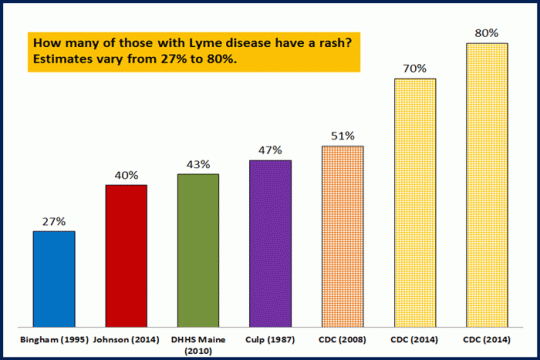
The article also states that 30% don’t get the rash.  That number is not accurate. Depending upon who’s counting, it’s highly variable with anywhere from 25-80% getting it. So many don’t get it that using it for diagnosis is fool-hearty.  If you get it, great – you have Lyme, but if you don’t get it – it means nothing.

The continued myth that only 20% go onto to develop persistent symptoms is also completely inaccurate.  According to this, upto 60% can struggle with continuing symptoms:  https://madisonarealymesupportgroup.com/2019/02/25/medical-stalemate-what-causes-continuing-symptoms-after-lyme-treatment/

Dr. Donta comes the the rescue by speaking out for patients. He states:

“The National Institutes of Health has not agreed to have further treatment trials.…so it is left to clinicians like myself who in their clinical experience have sorted out what works and what doesn’t work.”

So there you have it.  What little research exists is owned by The Cabal with clear conflicts of interest who control the study parameters for a pre-determined outcome.  Clinicians are forced to muddle through and figure it out the best they can.  What a predicament – that’s been going on for over 40 years and continues to this day. In light of current events, please remember this debacle and how much of science has been bought out – yielding little more than propaganda. 

For more:  


More on Tick prevention & how to remove a tick:  https://madisonarealymesupportgroup.com/2019/04/12/tick-prevention-2019/