
How the CDC Uses Their Own ‘Guidelines’ To Rig the System
By Alicia Cashman, MS, Lyme patient and advocate
July 30, 2020
Recently I read an astute article by the Children’s Defense Fund which brought up many important points about COVID and children attending school in the fall. The following statement was given and should set off alarm bells with Lyme/MSIDS patients and for those of you familiar with the Lyme debacle due to its familiarity:
These new and unnecessary guidelines were instituted by the CDC in private, and without open discussion among qualified professionals that are free from conflicts of interest. https://childrenshealthdefense.org/news/if-covid-fatalities-were-90-2-lower-how-would-you-feel-about-schools-reopening/
If I say the words, “CDC Lyme Guidelines,” every single Lyme/MSIDS patient will wince.
That’s because these politically self-serving mandates, not guidelines, have been used for over 40 years keeping patients from diagnosis and proper treatment. And these mandates are still being used against patients.
The same CDC which is creating new COVID guidelines behind closed-doors did the same thing for Lyme disease.
In this historical piece, Pam Weintraub outlines the chronology of all the behind closed door shenanigans: https://madisonarealymesupportgroup.com/2020/02/10/the-bitter-feud-over-lymerix/
Unlike the of loose parameters to be labeled COVID, Lyme disease has very strict CDC standards that hardly any patients meet.
The article points out a travesty that occurred at a Dearborn, Michigan conference that changed testing criteria by eliminating two borrelia proteins specific to Lyme disease which essentially resulted in many of the sickest patients no longer meeting the CDC’s already strict and arbitrary standard. The reason for this was these proteins interfered with the lucrative Lyme vaccine they were working on.
Important quote:
“The CDC said the standard was not to be used for diagnosis,” said Nick Harris, president of IgeneX, a California reference laboratory that tests for vector-borne diseases, “but they did not seem to realize how difficult they were making that choice for local physicians, who look to CDC definitions for guidance and take test results at face value – positive or negative – without reading between the lines. Without OspA or OspB to serve as markers, many of the sickest patients no longer met any diagnostic standard,” Harris says. “By excluding these patients from diagnosis, we excluded them from treatment as well.”
Other correlations between the handling of the two diseases is the hurried push for a vaccine and conflicts of interest.
Regarding the Lyme vaccine, researchers were pressured to quickly complete clinical trials so the vaccine could become approved. Many were damaged by this vaccine: https://madisonarealymesupportgroup.com/2018/01/28/the-secret-x-files-the-untold-history-of-the-lymerix-vaccine/
It seems history is repeating itself with a pushed COVID vaccine: https://madisonarealymesupportgroup.com/2020/05/14/dod-hhs-award-138-million-for-project-jumpstart-rapid-usa-for-prefilled-covid-19-vaccine-syringes/ What is the likelihood there will be vaccine damage due to an experimental DNA vaccine never used before in humans which is known to induce chronic inflammation, gene mutations, DNA replication issues, autoimmune responses and activation of cancer-causing genes that is skipping important animal safety studies?
The handwriting is on the wall for anyone looking.
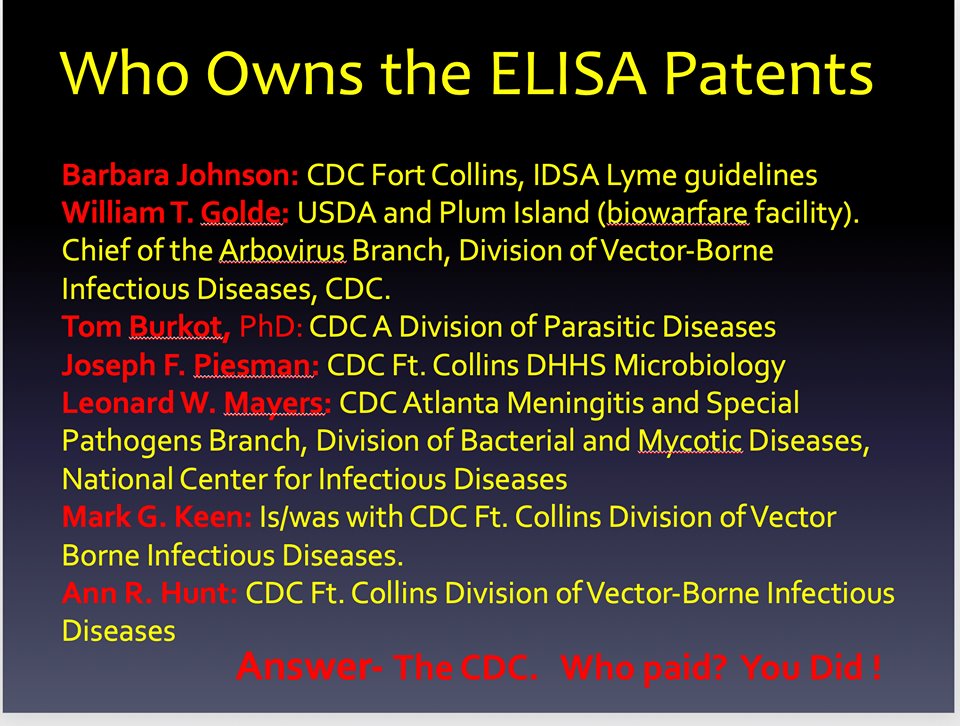
Regarding conflicts of interest, we learn from Weintraub that nine voting consultants on the Dearborn panel hired by the CDC had multiple patents and authorship in studies used to create the Lyme disease case definition: ConflictReport
Interestingly, we see this same thing with COVID: https://principia-scientific.org/a-tale-of-2-drugs-deep-state-chose-money-power-over-lives/
For a painful refresher of the CDC Lyme Disease treatment guidelines: https://www.cdc.gov/lyme/treatment/index.html (Hint: it’s a measly 21 day course of the mono-therapy of doxycycline, despite the fact nearly every antibiotic study done to date shows relapses after treatment)
Standing in opposition to the CDC mandates is ILADS, a group of physicians who read and understand worldwide research which clearly shows prolonged illness and infection in many patients: https://madisonarealymesupportgroup.com/2019/08/05/controversies-challenges-in-treating-lyme-other-tick-borne-diseases/
Similarly to doctors standing up to the CDC’s narrative on COVID-19 who are being maligned and censored, doctors who oppose the CDC narrative on tick-borne illness are also censored, maligned, and discredited:
COVID:
- https://madisonarealymesupportgroup.com/2020/07/29/frontline-doctors-on-censorship-were-coming-after-you-big-tech-we-will-not-be-silenced/
- https://www.youtube.com/watch? Senator Scott Jensen is the one who blew the whistle on hospitals getting money for labeling deaths as COVID-19, without testing or corroboration: https://madisonarealymesupportgroup.com/2020/04/11/hospitals-paid-extra-to-list-patients-as-covid19-3x-as-much-if-the-patient-is-on-a-ventilator/ Another doctor from Montana goes on record stating the exact same thing.
- Worst of all is the effort to stifle doctors from getting patients well or avoiding illness in the first place: https://madisonarealymesupportgroup.com/2020/07/16/government-agencies-coordinate-to-raid-clinics-and-threaten-doctors-who-help-patients-stay-healthy-during-coronavirus-pandemic/
Compare and contrast this censorship with the treatment of those who treat Lyme/MSIDS:
Lyme:
- https://madisonarealymesupportgroup.com/2020/02/08/why-lyme-disease-is-so-controversial-and-why-doctors-are-under-fire/
- https://madisonarealymesupportgroup.com/2018/06/14/corruption-human-rights-violations-against-lyme-doctors-scientists-and-parents-now-on-united-nations-record/
- https://madisonarealymesupportgroup.com/2020/03/11/cdcs-recommendations-for-lyme-epitomize-institutional-bias/
- https://madisonarealymesupportgroup.com/2017/06/24/llmd-daniel-cameron-disciplined-by-ny-medical-authorities/ Just one example of many doctors sanctioned for daring to treat Lyme/MSIDS patients. My own doctor went through this witch hunt as well: http://www.dailykos.com/story/2012/01/29/1059800/-Wisconsin-Lyme-doctor-gets-reprieve The first doctor we saw asked us not to refer other Lyme patients to her as she was afraid the board would come after her as 3 WI doctors had been sanctioned just that year.
- https://sciencebasedmedicine.org/fake-diagnoses-not-fake-diseases/ Hit pieces like this one by an oncology surgeon continue to push the CDC narrative keeping this ancient dogma alive and well. The emphasis, just like with COVID-19 is the misnomer ‘science-based medicine.’ This is an interesting term because scientists can twist and use data to say exactly what they want it to say and they’ve done this with both Lyme and COVID: https://madisonarealymesupportgroup.com/2020/05/13/covid-19-puts-spotlight-on-science-but-scientists-often-lie/ Scientists wanting government funding have to go through none other than the infamous Dr. Fauci, which means if you want the money you better toe the line – Fauci’s line. What is Fauci’s line? Glad you asked. He states it here (hint: Big Science in a closed loop system in which he directs it all): https://www.linkedin.com/pulse/god-precious-randomized-control-trials-rcts-chris-newton/?trackingId=bflx%2Bs9HS%2F25apj5I321xQ%3D%3D
For more: https://madisonarealymesupportgroup.com/2020/04/26/cdc-playbook-learning-from-lyme/


