The bacterial flagellar motor can rotate in counterclockwise (CCW) or clockwise (CW) senses, and transitions are controlled by the phosphorylated form of the response regulator CheY (CheY-P). To dissect the mechanism underlying flagellar rotational switching, we use Borrelia burgdorferias a model system to determine high-resolution in situ motor structures in cheXand cheY3 mutants, in which motors are locked in either CCW or CW rotation. The structures showed that CheY3-P interacts directly with a switch protein, FliM, inducing a major remodeling of another switch protein, FliG2, and altering its interaction with the torque generator. Our findings lead to a model in which the torque generator rotates in response to an inward flow of H+driven by the proton motive force, and conformational changes in FliG2 driven by CheY3-P allow the switch complex to interact with opposite sides of the rotating torque generator, facilitating rotational switching.
The Lyme disease bacterium, Borrelia burgdorferi, spreads through our bodies using a corkscrew-like motion.
For the first time, cryo-electron microscopes have given an up-close look at how the bacterial motors drive clockwise or counter-clockwise motion.
Spirochetes are like smart cars – burrowing into tissues, nerves and joints able to move forward and in reverse. So far scientists have been unable to dissect this mechanism at a molecular level, until now.
“We were able to reveal the direct interactions between a signaling protein and the switch proteins that control the rotational switching in the Lyme disease spirochete for the first time through the lens of a cryo-electron microscope (cryo-EM),” explained the study’s first author, Yunjie Chang, a postdoc in the lab of Jun Liu at Yale University’s West Campus.
The cryo-EM technique flash-freezes the cells to around -270°F then bombards them with electrons to produce thousands of 2D images, which are then combined together to reveal a 3D model, the structural basis to understand the rotational switching.
“This microscope is key,” said senior author Jun Liu, associate professor of Microbial Pathogenesis. “The power allows us to see through the Lyme disease vehicle, to understand how it navigates and disseminates in its hosts, and how in the future we can control it.”
This is important because now we can begin to understand how the bacteria spreads, with the possibility of new targets for treatment.
We’ll tell you where ticks are most commonly found, how to deal with them, and what Lyme symptoms are often overlooked.
Lyme disease has become a major concern in recent years, and for some very good reasons. Left untreated, the disease can cause serious health issues that may linger throughout a person’s lifetime.
I actually haven’t kept track of exactly how many times I’ve had Lyme disease. But suffice to say that I know for a fact that I’ve had it at least a half-dozen times. Some of the cases were severe, some not very severe, and some were in the middle.
My most recent and serious bout with Lyme disease occurred a couple years ago, and get this — the medical people who treated me for the disease on that occasion believe that I may actually have been bitten by a deer fly, not a tick.(See link for article)
_____________________
**Comment**
Great article and very practical advice from an experience hunter who shares space with ticks.
My only caution is waiting to get to a medical professional to remove a tick. Time is of the essence regarding ticks and the illnesses they transmit. See this article for more prevention tips and how to properly remove a tick. https://madisonarealymesupportgroup.com/2019/04/12/tick-prevention-2019/
Also, he mentions only hot water will kill ticks. I’ve been told by entomologists that water/soap will not kill ticks at all. It’s the high, dry heat of the dryer that will kill them. I call it “Fry and die.”https://madisonarealymesupportgroup.com/2016/05/31/fry-and-die/ (This says 6 minutes will do it but 10-15 is safe)
Before washing, stick your clothes in the dryer first, then you can wash them if they need it. I usually rewear these pretreated clothes a few times before I wash them to prolong the repellent. Make sure to spray your socks and shoes as well as your hat and shirt. Basically – anything that could brush up against trees and shrubs and grass/plants.
The author brings out many important points:
doctors believe he got Lyme from a Lipoptena cervi, the deer ked or deer fly, a species of biting fly that have been introduced to North America.[2] They are parasites of elk, deer, and other deer family members, burrowing through the fur and sucking the blood of the host animals. The bite hurts like hell. For the most part authorities deny they can transmit Lyme but they carry both Lyme and Anaplasma. This is another area of research that desperately needs to be done as ‘authorities’ are relying on ancient 30 year work covered in an inch of dust. But, again, this work isn’t sexy like ‘climate change,’ which is a moot point: https://madisonarealymesupportgroup.com/2018/11/07/ticks-on-the-move-due-to-migrating-birds-and-photoperiod-not-climate-change/
the author found ticks in unlikely places during unlikely weather when it’s cold with snow on the ground. This again proves that ticks are impervious to weather.
he mentions, rightly, that many never get a rash or that it looks different from the ‘classic bullseye’ rash ‘authorities’ keep insisting on. There is a picture of the rash he obtained which actually caused bruising.
he also rightly mentions that many may get all the characteristic symptoms of Lyme or just a few.
he doesn’t mention keeping the tick for testing, which is a good thing to consider. Many states have free tick testing – but Wisconsin(4th in the nation for Lyme)doesn’t. This article is a great resource. Keep it somewhere safe so you can refer to it should you get bitten: https://madisonarealymesupportgroup.com/2020/04/21/help-i-got-bit-by-a-tick-what-do-i-do/
due to the devastation Lyme/MSIDS can cause, many Lyme literate doctors suggest considering prophylactic treatment for black-legged tick bites. Everyone admits that prompt diagnosis and treatment is key for treatment success yet mainstream medicine continues to take a “wait and see” approach which only delays things.
he correctly states:
It is not uncommon for Lyme disease to be misdiagnosed as multiple sclerosis, Parkinson’s disease, lupus, mononucleosis, ulcerative colitis, ALS, Alzheimer’s disease or fibromyalgia. Misdiagnosis can mean not getting treatment, or worse, getting treatment for the wrong ailment.
University of New Haven Professor Makes Great Strides in Lyme Disease, Cancer Research
An internationally recognized expert on Lyme disease, Eva Sapi, Ph.D., has made groundbreaking discoveries in the lab that have shed light on the bacteria that cause the disease, as well as a possible link between Lyme disease and another largely unknown and increasingly common illness: breast cancer.
SEPTEMBER 15, 2020
By Renee Chmiel, Office of Marketing and Communications
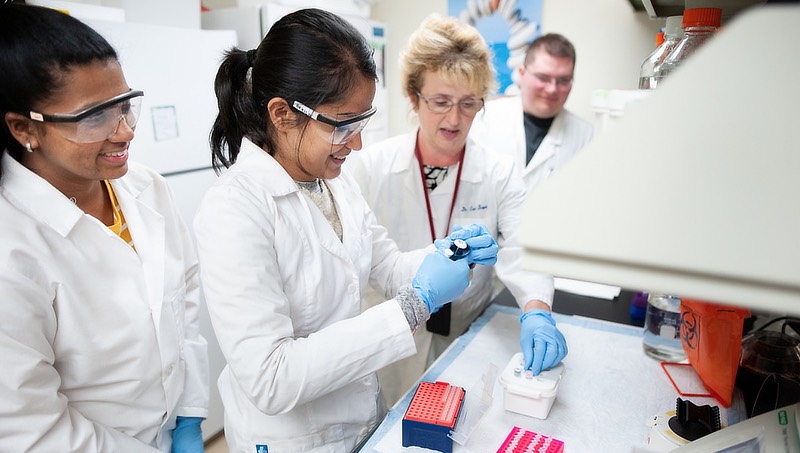
Dr. Eva Sapi’s students have been an integral part of her research.
Eva Sapi, Ph.D., has long been on the front lines in the search for a cure for Lyme disease – a disease that she herself contracted several years ago.
Dr. Sapi has spoken with media across the country, including CNN, warning of a “perfect storm” this year for Lyme disease, given the COVID-19 pandemic and the mild winter that, she says, contributed to a “bad year for ticks.”
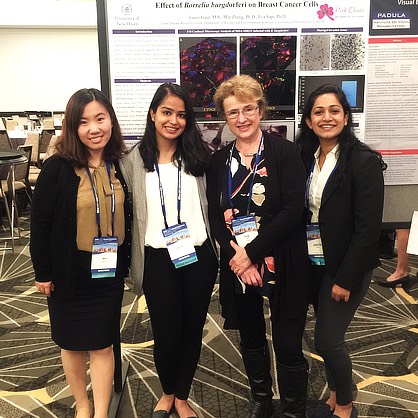
Left to right: Min Zhang ’20 M.S., Gauri Gaur ’20 M.S., Eva Sapi, Ph.D., and Ankita Chavan ’22 M.S.
A trained breast cancer researcher, Dr. Sapi spent 15 years conducting breast and ovarian cancer research at Yale University before shifting her focus to Lyme disease. These two research areas may be linked more closely than previously thought, and she is currently exploring a possible link between breast cancer and Lyme disease.
“I’d heard about people who suffered from Lyme disease and then received a breast cancer diagnosis soon after,” said Dr. Sapi, coordinator of the University’s graduate program in cellular and molecular biology. “I wondered if the Borrelia bacteria were in breast cancer tissue. My research group examined slides with several kinds of breast cancer, as well as healthy tissues. The normal breast tissues were completely negative for the bacteria, and we have found evidence that they are present in breast cancer tissues. Furthermore, when we introduced Borrelia to cancer cells, we found they start to invade very quickly.”
‘Presenting at the conference was a great experience’
Although the etiology of breast cancer is still unknown, it is believed to be caused by a combination of genetic and environmental factors – one of which, Dr. Sapi believes, may be bacterial infection. She and her students, who have been an integral part of her research, are focusing on Borrelia. When examining more than 400 invasive breast cancer tissues, they found that a significant number of samples were positive for Borrelia, suggesting that the bacteria may play a role in breast cancer development and metastasis.
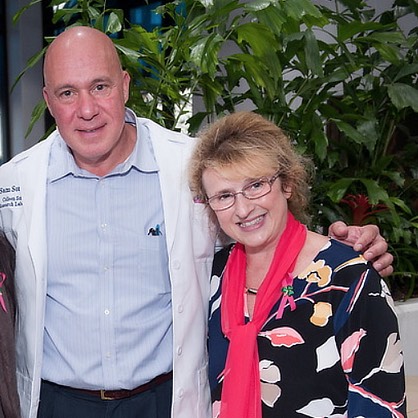
Eva Sapi and Sam Sorbello.
Dr. Sapi and several of her students – including Min Zhang ’20 M.S. and Gauri Gaur ’20 M.S. – presented their research examining a possible breast cancer/Lyme disease link and developing a novel model system for Borrelia at last year’s International Lyme and Associated Diseases Society conference.
Recent graduates of the University’s graduate program in cellular and molecular biology, Gaur and Zhang worked closely with Dr. Sapi as part of the Lyme Disease Research Group. Gaur was the leading graduate student in the breast cancer project, while Zhang developed a zebrafish model for the Lyme disease bacteria.
“The zebrafish model allows for rapid, non-invasive, and real-time analysis of Lyme disease bacteria,” she said. “This animal model shows the potential to extend our understanding of the interplay between bacterial virulence factors and host defense mechanisms in the pathogenesis of Borrelia. Presenting at the conference was a great experience, and it enabled me to get feedback from professional peers.”
‘I hope this research puts a different perspective on all cancer’
Dr. Sapi and her students’ pilot study was supported by Pink Clover, the Colleen Sorbello Breast Cancer Foundation, which was founded by University benefactor Sam Sorbello in honor of his late wife, Colleen. The University’s Colleen Sorbello Research Laboratory in Dodds Hall also bears the name of Colleen, who died of breast cancer.
“Cancer is so heterogenous,” said Dr. Sapi. “If you kill one population, another comes back. This reminds me of bacteria – you may kill most of them, but you have to take an antibiotic for ten days or they will come back. There are so many parallel lines here. I hope this research puts a different perspective on all cancer – not just breast cancer.”
Dr. Sapi’s goal is to identify antibacterial agents that are effective in killing all forms of the bacteria. She found Borrelia can form a protective layer – a biofilm – around themselves, enabling them to resist antibiotics. She and her students also discovered that liquid whole-leaf stevia extract reduced the biofilm mass by about 40 percent, and they continue to explore that as a possible lead.
‘Science can be fun and fascinating’
Dr. Sapi spent five years conducting research with an expert at Columbia University, assisting with a study that focused on a woman from New York who tested positive for Lyme disease and received antibiotic therapy for 16 years. Despite taking many combinations of antibiotics, the woman had serious complications, including seizures, and, ultimately, died from the disease. The researchers sequenced everything in her tissue, finding Borrelia and confirming that the bacteria can form a biofilm, enabling them to resist antibiotics. Dr. Sapi’s research was published in the journal Antibiotics.
In addition to her work on the front lines of Lyme disease and breast cancer research, Dr. Sapi is eager to share her passion for research with her students, and to teach and inspire the researchers of the future.
“I always make sure that students’ projects will get them excited and passionate about science,” she said. “I know they’ll be in the lab for long hours, and I want them to want to be there. As mentors, we need to be encouraging, and we need to show them that science can be fun and fascinating.”
_____________________
**Comment**
We owe a debt of gratitude to Sapi. You would think her work would rock the world, unfortunately, because her research consists of smaller case studies, our public health ‘authorities’ and mainstream medicine sniff at it and just flatly ignore it. Until they see large randomized controlled trials (RCTs) they aren’t impressed. This will likely never happen due to lack of funding, abysmal testing, and the wide variability in patients and how they present with differing symptoms. What little money there is is typically ear-marked with the moniker “Climate change,” which has been proven to be a moot point, yet clung to: https://madisonarealymesupportgroup.com/2018/11/07/ticks-on-the-move-due-to-migrating-birds-and-photoperiod-not-climate-change/
It’s also interesting to note that other researchers are studying a link between Bartonella (a common coinfection with Lyme) and cancer.
Regarding the work on stevia – it’s all been done in a test-tube and uses a special formulation which to my knowledge has not been divulged. I used it with zero effect, but you can read about it here: https://madisonarealymesupportgroup.com/2015/11/19/stevia-and-bb/
Newby recently shared her personal journey that took her from the beaches of Martha’s Vineyard into the depths of the U.S. government’s Cold War biological weapons program, what she found there, the FOIAs she filed along the way, and what the Centers for Disease Control and Prevention (CDC) had to say about her.
Requester’s Voice is a MuckRock series in which we interview public records requesters about the experience of using the Freedom of Information Act (FOIA). You can find the whole series here. Interviews are edited for length and clarity.
(See link for article)
_____________________
**Comment**
This, by far, is the most in-depth interview with Newby yet and will put you on the edge of your seat. I must confess I’ve not read the book yet but this interview is making me purchase the book.
She mentions Wisconsin’s involvement with all of this. There’s no question researchers experimented on ticks and dropped them from airplanes as part of a bioweapon program for the military. No question. Most of the records have been expunged but researchers have spoken out and more are still alive that could speak out.
She also exposes what I’ve been writing about for some time: the literal research Cabal that exists on all things Lyme/MSIDS. These cronies are interconnected, have severe conflicts of interest, and protect each other. Research funding for all things tick-borne related is scanty, therefore the competition to obtain that funding is cut-throat. This Cabal has dominated research on Lyme/MSIDS for over 40 years: https://madisonarealymesupportgroup.com/2017/01/13/lyme-science-owned-by-good-ol-boys/
WE OWE NEWBY A DEBT OF GRATITUDE FOR HER WORK. SHE DID MOST OF THIS FOOTWORK WHILE INCREDIBLY ILL HERSELF.
Lastly, Newby mentions her work with the documentary “Under Our Skin.” If you haven’t seen this yet, please do. It’s eye-opening and what many patients experience – despite the denial of CDC authorities, The Cabal, and ignorant mainstream medicine.