Archive for the ‘Lyme’ Category

Imaging Shows Early Vascular Interactions of Borrelia in Skin

https://www.nature.com/articles/s41467-025-64326-w

Open access

Published: 

Targeted volume imaging reveals early vascular interactions of Lyme disease pathogen in skin

Abstract

Although the contours of the dissemination pathways of human pathogenic spirochetes in the vertebrate hosts are known, detailed high-resolution information on these processes remain lacking. In this study, we establish an efficient serial block-face scanning electron microscopy workflow incorporating semi-automatic AI-driven segmentation to investigate the architecture of early events following the deposition of Borrelia burgdorferi at the tick bite site in mice. We capture evidence of Borrelia penetrating the lymphatic endothelium via both transcellular and paracellular routes and observe its early presence within the lumen of the lymphatic vessel. The multistep process of transcellular migration is documented in detail, showing sequential invagination and encasement of shorter Borrelia segments by the lymphatic endothelial cells during intravasation. Our findings reveal that the first contact of B. burgdorferi and blood vessels is not random but involves close interactions with pericytes. We also capture the infiltration of immune cells in the skin and their interactions with invading bacteria. Altogether, these observations suggest that Borrelia strategically targets vascular regions with lower mechanical resistance to breach the endothelial barrier, thereby enhancing its dissemination.

Case Report of Male With Anaplasmosis

https://www.cureus.com/articles/416304-relative-bradycardia-in-a-61-year-old-male-with-anaplasmosis-a-case-report#!/

Relative Bradycardia in a 61-Year-Old Male With Anaplasmosis: A Case Report

Jessica A. James • Melissa Brown • Samuel M. Segal • Maria Gutierrez-Castillo

Published: October 17, 2025

DOI: 10.7759/cureus.94785 

Peer-Reviewed

Cite this article as: James J A, Brown M, Segal S M, et al. (October 17, 2025) Relative Bradycardia in a 61-Year-Old Male With Anaplasmosis: A Case Report. Cureus 17(10): e94785. doi:10.7759/cureus.94785

Abstract

Human granulocytic anaplasmosis (HGA), or anaplasmosis, is a tick-borne illness caused by Anaplasma phagocytophilum, a gram-negative intracellular bacterium. A. phagocytophilum is primarily transmitted by Ixodes scapularis in the northeast United States and by Ixodes pacificus in California. Presenting symptoms typically include fever, chills, malaise, headache, myalgia, and rarely a rash. This case describes a 61-year-old Black male with a complex medical history, including prior tick-borne and arboviral infections (Lyme disease, dengue fever, and chikungunya), hypertension, mixed hyperlipidemia, bilateral carotid artery dissection, gastroesophageal reflux disease, atrial fibrillation with rapid ventricular response, and current tobacco use. This patient presented to an emergency department in upstate New York with a fever, fatigue, constipation, myalgia, and night sweats. Throughout the patient’s hospital course, he maintained a state of relative bradycardia. The patient reported that he had returned from Haiti and the Dominican Republic two weeks prior to presentation in the emergency department and received several mosquito bites while abroad. Initial guideline-based empiric treatment was started with doxycycline due to suspicion of tick-borne illness, given his history of Lyme disease and his onset of symptoms while in upstate New York. Treatment was continued to complete a 14-day course after confirming the diagnosis of anaplasmosis by PCR testing of whole blood. After completing treatment with doxycycline, the patient’s symptoms resolved completely. This case illustrates a unique finding of relative bradycardia and fever of unknown origin in the context of recent international travel and history of tick-borne and arboviral infections.


How Microbes Like Lyme May Trigger Alzheimer’s & Cognitive Decline

http://  Approx. 15 Min

 
Dr. Brian J. Balin, Professor of Neuroscience and Neuropathology and Director of the Center for Chronic Disorders of Aging at the Philadelphia College of Osteopathic Medicine (PCOM), shares how decades of research have revealed a possible infectious origin to Alzheimer’s disease.
 
His pioneering discovery that the respiratory bacterium Chlamydia pneumoniae infects brain tissue helped establish the Pathogen Hypothesis of Alzheimer’s disease.
 
His continuing work explores how tick-borne microbes—including Borrelia burgdorferi (Lyme disease), Bartonella, and Babesia—interact with other pathogens to drive neuroinflammation and cognitive decline.
 
Dr. Balin discusses how pathogens such as Chlamydia pneumoniae, Borrelia burgdorferi, Bartonella, and Babesia have been detected in Alzheimer’s brain tissue; evidence that microbes may enter the brain through the olfactory system or blood-brain barrier, initiating inflammation, amyloid buildup, and tau pathology; and findings from his collaboration with Galaxy Diagnostics and Nicole Bell, identifying polymicrobial infections—including Babesia otocoli, a species previously thought to affect only deer—in human brain tissue.
 
He explains how 3D brain organoids and animal models reveal infection-driven neurodegeneration, why infection must be viewed as part of the exposome—the lifetime accumulation of environmental exposures—and how future treatments such as immune-modulating drugs, antimicrobials, and phage therapy could change care.
 
This episode underscores how microbes, including those transmitted by ticks, may play a significant role in neuroinflammation, cognitive decline, and Alzheimer’s disease.
 
Recorded live at the 2nd Annual Alzheimer’s Pathobiome Initiative (AlzPI) and PCOM Symposium (October 2025) at Ohio University, Dublin, Ohio.
 
Learn more at AlzPI.org. Listen to Tick Boot Camp Podcast Episode 406 “Pathobiome – Interview with Nikki Schultek” and Episode 101 “The Young Gun – Interview with Alex (Ali) Moresco” at TickBootCamp.com
 
For Dr. Balin’s publications and ongoing research, visit pcom.edu.
 
For more:

How the CDC Validates Chronic Lyme is All Smoke & Mirrors

https://www.change.org/p/the-us-senate-calling-for-a-congressional-investigation-of-the-cdc-idsa-and-aldf/u/34076105?

Progress Toward Understanding Infection-Associated Chronic Conditions and Illnesses

Carl TuttleHudson, NH, United States

Nov 19, 2025

This letter was written after seeing the following Facebook post from “Tick Boot Camp

CDC Validates Chronic Lyme
https://www.facebook.com/photo/?fbid=1392710922860645&set=a.445348080930272

Carl Tuttle

———- Original Message ———-
From: CARL TUTTLE <runagain@comcast.net>
To: afiore@cdc.gov
Cc: dpd1@cdc.gov, Matthew_Kuehnert@mtf.org, ebelay@cdc.gov, richard.bradbury@jcu.edu.au
Date: 11/19/2025 9:06 AM EST
Subject: Progress Toward Understanding Infection-Associated Chronic Conditions and Illnesses

Emerging Infectious Diseases  Volume 31, Supplement—October 2025
 
Progress Toward Understanding Infection-Associated Chronic Conditions and Illnesses
Anthony E. Fiore
https://wwwnc.cdc.gov/eid/article/31/14/25-1187_article

Excerpt:

“Complicating the frustrated patient’s predicament, clinicians attempting unproven treatments (e.g., repeated antibiotic courses) might exacerbate illness by introducing additional risks or temporarily masking potentially treatable causes.”

To: Anthony Fiore, MD, MPH,

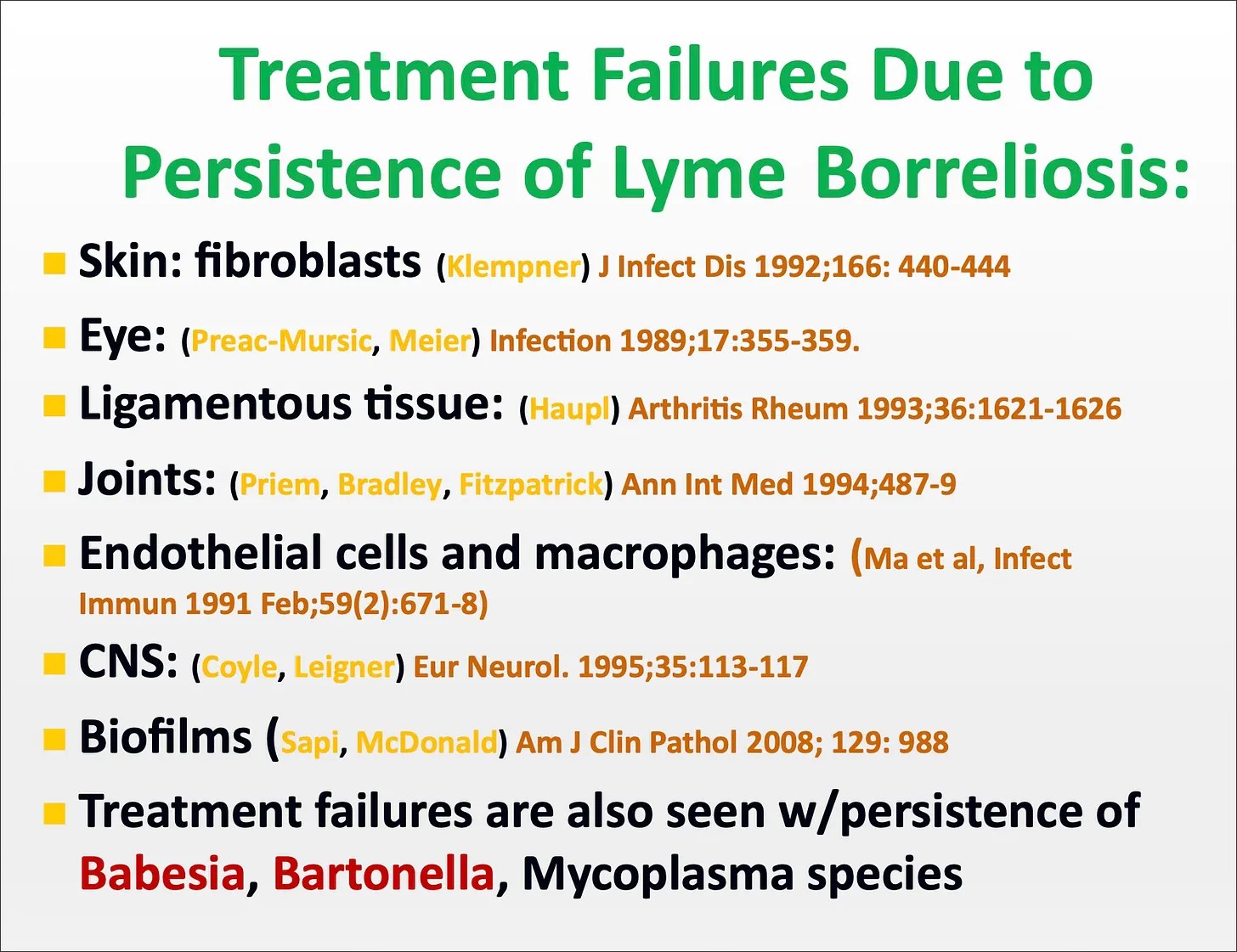
In 2016 Dr. Paul Auwaerter, past president of the Infectious Diseases Society of America coauthored a study revealing the persister form of Borrelia burgdorferi resistant to antibiotics.

Here is a timeline of events:

2015

Standard antibiotic treatment for Lyme disease does not kill persistent Borrelia bacteria.
http://droopyyoupi.blogspot.com/2015/08/standart-antibiotic-treatment-for-lyme.html

Excerpt:

-What has tuberculosis and Borrelia burgdorferi in common? In the late stage of the disease occurs persistent (tolerant) bacteria, which essentially means that the bacteria lasts and lasts and lasts. They protect themselves against antibiotics and are difficult to treat.

– Both Borrelia burgdorferi and tuberculosis is relatively easy to cure in the early stages, even with the use of one antibiotic. In the late stage it is impossible to cure the disease with the same type of treatment in the acute phase, said Dr. Ying Zhang when he visited the year NorVect conference.

-Dr. Ying Zhang is a professor at the Department of Molecular Microbiology and Immunology at the Johns Hopkins Bloomberg School of Public Health

-Two days after NorVect conference, published Dr. Ying Zhang’s latest research Identification of new compounds with high activity against stationary phase Borrelia burgdorferi from the NCI compound collection.

2016

A Drug Combination Screen Identifies Drugs Active against Amoxicillin-Induced Round Bodies of In Vitro Borrelia burgdorferi Persisters from an FDA Drug Library
Jie Feng 1, Wanliang Shi 1, Shuo Zhang 1, David Sullivan 1, Paul G Auwaerter 2, Ying Zhang 1
https://pubmed.ncbi.nlm.nih.gov/27242757/

Abstract

Under experimental stress conditions such as starvation or antibiotic exposure, Borrelia burgdorferi can develop round body forms, which are a type of persister bacteria that appear resistant in vitro to customary first-line antibiotics for Lyme disease. To identify more effective drugs with activity against the round body form of B. burgdorferi, we established a round body persister model induced by exposure to amoxicillin (50 μg/ml) and then screened the Food and Drug Administration drug library consisting of 1581 drug compounds and also 22 drug combinations using the SYBR Green I/propidium iodide viability assay. We identified 23 drug candidates that have higher activity against the round bodies of B. burgdorferi than either amoxicillin or doxycycline.

2022

Nitroxoline Drug Combinations Are More Active Than Lyme Antibiotic Combination and Can Eradicate Stationary-Phase Borrelia burgdorferi
Alvarez-Manzo, Hector S.1; Zhang, Yumin1; Zhang, Ying2,✉
https://journals.lww.com/imd/fulltext/2022/09000/nitroxoline_drug_combinations_are_more_active_than.7.aspx

Abstract

Lyme disease (LD), caused by Borrelia burgdorferi, is the most common vector-borne disease in the United States and Europe. Despite the standard 2–4 weeks’ antibiotic treatment, approximately 10%–20% of patients will develop posttreatment LD syndrome, a condition that is poorly understood. One of the probable causes is thought to be the presence of B. burgdorferi persister forms that are not effectively killed by the current LD antibiotics. In this study, we evaluated nitroxoline, an antibiotic used to treat urinary tract infections, for its activity against a stationary-phase culture enriched with persister forms of B. burgdorferi. Nitroxoline was found to be more active than doxycycline and equally active as cefuroxime (standard LD antibiotics) against B. burgdorferi. Importantly, the nitroxoline two-drug combinations nitroxoline + cefuroxime and nitroxoline + clarithromycin, as well as the nitroxoline three-drug combination nitroxoline + cefuroxime + clarithromycin, were as effective as the persister drug daptomycin-based positive control three-drug combination cefuroxime + doxycycline + daptomycin, completely eradicating stationary-phase B. burgdorferi in the drug-exposure experiments and preventing regrowth in the subculture study. Future studies should evaluate these promising drug combinations in a persistent LD mouse model.

Dr. Fiore… This is the missing research that should have been conducted early in the discovery phase of the disease but as we now know, all the eggs were put into the vaccine basket while a campaign was orchestrated to discredit the sick and disabled patient population along with the courageous clinicians attempting to help these patients. https://pubmed.ncbi.nlm.nih.gov/21867956/

What has been deceitfully established here in the US is wreaking havoc globally. Example:
Lyme disease: Australians ‘being treated worse than a dog riddled with mange’, Senator John Madigan says
https://www.abc.net.au/news/2016-01-11/lyme-disease-treatment-in-australia-criticised-by-john-madigan/7080708

This research is being suppressed as the disabled Lyme patient population around the globe remain sick indefinitely. (Three decades and counting)

Carl Tuttle
Independent Researcher
Hudson, NH

Cc: D. Peter Drotman, MD, MPH Editor-in-Chief

A Mother’s Story: The Nightmare in the Leaf Pile

https://www.lymedisease.org/a-mothers-story-the-nightmare-in-the-leaf-pile/

A mother’s story: the nightmare in the leaf pile

Nov. 4, 2025

By Dorothy Kupcha Leland

When many people see a big, beautiful pile of colorful autumn leaves, it feels like an open invitation to dive in. The scene evokes joy, nostalgia, and the simple thrill of childhood.

But for Isabel Rose, it brings up something very different. It reminds her of a moment that marked the beginning of her lifelong struggle with Lyme disease.

What others see as innocent fun, she now views with alarm.

Ticks thrive in damp, shaded environments close to the ground. Leaf piles, tall grass, and wooded edges are prime habitats for them. Children playing in these areas are at increased risk, often unaware that a single tick bite can lead to years of misery.

For Isabel, what began as a carefree childhood leap into a leaf pile became the start of a medical nightmare.

Isabel is now a writer, Lyme disease advocate, and founder of Mothers Against Lyme, a support network for families affected by congenital and pediatric Lyme. She also serves on the board of Project Lyme, a national nonprofit.

In a recent essay published on her Substack, Isabel shares the story of how a tick bite at age 8 led to decades of misdiagnosed symptoms, chronic illness, and eventually, the discovery that both she and her children had Lyme disease and co-infections.

Her experience is a powerful reminder of the importance of tick awareness. Ignoring the risks can be hazardous to yourself–and future generations.

Click here to read her raw and deeply informative essay.

Click here to learn more about Mothers Against Lyme.

TOUCHED BY LYME is written by Dorothy Kupcha Leland, President of LymeDisease.org. She is co-author of Finding Resilience: A Teen’s Journey Through Lyme Disease and of When Your Child Has Lyme Disease: A Parent’s Survival Guide. Contact her at dleland@lymedisease.org.

_______________

Ticks are everywhere.  Don’t believe me?  Read on…..