Archive for the ‘Bartonella’ Category

High Titers of Bartonella Found in Patients With Musculoskeletal Complaints

https://www.ncbi.nlm.nih.gov/pubmed/31115789

2019 May 22. doi: 10.1007/s10067-019-04591-5. [Epub ahead of print]

The seroprevalence of Bartonella spp. in the blood of patients with musculoskeletal complaints and blood donors, Poland: a pilot study.

Abstract

BACKGROUND:

Bartonella spp. can cause a variety of diseases, such as lymphadenopathies, cat scratch disease, and trench fever, but can also give rise to many non-specific symptoms. No data exists regarding the prevalence of Bartonella spp. in patients with musculoskeletal complaints, nor among blood donors in Poland.

METHODS:

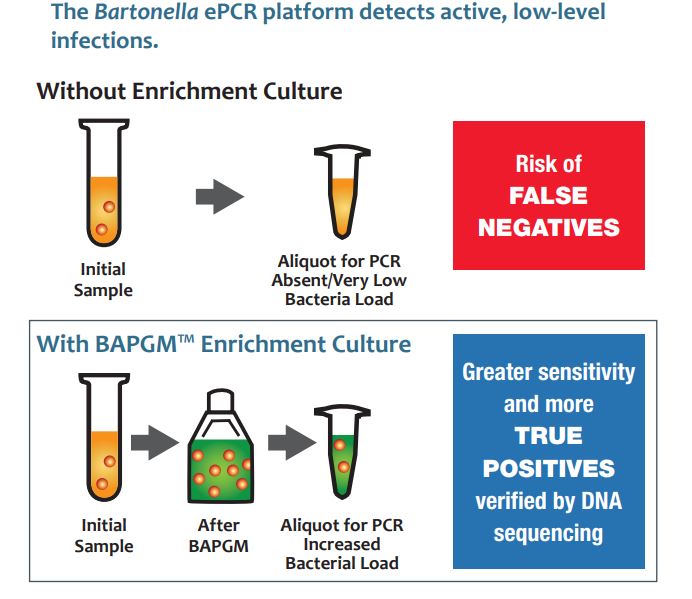
The presence of anti-Bartonella IgM and IgG in the serum of blood donors (n = 65) (Lodz, Poland) and in the patients of the Department of Rheumatology Clinic (n = 40) suffering from musculoskeletal symptoms was tested by immunofluorescence. Blood samples were cultured on enriched media. Epidemiological questionnaires were used to identify key potential risk factors, such as sex, age, contact with companion animals, and bites from insects or animals.

RESULTS:

Altogether,

  • 27 of the 105 tested subjects were seropositive for Bartonella henselae IgG (23%)
  • 3 for Bartonella quintana IgG (2.85%)
  • IgMs against B. henselae were found in 3 individuals (2.85%)
  • IgMs against B. quintana were found in one (1.54%)

No statistically significant difference was found between the prevalence of B. henselae in the blood of donors or patients and the presence of unexplained musculoskeletal complaints (23% vs 30%). Individuals who had kept or been scratched by cats were not more likely to be B. henselae seropositive (p > 0.01). Tick bites were more commonly reported in patients, but insignificantly (p > 0.01).

CONCLUSION:

This is the first report of a high seroprevalence of anti-Bartonella IgG in patients with musculoskeletal symptoms and in blood donors in Poland. The obtained results indicate that such seroprevalence may have a possible significance in the development of musculoskeletal symptoms, although it should be confirmed on a larger group of patients. Asymptomatic bacteremia might occur and pose a threat to recipients of blood from infected donors. Hence, there is a need for more detailed research, including molecular biology methods, to clarify the potential risk of Bartonella spp. being spread to immunocompromised individuals.

KEY POINTS:

•This is the first study presenting high seroprevalence of Bartonella spp. in Poland. • IgG and IgM antibodies against B. quintana were found in blood samples of blood donors.


How Vector-Borne Diseases Impact Heart Health

https://www.galaxydx.com/bartonella-lyme-impact-heart-health/

How Vector-Borne Diseases Impact Heart Health

LET’S SUFFICE IT TO SAY, HEART ISSUES WITH TICK BORNE ILLNESS IS NOT RARE.


Woman Wakes up With Black Eye & Swollen Face After Cat Scratch That Left Her on IV Drip For Four Days

https://www.dailymail.co.uk/health/article-7053027/Woman-42-wakes-BLACK-EYE-swollen-face-scratched-cat.html

Woman, 42, wakes up with a BLACK EYE and swollen face after being scratched by her cat that left her on an IV drip for four days

  • Heidi Plamping had been trying to calm down her cat, Storm, who was scared
  • The cat scratched her on the face and arm, but Ms Plamping wasn’t worried
  • Three days later she woke up with a mild reaction she thought was due to dust
  • But her face was soon covered in a rash, and she needed to visit the hospital 

A woman woke up with a black eye and swollen face after being scratched by her pet cat.

Heidi Plamping, from Canada, had been trying to calm down her cat, Storm, who had been freaked by a large dog.

As three-year-old Storm clambered on to her head for refuge, her claws caught Ms Plamping’s skin, drawing blood.

When the 42-year-old’s eyes and hands started to swell three days later, she thought dust mites were to blame.

But her face worsened over the next few days, to the point where it was covered in a rash.  She was given pills by her doctor and sent home.

However, they did not work and she needed to go to the hospital every day for four days to receive a drip of antibiotics to fight her swelling.

Doctors warned her cat scratches can be very serious – cats carry and can transfer bacteria, which, in very rare cases, can lead to life-threatening complications such as sepsis.

Heidi Plamping, 42, of Cochrane, Alberta, Canada, had been trying to calm down her cat, Storm, who scratched her face and arm as she clambered onto her head for safety

Ms Plamping's face swelled and became covered in a rash that worsened over the course of a few days. Pictured, on May 8, six days after being scratched

Ms Plamping had to go to hospital every day to receive a drip of antibiotics. Pictured on May 10

As three-year-old Storm clambered onto Ms Plamping's her head for refuge, her claws caught Ms Plamping's skin ten times. Pictured, cuts to her face
As three-year-old Storm clambered onto Ms Plamping’s head for refuge, her claws caught Ms Plamping’s skin ten times.  Pictured, cuts to her face.

Ms Plamping, a digital marketing consultant who lives in Cochrane, Alberta, had travelled to British Columbia at the start of May with Storm to stay and work with friends for the summer.

When they arrived on May 2, Ms Plamping let Storm out on her lead as she had done countless times before when they’ve visited the unidentified friend.

However, since their last visit, Ms Plamping’s friend had got two Great Danes who were very friendly and excited to meet Storm.

The large dogs scared her and she started to get tangled in her lead as she panicked to get away.

Ms Plamping said: ‘Their dogs are very friendly, but my cat hasn’t met a dog before so when one of them showed up she freaked out.’

Ms Plamping rushed to Storm’s rescue and started to untangle her beloved cat as she climbed up her face to the safety of her head.

Ms Plamping said: ‘Eventually I picked her up so I could bring her inside. She was so scared she climbed my face to my head while I screamed murder and put her inside.’

As a result, Ms Plamping had seven scratches on her face and three more on her hand and arm.

When she woke up the next day with a black eye, Ms Plamping thought nothing more of her injuries.

But by May 5, Ms Plamping had a swollen hand and eyes. Due to having sensitive skin, she thought that she could possibly be having a reaction to any dust that could have been present in her new surroundings.

Storm, pictured, was freaked by a Great Dane dog at Ms Plamping's friend's houseStorm, pictured, was freaked by a Great Dane dog at Ms Plamping’s friend’s house

When Ms Plamping woke up the day after the scratches with a black eye (pictured), but didn't think much of her injuries
When Ms Plamping woke up the day after the scratches with a black eye (pictured), but didn’t think much of her injuries
But by May 5, Ms Plamping had a swollen hand and eyes (pictured). Due to having sensitive skin, she thought that she could possibly be having a reaction to dust mites
On May 7, pictured, Ms Plamping's face was significantly more swollen and covered in rashes so she went back to the doctor she had seen the day before

On May 7, pictured, Ms Plamping’s face was significantly more swollen and covered in rashes so she went back to the doctor she had seen the day before

Ms Plamping said: 'When they had to order antibiotics that had to go into me through an IV, I knew it was serious'. Pictured, an IV line to administer the drugs

Ms Plamping said: ‘When they had to order antibiotics that had to go into me through an IV, I knew it was serious’. Pictured, an IV line to administer the drugs

Ms Plamping, a digital marketing consultant, said it wasn't the first week in British Columbia she had been hoping for. Pictured, on May 13 when the swelling and rashes had almost gone

Ms Plamping, a digital marketing consultant, said it wasn’t the first week in British Columbia she had been hoping for. Pictured, on May 13 when the swelling and rashes had almost gone

Ms Plamping, pictured before the drama, said if she had to rescue Storm again, she would
Ms Plamping has had Storm ever since she was four months old and said that this incident hasn't changed their relationship. Pictured together
Ms Plamping has had Storm ever since she was four months old and said that this incident hasn’t changed their relationship. Pictured together 
Ms Plamping was put on an IV and had to return every day for four days to get a new dose of antibiotics administered.

She said: ‘They said it is common for cat scratches or bites to cause infection. When they had to order antibiotics that had to go into me through an IV, I knew it was serious but was just thankful that we were heading in the right direction to make me better.

‘The next day, the swelling was going down but a rash was spreading on my arm. 

‘The doctor outlined my arm where the rash was and told me to go to the emergency room if it spread any further that night. Thankfully it didn’t and once the hand swelling went down they finally gave me prednisone [a medication to calm the immune system] to help with the swelling and rash in my face.’

The medication made Ms Plamping nauseous and sleepy, and she said: ‘I started getting upset when my face was so tight and itchy.

‘I knew it would get better, but I was growing impatient. So, it wasn’t exactly the first week in British Columbia that I had pictured for myself.’

Following her ordeal, animal lover Ms Plamping said that Storm looked at her funny for a few days whilst the swelling went down.

But the two forgave each other instantly and Ms Plamping said she wouldn’t hesitate to rescue Storm again if the situation arose.

Ms Plamping has had Storm ever since she was four months old and said that this incident hasn’t changed their relationship, but Storm is now more wary of going outside.

‘Storm is very hesitant to leave the cabin. Back home in Alberta she freely goes outside. Here she is nervous about the dog,’ said Ms Plamping.

‘If I had to protect her again and pick her up, I would. I don’t have kids. She is my baby. My fur baby.

‘I wasn’t aware that cat scratches were so infectious. If you get a cat scratch or bite, go to your doctor right away.’

CAN YOU GET AN INFECTION FROM A CAT SCRATCH?

Cat-scratch disease (CSD) is a bacterial infection spread by cats. The disease spreads when an infected cat licks a person’s open wound, or bites or scratches a person hard enough to break the surface of the skin. 

About three to 14 days after the skin is broken, a mild infection can occur at the site of the scratch or bite.

The infected area may appear swollen and red with round, raised lesions and can have pus. The infection can feel warm or painful. A person with CSD may also have a fever, headache, poor appetite, and exhaustion.

Later, the person’s lymph nodes closest to the original scratch or bite can become swollen, tender, or painful.

CSD is caused by a bacterium called Bartonella henselae. About 40% of cats carry B. henselae at some time in their lives, and it is more common in kittens. 

Although rare, CSD can cause people to have serious complications. CSD can affect the brain, eyes, heart, or other internal organs.

These rare complications, which may require intensive treatment, are more likely to occur in children younger than five years and people with weakened immune systems.

WHAT SHOULD YOU DO IF YOU’RE BITTEN BY AN ANIMAL? 

  • Clean the wound immediately by running warm tap water over it for a couple of minutes, even if the skin does not appear broken.
  • Remove any dirt or foreign objects from the wound.
  • Encourage the wound to bleed slightly by gentle squeezing (unless already bleeding freely).
  • If there is heavy bleeding, place a clean pad or sterile dressing over wound and apply pressure.
  • Dry the wound and cover with a clean dressing or plaster.
  • Seek medical advice unless the wound is very minor.
  • For severe wounds, go to A&E. 

___________________

**Comment**

Bartonella with cat scratch and fairly immediate & severe symptoms, while scary, is fairly straight forward.  Bartonella, without cat exposure that smolders over years, along with potential tick bites and other pathogen involvement can be devastating, fly under the radar, and remain undiagnosed for years.  This is what many Lyme/MSIDS patients struggle with.  

For more:  https://madisonarealymesupportgroup.com/2018/05/07/fox-news-bartonella-is-the-new-lyme-disease/

https://madisonarealymesupportgroup.com/2019/03/24/cat-scratch-disease-caused-teens-schizophrenia-like-symptoms-report-says/

https://madisonarealymesupportgroup.com/2019/03/02/skin-inflammation-nodules-letting-the-cat-out-of-the-bag/  Cases of Bartonella with NO cat exposure listed in comment section.

https://madisonarealymesupportgroup.com/2019/04/24/human-bartonellosis-an-underappreciated-public-health-problem/

https://madisonarealymesupportgroup.com/2019/05/09/bartonella-transmitted-to-children-at-birth-causing-chronic-infections/

More about Bartonella & Treatments: https://madisonarealymesupportgroup.com/2016/01/03/bartonella-treatment/

https://madisonarealymesupportgroup.com/2019/05/05/good-news-for-bartonella-patients-identification-of-fda-approved-drugs-with-higher-activity-than-current-front-line-drugs/

Pets can also bring ticks into the house to infect you:  https://madisonarealymesupportgroup.com/2017/08/12/pet-owners-have-nearly-2-times-the-risk-of-finding-ticks/

 https://madisonarealymesupportgroup.com/2019/01/29/woman-links-lyme-disease-diagnosis-to-pet-cat-sleeping-in-bed/

https://madisonarealymesupportgroup.com/2019/05/28/septic-shock-caused-by-rmsf-in-suburban-texas-patient-with-pet-dog-exposure-a-case-report/

https://madisonarealymesupportgroup.com/2018/09/20/tick-infestations-of-wildlife-companion-animals-in-ontario-canada-with-detection-of-human-pathogens-in-ixodes-scapularis-ticks/

https://madisonarealymesupportgroup.com/2019/04/16/april-lyme-prevention-month-for-dogs-a-pet-owners-guide/

https://madisonarealymesupportgroup.com/2019/05/14/tick-population-soaring-as-local-vets-see-lyme-disease-cases-in-dogs-quadruple/

https://madisonarealymesupportgroup.com/2018/10/02/fda-flea-tick-meds-for-pets-causing-seizures-neurological-issues/

If you are currently treating your fur baby with Bravecto, Nexgard or Simparica you need to be careful. According to the FDA, some animals treated with these medications

“have experienced adverse events such as muscle tremors, ataxia, and seizure.1 There is also another product in that class of drugs called, Credelio (it recently received FDA approval).

What Role Do Co-infections Play in Lyme Disease Diagnosis?

https://www.bca-clinic.de/en/what-role-do-co-infections-play-in-lyme-disease-diagnosis/

What Role Do Co-infections Play In Lyme Disease Diagnosis?

Chronic Lyme disease is an intimidating enough prospect by itself. Unfortunately, a large number of cases are compounded by Lyme co-infections – additional diseases that are transferred simultaneously with the Lyme-causative Borrelia burgdorferi bacteria. Ticks are responsible for all these transmitted infections; they carry the strains that are passed on to their human hosts. Unfortunately, many patients don’t realise that co-infections even exist, and more crucially, many doctors don’t either. It’s extremely important to test for co-infections at the same time as Lyme disease diagnosis, as they can compound or revitalise the primary debilitating symptoms of the umbrella infection. This makes simultaneous diagnosis an important area of study for Lyme-literate doctors.

The majority of co-infections will exacerbate the symptoms of chronic Lyme itself. They modulate and stymy the immune system, as well as providing resistance to therapy. Chronic Lyme disease diagnosis in itself is a controversial topic, whose waters do not need muddying further. Acute Lyme is relatively straightforward to diagnose, if the distinctive bullseye rash is present. This rash – a red circle surrounded by a larger red circle, forming the shape of a bullseye – will be noticeable in the majority of cases, although it can be easily missed. Once the infection develops to chronic Lyme, however, the process of diagnosis becomes much more difficult, as Lyme is not usually considered among potential diseases.

Lyme is sometimes nicknamed ‘the Great Imitator’, due to its symptoms mimicking the symptoms of other significant diseases. The symptoms themselves bear very little resemblance to the initial ones presented by acute Lyme, instead differing in severity from patient to patient. Broadly, they encompass everything from fatigue, joint pain and muscle pain to depression, neurological issues, headaches and sleep disturbances. These symptoms are so broad that it’s easy to see why under-educated doctors will often reach for something more common, like multiple sclerosis or fibromyalgia. When it comes to Lyme, misdiagnosis rates are estimated to be extremely high, with the full extent unknown. Co-infections can cloud diagnosis by adding more symptoms, presenting new ones, or making others more pronounced. To fully benefit Lyme disease treatment, the full spectrum of issues must be investigated and laid out before the process begins.

The full range of symptoms must be examined during Lyme disease diagnosis.

BCA-lab, who are Lyme specialists based in Augsburg, Germany, understand co-infections very well. They will run a full gamut of tests early on in the treatment process in an effort to understand exactly what the patient is suffering from, and how precisely they’re suffering from it. Some of the main diseases they test for can severely change the way Lyme develops within the body, and how it should be treated. Some co-infections can even revitalise the Lyme disease symptoms after the primary Borrelia infection has been dealt with, leading patients to believe that either they are not fully cured, or that they were never suffering from Lyme in the first place.

One of the most common Lyme co-infections is Bartonellosis. If this co-infection is present in the initial tick bite, and is allowed to run amok within the system, it can be expected to have substantial significance to the overarching Lyme infection. The clinical manifestations of both diseases contain numerous overlaps, and the symptoms presented by both are undeniably broad. Bartonellosis is still not well understood by the medical community at large; it was initially thought to be relatively benign. However, the long-term effects and symptoms of the disease are intimidating, especially if paired with Lyme. They include fever, fatigue, joint pain, muscle ache and brain fog. More alarmingly, the disease can have a range of neurological effects, resulting in symptoms such as panic attacks, seizures, depression, epilepsy and psychosis. Many of these symptoms are extremely similar to the ones presented by chronic Lyme, which makes differentiating them at the diagnostic stage a critical first step.

Another common co-infection is Chlamydophila pneumoniae, the primary manifestation of which is the well-known and well-understood pneumoniae. However, left over a long period of time, Chlamydophila pneumonia can severely compromise the body’s immune system by placing it under extreme stress. Upper respiratory infections can be a huge drain on the immune response, especially if they are recurring. Given the fact that chronic Lyme already sends the immune system haywire, Chlamydophila pneumoniae is a very dangerous co-infection, if left to its own devices. To compound this, the infection is quite hard to both detect and treat, as chlamydia are much smaller than other pathogens. Mixed in with Lyme disease and possible other co-infections, it can often go undetected.

Chlamydophila pneumoniae can be one of the more dangerous Lyme co-infections.


Bartonellosis and Chlamydophila pneumoniae are just two examples of co-infections that can cause severe problems for Lyme patients if they are not dealt with adequately. Currently, the answer to the question posed by this article, ‘what role do co-infections play in Lyme disease diagnosis’, is simply ‘not enough’. There needs to be a combined and concerted effort on the part of medical health professionals everywhere to engage with co-infections and recognise the danger they pose to Lyme patients. Diagnosis is often the hardest part of the Lyme battle; it’s the stage where we should strive to get everything right the first time. Correct diagnosis across the Lyme disease spectrum lays a strong foundation for successful patient treatment and subsequent recovery.

___________________

**Comment**

Great article overall, just remember this is written by a lab that does testing for profit, so their first priority is selling tests.

Testing throughout the history of Lyme/MSIDS has been extremely poor.  Most testing is serological testing – utilizing blood, where frankly these pathogens do not hang out.  They are stealth pathogens and burrow deep within the body to avoid the immune system, treatment, AND testing.

LLMD’S (Lyme literate doctors) are educated in the symptomology of these diseases and can diagnose you clinically.  Treatment is often a bit of “Let’s try this and see,” approach as everyone is so different with numerous variables.  This is why mainstream medicine is woefully unprepared and uneducated for all of this.  They simply are ignorant.

To date, nobody has a true bead on what the implications of multiple pathogens fighting synergistically to the body are, but this work is screaming to be done as recent research has borne polymicrobialism out to be true:  https://madisonarealymesupportgroup.com/2018/10/30/study-shows-lyme-msids-patients-infected-with-many-pathogens-and-explains-why-we-are-so-sick/

Mainstream medicine STILL hasn’t acknowledged or dealt with this FACT.

It makes the CDC/IDSA mono-therapy of doxycycline a true joke. As well as their FDA-approved 2-tiered testing which misses half of all cases.

Bartonella, as mentioned in this article, is a HUGE player that up until recently has been considered a benign disease with required of cat exposure, yet any Lyme literate doctor OR patient will tell you Bart is far from benign, and a plethora of case studies have proven you don’t have to be around cats to contract it.  In fact, personally, it is my Achilles heel.  It’s what I deal with – perhaps forever.

Great read on the types of chlamydia:  https://articles.mercola.com/chlamydia/types.aspx The first two are mentioned in the abstract:

  • Chlamydia trachomatis can be passed from one person to another via unprotected sexual intercourse. Pain English: this is a STD.
  • Chlamydia pneumoniae (C. pneumoniae), a nonsexually transmitted disease that infects the lungs and causes bacterial pneumonia.
  • Chlamydia psittaci is another chlamydia strain that can lead to a rare condition called psittacosis, aka “parrot fever.”

https://madisonarealymesupportgroup.com/2016/10/07/chlamydia-like-organisms-found-in-ticks/

https://madisonarealymesupportgroup.com/2019/04/19/first-study-showing-borrelia-chlamydia-mixed-biofilms-in-infected-human-skin-tissues/  Excerpt:  

IN SUMMARY, OUR STUDY IS THE FIRST TO SHOW BORRELIACHLAMYDIA MIXED BIOFILMS IN INFECTED HUMAN SKIN TISSUES, WHICH RAISES THE QUESTIONS OF WHETHER THESE HUMAN PATHOGENS HAVE DEVELOPED A SYMBIOTIC RELATIONSHIP FOR THEIR MUTUAL SURVIVAL.

https://madisonarealymesupportgroup.com/2019/03/09/researchers-identify-herpes-1-chlamydia-pneumoniae-several-types-of-spirochaete-as-major-causes-of-alzheimers/

https://madisonarealymesupportgroup.com/2018/04/04/correlation-of-natural-autoantibodies-heart-disease-related-antibacterial-antibodies-in-pericardial-fluid-mycoplasma-bb-chlamydia/  Excerpt:

Mycoplasma pneumoniae antibody positive patients had significantly higher anti-CS IgM levels. In CABG patients we found a correlation between anti-CS IgG levels and Mycoplasma pneumoniae, Chlamydia pneumoniae and Borrelia burgdorferi antibody titers. Our results provide the first evidence that natural autoantibodies are present in the PF and they show significant correlation with certain antibacterial antibody titers in a disease specific manner.


First Report of Lesions Caused By Bartonella Elizabethae in HIV Patient

https://www.ncbi.nlm.nih.gov/pubmed/31094718

2019 Apr 25. doi: 10.1097/DAD.0000000000001439. [Epub ahead of print]

First Report of Bacillary Angiomatosis by Bartonella elizabethae in an HIV-Positive Patient.

Abstract

We present the case of an HIV-positive patient who developed polymorphous lesions in which the evidence in the skin biopsy corresponds to the diagnosis of bacillary angiomatosis, and further tests proved the pathological agent involved in this case is not the usual Bartonella species, B. henselae and B. quintana, but B. elizabethae. As far as we know, this is the first case of bacillary angiomatosis secondary to this etiological agent.

_____________________

**Comment**

Before you brush this off as only happening in someone with HIV, please understand that  being infected with Lyme/MSIDS also cripples the immune system making us targets for diseases that often hit those with compromised immune systems.

In this case, another strain of Bartonella not normally associated with lesions is to blame.  This is important from the stand point that again, researchers and medical professionals have put much of this in a very small box which has to be rethought.  

More on Bacillary Angiomatosis:  https://emedicine.medscape.com/article/212737-overview

More on Bartonella:  https://madisonarealymesupportgroup.com/2016/01/03/bartonella-treatment/

https://madisonarealymesupportgroup.com/2019/04/24/human-bartonellosis-an-underappreciated-public-health-problem/

Similar to Lyme and Babesiosis, Bartonella is transmitted congenitally:  https://madisonarealymesupportgroup.com/2019/05/09/bartonella-transmitted-to-children-at-birth-causing-chronic-infections/

https://madisonarealymesupportgroup.com/2019/02/06/uh-study-shows-hawaii-kids-more-vulnerable-to-bartonella/

https://madisonarealymesupportgroup.com/2019/03/02/skin-inflammation-nodules-letting-the-cat-out-of-the-bag/

https://madisonarealymesupportgroup.com/2018/05/07/fox-news-bartonella-is-the-new-lyme-disease/