Archive for the ‘Babesia’ Category

Man Dies of Babesia

http://6abc.com/video/embed/?pid=2444383“>http://6abc.com/video/embed/?pid=2444383  (video here)

http://6abc.com/health/husband-dies-of-disease-caused-by-deer-tick-in-bucks-co/2440066/  By Ali Gorman, R.N.  

Husband dies of disease caused by deer tick in Bucks County

 A Bucks County woman is sharing the story of how she lost her husband to a disease she’d never heard of, and is spread by ticks.

Crissy Naticchia is still in shock. Her fun-loving husband Jeff died nearly two months ago from an infection spread by a tiny deer tick.

“It’s going to be a long, hard road ahead. I mean we had so much to do. He was only 50,” she said.

In late July, Jeff came down with a fever, sweating and fatigue. At the hospital, Crissy says it took several days for doctors to make the diagnosis. It was Babesiosis.

Doctor Neil Fishman with Penn Medicine didn’t treat Jeff, but he specializes in infectious diseases.

He says Babesiosis is transmitted by the same tick as Lyme disease.

Many people infected won’t have symptoms, but for others they will.

“The problem is the disease can get very severe if people don’t have a normal immune system,” Dr. Fishman said.

That includes people on chemotherapy, transplant recipients, elderly and anyone without a spleen.

Crissy says Jeff had his spleen removed as a child, but it never caused any problems.

“In 26 years, he’d been sick maybe twice,” she said.

Now she and their children Nicole and Max are hoping to raise awareness about Babesiosis.

It’s considered reportable, and tracked by many state health departments including, New Jersey and Delaware, but not Pennsylvania.

Doctor Fishman says it’s relatively rare in the state, but could be emerging.

“As you said we are seeing more and more Lyme disease in certain parts of the state, so we may start to see an increase in babesiosis,” he said.

Crissy added, “We live in Bucks County, across from a state park, there’s ticks everywhere. I want people to know, it’s not just Lyme. There’s other horrible diseases that are carried by ticks.”

The best prevention is insect repellent with DEET, long pants or sleeves, and to check your body for ticks after you’ve been outside in a park or in the
woods.

In the case of Babesiosis, if ticks are removed within 24 hours, they can’t transmit the disease. However, there are other tick-borne illnesses that can be spread faster. (Please read comment at end of article)

It’s always a good idea to consult with your physician if you have any concerns.

—————————————————————————————————————————————–
**Comment** 

A couple of things:  the lack of a spleen was this man’s undoing.Risk factors for severe disease include:

Do not have a spleen (up to 20% mortality)
Weak immune system (AIDS, corticosteroid therapy, malignancy with therapy, multiple stealth microbe infections at one time)
Elderly (>50 years old, especially with health problems)

As to removing a tick within 24 hours not transmitting Babesia – well that’s a crock of hooey.  Show me the studies and I will find a hundred people who defy them.
Rather,
The claims that removal of ticks within 24 hours or 48 hours of attachment will effectively prevent LB are not supported by the published data, and the minimum tick attachment time for transmission of LB in humans has never been established.
Additionally ticks carry many other diseases including tick-borne encephalitis, human granular ehrlichiosis, babesiosis, bartonellosis, and others. The attachment times for transmission of many of these are unknown, though there is evidence that some are transmitted very quickly.
The challenge with these studies, and there are many, is that most placed multiple ticks on multiple rodents. Multiple ticks may be transmitting different pathogens. It has also been shown that ticks feeding on mice coinfected with B. microti and B. burgdorferi were twice as likely to become infected with Bb compared to B. microti, suggesting that coinfection can amplify certain pathogens – which is another reason to only use one rodent and one pathogen to separate out multiplying factors that muddy the waters. Also, rarely do studies record the titer of both tick and host – again, making it nearly impossible to determine what’s what. It was also noted that transmission times are unknown for many pathogens.
**And as always: if you are the ONE person who contracted Lyme Disease in 10 minutes, all these numbers are essentially meaningless. The frightening truth is that these numbers, along with geographical information regarding tick habitats, are often used against patients. It is beyond time for doctors to listen, educate themselves, and treat patients with the respect they deserve – not to mention it’s time for them to treat patients clinically and not based on tests that are wrong over half the time and with the knowledge that ticks are spreading everywhere and bringing the pathogens with them. (In other words, throw the maps away!)
The review essentially gives the following transmission times for various pathogens. Again, please know these numbers are not definitive and many, many cases have proven this fact.
Take each and every tick bite seriously and don’t mess around and take a “wait and see approach.” There is too much at stake.
 There is so much we don’t know for certain and peoples’ lives are at stake.  To claim to be all knowing would be foolish.  Far better to plainly state, “Ticks are nature’s dirty needles.  The quicker you properly get that sucker off the better, as there is much we don’t know about transmission times!”  

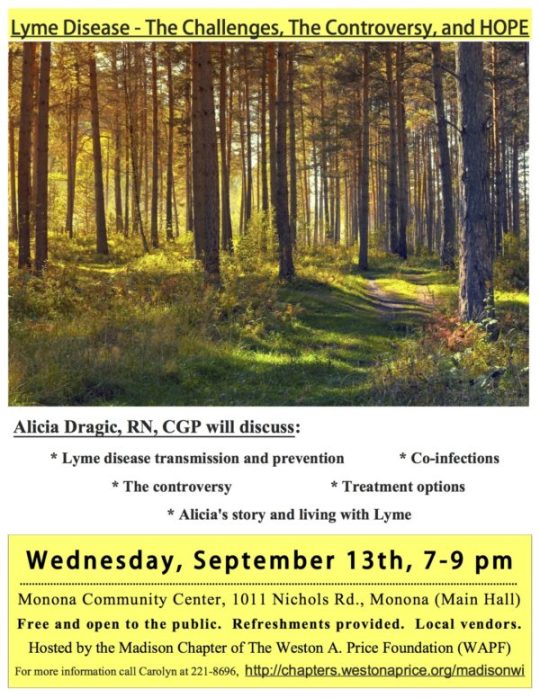
Lyme Talk Tomorrow Night in Monona

http://chapters.westonaprice.org/madisonwi/meeting-topics/

Lyme-1-600x776

Current Topic:

Lyme Disease – The Challenges, The Controversy, and HOPE – Sept. 13th, 7 pm

* Watch prior meeting topics on the: WAPF Madison youtube channel

Future Topics:

Oct. 11 – Dr. Steven Wilke, Chiropractor
Nov. 8 – Holistic Approach to Fat and Cardiovascular Health – Katy Wallace, ND
Dec. 13 – Holiday Party
Jan. 10 – Kefir – Bill Lensmire
Soy in the Diet of Humans & Animals
Nourishing Our Children DVD
Heart Disease / Cholesterol / Statins
High Lysine / Low Arginine Diet
Soil Health – Symphony of the Soil – film screening
Epigenetics
Cookware
Growing Cities film screening
Natural Parenting
Natural Birth Options
Our Immune System and Vaccines
Drinking Water
Chronic Pain
Autoimmune Diseases
Fat-Soluble Vitamins and Minerals

Your Idea For a Topic and/or a Speaker!
If you want more information, or have a suggestion for a future meeting topic, please email us: wapfmadison@gmail.com


Babesia Spread to Newborn

http://www.nbcnewyork.com/news/local/Thompson-Mom-Passed-Rare-Tick-Borne-Illness-to-Newborn-442057583.html  (News video here)

“Cole who was three and a half weeks old at the time spiked a fever at night and I brought him to the local emergency room,” Jillian said.

After the local clinic couldn’t figure out what caused the fever, the Kuhns took Cole to UMass Memorial Children’s Medical Center, where after much testing, they determined he had Babesiosis, a tick-borne blood infection.

Doctors believe Cole obtained the infection during pregnancy as the mother was also infected.

For more on Babesia:  https://madisonarealymesupportgroup.com/2016/01/16/babesia-treatment/

Of Birds and Ticks

http://mainepublic.org/post/battle-against-ticks-and-lyme-disease-scientists-look-skies#stream/0

In the Battle Against Ticks and Lyme Disease, Scientists Look to the Skies

  JUL 3, 2017

As we head into the Maine outdoors this summer, the all-too-familiar warnings about how to avoid ticks reverberate in many of our heads.

Stay on the trail. Steer clear of wooded and brushy areas where ticks congregate.

But while most of us take pains to dodge the eight-legged pests, Chuck Lubelczyk heads straight for them.

As a field biologist at the Maine Medical Center Research Institute’s Lyme and Vector-Borne Disease Laboratory, he studies the spread of diseases carried by ticks, as well as by mosquitoes. That means venturing out into the fields, forests and coastlines of Maine to collect the bugs and evaluate where they pose the most risk to humans.

On a recent June day, Lubelczyk trudged into the greenery of the Wells Reserve, a 2,250-acre spread in York County headquartered at a restored saltwater farm. He partnered with researchers from the Biodiversity Research Institute in Portland to collect ticks from creatures less often associated with them: birds.

The team, assisted by several interns, set up wide nets to ensnare the birds as they flew through the area. They then delicately extricated them, tucked the birds into breathable collection bags, and toted them to a shady picnic table for easier handling. Using tweezers, the team plucked off each tick — typically feasting around the birds’ eyes, bills, and throats — and preserved the bugs for later testing at the lab.

Lubelczyk held up a vial containing at least 50 tiny nymphal deer ticks swirling in a preservative solution. They’d been tweezed off a single bird, a towhee, that morning.

Once free of ticks, the birds were then safely released to continue on their way.

https://bangordailynews.com/video/ticks-on-migratory-birds/ (Video here)

While mice, chipmunks and deer get most of the attention as hosts for ticks, “Not a lot of people talk about the bird issue,” he said. “They’re understudied in a big way, I think. They do have a real role to play.”

Ticks are an annoyance to birds, but they don’t transmit disease to them or slowly and lethally drain them of blood, as researchers have seen among moose calves in Maine. But birds facilitate the spread of ticks, picking them up in Maryland, Connecticut and other eastern states as they fly north in the spring, Lubelczyk explained.

“As they’re migrating, they’re either dropping the ticks off as they fly or when they land. They’re kind of seeding them along migration patterns.”

Emerging diseases

By tracking the birds and the ticks they carry, researchers hope to predict where Lyme and other tick-borne diseases are most likely to accelerate. Lyme is now present in every county in the state, after hitting a record of 1,488 cases in 2016, but ticks are just getting established in areas such as Aroostook and Washington counties, Lubelczyk said.

Along with Lyme, Lubelczyk tested the ticks for other two other emerging diseases, anaplasmosis and the rare but potentially devastating Powassan virus. Powassan, carried by both the deer tick and the groundhog or woodchuck tick, recently sickened two people in midcoast Maine, following the death in 2013 of a Rockland-area woman.

A recent survey Lubelczyk led found the virus in ticks crawling around southern Maine, Augusta and on Swan’s Island in Hancock County.

In the modest Scarborough lab, medical entomologist Rebecca Robich furthered the findings of that survey. Clad in a white coat and blue gloves, she cloned a tiny band of the Powassan virus’ inactivated RNA, using a sample derived from the ticks that tested positive in the survey. Robich began the work, designed to confirm the earlier test results, last winter.

She expects to know conclusively within the next month what percentage of the sampled ticks were infected with Powassan, she said.

“We’re this close to finishing,” Robich said.

Growing exposure

Ticks have become so prevalent in Maine that Lubelcyzk and his colleagues are increasingly called upon to educate the public about the health risks the arachnids pose. That includes speaking at community forums, town meetings, garden clubs and even to groups of employees.

“They’re widespread enough now that DOT, CMP, people like that are bumping into them on a regular basis,” he said. “Even people like law enforcement. The warden service, regular police with police dogs, they’re exposed.”

Their outreach also includes plenty of phone calls to the lab, fielded by its small staff of four, not counting summer interns.

“If somebody calls, we never really turn them down,” he said.

Many people don’t realize that the lab no longer identifies ticks for the public, Lubelczyk said. Now located in Scarborough along with MMC’s medical and psychiatric research centers, the lab formerly operated in South Portland, where it identified a tick’s species for anyone who walked in the door or mailed a sample. The University of Maine Cooperative Extension in Orono has since taken over that service (it does not test ticks for disease).

“It’s very hard to say no to someone when they’re really frantic because they found a tick on themselves, or their child, or even their pet,” he said. “And they’re sitting out in the parking lot.”

So far this season, the lab has fielded numerous calls from worried residents only to discover after viewing a photograph that the tick in question is a dog tick, not a deer tick. Maine is home to 15 species of ticks, and the dog tick is not among those that transmit disease to humans, at least in this region.

Through its outreach work, the lab has also found itself at the center of debates about how to manage ticks. Lubelczyk recalled a town forum on Long Island a couple of years ago that grew tense as residents discussed the use of pesticides.

“As soon as the topic of any kind of spray was brought up, not even by us, by somebody else, the fishing community was dead set against it,” he said. “Understandably, they’re worried about the stock. It really makes that difficult because you start to have divisions in how to control the ticks.”

The lab’s research on the role of birds in spreading tick-borne disease is similarly delicate, because many birds are under threat ecologically, Lubelczyk said.

“No one really cares if you try to target mice. Birds are federally protected in a lot of cases,” he said.

That other biting pest

Educating the public represents a large part of the lab’s mission but only a small part of its budget. Its outreach work is funded largely through small grants from foundations, Lubelczyk said.

Most of its research funding is targeted toward mosquitoes rather than ticks, boosted by the federal government’s initiative to combat the Zika virus, he said. While Zika hasn’t appeared in Maine, warming temperatures due to future climate change could make the state habitable for one of the mosquito species that carries it.

Lubelczyk explained this as he stood in the lab’s testing area, next to a large freezer storing petri dishes packed with frozen mosquitoes. A piece of yellow tape affixed to the door warned, “Not for food.”

While Lyme is far more prevalent, diseases carried by mosquitoes, such as West Nile virus and Eastern Equine Encephalitis, can lead to more acute illness. Both can cause inflammation of the brain and other serious complications.

Funding for tick research is generally less reliable, Lubelczyk said. The recent Powassan survey, for example, was funded by the Maine Outdoor Heritage Fund, which collects money through the sale of instant scratch lottery tickets.

A continuing threat

The lab’s role in helping to prevent tick-borne diseases has only grown as the tick population and the diseases they carry spread. The incidence of Lyme in Maine is among the highest rates in the country, averaging 82.5 cases per 100,000 people between 2013 and 2015.

Anaplasmosis and babesiosis are less common but becoming increasingly worrisome.

Lubelczyk understands the illnesses on both a professional and personal level. He contracted Lyme several years ago, after a deer tick latched onto him while he made a pitstop on the way home from work one steamy July day, he said. He had just changed into shorts and sandals and jumped out of his car for 30 seconds to hang a mosquito trap in Wells, he recalled.

A day and a half later, he spotted the tick bite. After a round of antibiotics, he recovered, Lubelczyk said.

His usual garb for field work includes long sleeves and pants treated with permethrin, along with gaiters over his boots.

“It’s embarrassing,” he said, wincing. “We always talk about wearing appropriate clothing.”

_____________________

**Comment**

I’m thankful someone is dealing with the bird issue in relation to tick propagation as I believe it will be found to be much more of an issue than previously thought.  It would help explain why folks insist they’ve been infected while near trees as birds would drop them onto trees (as well as various rodents).  Like deer, birds serve primarily as transits that can spread ticks far and wide.

While Lubelczyk doesn’t feel dog ticks are important carriers (at least in his area) – he’s mistaken.  Every tick should be suspect until proven otherwise.  Think about it:  they all exchange bodily fluids with their hosts.  Dog ticks are known to carry Tularemia, https://www.cdc.gov/ticks/diseases/index.html Rocky Mountain Spotted Fever, Ehrlichia, Mediterranean Spotted Fever, Babesia in dogs (which should also make it suspect for humans), and potentially Bartonella.  http://labs.russell.wisc.edu/wisconsin-ticks/rhipicephalus-sangineus/  No, it would not be wise to think of the Dog Tick in friendly terms.  Remember that ticks are moving all over the place defying commonly held beliefs about geography.  And while folks fighting for research grants want to promote and blame the supposed “global warming” mentioned in this article, there are many who disagree for good reasons:  https://madisonarealymesupportgroup.com/2017/07/08/global-warming-numbers-fudged/

https://madisonarealymesupportgroup.com/2017/08/14/canadian-tick-expert-climate-change-is-not-behind-lyme-disease/  John explains, “The climate change range expansion model is what the authorities have been using to rationalize how they have done nothing for more than thirty years. It’s a huge cover-up scheme that goes back to the 1980’s. The grandiose scheme was a nefarious plot to let doctors off the hook from having to deal with this debilitating disease. I caught onto it very quickly. Most people have been victims of it ever since.”
“This climate change ‘theory’ is all part of a well-planned scheme. Even the ticks are smarter than the people who’ve concocted this thing,” he says.
“Climate change has nothing to do with tick movement. Blacklegged ticks are ecoadaptive, and tolerate wide temperature fluctuations. On hot summer days, these ticks descend into the cool, moist leaf litter and rehydrate. In winter, they descend into the leaf litter, and are comfortable under an insulating blanket of snow. Ticks have antifreeze-like compounds in their bodies, and can tolerate a wide range of temperatures. For instance, at Kenora, Ontario, the air temperature peaks at 36°C and dips to –44°C, and blacklegged ticks survive successfully.

Also, please note that although there has only been one Zika death in an elderly man with a preexisting health condition in the continental U.S., all the funding is going to it and mosquito research.  This is causing untold harm here where Lyme is causing around 400,000 new cases per year.  There is no official tally on all the other coinfections that often come with Lyme as they aren’t even reportable in many states but are a crucial detail in understanding the complexity of Lyme/MSIDS.  People are often infected with numerous pathogens.  https://madisonarealymesupportgroup.com/2017/07/01/one-tick-bite-could-put-you-at-risk-for-at-least-6-different-diseases/

To treat this complex as a one organism/one disease would be folly.  

Also, he claims that West Nile virus and Eastern Equine Encephalitis, can lead to more acute illness, I would disagree again.  Lyme (borrelia), Babesia, Bartonella, Mycoplasma, and numerous other viruses, and funguses have killed people outright.  Heart block, encephalitis, meningitis, and other serious illnesses are caused by TBI’s. Powassan can be transmitted in under 15 minutes and can kill. Rocky Mountain Spotted Fever is another killer.  There is much to show that if the non-cell wall and biofilm formation of borrelia isn’t successfully dealt with, it could lead to dementia or Alzheimer’s in the future:  https://madisonarealymesupportgroup.com/2017/06/10/the-coming-pandemic-of-lyme-dementia/https://madisonarealymesupportgroup.com/2016/06/03/borrelia-hiding-in-worms-causing-chronic-brain-diseases/https://madisonarealymesupportgroup.com/2016/08/09/dr-paul-duray-research-fellowship-foundation-some-great-research-being-done-on-lyme-disease/https://madisonarealymesupportgroup.com/2016/06/09/alzheimers-byproduct-of-infection/https://madisonarealymesupportgroup.com/2017/01/18/a-bug-for-alzheimers/

And of course, while many cases of Lyme (borrelia) don’t kill immediately, it can make you want to die and disrupt life in such a way people commit suicide.  https://madisonarealymesupportgroup.com/2017/06/20/suicide-lyme-and-associated-diseases/https://madisonarealymesupportgroup.com/2017/07/26/can-lyme-steal-your-mind/

If that isn’t serious, I don’t know what is.  We need to completely kill the idea that Lyme/MSIDS isn’t a severe disease(s).


Transfusion-Transmitted Babesiosis in Nonendemic Areas

Cases of transfusion-transmitted babesiosis occurring in nonendemic areas: a diagnostic dilemma
LeBel, D. P., Moritz, E. D., O’Brien, J. J., Lazarchick, J., Tormos, L. M., Duong, A., Fontaine, M. J., Squires, J. E. and Stramer, S. L.
Transfusion, online first August 7, 2017.

https://doi.org/10.1111/trf.14246

Abstract

BACKGROUND
Transfusion-transmitted babesiosis (TTB) has been rapidly increasing in incidence since the beginning of the 21st century. Asymptomatic individuals with Babesia infection are able to donate blood in the United States because of the lack of specific blood donation testing. Blood products collected in Babesia-endemic areas are distributed nationally; thus, clinicians in nonendemic states may fail to include babesiosis in the differential diagnosis of a patient who had a recent transfusion history and a fever of unknown origin.

STUDY DESIGN AND METHODS
We report the details of two cases of clinical transfusion-transmitted babesiosis and one asymptomatic infection identified in red blood cell recipients in two nonendemic states (South Carolina and Maryland), which, when combined with three recent additional cases in nonendemic states, totals six recipient infections in three nonendemic states.

RESULTS
Delayed diagnosis of transfusion-transmitted babesiosis places patients at risk for increased morbidity and mortality and may result in clinical mismanagement or unnecessary treatments. A peripheral blood smear should be reviewed in any patient with a recent transfusion and a fever of unknown origin. Prompt communication of the diagnosis among physicians is key to ensuring that patients with transfusion-transmitted babesiosis are treated expeditiously, and a transfusion service investigation is necessary to identify additional recipients from the same donor.

CONCLUSION
TTB is appearing in traditionally nonendemic states because of blood product distribution patterns. Clinicians should include TTB on the differential diagnosis in any patient presenting who had a recent transfusion history and a fever of unknown origin, regardless of where the transfusion took place.

More on Babesia:  https://madisonarealymesupportgroup.com/2016/01/16/babesia-treatment/

https://madisonarealymesupportgroup.com/2016/11/19/seroprevalence-of-babesia-in-individuals-with-ld/

https://madisonarealymesupportgroup.com/2016/10/31/the-gift-that-keeps-giving-wisconsin-organ-donor-gives-babesiosis-to-two-recipients/