https://journals.plos.org/plosone/article?id=10.1371/journal.pone.0212222

Association of small fiber neuropathy and post treatment Lyme disease syndrome

Peter Novak , Donna Felsenstein, Charlotte Mao, Nadlyne R. Octavien, Nevena Zubcevik

Published: February 12, 2019  https://doi.org/10.1371/journal.pone.0212222

Abstract

Objectives

To examine whether post-treatment Lyme disease syndrome (PTLDS) defined by fatigue, cognitive complaints and widespread pain following the treatment of Lyme disease is associated with small fiber neuropathy (SFN) manifesting as autonomic and sensory dysfunction.

Methods

This single center, retrospective study evaluated subjects with PTLDS. Skin biopsies for assessment of epidermal nerve fiber density (ENFD), sweat gland nerve fiber density (SGNFD) and functional autonomic testing (deep breathing, Valsalva maneuver and tilt test) were performed to assess SFN, severity of dysautonomia and cerebral blood flow abnormalities. Heart rate, end tidal CO2, blood pressure, and cerebral blood flow velocity (CBFv) from middle cerebral artery using transcranial Doppler were monitored.

Results

10 participants, 5/5 women/men, age 51.3 ± 14.7 years, BMI 27.6 ± 7.3 were analyzed. All participants were positive for Lyme infection by CDC criteria. At least one skin biopsy was abnormal in all ten participants. Abnormal ENFD was found in 9 participants, abnormal SGNFD in 5 participants, and both abnormal ENFD and SGNFD were detected in 4 participants. Parasympathetic failure was found in 7 participants and mild or moderate sympathetic adrenergic failure in all participants. Abnormal total CBFv score was found in all ten participants. Low orthostatic CBFv was found in 7 participants, three additional participants had abnormally reduced supine CBFv.

Conclusions

SFN appears to be associated with PTLDS and may be responsible for certain sensory symptoms. In addition, dysautonomia related to SFN and abnormal CBFv also seem to be linked to PTLDS. Reduced orthostatic CBFv can be associated with cerebral hypoperfusion and may lead to cognitive dysfunction. Autonomic failure detected in PTLDS is mild to moderate. SFN evaluation may be useful in PTLDS.

________________

**Comment**

Keep in mind, researchers by nature have to keep tight & narrow study parameters. In this case they chose to use the unscientific and abysmal CDC 2-tiered blood serology which research has shown misses over half of all cases.  It was also never intended for diagnosis but for surveillance purposes only.  Lyme should be a clinical diagnosis.  We desperately need a better form of accurate testing for this very reason.  Nearly ALL research is based upon 2-tiered serology which leaves out a huge subset of patients – which means there is study bias. 

Some of the sickest people NEVER test positive using CDC criteria.

Also, please note:  

All patients had received a course of antibiotics for Lyme disease including 3 weeks of oral doxycycline as recommended by Infectious Diseases Society of America (IDSA) guidelines [13,30]. Because of symptoms persistence, all participants were treated with additional antibiotics (data in S1 Table). The list may not be accurate and may underestimate the antibiotic therapy as many participants were treated in multiple institutions and as such medical records may be incomplete.

Many would argue that the entire premise of this research article is flawed in that the CDC moniker of PTLDS is not taking into account persistent/chronic infection.  For a fantastic read on that:  https://madisonarealymesupportgroup.com/2019/02/25/medical-stalemate-what-causes-continuing-symptoms-after-lyme-treatment/

Until this issue is resolved, people will be put into two camps based on a false premise, 1) Acute cases 2) PTLDS.  There are numerous subsets of people.  See link above.

Parasympathetic failure & low orthostatic CBFv  was noted in 7 out of 10 patients and abnormal total CBFv score was found in all 10!
All of you out there suffering with dry eye & mouth, inability to digest food, and having colitis type symptoms (either diarrhea or constipation – usually alternating) this study reveals why.
Lyme loves the spine!  
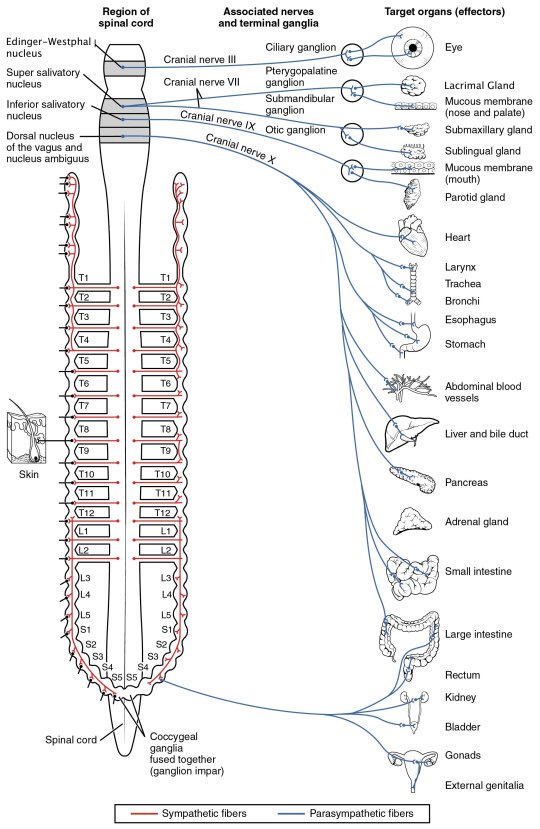
1503_Connections_of_the_Parasympathetic_Nervous_System

By OpenStax College – Anatomy & Physiology, Connexions Web site. http://cnx.org/content/col11496/1.6/, Jun 19, 2013., CC BY 3.0, https://commons.wikimedia.org/w/index.php?curid=30148020

You can visualize where on the spine the various organs receive information from.  Notice all the things connected to the cranial nerves at the top.  Please know Bartonella and other coinfections can affect these areas as well.  Dr. Ericson’s found Bart all over the place:  https://madisonarealymesupportgroup.com/2019/02/27/advanced-imaging-found-bartonella-around-pic-line/  Take a gander at her slides where she’s found Bart in collagen, where a PIC line was removed, skin biopsies (including the brain), cartilage, and blood cells.

Lastly, besides the spinal involvement, notice ALL of the patients had an abnormal Total CBFv score.  This is cerebral blood flow velocity from the middle cerebral artery.  Not enough blood flow = not enough oxygen, which is required for normal functioning.  It alone can account for brain fog and fatigue.  Too much blood flow = swelling and inflammation which can cause severe pain and even lead to Chiari:  https://madisonarealymesupportgroup.com/2016/04/02/chiari/  In one week I met 3 Lyme patients with a Chiari diagnosis.  I had an MRI to rule it out myself.

One drug that was most effective for me for this issue was Minocycline:  https://madisonarealymesupportgroup.com/2017/06/04/minocycline-for-ms-and-much-more/


https://www.mdpi.com/2075-4418/9/1/25

Diagnostics 2019, 9(1), 25; https://doi.org/10.3390/diagnostics9010025

Disseminated Bartonella henselae Infection Visualized by [18F]FDG-PET/CT and MRI

Published: 1 March 2019
Abstract
We describe the clinical course of a 24-year old male with Crohn’s disease in immunosuppressive therapy admitted with a 6-week history of fever, weight loss, night sweat, and general malaise. The patient received extensive workup for a fever of unknown origin and received empiric antibiotics. Workup with Fluorine-18 fluoro-2-deoxy-d-glucose ([18F]FDG) positron-emission tomography (PET/CT), and magnetic resonance imaging (MRI) with intravenous contrast showed multifocal ostitis of the columna and os sacrum, as well as abscesses in m. iliopsoas and m. iliacus and affection of the retroperitoneum, liver, and spleen. Initially, malignancy was suspected, but a subsequent liver biopsy showed necrotizing granulomatous inflammation and a later polymerase chain reaction (PCR) showed Bartonella henselae. The patient had relevant exposure from housecats. He was treated with Doxycycline and Rifampicin for 12 weeks resulting in complete recovery. This case is, to our knowledge, a rare example of disseminated infection with Bartonella henselae visualized on both [18F]FDG-PET/CT and MRI. View Full-Text
___________________
**Comment**
The Cat’s beginning to get out of the bag regarding Bartonella.  Prepare yourself to see a whole lot more of this. I’m thankful that the authors stated that this case was to their knowledge a rare example; however, Bartonella has flown under the radar for so long chances are quite high there is much more of this going on. Similarly to Lyme and other coinfections, testing that relies on serology is abysmal and many remain undiagnosed.
We’ve always been told that folks that contract Bartonella need a history of cat exposure or other animals and have suppressed immune systems.  Please know, many completely healthy individuals with NO cat exposure can have disseminated Bartonella.  For examples of this:  https://madisonarealymesupportgroup.com/2019/03/02/skin-inflammation-nodules-letting-the-cat-out-of-the-bag/  After the study I list 6 cases.
Dr. Ericson’s work has shown Bartonella virtually everywhere in the human body:  https://madisonarealymesupportgroup.com/2019/02/27/advanced-imaging-found-bartonella-around-pic-line/  Slides in link
In my experience Bartonella is as bad if not worse than Lyme which gets all the press. Authorities do not even consider it with Lyme patients but nearly everyone I work with has it along with Lyme and often Babesia as well as Mycoplasma and various viruses.  Until the polymicrobial aspect is acknowledged and treated, we are doomed as patients.
Yes, Martha, Lone Star ticks are in Wisconsin as well:  https://madisonarealymesupportgroup.com/2017/02/10/lone-star-ticks-in-wisconsin/


https://www.eveningtribune.com/news/20190306/stronglegislators-highlight-lyme-disease-preventionstrong

Legislators Highlight Lyme disease Prevention

ALBANY — State Senator Tom O’Mara (R-Big Flats) joined his Senate colleagues this week to urge Governor Andrew Cuomo and legislative leaders to include funding for research, education, and prevention initiatives in the 2019-2020 state budget to continue combating Lyme and Tick-Borne Diseases (TBDs).

“Important actions over the past several years have broadened the state’s overall response to the spread of Lyme and other tick-borne diseases. Nevertheless, much more needs to be done, particularly in the areas of reporting, testing and treatment, and education and awareness,” said O’Mara, who has served as a member of the Senate Task Force on Lyme and Tick-Borne Diseases.

The state Senate has led the way in recent years in securing nearly $3 million in state funding to advance research, education, and prevention initiatives statewide.

O’Mara and his colleagues noted, however, that the governor’s 2019-20 proposed state budget fails to include funding to build on past efforts and further combat the spread of Lyme and TBDs.

In response, the Senate Republican conference this week launched “Let’s Talk Ticks!” as an advocacy and educational campaign to continue raising awareness about the importance of ongoing state investment and support. At a round table discussion, lawmakers and other policy makers heard testimony from researchers, patients, and other experts committed to tackling the TBD epidemic.

________________

**Comment**

We need this in Wisconsin which is 4th in the nation for Lyme disease.

If you want to make a difference, contact your representative & senators. Here is a letter you can use as is or you can use to derive your own.  We need to keep pressing the issue or they will happily ignore it.

Letter to WI Reps and Senators copy

april-days

Our next Lyme Support Meeting:

Date: April 13, 2019

Time:  2:30-4:30pm

Where:  809 S. Thompson Drive (East Madison Police Station)

What:  Regular Support


Upcoming:  For Lyme Awareness on May 4, 2019 we are planning on a Community Viewing of “Under Our Skin,” the best primer on Lyme disease on the market.  If you haven’t seen this, you need to.  It’s how I diagnosed myself and my husband.  Also, please bring family, friends, anyone who will come to learn about this devastating disease(s). This will be our last meeting until Fall.

Don’t forget to register for the Learn About Lyme Workshop – deadline is Monday, March 18, 1019.

Details here:  https://madisonarealymesupportgroup.com/2019/03/01/learn-about-lyme-wisconsin-workshop-march-23/

It’s only $10 with a gluten-free lunch provided.

See you there!