Lyme in Kenosha
Nancy Carlson: ‘The little bite cost me quite a lot’ says Hawthorn Hollow naturalist

Hawthorn Hollow Nature Sanctuary and Arboretum naturalist Nancy Carlson sets up artifacts inside of a wigwam for a class about Native Americans.
KENOSHA NEWS PHOTO BY KEVIN POIRIER
A tick clung to Nancy Carlson’s hip after a workday spent outside in 2013.
It wasn’t abnormal.
“I pull ticks off all the time, it’s not a big deal,” Nancy Carlson, a naturalist at Hawthorn Hollow Nature Sanctuary and Arboretum on Green Bay Road, said.
Weeks later joint pains and flu symptoms took over her body. She tested positive for Lyme and was prescribed antibiotics.
“But it wasn’t enough,” Carlson said. “After that I was never better.”
Breathing and heart issues landed Carlson in the hospital twice during her treatment, due to symptoms caused by the toxins building up in her body as the Lyme-causing bacteria deteriorated.
She saw a rheumatologist, an endocrinologist and a neurologist, trying to get the best treatment for her Lyme.
“None of those knew the truth about Lyme disease,” she said.
The average patient sees five doctors over two years before being diagnosed, according to the International Lyme and Associated Diseases Society, a nonprofit dedicated to educating the public and doctors about proper Lyme treatment. It also states 40 percent of Lyme patients end up with long-term health problems.
She started feeling relief when she met Dr. Debra Muth, a Lyme-literate doctor in Waukesha. Her practice has more than 5,000 patients — 60 percent who are there for Lyme.
Carlson went on a treatment regimen specific to her needs.
Reaching into her pocket this summer, Carlson counted the midday pills she takes as part of her routine to manage her chronic Lyme, spurred by that 2013 tick bite.
Throughout the day, she takes 19 pills to treat the disease and co-infections.
When it all started, she didn’t know anything about Lyme disease.
“Take a course of antibiotics and I’ll be back to good,” she said. “That’s what the doctor thought as well.”
Living with Lyme
“It’s hard for doctors to diagnose but I knew that I had it,” Carlson said.
Carlson suffered the most a year after her Lyme diagnosis, causing her to take sick days from her office — the outdoors — which she now sees as her sanctuary.
Horrible headaches and sensory issues kept Carlson from going to the movies, enjoying Summerfest or simply scrolling on a computer screen.
“All of a sudden you’re changing the way you live your life based on your illness,” she said, holding her wrist bound by a brace to control the nerve pain.
Carlson learned what overstimulated her through trial and error. Going to the grocery store now, even though her Lyme and co-infections are under control, is out of the question.
Now she suffers mostly with her co-infections, which include bartonella, Rocky Mountain spotted fever and babesia.
“Those are the parasites I’m struggling with — that we know of,” she said.
Carlson can’t afford all of the tests that could reveal what else threatens her health.
“The little bite cost me quite a lot,” she said. “Not only in health but financially.”
Carlson has $20,000 in medical debt in addition to the $20,000 out of pocket she’s already paid.
Insurance companies are wary to cover chronic Lyme treatment, she said.
No insurance coverage
Some of Muth’s other patients were forced to take on second and third mortgages to pay for their physical pain relief and treatment.
Paying for that treatment is difficult as bureaucratic organizations, societies and federal medical guidelines clash.
Insurance companies often follow what the Infectious Disease Society of America, a medical association that represents health care professionals who specialize in infectious diseases, recommends for Lyme treatment, Muth said.
That organization says 30 days of antibiotics should treat Lyme disease, Muth said, but the International Lyme and Associated Diseases Society support long-term treatment.
The National Guideline Clearinghouse, a federally-run database of clinical practice guidelines, agrees with the later and removed the Infectious Disease Society of America’s guidelines from its website in February 2016.
Many doctors remain unaware of that change, Muth said.
“It’s very difficult to get education out to physicians unless it comes from a pharmaceutical company,” she said.
The insurance company issue could be political, Muth said.
“No one wants Lyme to be a problem in their state for financial and fear reasons,” she said.
Advocacy
Carlson still works as a naturalist, spending every day outside in the same environment in which she was bitten.
Keeping a health journal helps track of her symptoms, which she reports to Dr. Muth during checkups every three months.
She goes to city council meetings in Racine to get tick awareness signs put up in local parks and beaches to keep people alert.
“Once I got through the hardest part of being sick, I felt like it was my job to bring awareness to the community,” she said.
Part of her job is to educate children about the environment, and she always mentions to check for ticks.
“Education is the key to getting this under control,” she said.
____________________________________________________________________________________________
John Bush: Teen saw many doctors before finding help for chronic pain

John Bush talks color schemes for next year’s yearbook with his yearbook teacher, Ellie Smith, during a lunch meeting at Gateway Cafe on July 19.
KENOSHA NEWS PHOTO BY SEAN KRAJACIC
The right doctor changed everything for John Bush.
Since October of 2016, the Kenosha teenager had had a series of health issues, shifting his life filled with musical theater and academics to a life of constant doctor visits. Doctor after doctor told his family what they thought would relieve his pain, but nothing sufficed.
If he had waited four more months before seeing yet another doctor, he could’ve faced paralysis.
That’s the usual waiting period to see Dr. Casey Kelly, a Lyme-literate doctor in Chicago.
But when John’s mom, Laura Bush, called the office seeking treatment for her son, the receptionist had good news.
“You’re really lucky,” the receptionist said. “Someone just canceled a new patient appointment; can you be here tomorrow at 2 p.m.?”
Developing diagnosis
About a month after his colonoscopy and initial Lyme diagnosis, John had finished his 30 days of antibiotics, but his body continued to scream with pain.
“They’re going to tell me it’s not active in my body anymore,” John said to his mom when she made an appointment to see another doctor, a rheumatologist, who specializes in joint pains and autoimmune diseases.
His stiff muscles made it difficult to get out of bed each morning and the flu-like symptoms persisted.
Holding the songbook at church made his hands and neck ache with pain, a common sign of chronic Lyme.
It was supposed to be gone. That’s what his doctors kept telling him.
According to the Centers for Disease Control and Prevention, there are no accurate tests to prove that Lyme has been eradicated from the body.
John’s frustration grew with his doctors’ seemingly low knowledge of what was happening to his body. His first doctor thought it might just be mononucleosis.
Finding the book “Why Can’t I Get Better?” by Dr. Richard Horowitz changed John’s perception of Lyme.
Horowitz wrote rheumatologists often think the disease is depression and anxiety if the antibiotics fail. John felt the doctor visit was going to be useless.
The doctor’s explanation of John’s chronic pain resembled Horowitz’s prediction.
Laura Bush asked to see the Lyme doctor in the building.
“I am the Lyme doctor,” he replied.
They left quickly.
The right treatment
John shared his entire medical history with Dr. Kelly, leading her to believe he was bitten by a tick 11 years ago.
The body doesn’t always recognize the bacteria as an active disease when it’s first transmitted. That leaves it dormant for years — sometimes presenting itself as other health conditions — until it’s stirred up, Dr. Debra Muth, a Lyme-literate doctor in Waukesha, said.
John’s symptoms surfaced when he started taking doxycycline for his acne.
He had yet to be diagnosed with Lyme. The antibiotic went to work, not only on the bacteria causing his acne, but on the dormant Lyme-causing organisms in his body. As they died off, they unleashed toxins, creating John’s symptoms.
Throughout his life, John had been diagnosed with attention deficit disorder, obsessive-compulsive disorder, oppositional defiant disorder, motor impairment, concussions and a slew of stomach issues.
Kelly told John she thought those diagnoses were caused by the bacteria festering in his body, he said.
John was skeptical about the treatment until he spotted Dr. Horowitz’s book in the waiting room, which instantly calmed him.
John was in Chicago four days a week for three weeks for a mixed-medication plan.
That treatment included mass doses of vitamins, infusions of medicine and cleaning toxins from his blood using a UV light.
Living with Lyme
One January morning, months after his initial diagnosis and attempt at treatment, John realized he needed help walking one morning.
With a grimace plastered on his face, his stiff muscles walked into his basement to fetch his grandpa’s wooden cane.
His parents thought he was being theatrical at first, citing John’s involvement in local theater, but quickly saw the look on their son’s face and knew it was real.
Clutching his newly bought blue plastic cane, John steadied himself walking the halls of Bradford High School.
He felt his classmates’ and teachers’ eyes on it, not quite understanding why he had it while he was still trying to understand his disease, too.
“I didn’t want anyone to feel like they owed me anything,” John said, recalling how he attempted to minimize his suffering.
During choir practice, he danced with the cane through his muscle pains while he struggled with brain fog, making it hard to memorize the songs he loved performing.
“I didn’t want people to see me as disabled, which I was,” he said.
Looking back, he recognizes he was trying to fight reality.
Eventually, John had to drop most of his classes. School became too much.
The Lyme drained his energy and took a toll on his family’s finances.
“How do you go about something that’s difficult to begin with and how do you wrap the budget around it?” he said.
Finances
The insurance company wouldn’t cover the cost of John’s treatment.
After the first visit with Kelly, they left with about $400 worth of supplements. So far, his family has paid $12,000 out of pocket for his treatment.
“I don’t know how my parents are doing it, because it’s not cheap,” John said.
His initial medical routine included a strict diet with seven medications at breakfast, two at lunch, six at dinner and another six at bedtime.
After two weeks on the new routine, John ditched his cane.
Advocacy
Now, six months removed from his initial diagnosis, John speaks at Rotary clubs to share his story.
He wants to shift the conversation so others get treatment quicker at lower costs.
“It’s really important for people to realize that we have an epidemic in this country and in the state of Lyme disease,” he said.
The reality of Lyme disease
Lying in a hospital bed at Aurora Medical Center, John Bush, 17, had an empty stomach with a bag of saline next to him, waiting for his colonoscopy.
He looked at his mom, Laura Bush, who seemed to be hiding her worry as they waited.
John was supposed to be studying for his three college-level classes at Bradford High School. He should have been reviewing lyrics for choir or helping the student government club. But a series of health problems — stomach pains, stiff muscles, extreme flu-like symptoms, bloody feces and losing 20 pounds — had him in that hospital room.
“The blood test we took showed you do have Lyme,” he said.
John didn’t understand. He didn’t remember being bitten by a tick — the common carrier of Lyme disease.
Most don’t.
Defining the disease
Lyme disease is a bacterial infection commonly transmitted by the deer tick, but recent research shows it can come from any tick, said Dr. Debra Muth, a Lyme-literate doctor with Serenity Health Care Center in Waukesha.
Chances of being bitten are greater this summer because of Wisconsin’s warm winter, said Pringle Nature Center naturalist Valerie Mann.
“More of (the ticks) were able to survive,” she said. “Winter usually kills most of them.” (please see comment at end of article)
About 50 percent of all ticks carry Lyme disease. It only takes about 10 minutes of bite-to-skin contact for the disease to spread, Muth said.
The signs, diagnostic tests and treatment options for Lyme have varying degrees of success.
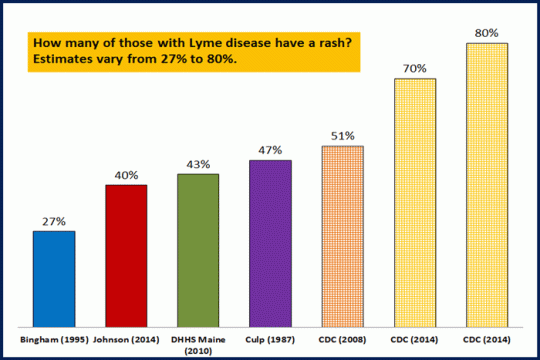
A bull’s-eye rash on the infected area used to be considered the warning of Lyme disease, but fewer than 20 percent of those infected get that rash, Muth said.
Those who are promptly tested for Lyme have a 50 percent chance of receiving a false negative result, Muth said.
Treatment variations
Traditional doctors prescribe up to 21 days of antibiotics to eradicate the bacteria, while Lyme-literate doctors treat it for up to three years.
Muth compares Lyme disease to syphilis, a sexually-transmitted disease that requires constant treatment.
“That is the same mindset that a Lyme-literate doctor has,” she said.
Muth uses a combination of antibiotics, herbal treatments and alternative medicine for treatment.
Lyme-literate doctors treat co-infections in addition to the bacteria that causes Lyme. Co-infections include bartonella, which can cause neurological disorders, to Rocky Mountain spotted fever.
Lyme disease can be hard to cure if other infections are not treated at the same time, according to the International Lyme and Associated Diseases Society, a nonprofit dedicated to educating the public and doctors about Lyme treatment.
Sometimes, antibiotics are not able to rid the body of the bacteria that cause Lyme disease to persist.
The bacterium changes from its original corkscrew shape into alternative shapes, making it hard to reach with antibiotics, Muth said. A protective cyst also grows around the bacterium, literally blocking the treatment, she said.
Wisconsin had 46 cases in 2015, eight in Kenosha County, according to the Wisconsin Department of Health.
That could all be under-reported, Muth said, especially given the likelihood that Lyme disease is misdiagnosed and mistreated.
Misdiagnosis
When the disease isn’t treated properly, the consequences are staggering.
Extreme mishandled cases of Lyme have been misdiagnosed as multiple sclerosis — an unpredictable, disabling disease of the central nervous system that disrupts the flow of information within the brain and between the brain and the body, often leaving its victims paralyzed, Muth said.
Two patients came to her in wheelchairs, unable to walk long distances. Two years of treatment restored full mobility, Muth said.
That misdiagnosis is caused when an MRI scan shows signs of multiple sclerosis when, in reality, it’s truly Lyme disease, Muth said.
A spinal tap is used to differentiate between Lyme and MS, but most patients never receive one.
Muth’s patients were shocked when they found out their health problems plaguing them for years were Lyme all along.
“Most of them are extremely frustrated that no one thought of that before,” Muth said.
____________________________________________________________________________________________
**Comment**