Archive for the ‘Ticks’ Category

Nootkatone Registered by EPA -Insect Repellent Products Could Be Available by 2022

https://content.govdelivery.com/accounts/USAEPAOPPT/bulletins/2998fd2

Pesticide Program Update: Nootkatone Now Registered by EPA

**Comment**

I posted on Nootkatone before:  https://madisonarealymesupportgroup.com/2017/01/10/nootkatone/  Videos within.  https://madisonarealymesupportgroup.com/2018/04/12/nootkatone-against-ticks/

This New York tTmes article explains more:  https://www.nytimes.com/2020/08/10/health/tick-mosquito-repellant-nootkatone.html

  • Nootkatone is an oil found in cedar trees and grapefruit.
  • It’s considered safe and is used in food and perfume.
  • The EPA registration only applies to Nootkatone – not forthcoming products which will each need to be tested and registered.
  • The chemical repels mosquitoes, ticks, bedbugs, fleas and may be effective against lice, sandflies, midges, and other pests.
  • An ISU insect toxicologist found it to be an “impressive repellent but a weak insecticide.” It can kill insects but takes a vast amount of product making it impractical.
  • Nootkatone repels ticks better than synthetics and is their equal at repelling mosquitoes.
  • Unlike other natural products, it does not lose its potency after an hour but lasts as long as synthetics.


FREE Webinars on Ticks, Lyme, & Prevention

https://extension.psu.edu/catalogsearch/result/?education_format=810&q=tick

EDUCATION

Tick Series: Hunters and Vector-Borne Disease - A Tick-ing Time Bomb

Tick Series: Hunters and Vector-Borne Disease - A Tick-ing Time Bomb - Webinars WEBINARS

Free
Attend this Live webinar to learn how to protect yourself from ticks and other vector-borne diseases this hunting season!
Tick Series: Protecting Your Horses from Tick Bites

Tick Series: Protecting Your Horses from Tick Bites - Webinars WEBINARS

Free
Learn how to treat horses and their environments to prevent ticks with this live webinar!
Tick Series: Tick Risks for Pennsylvania Cattle

Tick Series: Tick Risks for Pennsylvania Cattle - Webinars WEBINARS

Free
Learn how to control ticks in your herd with this webinar.
Tick Series: Lyme Disease and Other Tick-Borne Diseases

Tick Series: Lyme Disease and Other Tick-Borne Diseases - Webinars WEBINARS

Free
Tick prevention, treatment, and more will be covered in this Live webinar.
Tick Series: Protecting Yourself from Tick Bites

Tick Series: Protecting Yourself from Tick Bites - Webinars WEBINARS

Free
Learn how to prevent tick bites during this live webinar!
Deer tick, National Park Service.

Time to Talk Ticks: Symptoms, Treatment, and Prevention - Webinars WEBINARS

Free
Two experts weigh in on a variety of tick-related topics, from tick habitats to common tick diseases, and how they affect horses.
Extension at Home: Preventing Tick and Mosquito Bites

Extension at Home: Preventing Tick and Mosquito Bites - Webinars WEBINARS

Free
Join us for the Extension at Home webinar series to prepare and protect your outdoor sanctuary.
Tick Series: Vector-Borne Disease Basics

Tick Series: Vector-Borne Disease Basics - Webinars WEBINARS

Free
Learn about the basics of vector-borne diseases in Pennsylvania during this live webinar.
Tick Series: Identification, Distribution, and Natural History

Tick Series: Identification, Distribution, and Natural History - Webinars WEBINARS

Tick Series: Identification, Distribution, and Natural History

Learn about the many species of ticks found in Pennsylvania during this live webinar.

Tick Series: Tick Protection Around the Home

Tick Series: Tick Protection Around the Home - Webinars WEBINARS

Tick Series: Tick Protection Around the Home

Join our informative webinar to learn how to protect you and your family from tick bites while still enjoying your backyard this season!
Tick Series: Ecology and How to Approach Tick Control

Tick Series: Ecology and How to Approach Tick Control - Webinars WEBINARS

Free
This live webinar will discuss tick development, hosts, and where ticks are found.
Tick Series: Protecting Pets from Tick-Borne Disease

Tick Series: Protecting Pets from Tick-Borne Disease - Webinars WEBINARS

Tick Series: Protecting Pets from Tick-Borne Disease

Ticks carry diseases that can greatly affect the health of your pets. Learn how to protect your pets from tick-borne diseases during this informative webinar.

Tick-borne Virus: All You Need to Know About the Disease That Has Killed 7 in China

https://economictimes.indiatimes.com/news/international/world-news/tick-borne-virus-all-you-need-to-know-about-the-disease-thats-killed-7-in-china/

Tick-borne virus: All you need to know about the disease that has killed 7 in China

**Comment**
While the world is fixated on COVID, there are other viruses that are deadly, and SFTS is one of them.
Important points:
  1. Symptoms include fever, coughing, thrombocytopenia (low platelets), leukcytopenia (love white blood cells), neurological issues and gastrointestinal disorders.
  2. SFTS has a 30% fatality rate.
  3. The Asian Longhorned tick appears to be the culprit which is now spreading across the U.S. ,despite the weather, by migrating birds.
  4. They don’t know if human to human transmission occurs.
  5. Since this was first isolated in 2011 you would think we would have better answers for something that kills 30% of the people it infects….

For more:  https://madisonarealymesupportgroup.com/2017/08/11/death-from-tick-borne-virus-sfts/  This article states the woman may have been infected by the bite from a cat.  If this is true, human to human transmission is highly probable.

https://madisonarealymesupportgroup.com/2018/09/12/three-surprising-things-i-learned-about-asian-longhorned-ticks-the-tick-guy-tom-mather/  We need answers on this tick fast because they line up on a blade of grass like a cluster-bomb.  Brush against it and you have hundreds if not thousands of ticks on you all at once.
And while researchers are quick to report it transmits Lyme disease rarely, it’s still a possibility:  https://madisonarealymesupportgroup.com/2019/10/26/researchers-conclude-asian-longhorned-tick-contributes-minimally-to-lyme-disease-in-the-u-s/
uninfected H. longicornis larvae could acquire B. burgdorferi s.s. while feeding on infected Mus musculus mice (infection prevalence >50% in freshly fed larvae) but that the infection was lost during the molt to the nymphal stage. None of 520 tested molted nymphs were found to be infected, indicating that transstadial passage of B. burgdorferi s.s. is absent or rare in H.
This tick should be a grave concern to all of us.

Allegheny County’s Tick Collector Warns of Lyme Disease Risks

https://www.post-gazette.com/news/environment/2020/08/07/ticks-Lyme-disease-risks-Allegheny-County-blacklegged-tick/stories/

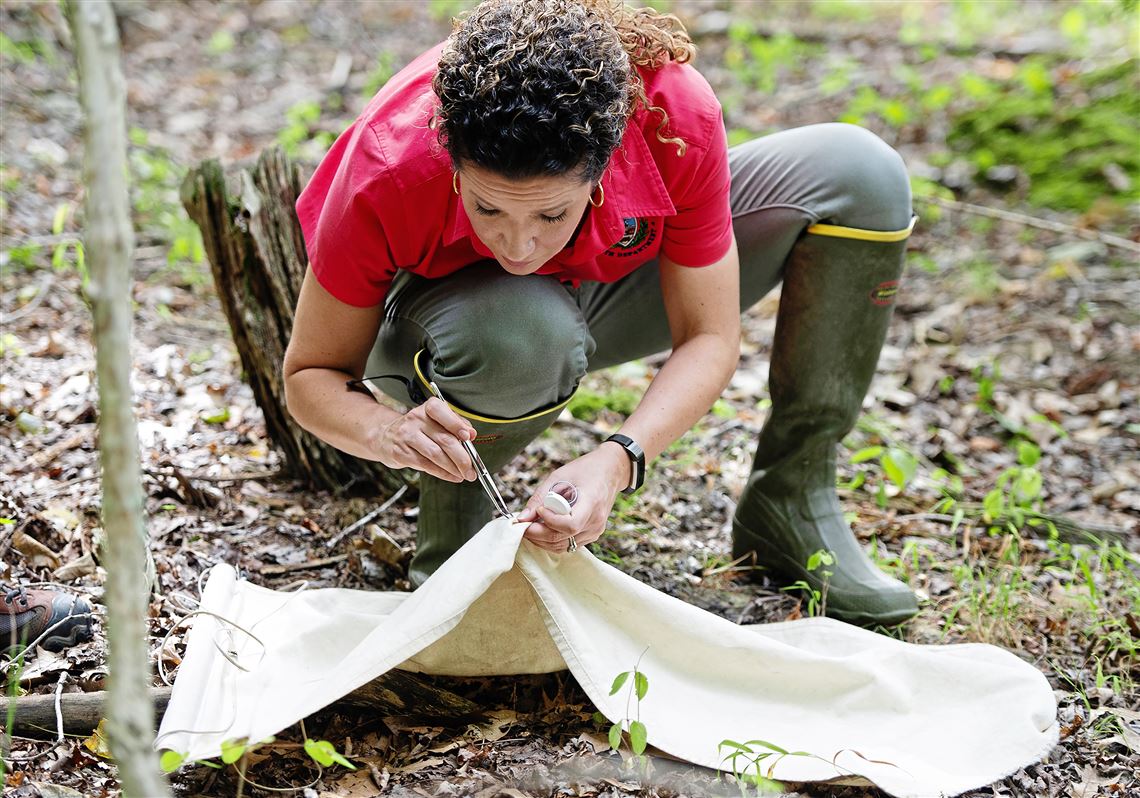
Leah Lamonte, vector control specialist for the Allegheny County Health Department, looks for blacklegged ticks in their nymph stage after dragging a cloth along a trail in Hartwood Acres on July 30, 2020, in Allison Park.

Allegheny County’s tick collector warns of Lyme disease risks

Pam Panchak / Post-Gazette


Active Surveillance of Pathogens From Ticks Collected in New York Suburban Parks and Schoolyards

https://pubmed.ncbi.nlm.nih.gov/32697888/

Abstract

Schoolyards and suburban parks are two environments where active tick surveillance may inform local management approaches. Even in a state such as New York with a robust active tick surveillance programme operated by the state Department of Health, these settings are not routinely covered. The goal of this study was to highlight the importance of active surveillance for tick-borne pathogens by describing their prevalence in ticks collected from schoolyards and suburban parks and to guide the use of integrated pest management in these settings. Tick dragging was performed in three regions of New York State: Long Island, the Lower Hudson Valley and the Capital Region. A total of 19 schoolyards and 32 parks were sampled. The location, habitat and weather at the time of tick collection were recorded. Ticks were speciated and tested for the presence of 17 pathogens with a novel application of nanoscale real-time PCR.

  • The causative agents of Lyme disease, anaplasmosis, babesiosis and Powassan virus disease were all detected from Ixodes scapularis in various sites throughout the capital region and south-eastern counties of New York state.


  • The most common agent detected was Borrelia burgdorferi


  • coinfection rates were as high as 36%


  • This surveillance study also captured the first of the invasive Asian longhorned tick species,Haemaphysalis longicornis, in New York state (collected 2 June 2017).

Results from this study highlight the importance of collaborative efforts and data sharing for improvement of surveillance for tick-borne disease agents.

___________________

**Comment**

This study doesn’t surprise me one bit.  New York is a hot-zone and it only follows that parks and schoolyards would be prime tick locations.  Here in Wisconsin, they’ve found ticks even in shortly cut grassy playing fields that school children use. They aren’t just in the shrubby and wooded areas commonly thought of.

It is imperative we get the word out.  By taking simple precautions you can make your children tough targets:  https://madisonarealymesupportgroup.com/2019/04/12/tick-prevention-2019/

https://madisonarealymesupportgroup.com/2020/07/20/ticks-lyme-disease-information-for-families/

You can purchase pre-treated socks from Wisconsin Lyme Network AND help by having part of the proceeds go toward Wisconsin doctor education for tick-borne illness:  https://wisconsinlymenetwork.z2systems.com/np/clients/wisconsinlymenetwork/giftstore.jsp  These socks make great stocking stuffers for Christmas.

Lastly, this study shows the importance of coinfection as 36% of ticks were infected with more than one pathogen.  ‘Authorities’ have not dealt with this crucial issue that’s affecting many patients and the need for them to rethink and revise their ‘guidelines’ that they’ve left virtually untouched for over 40 years. Treatment is far more complex than they are admitting to:  https://madisonarealymesupportgroup.com/category/lyme-disease-treatment/