Returning to Nature Helped Heal This Lyme Survivor
https://www.lymedisease.org/returning-to-nature-after-lyme/
Returning to nature helped heal this Lyme survivor
By Fred Diamond
When I was researching my book Love, Hope, Lyme: What Family Members, Partners, and Friends Who Love a Chronic Lyme Survivor Need to Know, I had no idea how traumatizing being out in nature could be for some persistent Lyme disease survivors. Even seeing a deer on the side of the road could be triggering.
But I met some people who have attributed embracing the nature they once loved as helpful in healing while still maintaining tick prevention habits.
One such person, marine scientist Alayna Bellquist, discussed on my Love, Hope, Lyme podcast how she was able to reduce her Lyme anxieties and challenges by fully embracing her love for the sea and horseback riding as critical to her recovery.
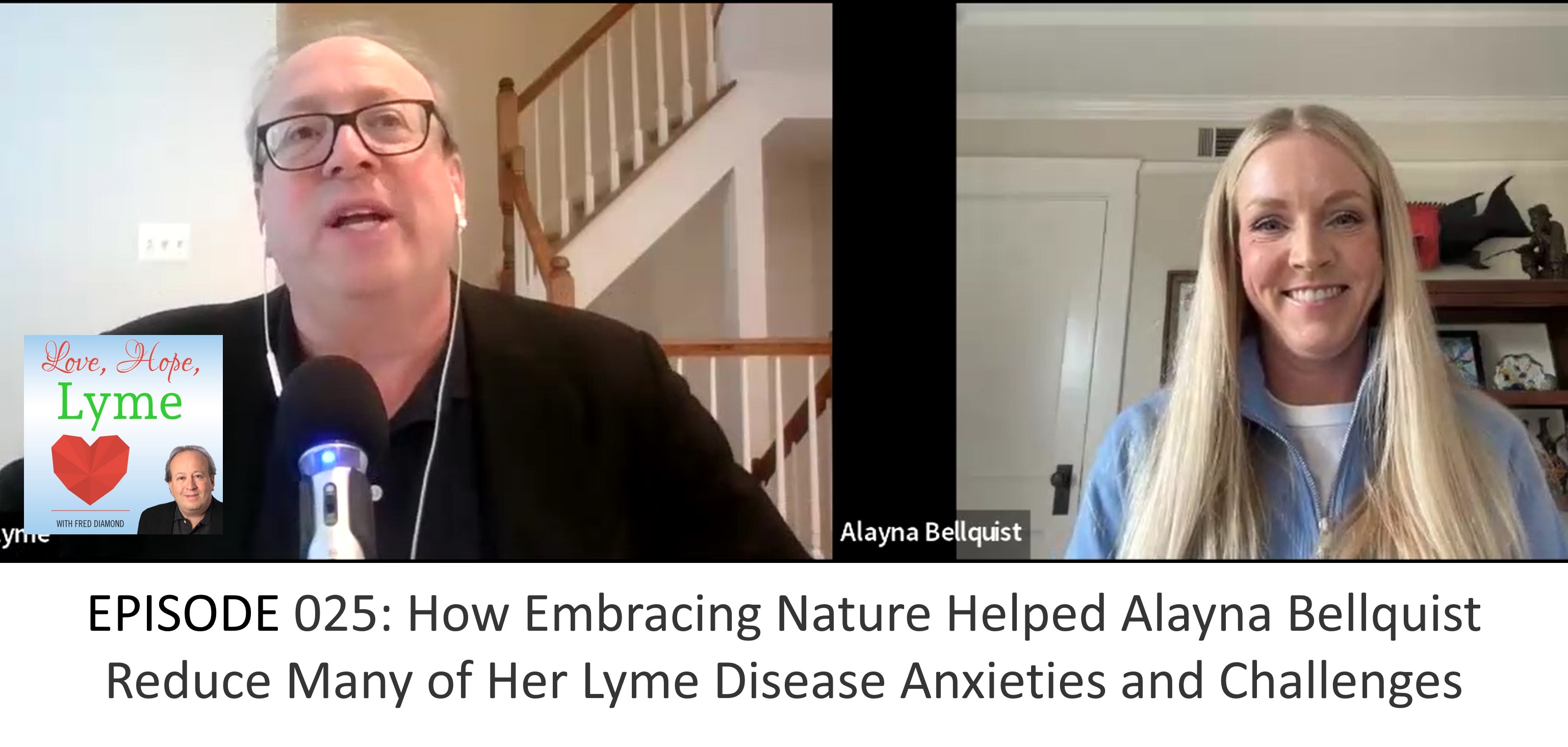 “I’m a classic Lyme person in that I was very overachieving, very people-pleasing, very go, go, go. I live in San Diego, had a relatively frantic life (before being infected),” she said.
Although she was bitten by tick in Southern California, she said she was not tick aware growing up.
“I grew up on Vancouver Island where no one ever spoke about Lyme. I had no tick awareness until I moved to Southern California, and it came up a bit more,” she said.
She said she was bitten when riding her horse, noticed the infection, and immediately sought antibiotic treatment, which mildly helped. In 2020, her symptoms increased, and she became bedridden for a year. Although she tried a lot of conventional and alternative healing methods, and did mental and emotional work, it was getting back into the nature she loved that accelerated her healing.
“Fearing nature is understandable when you have Lyme, but I think that mindset is dangerous. I want chronic Lyme survivors to know that getting back into nature can be helpful, while, of course, ensuring you take proper precautions,” she advised.
Missing nature was brutal, but led to healing
“Before I got sick, horseback riding was a big part of my identity. I was a marine scientist and a horseback rider. Every minute I wasn’t working, I wanted to be on the back of a horse. I’ve been nature and animal oriented my whole life,” she said. “There was no limit to how much time I could spend around them.”
She said becoming bedridden and not being out in nature was brutal.
“Having had worked in fisheries for 20 years, I learned that nature always heals, given the chance. Nature is inherently resilient and heals from devastation that you cannot even grasp. These are principles that people are not really taught,” she said.
“Growing up in Vancouver Island, there’s nature everywhere and we are a part of it. I learned that if certain species, such as white sharks, can be in such terrible shape for a long time and then recover, that principle can apply to me, too.”
She said since the bond with nature was so intrinsic to her, she did not realize how fearful of it Lyme survivors might be.
“There is a lot in science to back the healing properties of doing that, especially for your nervous system,” she said.
“My nervous system was 100% fried when I was bitten. I was running all of time and had chronic anxiety and a racing heart. My stomach was always in knots. I also had Babesia, but sitting on the earth, calming my nerves, taking the time to look at the stars healed me. I know it’s so basic, but I never looked at the stars before,” she said.
“Being back in nature, while at the same time ensuring that I am preventing another tick bite, has been the most important to my recovery,” she said.
Getting back into nature healed her
“If you want to bring a species back from depleted numbers, you work on the ecosystem. You work on the things that depleted its resiliency. If there’s pollution or problems in the food chain or warming oceans, for instance, those are the things that you address so that the species can flourish,” she said.
“I asked myself, ‘What are the things that are attacking my ability to heal?’ People-pleasing, never saying no, running 12 to 14-hour days nonstop, perfectionism came to mind. Those are my pollution and overfishing and ocean warming. That was the connection I made. Those are the things that made me incapable of healing,” she realized.
Alayna said although she accepted that she was infected, she didn’t accept it as a lifelong diagnosis. Returning to nature helped with her emotions and mindset.
“I’ve chosen, through a lot of work, to shift from victim to ownership. I radically own what happened to me. Wanting to be a people-pleaser and an overachiever is on me. That’s radical acceptance and responsibility,” she surmised.
“But in owning it, it’s up to me how the direction this goes. I don’t want to lose control. I want control of the next 40, 50 years of my life and returning to nature helped me realize that,” she summarized.
She also advised bringing family members into the healing process.
“You can be there simply by answering the phone, going and doing something in a Lyme friendly way. If all your Lyme family member can do is sit on a rock, go sit on a rock together.”
Click here to listen to all episodes of the Love, Hope, Lyme Podcast or on YouTube.
Fred Diamond is based in Fairfax, Virginia and can be contacted via Facebook. His book, “Love, Hope, Lyme: What Family Members, Partners, and Friends Who Love a Chronic Lyme Survivor Need to Know” is available on Amazon. The e-version of the book is always free to Lyme survivors. PM Fred on Facebook for your copy.