Archive for the ‘Ticks’ Category

Tick Project Takes a Deeper Look at Disease

http://www.wboi.org/post/tick-project-takes-deeper-look-disease#stream/0

Tick Project Takes A Deeper Look At Disease

Oct 19, 2018

A project to track ticks in Indiana hosted student scientists at Purdue University last week. The students have been involved in the statewide collection of ticks to better understand what diseases they carry.

Purdue University entomology professor Catherine Hill leads the project. She says a better understanding of what else is inside a tick influences diagnosis and treatment.

“We always think about one tick bite, one pathogen, one disease and that’s not really the case,” says Hill.

The Tick INsider project was created because so many Hoosiers reported difficulty getting an accurate right diagnosis.

“What we’re beginning to understand is that ticks are filled with lots of different bacteria and probably some parasites and protozoa and viruses,” says Hill.

These factors are influenced by what animal the tick feeds on.

The students visited the Purdue labs to learn about how the analysis works.

Hill says students are drawn to this opportunity because of the intersection of environment, entomology and health. Another class of student scientists will be recruited next year.

Nine different diseases have been identified in ticks in Indiana including Rocky Mountain spotted fever and Lyme disease.
**Comment**
Don’t forget nematodes (worms), eggs, & larvae:  https://madisonarealymesupportgroup.com/2016/06/03/borrelia-hiding-in-worms-causing-chronic-brain-diseases/  Lyme discoverer, Willy Burgdorfer, wrote of finding nematodes in tick guts way back in 1984 and in 2014 University of New Haven researcher, Eva Sapi, found 22% of nymphs and 30% of adult Ixodes ticks carried nematodes.

One thing is for sure, the idea of numerous pathogens working symbiotically is not even on The Cabal’s radar.  No research exists.  No treatments are offered – just a “one-size fit’s all”  21 days of doxy to “cure” you of this complex monster, which if you ponder that for just 1 solitary second would be a joke if it wasn’t so deadly.


Study Finds Q Fever & Rickettsia (Typhus) in Australian Ticks and People

https://www.ncbi.nlm.nih.gov/m/pubmed/30270855/

Ixodes holocyclus Tick-Transmitted Human Pathogens in North-Eastern New South Wales, Australia.

Graves SR, et al. Trop Med Infect Dis. 2016.

Abstract

A group of 14 persons who live in an area of Australia endemic for the Australian paralysis tick, Ixodes holocyclus, and who were involved in regularly collecting and handling these ticks, was examined for antibodies to tick-transmitted bacterial pathogens.

Five (36%) had antibodies to Coxiella burnetii, the causative agent of Q fever and three (21%) had antibodies to spotted fever group (SFG) rickettsiae (Rickettsia spp). None had antibodies to Ehrlichia, Anaplasma, Orientia, or Borrelia (Lymedisease) suggesting that they had not been exposed to these bacteria.

A total of 149 I. holocyclus ticks were examined for the citrate synthase (gltA) gene of the SFG rickettsiae and the com1 gene of C. burnetii; 23 (15.4%) ticks were positive for Rickettsia spp. and 8 (5.6%) positive for Coxiella spp. Sequencing of fragments of the gltA gene and the 17 kDa antigen gene from a selection of the ticks showed 99% and 100% homology, respectively, to Rickettsia australis, the bacterium causing Queensland tick typhus.

Thus, it appears that persons bitten by I. holocyclus in NE NSW, Australia have an approximate one in six risk of being infected with R. australis. Risks of Q fever were also high in this region but this may have been due to exposure by aerosol from the environment rather than by tick bite. A subset of 74 I. holocyclus ticks were further examined for DNA from Borrelia spp., Anaplasma spp. and Ehrlichia spp. but none was positive. Some of these recognised human bacterial pathogens associated with ticks may not be present in this Australian tick species from northeastern New South Wales.

_____________________

**Comments**

Folks in Australia have been fighting the denial of authorities for decades regarding Lyme Disease:  https://madisonarealymesupportgroup.com/2018/08/21/our-battle-ongoing-lyme-disease-in-australia/

https://madisonarealymesupportgroup.com/2016/11/03/ld-not-in-australia-here-we-go-again/

https://madisonarealymesupportgroup.com/2018/10/03/aussie-widow-of-lyme-disease-victim-to-sue-nsw-health/  A SYDNEY woman launches a class action against NSW Health after autopsy results showed her husband was riddled with Lyme in his liver, heart, kidney, and lungs.  He was only 44 years old and was bitten by a tick while filming a TV show in Sydney.

Now how in the world did that happen?

While they still deny Lyme (borrelia) this recent study definitively shows a number of pathogens in Australian ticks and humans including Rickettsia (more commonly known as Tick & arthropod TyphusQueensland typhus or Rickettsia australis), as well as Q Fever.

Tick Typhus is similar to Rocky Mountain spotted fever, but deemed not as severe.  Symptoms include:

  • Fever
  • Headache
  • Malaise
  • Bloodshot eyes
  • Red lump at tick bite site
  • Ulceration at tick bite site
  • Black scab at tick bite site
  • Enlarged local lymph nodes
  • Forearm red rash
  • Red body rash
  • Palm rash
  • Rash on soles of feet

Doxycycline is the front-line drug for typhus and broad-spectrum antibiotics aren’t helpful.

Fact sheet on typhus:  https://www.health.nsw.gov.au/Infectious/factsheets/Factsheets/typhus.PDF  The perps are typically lice, fleas, mites, and ticks.

https://madisonarealymesupportgroup.com/2018/08/19/monster-ticks-found-in-germany-threaten-europe-with-deadly-disease-crimean-congo-fever/  In this article, they found a tropical form of tick typhus in tropical ticks found in Germany. Typhus is making a comeback, particularly in the southern U.S. Migrating birds are transporting ticks as well as the diseases they carry worldwide 

Fact sheet on Q Fever: http://www.stopticks.org/ticks/qfever.asp

Caused by the bacteria Coxiella burnetii, it can cause pneumonia and hepatitis (liver inflammation) in its early stage, and infection of the heart valves (endocarditis) in its chronic stage.  Perps are the Brown Dog Tick (Rhipicephalus sanguine us), Rocky Mountain Wood Tick (Dermacentor andersoni), and the Lone Star Tick (Amblyomma americium).

https://coloradoticks.org/tick-borne-diseases/q-fever/  This article states it’s usually a mild disease with flu-like symptoms but sometimes it can resurface years later.  This more deadly, chronic form, of Q fever can damage heart, liver, brain and lungs. C. burnetii is highly infectious. Humans that are susceptible to this disease can be infected by a single organism. It is considered a significant threat for bio warfare and is classified as a Category B agent of bioterrorism.

The severity and combination of signs and symptoms vary greatly. About half the people infected with Q fever will get sick. Symptoms include:

  • High fever (up to 105°F)
  • Fatigue
  • Severe headache
  • General malaise
  • Myalgia
  • Chills or sweats
  • Non-productive cough
  • Nausea
  • Vomiting
  • Diarrhea
  • Abdominal pain
  • Chest pain

Doxycycline is also the front-line drug for this with quinolone antibiotics as an alternative.

Add the Ixodes holocyclus tick to this list as well.

And before you think it can only ever be in Australia, this article in the 2013 issue of the Australian Veterinary Journal shows the likelihood of a population of Ixodes holocyclus breeding outside their common range.  https://conference.ava.com.au/13097.

Well there goes the neighborhood.

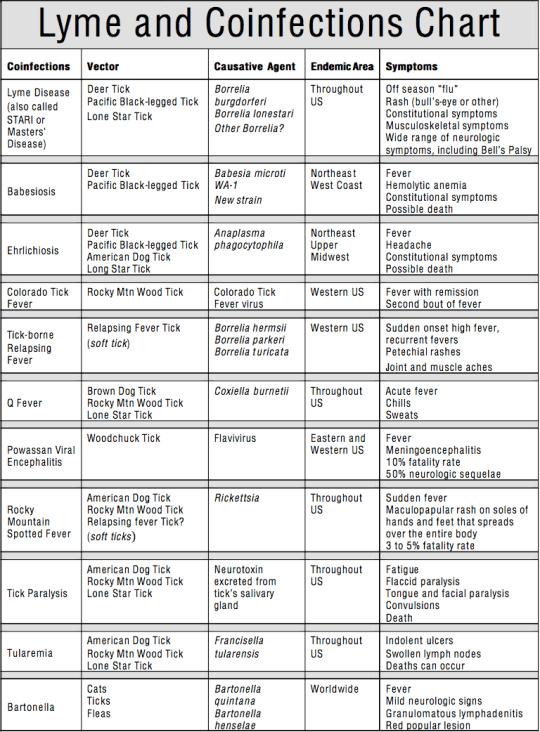
Here’s a nifty chart:  https://www.lymedisease.org/lyme-basics/co-infections/other-co-infections/ (Please remember this is constantly changing)

Screen-Shot-2014-08-26-at-5.27.54-PM

If there’s one think I know for sure, it’s that nothing about ticks and the diseases they carry is sure.

They are finding tropical ticks in Germany (where they shouldn’t be)  https://madisonarealymesupportgroup.com/2018/08/19/monster-ticks-found-in-germany-threaten-europe-with-deadly-disease-crimean-congo-fever/ and they are finding Asian ticks in the U.S. (where they shouldn’t be)  https://madisonarealymesupportgroup.com/2018/10/03/1st-person-bitten-by-east-asian-longhorned-tick/.

When is the CDC going to get the memo and scrap the tick maps?


Transmission of Borrelia Miyamotoi By Tranovarially-Infected Larval Ticks

https://www.ncbi.nlm.nih.gov/m/pubmed/30007502/

Transmission of the relapsing fever spirochete, Borrelia miyamotoi, by single transovarially-infected larval Ixodes scapularis ticks.

Breuner NE, et al. Ticks Tick Borne Dis. 2018.

Abstract

The relapsing fever spirochete, Borrelia miyamotoi, is increasingly recognized as a cause of human illness (hard tick-borne relapsing fever) in the United States. We previously demonstrated that single nymphs of the blacklegged tick, Ixodes scapularis, can transmit B. miyamotoi to experimental hosts. However, two recent epidemiological studies from the Northeastern United States indicate that human cases of hard tick-borne relapsing fever peak during late summer, after the spring peak for nymphal tick activity but coincident with the peak seasonal activity period of larval ticks in the Northeast. These epidemiological findings, together with evidence that B. miyamotoi can be passed from infected I. scapularis females to their offspring, suggest that bites by transovarially-infected larval ticks can be an important source of human infection. To demonstrate experimentally that transovarially-infected larval I. scapularis ticks can transmit B. miyamotoi, outbred Mus musculus CD1 mice were exposed to 1 or 2 potentially infected larvae. Individual fed larvae and mouse blood taken 10 d after larvae attached were tested for presence of B. miyamotoi DNA, and mice also were examined for seroreactivity to B. miyamotoi 8 wk after tick feeding.

We documented B. miyamotoi DNA in blood from 13 (57%) of 23 mice exposed to a single transovarially-infected larva and in 5 (83%) of 6 mice exposed to two infected larvae feeding simultaneously. All 18 positive mice also demonstrated seroreactivity to B. miyamotoi. Of the 11 remaining mice without detectable B. miyamotoi DNA in their blood 10 d after infected larvae attached, 7 (64%) had evidence of spirochete exposure by serology 8 wk later.

Because public health messaging for risk of exposure to Lyme disease spirochetes focuses on nymphal and female I. scapularis ticks, our finding that transovarially-infected larvae effectively transmit B. miyamotoi should lead to refined tick-bite prevention messages.

______________


**Comment**

A mother tick CAN transmit to her own children.  (Just as human mothers can):  https://madisonarealymesupportgroup.com/2018/06/19/33-years-of-documentation-of-maternal-child-transmission-of-lyme-disease-and-congenital-lyme-borreliosis-a-review/

This is why it is unwise to focus on months of the year regarding when you can and can not become infected.  First, ticks are marvelous ecoadaptors and can survive the harshest environments:  https://madisonarealymesupportgroup.com/2018/08/13/study-shows-lyme-not-propelled-by-climate-change/.  Second, we can’t just be concerned with one stage of the tick but recognize the potential transmission of ALL stages to infect.

There’s a high probability more than ticks can transmit:  https://madisonarealymesupportgroup.com/2017/02/24/pcos-lyme-my-story/

Then, there’s the added complexity of being able to transmit many things simultaneously:  https://madisonarealymesupportgroup.com/2017/07/01/one-tick-bite-could-put-you-at-risk-for-at-least-6-different-diseases/

They are finding ticks in places they shouldn’t be making geographical maps virtually useless:  https://madisonarealymesupportgroup.com/2018/07/16/ticks-that-carry-lyme-disease-are-spreading-fast/  (Please also read my comment at end of article)

Time for researchers to quit sounding so “all knowing,” and write research articles carefully, making sure to remember that what they write will and has been used against patients in every possible way imaginable.
Plus, everything they thought they knew is constantly changing.

New England Scientists Explore New Method for Eradicating Lyme Disease

https://triblive.com/usworld/world/14142957-74/new-england-scientists-explore-new-method-for-eradicating-lyme-disease  (Please see comment after article)

New England scientists explore new method for eradicating Lyme disease

Patrick Varine
Wednesday, Oct. 3, 2018, 5:03 p.m.

This undated file photo provided by the U.S. Centers for Disease Control and Prevention shows a blacklegged tick, also known as a deer tick, a carrier of Lyme disease.
AP

Pennsylvania is No. 1 in an unfortunate category: number of Lyme disease cases, which spiked between 2016 and 2017 according to a Quest Diagnostics report released this summer.

With more than 10,000 infections reported in the state last year, it might seem that any solution is worth trying. (**Please see my comment at end of article**)

In New England, scientists from Harvard, MIT and Tufts University have begun genetically engineering white-footed mice — which in the wild carry the Borrelia microbe that causes Lyme disease and pass it along to ticks that feed on their blood — to produce antibodies resistant to both ticks and a particular Borrelia protein. The idea is that immunizing the mice will have a trickle-down effect to the local tick population.

The plan is to eventually release small groups of mice on local islands off the coast of Massachusetts, where they can be isolated for study, to look at potential options for larger application.

For Dr. Bill Rawls of North Carolina, who contracted Lyme disease and is the author of “Unlocking Lyme,” the solution is much more complex.

“There are a lot of microbes in ticks, not just the Borrelia microbe that is associated with Lyme disease,” said Dr. Rawls, medical director for Vital Plan, an herbal supplement company. “The problem with the mouse thing is that even if it is successful, and you block the transmission of Borrelia and prevent the spread of that variety of Lyme disease, perhaps that opens the door to something worse, like Rickettsia, (a microbe associated with the spread of Rocky Mountain Spotted Fever).”

As an advocate of holistic medicine, Dr. Rawls said the increase in Lyme cases, as well as the way it affects humans, is symptomatic of a changing world.

“We’ve radically changed our food supply, we all live under oppressive stress and we don’t exercise,” he said. “And all of those factors affect our immune systems. I think it’s time our society starts looking at problems like Lyme disease in that light.”

The Borrelia microbe has been around for millions of years, as have ticks, Dr. Rawls said.

“So the question is: why are people getting much more sick with it now?” he said. “I see Lyme disease as a fundamental model for all chronic illness.”

Dr. Sam Donta, a Western Pennsylvania native who now lives in Falmouth, Mass., was the keynote speaker at the 2018 Pennsylvania Lyme Medical Conference, held this spring at Drexel University College of Medicine. He has been studying Lyme for three decades, and echoed Dr. Rawls’ view that it is a complex illness.

It is also difficult to diagnose, he said. There is no blood test to see if a person is infected.

“All the blood tests say is whether a person has been exposed,” Dr. Donta said. “I diagnose it clinically. It is a combination of symptoms.”

Those symptoms can be fatal.

The PA Lyme Resource Network is partnering with Storyhouse Documentary Theater to present “The Little Things” on Oct. 13 at Ursinus College in Collegeville outside Philadelphia. It tells the story of a family who lost their son to Lyme disease, and is being dedicated to the memory of three eastern Pennsylvania men who died of Lyme-related complications in 2017.

One of those men, Kevin Furey of Lafayette Hill, Pa., contracted five different infections from one tick bite, according to network officials.

Dr. Rawls said he is not suggesting that the white-footed house proposal is futile,

“but there’s the old saying: don’t mess with Mother Nature,” he said. “If you eliminate this microbe, do you open up other pathways for other infections?”

Patrick Varine is a Tribune-Review staff writer. You can contact Patrick at 724-850-2862, pvarine@tribweb.com or via Twitter @MurrysvilleStar.

__________________

**Comment**

I’ve been waiting for this with bated breath ever since I heard Kevin Esvelt speak at a Lyme CME conference.  I cringed then and I’m cringing now.

If you need a primer on GMO mice, start here:  https://madisonarealymesupportgroup.com/2016/06/21/first-frankenbugs-now-frankinmice/

According to a study by an independent Canadian tick researcher, there’s been an inordinate amount of stress placed on mice, when there are plenty of other reservoirs:  https://madisonarealymesupportgroup.com/2018/08/13/study-shows-lyme-not-propelled-by-climate-change/  Scott has shown that there are established populations of deer ticks in Manitoba as well as in insular, hyper-endemic Corkscrew Island, yet both are devoid of white-footed mice. He points out that there are numerous reservoir hosts that must be considered including other mammals, birds, and reptiles.  For decades we’ve been told it’s the mice. Yet a real problem in the West and South are reptiles like skinks and lizards: https://madisonarealymesupportgroup.com/2017/12/03/biologists-at-sf-state-dig-into-ticks-and-ld/, https://madisonarealymesupportgroup.com/2018/06/25/the-confounding-geography-of-lyme-disease-in-the-u-s/

So mice are only a part of the problem.  Maybe a lot less than we’ve been told.

Another point to stress is that the CRISPR gene-editing technology (tinkering with genes) has been shown to create unintended mutations.  http://articles.mercola.com/sites/articles/archive/2017/06/13/crispr-gene-editing-dangers.aspx?  This article shows 100 deletions and insertions and more than 1,500 unintended single-nucleotide mutations occurred .  

Oops.

Geneticist and virologist Jonathan Latham, Executive Director of the Bioscience Resource Project and editor of Independent Science News, has spoken out about the fallacy of industry talking points in the past.

“So far, it is technically not possible to make a single (and only a single) genetic change to a genome using CRISPR and be sure one has done so,” Latham reportedly explained.  This feat may not even be possible biologically; one small change to genome can inevitably lead to a host of other, unanticipated changes.  https://www.naturalnews.com/2018-06-14-scientists-warn-genetic-editing-of-humans-with-crispr-technology-may-lead-to-cancer.html#

In fact, experts say that CRISPR could cause hundreds of unintended DNA alterations.

Go here to watch a short 2 min video:  What is CRISPR  https://articles.mercola.com/sites/articles/archive/2017/06/13/crispr-gene-editing-dangers.aspx?

While it all seems neat and tidy on paper and in a cool colored video, what happens in the wild could be an entirely different matter.  Releasing GMO mosquitoes to supposedly eradicate Zika has shown many undesirable effects:  https://articles.mercola.com/sites/articles/archive/2016/11/08/zika-virus-wolbachia-mosquito.aspx  The $18-million project, funded in part by the Bill and Melinda Gates Foundation, involves mosquitoes that have been infected with Wolbachia bacteria, which stops viruses from growing inside the mosquito and therefore from being transmitted between people.

I wrote about that when it all went down:  https://madisonarealymesupportgroup.com/2018/02/12/wolbachia-laced-mosquitoes-being-released-why-lyme-msids-patients-might-be-negatively-affected/  (This link shows an important dog study you need to read about as well)  Take away:  in dogs, Wolbachia released into the blood stream causes wide-spread inflammation, something Lyme/MSIDS patients already struggle with.

Even the European union has ruled that CRISPR plants are GMO’s and should be subjected to the same rules:  https://www.technologyreview.com/the-download/611716/in-blow-to-new-tech-europe-court-decides-crispr-plants-are-gmos/

“It means for all the new inventions … you would need to go through the lengthy approval process of the European Union,” Kai Purnhagen, an expert at Wageningen University in the Netherlands, told Nature.

Then there’s the issue of pathogen enhancement:

According to a study by Penn State, mosquitoes infected with Wolbachia are more likely to become infected with West Nile – which will then be transmitted to humans.“This is the first study to demonstrate that Wolbachia can enhance a human pathogen in a mosquito,“ one researcher said. “The results suggest that caution should be used when releasing Wolbachia-infected mosquitoes into nature to control vector-borne diseases of humans.” “Multiple studies suggest that Wolbachia may enhance some Plasmodium parasites in mosquitoes, thus increasing the frequency of malaria transmission to rodents and birds,” he said. https://www.sciencedaily.com/releases/2014/07/140710141628.htm  So besides very probable wide spread inflammation, and that other diseases may become more prevalent due to Wolbachia laced mosquitoes, studies show Wolbachia enhances Malaria in mosquitos.  Many Lyme/MSIDS patients already struggle with Babesia, a malarial-like organism.

This article states CRISPR has the potential to cause cancer in a whole generation of humans:  https://www.naturalnews.com/2018-06-14-scientists-warn-genetic-editing-of-humans-with-crispr-technology-may-lead-to-cancer.html# (Excerpt below)

Emma Haapaniemi, a co-author of the Karolinska Institute study, explained why this is such a concerning find.

“By picking cells that have successfully repaired the damaged gene we intended to fix, we might inadvertently also pick cells without functional p53.” Dysfunctional p53 is a major cancer risk; nearly half of ovarian and colorectal cancers can be connected to a disruption in p53. Many other types of cancer, like lung, pancreatic, stomach, liver and breast cancers, can also be attributed to p53 problems.

“If transplanted into a patient, as in gene therapy for inherited diseases, such cells could give rise to cancer, raising concerns for the safety of CRISPR-based gene therapies,” Haapaniemi added.


Lastly, with Brazil’s recent explosion of microcephaly, the introduction of yet another man-made intervention (Wolbachia laced mosquitos) should be considered in evaluating potential causes and cofactors. And while the CDC is bound and determined to blame the benign virus, Zika, there are numerous other factors that few are considering – as well as the synergistic effect of all the variables combined. Microcephaly could very well be a perfect storm of events.
https://madisonarealymesupportgroup.com/2016/12/21/how-zika-got-the-blame/, https://madisonarealymesupportgroup.com/2016/03/04/health-policy-recap/, https://madisonarealymesupportgroup.com/2016/03/08/fixation-on-zikapolio/

So besides the unintended consequences of mutations and enhancement of other potential pathogens, and cancer in humans, is the issue of ethics.  Here’s some telling quotes:  https://madisonarealymesupportgroup.com/2015/12/28/frankinbugs/

“It is essential that national regulatory authorities and international organizations get on top of this — really get on top of it,” says Kenneth Oye, a political scientist at the Massachusetts Institute of Technology and lead author of the Science commentary. “We need more action.” The US National Research Council has formed a panel to discuss gene drives, and other high-level discussions are starting to take place, but Oye is concerned that regulatory changes may happen only after a high-profile gene-drive release, in other words, after it’s too late. (For a five minute audio of reporter Kerri Smith investigating the meteoric rise of CRISPR click on the link above.

On top of those difficulties, scientists do not know how all of this will affect ecosystems and are unclear if the gene drives could spread to closely related species.

Noam Prywes, PhD candidate in chemistry at Harvard, claims that CRISPR/Cas-9-based gene drives will

“add a twist – introducing one gene drive after another to correct unforeseen consequences as they are discovered,” and that “decisions by researchers would become permanently written into the genomes of entire wild populations.” He also adds that there are alternative ways to wipe out local populations of mosquitoes carrying disease that are much safer.

In this same vein, David Burwitz of Tel Aviv University, feels that gene drive research should be classified to prevent weapon development, and he’s not alone.
http://nextstageprep.com/gene-drivesthis-next-weapon-mass-destruction/ In theory, a terrorist could create a handful of insects with a gene for making a toxin, and power it with a gene drive. Pretty soon, all of these insects would make the toxin, and every insect bite would be lethal. However, according to Austin Burt, who proposed the theoretical method for making gene drives, the gene drives only work in sexually reproducing species, unlike the vast majority of genetically engineered microbes which produce asexually and they’ve only been shown to work for one generation – so far.

I’m with Dr. Rawls and Dr. Donta, “Don’t mess with Mother Nature.”  That’s what got us in this mess to begin with.


Babesia Found in Patient With Persistent Symptoms Following Lyme Treatment

https://www.ncbi.nlm.nih.gov/m/pubmed/30262525/

Diagnosis of a tick-borne coinfection in a patient with persistent symptoms following treatment for Lyme disease.

Hoversten K, et al. BMJ Case Rep. 2018.

Abstract

A 67-year-old woman presented with 5 days of myalgias and fevers on completion of a 21-day course of amoxicillin for Lyme disease (Borrelia burgdorferi infection). She was found to have profound thrombocytopenia, as well as new anaemia and leucopenia. Workup revealed Babesia microti as the causative agent of her symptoms. The patient quickly improved after appropriate antimicrobial therapy directed against babesiosis was started. This case illustrates the importance of basic microbiology, including epidemiology and common vectors, when creating a differential diagnosis. Because the Ixodes scapularis tick can harbour and transmit multiple parasites simultaneously, the possibility of coinfection should be considered in any patient not responding to appropriate initial medical therapy.

________________

**Comment**

Expect a lot more articles like this.  

Word is finally getting out that Lyme is just the Rock Star we all know by name but there are a lot of wanna be’s right behind him that haven’t made the news.  Research still hasn’t been done showing the synergistic effects of all of this together on the human body.  

To date, ticks can transmit 18 and counting pathogens – ALL as devastating as Lyme:  https://madisonarealymesupportgroup.com/2017/07/01/one-tick-bite-could-put-you-at-risk-for-at-least-6-different-diseases/

Lyme alone is a formidable foe that shape shifts to avoid treatment and the immune system that persists for many despite treatment.

Throw in Babesia, Bartonella, Mycoplasma, viruses, Nematodes (parasitic worms), and stuff not even named yet and a scary but telling picture begins to emerge.

More on Babesia:  https://madisonarealymesupportgroup.com/2016/01/16/babesia-treatment/

Please note that Dr. Horowitiz, a prominent Lyme literate doctor (LLMD) recommends 9 months to a year of solid treatment for Babesia.  He’s finding it to be particularly tenacious.

https://madisonarealymesupportgroup.com/2018/06/08/two-cases-of-babesia/  (They typically blame “severe” cases on a compromised immune system like a missing spleen but here we see someone as healthy as a horse all of a sudden develop shock and near respiratory failure).  If you have Lyme & Babesia &/or any other coinfection, your immune system is severely compromised.

https://madisonarealymesupportgroup.com/2018/07/02/splenic-rupture-from-babesiosis-an-emerging-concern-a-systematic-review-of-current-literature/

https://madisonarealymesupportgroup.com/2018/02/20/babesia-and-heart-issues/

https://madisonarealymesupportgroup.com/2018/10/06/case-of-recurrent-fever-multiple-splenic-infarcts-why-short-treatment-duration-often-doesnt-work-for-babesia/

https://madisonarealymesupportgroup.com/2018/06/03/heart-problems-tick-borne-disease/

https://madisonarealymesupportgroup.com/2018/05/31/widespread-babesiosis-in-canada/

https://madisonarealymesupportgroup.com/2018/03/22/what-is-air-hunger-anyway/