Archive for the ‘Ticks’ Category

Updates and News From Russell Labs – Wisconsin

http://labs.russell.wisc.edu/wisconsin-ticks/

Updates

August, 2018: Nymphal deer ticks are less abundant but still active in Wisconsin right now. About 20-25% of nymphs are infected with the Lyme spirochete. Overall, 2018 has been normal in terms of tick numbers.

Live in Wisconsin and want your tick identified?


Take a picture of ticks on your phone and go here:  https://uwmadison.co1.qualtrics.com/jfe/form/SV_3s1wBopYCcW0lzT

Wisconsin ticks:  http://labs.russell.wisc.edu/wisconsin-ticks/

Go to link for pictures and information on each.  There are 4 ticks listed including the Lone Star Tick, which was until recently considered a Southern tick but is here as well.  Wisconsin had its first RMSF death, transmitted by the Lone Star Tick, recently:  https://madisonarealymesupportgroup.com/2018/07/10/first-rmsf-death-in-wisconsin/

There is also a tab titled “Tick-Borne Diseases.”  Go to link to read about them.  They give WI stats as well.  Please remember ALL the numbers are low as many go unreported:

  • Lyme (Bb or Bm)
  • Borrelia miyamotoi (relapsing fever)
  • Anasplasmosis
  • Ehrlichia muris eauclairensis (EML)
  • Babesiosis
  • Powassan virus/deertick virus
  • Ehrlichia chaffeensis
  • Rocky Mountain Spotted Fever

__________________

A few points stick out to me:

  1. Please take pictures of these ticks & send them in so we finally have an accurate record.  They are asking us for help so let’s give it.  It will only help us in the end.  Flood them with ticks!
  2. Baronella didn’t make the list, yet nearly everyone I work with has it.  WHY?  Because while Bart has been found in ticks, it hasn’t been proven conclusively they transmit.  Bart is a nasty, nasty bug and alone can kill you.  Coupled with Lyme it can make you want to die.
  3. For viruses, they only list Powassan when many more are on record including Heartland and Bourbon (unfortunately they aren’t mandatory to report).  They know Heartland is transmitted by the Lone Star tick but I couldn’t even find the tick supposedly responsible for Bourbon, although it’s a killer:  https://madisonarealymesupportgroup.com/2017/07/01/one-tick-bite-could-put-you-at-risk-for-at-least-6-different-diseases/
  4. The lack of data is glaring.  Seriously.  Glaring.  Zika makes front page news here and our mosquitoes can’t even carry it.  https://madisonarealymesupportgroup.com/2018/03/13/wed-nite-the-lab-talk-on-mosquitoes-ticks-disease/  There were only 46 cases of Zika in the U.S. in 2018 – ALL due to travelers returning from affected areas.The CDC “estimates” that there are 300,000 NEW Lyme Disease cases annually in the U.S.  Anyone see a disparity here between Zika and Lyme?  (Other tick-borne diseases aren’t even on the radar yet)


Colorado Tick-Borne Disease Prevalence in Dogs

https://coloradoticks.org/for-physicians-and-patients/colorado-tick-borne-disease-prevalence-dogs/

Colorado Tick-Borne Disease Prevalence in Dogs

Colorado Tick-Borne Disease Awareness Association

PO Box 53
Poncha Springs, CO 81242

Email: info@coloradoticks.org
Facebook: Facebook.com/ColoradoTicks/

Help Support the COTBDAA with your tax deductible donation.

Bb Found in Brazilian Primates for the 1st Time

http://www.scielo.br/scielo.php?script=sci_arttext&pid=S0036-46652018005000704&lng=en&nrm=iso&tlng=en

Rev. Inst. Med. trop. S. Paulo vol.60  São Paulo  2018  Epub Sep 13, 2018

http://dx.doi.org/10.1590/s1678-9946201860053

Letter to the Editor

Molecular detection of Borrelia burgdorferi in free-living golden headed lion tamarins (Leontopithecus chrysomelas) in Rio de Janeiro, Brazil

Aline Vieira Pinheiro dos Santos1  Aline Moreira de Souza1  Marina Galvão Bueno2  3  José Luiz Catao-Dias4  Helena Keiko Toma5  Alcides Pissinati4  6  Camila Vieira Molina2  Maria Cecília Martins Kierulff2  7  Danilo Gomes Freitas Silva2  4  Nádia Regina Pereira Almosny1 


Borreliosis is an infectious disease caused by Borrelia spirochetes, transmitted mainly by Ixodes ricinus ticks1 to animals or humans2. The known Borrelia species determine five distinct disease groups: human recurrent fever, avian borreliosis, bovine borreliosis, Lyme borreliosis and bovine scrapie36. Lyme disease (LD) is a multisystem disease with a wide geographical distribution and has B. burgdorferi as the main agent in several continents5,7.

In Brazil, borreliosis is called Brazilian Lyme-like disease, Baggio-Yoshinari Syndrome or Brazilian Borreliosis (BB), is transmitted by ticks that are not from the Ixodes ricinus complex, and is caused by B. burgdorferi sensu lato8.

Borrelia species were described in non-human primates that currently serve as an experimental model for Lyme disease2,911.

Borrelia species are transmitted primarily by ticks, but in rare cases or experimentally, they can be transmitted by tabanids, culicides and siphonapters12. Studies on borreliosis have been carried out to compare immunological, histopathological and clinical responses of animals and humans infected with Borrelia burgdorferi. In these studies, animals were inoculated or exposed to the Ixodides dammini tick1,9,11, and findings such as conjunctivitis, rash, deep perivascular lymphocytic infiltration that are characteristic in humans1, a large amount of spirochetes in nervous tissue of immunosuppressed animals9 and spirochetes in cardiac tissue10 were reported.

In order to identify arthropod-borne pathogens in an exotic invasive population of Leontopithecus chrysomelas (golden-headed lion tamarin), that inhabit Serra da Tiririca State Park (PESET), an urban Atlantic Rainforest area in Niteroi (Rio de Janeiro, Brazil), to translocate them to their native area (Bahia, Brazil), blood samples were analyzed. PESET harbor a large diversity of endemic fauna and flora and is considered an important ecotourism area. Inappropriate housing constructions, the increase of human and animal populations living inside the park or in its surroundings, hunting and inadequate garbage disposal have been recently causing damage to the park13.

This study was approved by the Ethics Commission on Animal Use (CEUA) from Universidade Federal Fluminense (process N° 367, issued in 10/10/2013) and was in full compliance with the federal authorizations issued by the Environment Ministry (SISBIO n 30939-4 issued in 18/05/2012). All procedures were also approved by the Committee on Ethics on Animal Research (CEUA) of Veterinary Medicine and Animal Science Faculty of the Universidade de Sao Paulo (Protocol N° 2662/2012 and 7085041215).

Blood samples of 200 L. chrysomelas, males and females, of different ages and independent of clinical alterations were subjected to DNA extraction using the Illustra blood genomic Prep Mini Spin Kit (GE Healthcare Life Sciences, Sao Paulo, Brazil), according to the manufacturer instructions. Extracted DNA was then used as the template DNA in B. burgdorferi sensu lato (s.l.) amplifications. Nested Polymerase Chain Reaction (n-PCR) assay using primer 5Bor-out (5′-GTCAAACGGGATGTAGCAA TAC-3′) and 3Bor-out (5′-CACACTTAACACGTTAGCTTCG-3′), followed by a second reaction with primer 5Bor-in (5′-ATTCAGTGGCGAACGGGTG-3′) and 3Bor-in (5′-AACAACGCTCGCCCCTTAC-3′), which amplifies a fragment of 811 bp/ 469 bp of the 16S rRNA gene of B. burgdorferi sensu lato, were performed.

A total of 16% (32/200) L. chrysomelas were positive to B. burgdorferi by n-PCR. Sequencing of five positive samples showed 99% of similarity with B. burgdorferi sequences available in GenBank. This was the first time that borreliosis is found in non- human primates in Brazil.

Borrelia infection in humans was first described in Brazil in 1992, and has an increasing number of suspect cases, differing from LD due to the recurrence rate after treatment and the intense immune response8. The presence of Borrelia burgdorferi in free-living golden-headed lion tamarins that inhabit Atlantic Forest biome of Rio de Janeiro, Brazil, confirms that this spirochete is circulating in this region and suggests that these small primates may play a role in transmission of this pathogen to other animals or human beings. Veterinarians and medical doctors should consider this zoonotic pathogen in their diagnostic routine.

Further studies are needed, including sequencing of all positive samples, in order to compare these small primates positive sequences with those of humans and other animals in study area.

REFERENCES

1. Philipp MT, Aydintug MK, Bohm RP Jr, Cogswell FB, Dennis VA, Lanners HN, et al. Early and early disseminated phases of Lyme disease in the rhesus monkey: a model for infection in humans. Infect Immun. 1993;61:3047-59. [ Links ]

2. Soares CO, Ishikawa MM, Fonseca AH, Yoshinari NH. Borrelioses, agentes e vetores. Pesq Vet Bras. 2000;20:1-19. [ Links ]

3. Babour AG, Hayes SF. Biology of Borrelia species. Microbiol Rev. 1986;50:381-400. [ Links ]

4. Quinn PJ, Carter ME, Markey BK, Carter GR. Clinical veterinary microbiology. London: Wolfe; 1994. [ Links ]

5. Wang G, van Dam AP, Le Fleche A, Postic D, Peter O, Baranton G, et al. Genetic and phenotypic analysis of Borrelia valaisiana sp. nov. (Borrelia genomic groups VS116 and M19). Int J Syst Bacteriol. 1997;47:926-32. [ Links ]

6. Zingg BC, LeFebvre RB. Polymerase chain reaction for detection of Borrelia coriaceae, putative agent of epizootic bovine abortion. Am J Vet Res. 1994;55:1509-15. [ Links ]

7. Bennett CE. Ticks and Lyme diseases. Adv Parasitol. 1995;36:343-405. [ Links ]

8. Basile RC, Yoshinari NH, Mantovani E, Bonoldi VN, Macoris DG, Queiroz-Neto A. Brazilian borreliosis with special emphasis on humans and horses. Braz J Microbiol. 2017;48:167-72. [ Links ]

9. Cadavid D, O’Neill T, Schaefer H, Pachner R. Localization of Borrelia burgdorferi in the nervous system and other organs in a nonhuman primate model of Lyme disease. Lab Invest. 2000;80:1043-54. [ Links ]

10. Cadavid D, Bai Y, Hodzic E, Narayan K, Barthold SW, Pachner AR. Cardiac involvement in non-human primates infected with the Lyme disease spirochete Borrelia burgdorferi. Lab Invest. 2004;84:1439-50. [ Links ]

11. Roberts ED, Bohm RP Jr, Lowrie RC, Habicht G, Katona L, Piesman J, et al. Pathogenesis of Lyme neuroborreliosis in the rhesus monkey: the early disseminated and chronic phases of disease in the peripheral nervous system. J Infect Dis. 1998;178:722-32. [ Links ]

12. Alvim NC, Bento MA, Martins LA. Borreliose de Lyme: a doença da década. Rev Cient Eletr Med Vet. 2005;4. [ Links ]

13. Instituto Estadual do Ambiente. Resumo executivo: plano de manejo: Parque Estadual da Serra da Tiririca – PESET. Rio de Janeiro: INEA; 2012. [ Links ]

Received: August 13, 2018; Accepted: August 16, 2018


Osteomyelitis: Types, Complications, Imaging Studies & Lyme/MSIDS

http://outbreaknewstoday.com/osteomyelitis-types-complications-and-imaging-studies-68658/

Osteomyelitis: Types, complications and imaging studies

September 28, 2018
Infection of the bone–short and sweet, that is the definition of osteomyelitis. Associate Professor of Infectious Disease and International Medicine at USF Health, Sandra Gompf, MD joined me to answer a few questions about this topic, something she addresses in her handy guide, Gompf’s ID pearls.


During the discussion, Dr Gompf explains what the three basic types of osteomyelitis are, the different complications of the infection and what imaging studies are most useful in the diagnosis of osteomyelitis.

Audio Player:

__________________

**Comment**

Patients with Lyme/MSIDS can develop osteomyelitis.

https://www.columbia-lyme.org/bartonellosis  In immunocompetent people, the systemic symptoms of cat scratch disease (Bartonella) are usually limited to regional adenopathy, though it can also cause fever and, more rarely, eye disorders, hepatosplenic infection, osteomyelitis, and encephalopathy.

Here is a literature review of bone infections associated with Bart (Cat Scratch Disease):  https://www.prohealth.com/library/bone-infections-associated-bartonella-cat-scratch-disease-82357.  51 cases identified. Fever (84.3%), often with a prolonged course (64.7%), and osteoarticular pain (88.2%) were the most common clinical findings. Lymphadenopathy was present in 64.7% of patients. Vertebral body was mainly involved (51.9%). MRI (50%) and bone scintigraphy (48.1%) were favored to confirm osteomyelitis, while serology was the preferred microbiological diagnostic. Various antibiotics were prescribed in combined or sequential regimens, with median duration of therapy of 23 days.

(While around 12% didn’t receive any treatment but still completely recovered, if other tick borne infections are involved, please remember that these pathogens work synergistically together to mess up the immune system.  Most of us out here are infected with numerous pathogens.  Bart is often just one of many.)

https://www.ncbi.nlm.nih.gov/pmc/articles/PMC165354/  A 62-year-old woman presented with a 2-week history of cervical column tumefaction (swelling due to excess fluid). She complained of severe pain in the cervical column with radiation of the pain and paresthesia (burning or pins & needles sensation) in both arms. She had intermittent fevers and night sweats. Histological examination showed necrotizing granulomatous inflammation indicative of cat scratch disease (CSD). (She owned 20 cats)

https://www.ncbi.nlm.nih.gov/pubmed/19303175  (This was in 2009.  Hopefully, now that Bartonella is beginning to be recognized, more cases will start showing up in the literature so they will refrain from using the word, “rare” when it comes to osteomyelitis and Bart).  

We report an immunocompetent 61-year-old woman who presented with a systemic cat scratch disease including a multifocal osteomyelitis. Diagnosis was confirmed by PCR on the adenopathy. A literature review identified 51 other cases of osteomyelitis associated with cat scratch disease, 14 of those confirmed by PCR.

Here, Lyme caused it:  https://www.researchgate.net/publication/15305104_Subacute_Multiple-Site_Osteomyelitis_Caused_by_Borrelia_burgdorferi  Before the specific diagnosis was established, the patient received several potent antimicrobial drugs, without a favorable outcome. In contrast, therapy with ceftriaxone led to a rapid cure that persisted thereafter. We conclude that infection due to B. burgdorferi must be considered a possible cause of subacute pediatric osteomyelitis.

Here, Bb infects the bones of mice and induces bone loss:  https://iai.asm.org/content/85/2/e00781-16
______________________

On page 21 & 26 of Gompf’s ID Pearls, she speaks about Daptomycin for MRSA osteomyelitis, a drug being used by Dr. Horowitz on his toughest Lyme/MSIDS patients with success.  She also recommends getting the G6PD Level on any patient being considered for Dapsone as it’s a common mutation which can trigger hemolysis (when red blood cells rupture and release contents into surrounding fluid).  Go to page 113 for Osteomyelitis.

She states that Rheumatoid arthritis caused by Staphylococcus aureus as an underlying condition associated with osteomyelitis as well as immunodeficiencies caused by Candida, atypical mycobcteria and Bartonella especially in HIV.  Animal exposures such as cat, dog, human, rat, and hoofed animal bites are associated with osteomyelitis.

On page 337 she states that LD, Babesia, and Ehrlichiosis are diseases that can occur concurrently.  I’m sure the reason she left out Bartonella is due to the fact the authorities still haven’t gotten the memo that many Lyme/MSIDS patients have Bartonella and it’s been found in ticks.  The final nail in the coffin needs to be hammered down showing that it is clearly transmitted by ticks, then Bartonella will make her list.  She also states that endocarditis & acute osteomyelitis occur concurrently which is ironic because Bart can cause both endocarditis and osteomyelitis….

More on Dapsone:  https://madisonarealymesupportgroup.com/2016/05/09/leprosy-drug-for-lyme/

https://madisonarealymesupportgroup.com/2016/10/09/mycobacterium-drugs-for-ld/

More on rheumatoid arthritis:  https://madisonarealymesupportgroup.com/2015/08/12/connecting-dots-mycoplasma/  Nicholson’s experience has found Mycoplasma to be the number one Lyme coinfection, and similar to other coinfections can be supposedly cleared for years only to reappear when conditions are right.  90% of evaluated ALS patients had Mycoplasma. 100% of ALS patients with Gulf War Syndrome had Mycoplasma and nearly all of those were specifically the weaponized M. fermentans incognitus.

*One of the hallmark symptoms of Mycoplasma is fatigue*


Increase of Infected Ticks Means Higher Risk of Tick Bites

https://www.lymedisease.org/lymesci-tick-bites/  (Please see comment at end of article)

LYMESCI: Increase of infected ticks means higher risk of tick bites

by Lonnie Marcum

More ticks in more places means more tick bites.
More tick bites resulting in more sick people.

That’s the result the Entomological Society of America (ESA) was trying to avoid, when in 2015, it published a “Position Statement on Tick-Borne Diseases.”

The article describes a multitude of factors that have created a near “perfect storm,” leading to more infected ticks in more places throughout the United States.

Along with other steps, the ESA recommended engaging the help of citizen-scientists. In 2016, the Bay Area Lyme Foundation (BALF) decided to do just that. The results of this groundbreaking nationwide project have recently been published—and the news is NOT GOOD!

Among many disturbing facts, the new study found blacklegged ticks —carriers of 7 of 18 US tick-borne diseases—in 83 counties where they had never previously been recorded.

More tick bites = more sick people

Ticks have undergone a population explosion over the past two decades, with Ixodes ticks, the primary source of Lyme disease, now found in nearly 50% more U.S. counties than in 1996.

“Since the late 1990s, the number of counties in the northeastern United States that are considered high-risk for Lyme disease has increased by more than 320%,” says Rebecca Eisen from the Division of Vector-Borne Diseases at the CDC. “The tick is now established in areas where it was absent 20 years ago,” she adds.

The reasons for the explosion of tick populations involves complex human and environmental factors and varies by geographic region. Experts feel the major contributing factors are:

  • Warming winter temperatures
  • Migratory bird patterns
  • Changes in landscape, land use and fragmented forests
  • Abundance of vertebrate hosts (mice, deer, squirrels, etc)
  • Reduction in natural predators (foxes, bobcats, etc.)
  • Invasive and non-native plant species
  • Accidental transport by humans (pets, livestock)

With the increase in ticks, we’ve seen a sharp rise in tick bites and tick-borne diseases, with reports of Lyme disease now coming from all 50 states, costing upwards of $75 billion per year.

What’s being done?

While the CDC lists Lyme disease as a nationally notifiable disease, the responsibility for reporting falls to each state’s health departments. The fact is, many states do not (or can’t) enforce these reporting requirements.

In addition to Lyme disease, the CDC lists six other tick-borne diseases as reportable—anaplasmosis, babesiosis, ehrlichiosis, spotted fever rickettsiosis (including Rocky Mountain spotted fever), and tularemia. Again, many states don’t put resources in tracking these illnesses.

The lack of accurate disease reporting leads to a reduction in public health awareness and medical education in areas where it’s needed. This then hinders a patient’s access to timely and accurate diagnosis and early treatment—which are absolutely critical to a good prognosis.

Citizen scientists collect ticks

BALF’s recently published tick study invited citizens from all over the US to send ticks to Northern Arizona University (NAU) for free testing, with the goal of mapping ticks and the diseases they carry.

Many Lyme advocacy groups helped spread the word. For instance, there were more than 16,000 website hits on LymeDisease.org’s announcement about the project.

Researchers had expected that maybe 2,400 ticks would be sent in. To their astonishment, they received over 16,000 ticks collected from 49 states and Puerto Rico. No ticks were received from Alaska.

As lead author Nate Nieto, PhD, associate professor in NAU’s Department of Biological Sciences, explains,

“This study offers a unique and valuable perspective because it looks at risk to humans that goes beyond the physician-reported infection rates and involves ticks that were found on or near people.”

This represents the first nationwide tick study with the goal of mapping the prevalence of disease-carrying ticks throughout the United States. During the period from January 2016 through August 2017, people could send ticks to NAU, free of charge, for testing of the most common tick-borne infections:

  • Borrelia burgdorferi, the cause of Lyme disease,
  • Borrelia miyamotoi, which causes tick-borne relapsing fever (TBRF), a Lyme-like illness,
  • Anaplasma phagocytophilum, the cause of granulocytic anaplasmosis, and
  • Babesia microti, the protozoan parasite that causes Babesiosis.
The Findings
  • Over 70% of submissions were the result of human tick bites.
  • Blacklegged ticks were found in 83 counties (in 24 states) where they had not previously been recorded.
  • All four pathogens tested for (Anaplasma, Babesia, Borrelia burgdorferi and Borrelia miyamotoi) were found in all three of the most commonly encountered hard-ticks species collected (deer tick, American dog tick, lone star tick).
  • Some ticks tested positive for up to three pathogens (no ticks contained all four).
  • All life stages of these three hard-tick species, including some larvae, were found to be infected with both Borrelia burgdorferi and Borrelia miyamotoi.
  • On the East Coast, B. burgdorferi, the cause of Lyme disease, was predominantly detected in adult Ixodes scapularis (deer tick).
  • On the West Coast, B. burgdorferi was highest in larval Ixodes pacificus (western blacklegged tick).
  • The highest prevalence of Borrelia miyamotoi (a relapsing fever species Borrelia that causes Lyme-like illness) was found in larval ticks in the western US.
  • Babesia was found in lone star ticks in 26 counties (in 10 states) where public health departments do not require reporting.
  • Several Amblyomma americanum, commonly known as the lone star tick and capable of carrying bacteria that cause disease in humans, were found in Northern California, the first known report of this tick in the state.
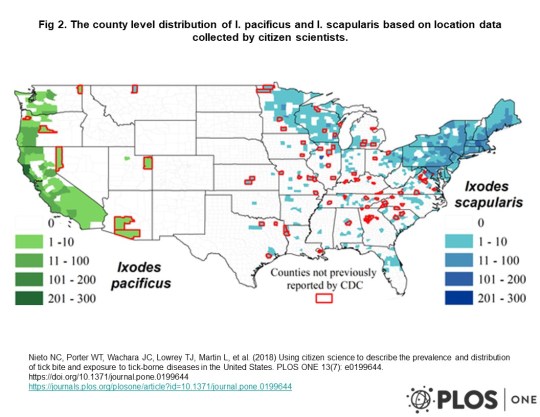
tick-bite-map

Tick bite map of US

Limits of the Study

While the study was hugely successful, it did have some limits. For one, the sample of ticks was limited to only those areas where citizens were participating, therefore the maps may not show all areas with ticks.

In addition, the researchers only tested for four of the many pathogens known to cause illness in humans.

Pathogens not tested for include: Multiple species of Borrelia including Mayonii, and Bisettii, which also cause Lyme-like illness; Ehrlichia chaffeensis, the cause of human monocytic erhlichiosis; Francisella tularensis, the cause of tularemia; Rickettsia rickettsii, the bacterial agent of Rocky Mountain spotted fever; multiple species of the protozoan pathogen Babesia, including duncani and divergens; and several viruses known to be transmitted by ticks including Bourbon virus, Colorado tick fever virus, Heartland virus, and Powassan virus.

Lack of funding for more studies

Lack of funding poses the biggest challenge to fully understanding the risks that ticks pose to the US population.

When asked, the CDC’s Ben Beard stated

“We’ve got national maps, but we don’t have detailed local information about where the worst areas for ticks are located.…The reason for that is there has never been public funding to support systematic tick surveillance efforts.”

It’s no secret that within weeks of the first Zika infection in 2016, Congress authorized $1.7 billion in funding, of which $397 million was made immediately available to rapidly develop an accurate test and begin work on a vaccine.

That same year, the federal budget allotted only $28 million for Lyme disease—the most common vector-borne disease in the US. (Note: while the CDC can study and report on diseases, it is not allowed to lobby Congress for funding.)

What did we learn?

The big take-away from the NAU study is that ticks are everywhere, and they are full of dangerous pathogens—not just Lyme disease. This study demonstrates that ticks are spreading in range, and they are carrying more pathogens than ever before.

Until we find better ways for the CDC to report illnesses, these type of risk maps, that are generated from the pathogens the ticks are carrying, will be the best predictor of disease.

Finally, we all need to get out there and tell our representatives the dangers that lurk in our backyards. Call them. Ask to meet with them. Bring them a copy of this report. Let them know we need an dramatic increase in funding for Lyme and tick-borne diseases.

Click here for more information about ticks:  https://www.lymedisease.org/lyme-basics/ticks/about-ticks/

LymeSci is written by Lonnie Marcum, a Licensed Physical Therapist and mother of a daughter with Lyme. Follow her on Twitter: @LonnieRhea Email her at: lmarcum@lymedisease.org .

References:

  1. Using citizen science to describe the prevalence and distribution of tick bite and exposure to tick-borne diseases in the United States, PLOSone, July 2018,  https://journals.plos.org/plosone/article?id=10.1371/journal.pone.0199644
  2. County-Scale Distribution of Ixodes scapularis and Ixodes pacificus (Acari: Ixodidae) in the Continental United States , Journal of Medical Entomology, Volume 53, Issue 2, 1 March 2016, Pages 349–386,  https://academic.oup.com/jme/article/53/2/349/2459744
  3. Entomological Society of America Position Statement on Tick-Borne Diseases Approved on July 29, 2015, Valid through July 29, 2019  http://www.entsoc.org/PDF/2015/ESA-PolicyStatement-TickBorneDiseases.pdf
  4. Report of the Disease Vectors, Surveillance, and Prevention Subcommittee to the Tick-Borne Disease Working Group  https://www.hhs.gov/ash/advisory-committees/tickbornedisease/reports/disease-vectors-2018-5-9/index.html

_________________

**Comment**

Canadian independent tick researcher, John Scott, stands in opposition to the climate change model affecting tick movement:  https://madisonarealymesupportgroup.com/2018/08/13/study-shows-lyme-not-propelled-by-climate-change/  A recent study shows that warm winters are lethal to I. scapularis (black-legged) ticks. In fact, overwinter survival dropped to 33% when the snow melted. This has been substantiated by other researchers as well. Scott & Scott, 2018, ticks and climate change, JVSM

Also, illogically, people on one hand admit that ticks are now “everywhere” but keep pushing the importance of geographical maps.  Why?  These maps are worthless & constantly changing.  Migratory birds are transiting ticks worldwide along with the fox, coyote, lizard, mouse, and 1,000 other carriers including humans traveling everywhere.

Why do we continue to push and believe in maps that have kept people from diagnosis and treatment for decades?

I’ll tell you why – it’s lining pockets with money.

Authorities look at the inaccurate and constantly changing maps and announce,
“You can’t have ______________, it doesn’t exist here.”

More data that actually hurts patients.

This tick border thing is a man-made constructed paradigm that has never been accurate, but it fits the CDC/NIH/IDSA narrative. http://steveclarknd.com/wp-content/uploads/2013/11/The-Confounding-Debate-Over-Lyme-Disease-in-the-South-DiscoverMagazine.com_.pdf (go to page 6 and read about Speilman’s maps which are faulty but have ruled like the Iron Curtain, and have been used to keep folks from being diagnosed and treated)

Dr. Masters fought this tooth and nail for his suffering patients in the South:  https://madisonarealymesupportgroup.com/2017/10/06/remembering-dr-masters-the-rebel-for-lyme-patients-who-took-on-the-cdc-single-handedly/  Even though Fier found borrelia in 2% of sampled lone star ticks and subsequently supported Masters’ Missouri Lyme, the CDC insisted that the EM rash was NOT diagnostic for LD for Missouri patients due to the fact that neither Ixodes dammini nor Ixodes pacificus were found there.  

Maps are continually used against patients and have ALWAYS been faulty:  https://madisonarealymesupportgroup.com/2017/08/24/canine-maps-better-than-the-cdcs-in-predicting-lyme-disease/ (nothing’s changed)

TIME TO PULL THE BLINDERS OFF AND LOOK AT THIS THING AS THE PANDEMIC IT TRULY IS, AND TIME TO FOCUS ON ISSUES THAT ACTUALLY RELIEVE PATIENT SUFFERING.