Archive for the ‘Ticks’ Category

Got Deer Flies?

https://dianeatwood.com/deer-flies-trap/

Get rid of pesky deer flies with this easy-to-make hat trap

Thanks to a yard thick with deer flies, mowing the lawn used to be a nightmare for Barry. Now, it’s a dream. Well, that might be an exaggeration, but it’s a whole lot better. He shares his secret to getting rid of deer flies in this guest post.

By Barry Atwood (2016)

A few years ago after being driven half crazy by deer flies, I did some research. I discovered a strategy to deal with them that actually works! For some reason, deer flies are attracted to the color blue. They also prefer heads as a place to take their bite.

So first, I acquired a royal blue baseball cap.

Barry with blue hat

Then off to a garden center to buy a product called Tree Tanglefoot. It is an extremely sticky substance that you squeeze from a tube. It is primarily used to create a barrier at the base of a tree to prevent pest insects from climbing the tree.
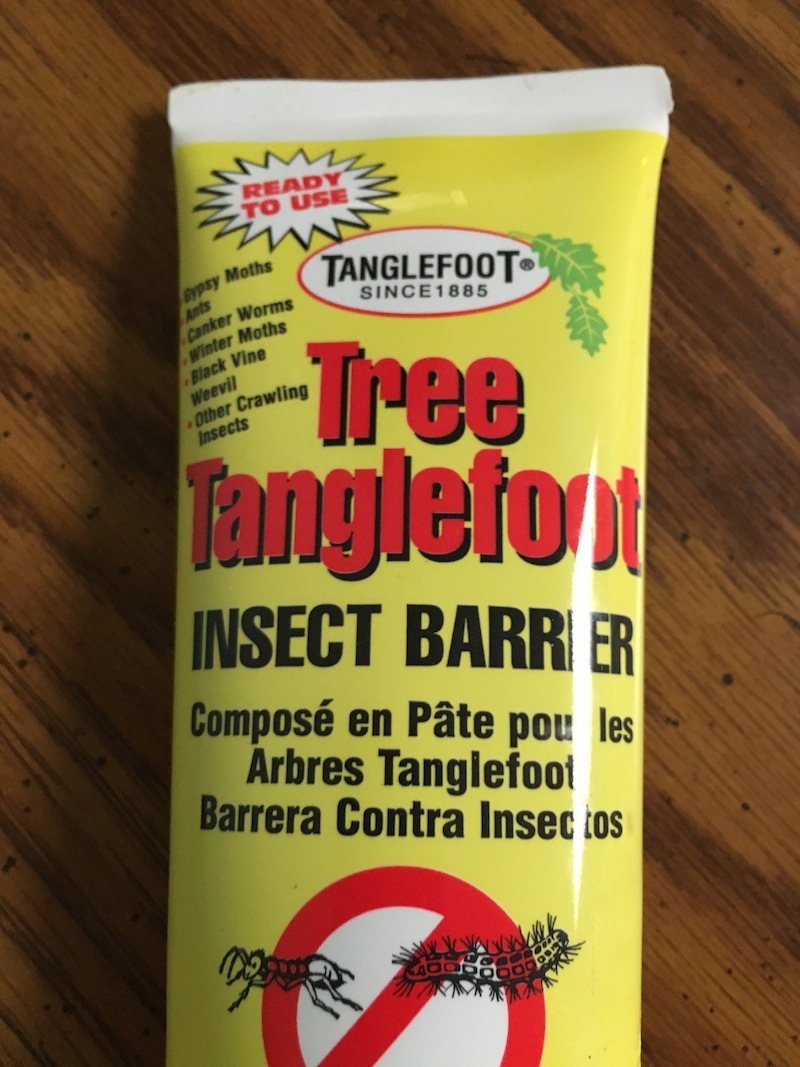
Tanglefoot for deer flies

You need to smear Tanglefoot all over the outside surface of the cap. It helps to wear disposable rubber gloves when you do this.

Smearing Tanglefoot on hat

Then don the hat and go wherever you want. You will NOT be bitten by one single deer fly. I promise!

When you are done outside remove the hat and behold the (many) flies trapped in the goo. I have snared as many as 15 or 20 in a single outing. And even though I am not big on killing things, I do make an exception for deer flies and have dubbed my sticky fly trap the Blue Hat of Death. Trust me, it REALLY works!

Barry wearing hat to trap deer flies

Update from Barry August 2019

My Blue Hat of Death continues to do its job. The first time this spring that I got dive bombed in the back yard I retrieved it from the (high) hook in the barn where it lives in winter. Although the Tanglefoot probably remains sticky forever, I reapply a fresh coat each year.

I have incorporated the technique of putting strips of packing tape on my hat prior to slathering on the goo. This way the embedded deer fly carcasses can easily be discarded. I continue to marvel at the effectiveness of this unsightly invention.

Speaking of inventions, I have discovered something that is equally effective in repelling mosquitoes. I cannot dislike these relentless vampires enough when their twilight swarms make our deck all but unusable. The device(s) that work perfectly are marketed under the brand name of Thermacell. You can do a search to find various vendors (I am NOT being compensated to promote these products), we got ours from L.L. Bean.

If you go to the Thermacell website you will also see something they market as “tick tubes”. You can read about how they work but they sound like a promising new tool to fight the spread of tick borne illnesses. I have just ordered some to try as we have also been finding lots of deer ticks.

________________

For more:  https://madisonarealymesupportgroup.com/2019/04/12/tick-prevention-2019/

https://madisonarealymesupportgroup.com/2019/07/01/what-you-need-to-know-about-bug-sprays/

https://madisonarealymesupportgroup.com/2018/05/27/study-conforms-permethrin-causes-ticks-to-drop-off-clothing/

https://madisonarealymesupportgroup.com/2018/04/03/fire-good-news-for-tick-reduction/

https://madisonarealymesupportgroup.com/2018/09/15/talking-tick-prevention-ask-a-uw-veterinarian/

Mom Urges Daily Tick Inspections After Lyme ‘Nightmare’

Mom Urges Daily Tick Inspections After Lyme ‘Nightmare’

Published on Aug 1, 2019

‘It was a nightmare’: Kemptville mom relives stress of her 5-year-old’s missed diagnosis

Mother warns parents to include tick inspections in daily routine for children

Five-year-old Chase Green is seen here at CHEO. (Supplied by Mandy Green)

The mother of a five-year-old boy from eastern Ontario now recovering from Lyme disease and meningitis says some doctors still aren’t recognizing the symptoms, and is calling for better education about them.

Mandy Green said that last week, an emergency room doctor and a family doctor mistook her son Chase’s condition for the flu or an allergy and sent him back to their home in Kemptville, south of Ottawa.

Days later, Chase ended up in a hospital bed at the area’s children’s hospital, hooked up to heart monitors and an IV to pump antibiotics through his system.

A spinal tap and blood tests at CHEO had revealed Chase was suffering from early disseminated Lyme disease with meningitis, an inflammation of the lining of the brain.

“It was a nightmare, it was awful,” said Green, “and it could have been prevented.”

Spot, circles

It began innocuously enough.

On July 20, Green noticed a small red spot on Chase’s face that got bigger and turned a brighter red by the evening. When her son woke up the next day, there was a perfect red circle on his shoulder.

“My first thought was it’s a bull’s-eye, it’s Lyme disease,” said Green, who had no recollection of her son being bitten by a tick. A bull’s-eye rash surrounding a tick bite is one of the early symptoms of Lyme disease.

The family drove to the emergency department at Kemptville District Hospital, where they waited for several hours as four more circles appeared on Chase’s wrist, stomach and back.

By then, Green assumed Chase was having an allergic reaction, because nothing she’d ever seen or read about Lyme disease said anything about multiple bull’s-eye rashes.

CBC News
‘It’s the saddest thing I’ve ever experienced’
Mandy Green’s five-year-old son was diagnosed with early disseminated Lyme disease and meningitis after doctors initially mistook his condition for the flu or an allergy. 0:51

Sent home with antihistamine prescription

The family grew tired of waiting and Chase was becoming impatient, so they decided to return home and administer allergy medication.

But by July 22, Chase was feverish, lethargic and complaining of headaches and a sore neck, so they headed back to the hospital.

After almost five hours they saw a doctor who Green said seemed stumped by the symptoms. The physician ordered blood tests and sent them home with a prescription for antihistamines.

Chase’s condition worsened that night, and a visit to the family doctor the morning of July 23 didn’t come up with any more answers. The doctor encouraged the parents to wait for the blood test results.

A map produced by Public Health Ontario shows various Lyme disease risk areas across the province. The Ottawa area is one of those areas estimated to be at risk. (Public Health Ontario)

By the afternoon of the 23rd, Green knew something was wrong when Chase screamed in pain and laid down on the couch.

“As soon as he laid on the couch and didn’t get up, I knew. This isn’t Chase. This is something wrong.”

The parents took Chase to CHEO, where he was quickly given the proper diagnosis.

“He was in so much pain and couldn’t stop crying. I curled up in his hospital bed with him,” Green said.

Chase received antibiotics intravenously and was sent home with a prescription for oral antibiotics.

But that wasn’t the end of it.

On Saturday, Chase appeared to relapse and was readmitted to CHEO, where he underwent surgery to have a catheter inserted into his chest so he could get more antibiotics intravenously at home, monitored by health-care workers. 

Chase required surgery to enable him to continue getting antibiotics intravenously at home, and he’s starting to feel better. (Supplied by Mandy Green)

Dr. Jason Brophy, a pediatric infectious disease specialist at CHEO who did not treat Chase, said he’s seeing an increase in cases of Lyme disease among children in the Ottawa area.

“In the past five years Ottawa has become an endemic area, meaning the ticks in our region carry Lyme disease over 20 per cent of the time,” he said.

A lot of people who contract Lyme can get over it without treatment, but for others it can lead to complications if there’s no medical intervention.

The form of meningitis associated with Lyme disease may occur several weeks after a tick bite, Brophy added.

Full recovery expected

As for Chase, a full recovery is expected.

His mother said she doesn’t blame the medical system for what happened to her son, but she’s calling for better information about the symptoms of Lyme disease to be distributed to health facilities.

She’s also warning parents to keep an eye out for ticks on their children, so they can avoid her son’s painful experience.

On a widely distributed Facebook post about the ordeal, she wrote: “Check your kids for ticks, check yourself. We never found the tick that caused this, so listen to your gut, get second opinions, advocate for yourself and your children.”

___________________


News video- Lyme More Common in UK than Thought

Interview with Janey Cringean – Channel 5 News

Lyme Disease is more common in the UK than thought.

July 31, 2019


Tick Expert Admits to ‘Working on Ticks’ & Dropping Them Out of Airplanes

Tick Expert Admits to ‘Working on Ticks’ & Dropping Them Out of Airplanes

The following full-length interview with James H. Oliver, Jr. is an eye opener on the type of work that’s been done on ticks and mosquitoes.

He’s described by Pamela Weintraub in the book, Cure Unknown, as a “world-class entomologist” for figuring out that the southern U.S. had Lyme Disease by finding 300 southern genetic strains of Borrelia, 57 of which are nearly identical to the northern pathogen and are classified as Borrelia burgdorferi sensu stricto. He also discovered two new species, Borrelia americana and Borrelia carolinensis that could potentially help explain why many in the South suffer with Lyme yet are not testing positive on current tests.

Oliver was responsible for producing ticks and mosquitos, running distribution tests, and determining factors that would cause migration for the Army.

Oliver also worked in Australia where he found ticks on snakes there.

The Navy used Oliver in Uganda, where he stayed at the Rockefeller Institute, as their acarologist where he collected ticks.

For full interview:  https://academic.oup.com/ae/article/62/4/206/2712469

James H. Oliver, Jr.: Ticks, Lyme Disease, and a Golden Gloves Champion

Source:

Marlin E. Rice & James H. Oliver, Jr. Ticks, Lyme Disease, and a Golden Gloves Champion. American Entomologist (2016) 62 (4): 206–213, doi:10.1093/ae/tmw073. Published by Oxford University Press/ on behalf of the Entomological Society of America.

__________________

For more:  https://madisonarealymesupportgroup.com/2019/07/19/biological-warfare-experiment-on-american-citizens-results-in-spreading-pandemic/

https://madisonarealymesupportgroup.com/2019/07/21/got-15-minutes-the-officially-ignored-link-between-lyme-plum-island/

https://madisonarealymesupportgroup.com/2019/07/24/lyme-disease-expert-champions-investigation-into-pentagon-weaponizing-ticks-its-a-courageous-move/

https://madisonarealymesupportgroup.com/2019/07/27/lyme-biowarfare-4-video-series/

https://madisonarealymesupportgroup.com/2018/12/19/its-1984/

USA’s History of Testing Bioweapons on the Public-Were Ticks Used, Too?

https://www.lymedisease.org/usa-testing-bioweapons/

USA’s history of testing bioweapons on the public–were ticks used, too?