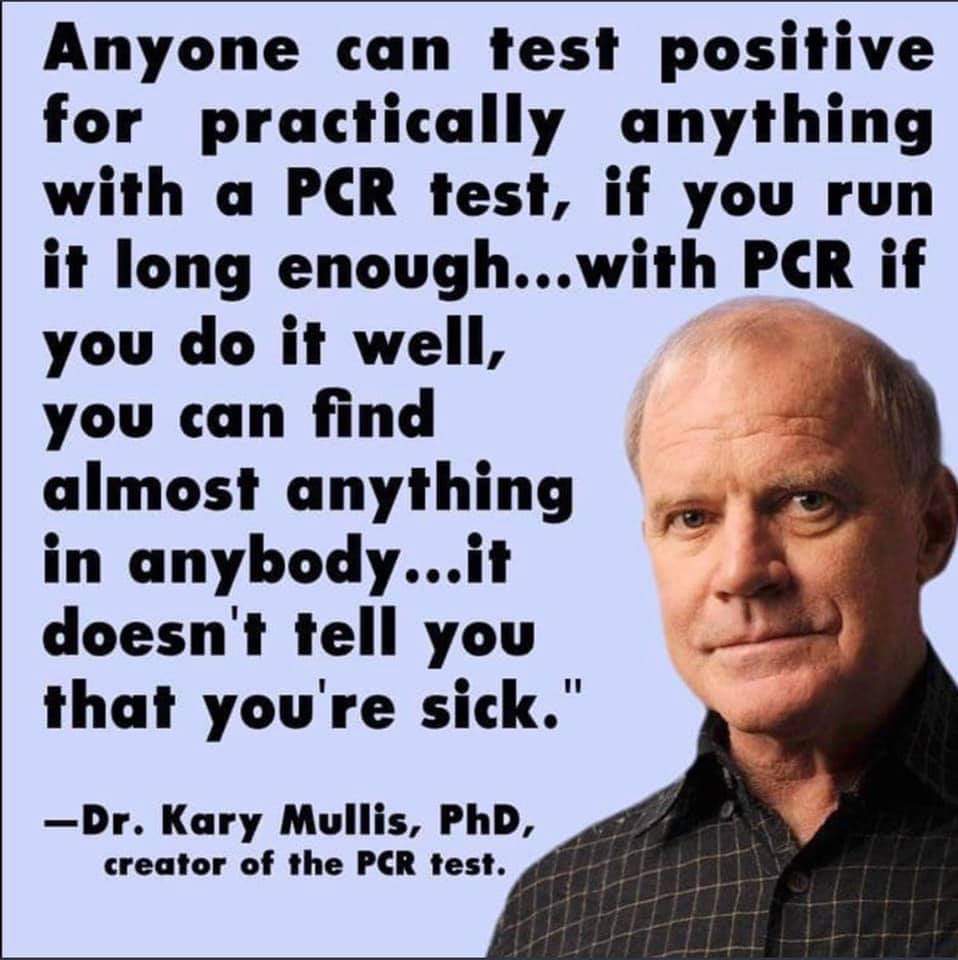
Scam Has Been Confirmed PCR Does Not Detect SARS-CoV-2
**UPDATE May, 2023**
A Portuguese court has ruled that PCR tests are unreliable and that it is unlawful to quarantine people based solely on them.
Citing Jaafar et al. 2020, the court concludes that:
if someone is tested by PCR as positive when a threshold of 35 cycles or higher is used (as is the rule in most laboratories in Europe and the US), the probability that said person is infected is less than 3%, and the probability that said result is a false positive is 97%.
Earlier, the WHO’s testing protocol was even questioned by Finland’s national health authority.
Now we find out that Stanford researchers had a simple test to determine if an asymptomatic person who tested positive for COVID was infectious but CDC and Fauci ignored it. It was found that the vast majority of asymptomatic individuals who tested positive — 96% — did NOT transmit the virus. We were even warned by honest virologists about this back in 2020, as well as having the fact play out in reality over and over and over and over again but it was completely ignored by corrupt public health ‘authorities’ because it would have stifled their plan to make the asymptomatic public enemy #2 right after public enemy #1, the unvaccinated, who were blamed for extending the ‘pandemic’ when it’s actually the “vaccinated” that are forcing the virus to mutate.
The CDC particularly pin-pointed the asymptomatic as “silent carriers” to create a boogie-man to be able to continue their fear-mongering, pushing people to test more frequently, and agree to get the completely worthless, experimental, fast-tracked, dangerous COVID gene therapy injections that actually make it more likely to contract COVID, just like the flu vaccine puts you at higher risk for COVID and other respiratory viruses. They are currently doing it again with asymptomatic bird flu and are prepping a shot for humans “just in case.”
This is their MO. Learn it well because they do it repeatedly.
Their plan is working beautifully.
The Stanford test would have prevented lockdowns, masks, and the 3 years of tyranny that followed – all of which were fruitless, and in fact made things much worse, which is why they ignored it. It would have put a big ugly dent in their plan.
Faulty testing has also been used against Lyme/MSIDS patients – for over 40 years which continues to this day. Everyone admits the tests are abominable but nothing is done about it.
Please keep in mind:
- the common cold may trigger a positive COVID test because the tests can not differentiate between coronaviruses
- COVID tests can’t distinguish between a virus and dead, harmless viral fragments which is why those who have recovered can still test positive
- Fauci admitted testing has a fatal flaw and quietly withdrew its request for EUA after using it for a year
- despite this, the CDC recommended newborns be tested for COVID twice and separated from mothers with confirmed or suspected COVID. Never forget this travesty and never trust this agency again!
- the Gates Foundation helped negotiate a $100 B government-backed contract tracing contract just 6 months before the COVID ‘pandemic,’ which was then introduced by Illinois Democratic Congressman Bobby L. Rush as H.R. 6666 which would have allowed ‘authorities’ to come into your home and separate family members. China futilely did this
- local governments hired “contract tracers” who were empowered to order the confinement of individuals at home even if they were asymptomatic. WI governor Tony Evers received 1,000 applications for tracing jobs at one point. NY contract tracers were paid $65K to rat our their neighbors and restaurant owners were required to keep logs of their guests as blackmail for the condition of re-opening. Never, ever forget this!
- they manipulated PCR cycle thresholds for their own nefarious purposes and the media was complicit
- 8 in 10 test results are false positives
- a Portuguese court ruled the PCR test is unreliable and unlawful to quarantine people
- tests were contaminated with COVID
- tests have graphene silver, aluminum, titanium, glass fibers in them which are undeclared on the package insert. These things can cause the mucus membranes to harden in those who are tested frequently
- CDC admits COVID tests are wrong up to half the time and the President of Tanzania punks the WHO by showing nearly half of samples taken from goats, sheep, rabbits, fruit, birds, and even motor oil came back positive
- a testing company faked tests, threw samples away, but still made $83 M in government funding
- CDC insists upon using its own patented faulty testing due to conflicts of interest
I will say this again for the hard of hearing: never forget these facts, never forgive what was done, and don’t let them get away with it.
https://www.greenmedinfo.com/blog/scam-has-been-confirmed-pcr-does-not-detect-sars-cov-2?
The Scam Has Been Confirmed: PCR Does Not Detect SARS-CoV-2
Posted on: December 14th 2020
Posted By: GMI Reporter

Unofficial English translation of ‘Frauds and falsehoods in the medical field’ originally published on www.dsalud.com
The genetic sequences used in PCRs to detect suspected SARS-CoV-2 and to diagnose cases of illness and death attributed to Covid-19 are present in dozens of sequences of the human genome itself and in those of about a hundred microbes. And that includes the initiators or primers, the most extensive fragments taken at random from their supposed “genome” and even the so-called “target genes” allegedly specific to the “new coronavirus”. The test is worthless and all “positive” results obtained so far should be scientifically invalidated and communicated to those affected; and if they are deceased, to their relatives. Stephen Bustin, one of the world’s leading experts on PCR, in fact says that under certain conditions anyone can test positive!
We have been warning you since March: you cannot have specific tests for a virus without knowing the components of the virus you are trying to detect. And the components cannot be known without having previously isolated/purified that virus. Since then we continue to accumulate evidence that no one has isolated SARS-CoV-2 and, more importantly, that it can never be isolated for the reasons we explained last month (read the report “Can you prove that there are pathogenic viruses?” on our website –http://www.dsalud.com-). And in the present report we are going to offer new data that show that RT-PCR does not detect the so called SARS-CoV-2 as it is known, but fragments of human RNA and those of numerous microbes.
We have already explained the numerous problems that RT-PCR poses, recognised by organisations or governments such as the WHO or the CDC and by prestigious international experts such as Dr. Stephen Bustin who considers both the arbitrariness of establishing criteria for results and the choice of the number of cycles to be nonsense because they can lead to anyone testing positive.
In this report we are going to add the results of a particular research we have done from the data published on the alleged SARS-CoV-2 and on the protocols endorsed by the WHO for the use of RT-PCR as well as the data corresponding to the rest of the “human coronaviruses”. And the conclusions are extremely serious: none of the seven “human coronaviruses” have actually beenisolatedand all the sequences of the primers of their respective PCRs as well as those of a large number of fragments of their supposed genomes are found in different areas of the human genome and in genomes of bacteria and archaea, such as these: Shwanella marina JCM, Dialister succinatiphilus, Lactobacillus porcine, Lactobacillus manihotivorans, Leptospira sarikeiensis, Bizionia echini, Sanguibacteroides justesenil, Bacteroides massiliensis, Lacinutrix venerupis, Moraxella bovis, Leptospira saintgironsiae, Winogradskyella undariae, Acetobacterium puteale, Chryseobacterium hispanicum, Paenibacillius koleovorans, Tamiana fuccidanivorans, Fontibacillua panacisegetis, Ru bacter ruber , Skemania piniformis, Chryseobacterium shigense, Caloramator peoteoclasticus, Cellulosilyticum ruminicola, Nitrosopumilius evryensis and a long list of others.
We are going to explain step by step the research that has led us to such an unusual conclusion.
HAVE ANY HUMAN CORONAVIRUSES BEEN ISOLATED?
During the first half of April, when the first research we conducted indicated that SARS-CoV-2 had not been isolated and since those who claimed to have done so were relying on “isolates” of previous “human coronaviruses”, we began to do a thorough review of those claimed isolates. Specifically, we reviewed the alleged isolation work of suspected human coronaviruses 229E (said to have been isolated in 1965), OC43 (in 1967), SARS-CoV (in 2003), NL63 (in 2004), HKU1 (in 2005) and MERSCoV (in 2012). And these have been the results:
Coronavirus 229E.
Reference article: Dorothy Hamre and John Procknow. A new virus isolated from the human respiratory Tract. Proceedings of the Society for Experimental Biology and Medicine, 121: 1:190-193. January 1, 1966.
Since the authors refer to other articles to explain the method of isolation – which they call Complement Fixation – we consulted a reference article for that method: that of Janet W. Hartley et al. Complement Fixation and tissue culture assay for mouse leukaemia viruses PNAS, 53(5):931-938, May 1965. This is a procedure already in disuse that uses the antigen-antibody reaction to detect either one or the other. In the case we are dealing with, the aim was to detect the antigens of the supposed new virus but, as we have already explained, specific antibodies are needed which cannot be obtained the first time a virus is detected.
Coronavirus OC43.
Reference article: Paul Lee. Molecular epidemiology of human coronavirus OC43 in Hong Kong. Thesis for the Department of Microbiology, University of Hong Kong, August 2007. The HKU Scholars Hub.
What was considered to be viral RNA was extracted from cultures without any proof that the RNA belongs to a virus.The tool used – a QIAamp kit – removes reagents, inhibitors and contaminants but what it cannot do is determine where the extracted RNA comes from. And there are no controls.It is then amplified by PCR and sequenced assuming (!) that it is genetic information of a virus. Finally, the author speculates about mutations, recombinations, genotypes, molecular evolution, strains and other jargon that conveys the idea -unproven- that a “virus” is being worked with.
SARS-CoV Coronavirus.
Reference article: J. S. M. Peiris and others. Coronavirus as a possible cause of SARS. Lancet 361: 1319-25, April 2003.
There is no mention of purification in the article. There is not even any mention of filtration or centrifugation. It is only stated that “the viruses were isolated in fetal monkey liver cells from nasopharyngeal aspirates and lung biopsies of two patients”. There are no controls. The only mention is of a “cytopathic effect” that is attributed to a virus and that PCR was done for known viruses and retroviruses without obtaining results. Finally, RT-PCR was done with “random initiators” and a sequence “of unknown origin” is detected to which “a weak homology with thecoronaviridiae family” is found. Then they designed primers for that sequence and when testing 44 samples from SARS patients only 22 were positive.
Coronavirus NL63.
Reference article: Lia van der Hock and others. Identification of a new human coronavirus. Nature Medicine, 10, 4 April 2004.
The authors state that “the identification of unknown pathogens using molecular biology tools is difficult because the target sequence is not known so that PCR-specific initiators cannot be designed”.
What they used is a tool they developed themselves called VIDISCA which, they claim, does not require prior knowledge of the sequence! Is that possible? Let’s see how it works: first the culture is prepared and it is assumed that a virus is present due to the evidence of “cytopathic effect”. The novelty introduced by this method is that “restriction enzymes” are added, enzymes that cut the nucleic acid molecules at certain locations and always by the same length. In this way, if after the action of these enzymes they observe many fragments of DNA or RNA that are the same or very similar, they deduce that it comes from a virus, since the host genome would present random cuts, while the virus genome presents a large number of copies that are the same due to the replication of the virus. And is such a deduction correct? Of course not! This assumption (which adds to the previous assumption that there is a virus) does not take into account that there are “virus-like particles”, “retrovirus-like particles”, “endogenous retroviruses”, “exosomes”, “extracellular” particles and even mitochondrial DNA. In denial, there are a multitude of particles that possess the same reproductive characteristics in large quantities as “viruses” and therefore can falsify resultsby producing large numbers of identical copies when cut by enzymes as recognised in an article on the VIDISCA technique entitled Enhanced bioinformatic proSling of VIDISCA libraries for virus detection and Discovery. It was published in volume 263 of Virus Research on April 2, 2019, and its authors-Cormac M. Kinsella et al.-recognise that “no redundancy is expected in the VIDISCA insert from the host background nucleic acid except inthe case of ‘virus-like’ characteristics, i.e., high copy numbers as in mitochondrial DNA.
Coronavirus HKU1.
Reference article: Patrick C. Y. Woo and others. Characterisation and Complete Genome Sequence of a Novel Coronavirus, Coronavirus HKU1, from Patients with Pneumonia. Journal of Virology, 79, 2, January 2005.
The article, incredibly, begins with these words: “Despite extensive research in patients with respiratory tract infections, no microbiological cause has been identified in a significant proportion of patients. RNA is extracted from non-purified cultures.”And a PCR with coronavirus genes is used. For the sequencing they use two protein databases organised in families, domains and functional sites -PFAM and INterProScan- combined with two computer programs that carry out “predictions” on how nucleotides should be combined. The text adds: “The sequences were manually assembled and edited to produce a final sequence of the viral genome”. And once again there are no controls.
MERS-CoV Coronavirus.
Reference article: Ali Moh Zaki and others. Isolation of a Novel Coronavirus from a Man with Pneumonia in Saudi Arabia. The New England Journal of Medicine, 367:19, November 2012.
The genetic material is extracted directly from the culture supernatantand sputum sample with a tool called High Puré Viral Nucleic Acid Kit and then tested with different PCRs for various known microorganisms. There is no mention of purification and there are no controls.
In short, what had been done with the first coronaviruses -and with many other supposed viruses– isto cultivate supposedly infected tissues– any “cytopathic effect” was attributed to the presence of a virus only – and then either some proteins are obtained which without anytest are considered “virus antigens” and when these “antigens” are detected in cultures it is interpreted as “isolation”, or fragments of nucleic acids are extracted assuming that they belong to a virus.
We already explained in the article published in the previous issue of the magazine that according to Dr. Stefan Lanka the so-called “cytopathic effect” is actually an effect caused by the conditions of the culture itself. This is recognised for example in the article Antibiotic-induced release of small extracellular vesicles (exosomes) with surface-associated DNA published on August 15, 2017 on the website of Nature and signed by Andrea Németh and others
(https://www.ncbi.nlm.nih.gov/pmc/articles/PMC5557920/pdf/41598_2017_Article_8392.pdfIt explains that certain substances -such as antibiotics- added to in vitro experiments can stress the cell cultures so that they generate new sequences that had not been previously detected. This had already been noticed by none other than Dr. Barbara McClintock in 1983 during her Nobel Prize lecture, as can be seen at https://www.nobelprize.org/uploads/2018/06/mcclintock-lecture.pdf
In essence, NOT ONE OF THE SEVEN SUPPOSED HUMAN CORONAVIRUS HAS REALLY BEEN ISOLATED. The only thing that has been different between them are the laboratory procedures and techniques that were becoming progressively more sophisticated which, in this case, has implied not a greater accuracy but a greater capacity for deception and self-deception that has culminated in the virtual manufacture of the SARS-CoV-2.
And the obvious consequence of the lack of evidence of its isolation is that such “coronaviruses” cannot be held responsible for any disease. Moreover, all tests – of whatever kind – based on the presumed components of these “viruses” (nucleic acids or proteins) are completely disqualified as “infection tests” and even more as “diagnostics” of diseases.
MORE UNANSWERED REQUESTS
In the previous issue we already collected the answers given by the authors of several articles that supposedly described the isolation of SARS-CoV-2 in which they acknowledged that they had not “purified” which implicitly means acknowledging that the virus was not isolated. And now we are going to add one more piece of evidence: the responses given by different authorities – political and health – from various countries about the purification and isolation of SARS-CoV-2.
- James McCumiskey -author of the book The Latest Conspiracy: The Biomedical Paradigm– tells us that the National Virus Reference Laboratory of Ireland requested information about it from the University of Dublin and the latter responded that“it has no records that could provide ananswer to their request”. The director of legal services of the laboratory insisted on his request to the university and the university responded as follows: “The position of the university is that material of academic debate cannot be subject to the Freedom of Information Act”. It follows from the NVR’s request that they have not cultivated SARS-CoV-2 or purified it. They only acknowledge having “detected SARS-CoV-2 RNA in diagnostic samples.”
- On June 22, a group of experts sent a consultation in similar terms to British Prime Minister Boris Johnson. The letter was signed by Dr. Kevin Corbett, Piers Corbyn – professor at Imperial College London -, the engineer and independent researcher – who we interviewed in the journal at the time – David Crowe, Dr. Andrew Kaufman, the Edinburgh professor of biology Roger Watson and the biologist and chemist David Rasnick – and to this day they still have not received a reply!
- Another similar request – in this case to the National Research Council of Canada – received the following response: “We have not been able to carry out a complete search of the NRC’s records so we regret to inform you that no records have been identified that respond to your request.”
- We will add that two journalists have been sending similar requests – under the Freedom of Information Act – to various institutions in Canada, New Zealand, Australia, Germany, the United Kingdom and the United States, and as of September 5, twelve institutions have responded, all indicating the same thing: that they have no record of work describing the isolation of the virus that is supposed to cause Covid-19. The details and the answers can be seen at: https://www.fluoridefreepeel.ca/u-k-dept-of-health-and-social-care-has-no-record-of-covid-19-virus-isolation/
LOOKING FOR THE ORIGIN OF THE FALSE GENOME
The question we asked ourselves then was: if the sequences that have been published do not belong – as claimed- to new viruses, where do they come from? And to try to answer that question we decided to carry out a search with a computer program called Basic Local Alignment Search Tool (BLAST), a sequence alignment search tool that allows us to compare a given sequence with all the sequences stored in the National Institutes of Health of the United States (it is public and can be consulted at https://blast.ncbi.nlm.nih.gov/Blast.cgi. We explain step by step what we did so that our readers can repeat the search for themselves and check the results.
First we collected all the initiators of the PCRs described in the protocols hosted on the WHO website at the time which were these:
- China CDC protocol: uses ORF1ab and N genes as target.
- Protocol of the Pasteur Institute (France): uses two fragments of the RdRP (which is supposed to be SARS.CoV-2 specific).
- United States CDC protocol: uses three fragments of the N gene.
- Protocol of the National Institute of Infectious Diseases of Japan: it is the only one that has as target the S gene together with other genes supposedly shared with other coronaviruses.
- Charite Protocol (Germany): uses the E, N and RdRP genes.
- Hong Kong University Protocol: uses ORF1b-nsp14 and N gene.
- National Institute of Health Thailand protocol: uses the N gene.
We then introduced the sequence of the primers – the one that indicates the beginning of the sequence to be detected (forward) and the one that indicates the final (reverse) – into the BLAST so that it could search for them in two databases: a collection of microbe genomes and the one corresponding to the human genome.
THE SEQUENCES OF THE SO-CALLED SARS-COV-2 ARE FOUND BOTH IN HUMANS AND IN NUMEROUS MICROBES!
Let’s see in detail the procedure taking as an example the initiators of the French protocol. Once on the BLAST website, we chose Microbes to search the microbial genome databases and moved to the next page. Then a form appeared in which we entered the sequence of the forward initiator of the French protocol -that is ATGAGCTTAGTCCTGTG-, we selected the option Highly similar sequences and pressed the BLAST key. Just a few seconds later the results appeared -we took a screenshot (image 1)– and we were shown 100 sequences of microbes -particularly bacteria and archaea- with a coincidence of between 77% and 100% with an identity percentage of 100%.
We then returned to the home page and that second time we chose Human to search the human genome, we repeated the same operation and after a few seconds the result appeared which we screen captured again (image 2). And it turns out that the sequence entered coincides with 74 sequences of the human genome, with a coincidence of between 66% and 100% and a percentage of identity of 100%.
And that indicates that the sequence of that initial PCR primer that is supposed to be specific to SARS-CoV-2 actually corresponds to 74 fragments of the human genome and a hundred microbial fragments as well!
We then decided to repeat the operation but with the final or reverse primer – which is CTCCCTTTGTGTGTGT – and the results were similar.
Since these were very short sequences -about twenty genetic letters or nucleotides- we decided to try again but with the target sequence defined by these two primers, i.e. the sequence of the supposed SARS-CoV-2 genome that is between the initial primer and the final primer. Obviously, for this we needed the sequence that is officially claimed to be the “SARS-CoV-2 genome” and although thousands of laboratories claim to have isolated and sequenced it – a false claim as we have explained in previous reports- we decided to go to the National Centre for BiotechnologyInformation website: https://www.ncbi.nlm.nih.gov/nuccore/NC_045512.2?report=genbank&to=29903. Once there, we located the “target sequence”, a fragment of 108 nucleotides located between positions 12,690 and 12,797 of the “genome”, which is this one:
ATGAGCTTAGTCCTGTTGCACTACGACAGATGTTGTGCCGGTACACAAACTGCTTGCACTGAT GACAATGCGTTAGCTTACAACAACAAAGGGAG.
With this we repeated the steps previously described and the results were again surprising since there appeared again a hundred microbe sequences with a percentage of a match of 100% and four sequences of the human genome with an identity percentage between 83% and 95%. The matches were therefore lower but the important thing is that we continue to find fragments of the supposed “target sequence” of SARS-CoV-2 both in microbes and in our own genome.
Truly astonished we took a further step and tested with the gene considered at that time as the most specific of SARS-CoV-2, the E gene that is supposed to generate the envelope proteins and is located between positions 26,245 and 26,472:
ATGTACTCATTCGTTTCGGAAGAGACAGGTACTACGTTAATAGTTAATAGCGTACTTCTCTTGCTTTCGTGGTATTCTTGCTAGTTACACTAGCCATCCTGCTTCGATTGTGCGTACTGCTGCAATATTGTTAACGTGAGTCTTGTAAAACCTTTACGTTTACTCGTGTTAAAATCTGAATTCTTCTAGAGTTCGATTCTGGTCTAA.
We repeated with it the steps already described and the result was even more surprising because despite its length another hundred microbe sequences appeared with a percentage of identity of 100% and 10 sequences of the human genome with a percentage of identity between 80% and 100%. And similar results were obtained with a fragment chosen atrandom and with the N gene which they say corresponds to the proteins of the SARS-CoV-2 nucleocapsid.
We finally decided to test with the S gene which is said to generate the structural “spike” proteins that are key to entry into the cell and was subsequently considered to be the most specific SARS-CoV-2 gene. Since it is a gene whose sequence is much longer – 3821 nucleotides between positions 21,563 and 25,384 – we tested with two fragments chosen at random within that gene and the first – TTGGCAAAATTCAAGACTCACTTTC – resulted in another hundred microbe sequences and 93 sequences of the human genome and the second – CTTGCTGCTACTAAATGCAGAGTGT – a hundred microbial sequences and 90 of the human genome.
Finally we decided to test with the initiators of the Japan Protocol, the only one that includes target sequences of the S gene and, the reader will have already guessed, the results were once again similar: a hundred microbe sequences and 93 sequences of the human genome with an identity percentage between 94.12% and 100%!
CONCLUSIONS
The consequence of all that we have just explained is clear and immediate: THERE IS NO VALID TEST TO DETECT SARS-COV-2, neither antibody or antigen tests nor RT-PCR. And we included those based on the supposed gene that codes for the S1 or spike protein. And that means that
ALL THE NUMBERS OF “CASES”, “INFECTED”, “SICK”, “Asymptomatic” OR “DEAD DUE TO COVID-19” LACK A SCIENTIFIC BASE AND ALL “POSITIVES” ARE FALSE POSITIVES, something that should be communicated immediately to those affected and those responsible should be held accountable.
We end by adding that even the WHO itself does not really believe in these tests. Just read the document published last September 11 as a laboratory guide for SARS-CoV-2 entitled Diagnostic tests for SARS-CoV-2 – it is available at https://apps.who.int/iris/rest/bitstreams/1302661/retrieve– and it literally says on page 5: “Whenever possible, suspected active infection should be tested with a nucleic acid amplification test (NAAT) such as RT-PCR. NAAT tests should target the SARS-CoV-2 genome but since there is no known global circulation of SARS-CoV-1 a Sarbecovirus sequence (presumed to include at least five human and animal coronaviruses including SARS-CoV-1 and SARS-Cov-2) is also a reasonable target”. That is, WHO agrees to use non-specific sequences to detect SARS-CoV-2.
That is not all because the manual later states, “An optimal diagnosis consists of a NAAT test with at least two genome-independent targets of the SARS-CoV-2; however, in areas where transmission is widespread, a simple single-target algorithm can be used.”
The WHO manual states, “One or more negative results do not necessarily rule out SARS-CoV-2 infection.There are a number of factors that can produce a negative result in an infected individual including poor quality of the sample, late collection of the sample, inadequate handling, or technical reasons inherent in the test, such as mutation of the virus or inhibition of PCR.”
What are the judges waiting for to act on their own initiative?
Jesus Garcia Blanca
Note: the author publicly thanks Juan Pedro Aparicio Alcaraz for his patient and meticulous collaborative work in the search for scientific articles and for his tedious work with the BLAST.
THIS REPORT APPEARS IN (https://www.dsalud.com/revistas/numero-242-noviembre-2020/)
- https://madisonarealymesupportgroup.com/2020/03/16/does-the-coronavirus-exist/
- https://madisonarealymesupportgroup.com/2020/09/02/covid19-pcr-a-test-that-tells-you-your-body-is-the-enemy-a-vaccine-would-be-death-by-1000-cuts/
- https://madisonarealymesupportgroup.com/2020/12/07/ten-fatal-errors-scientists-attack-paper-that-establish-global-pcr-driven-lockdown/
- https://madisonarealymesupportgroup.com/2020/10/17/massive-lawsuit-launches-against-covid-19-lockdowns/
- https://madisonarealymesupportgroup.com/2020/08/20/politicians-could-have-known-covid-facts-since-april-but-they-dont-care-about-facts/
- https://madisonarealymesupportgroup.com/2020/09/30/proof-that-the-pandemic-was-planned-with-purpose/
 Stephen Bullough before and after Lyme disease