Archive for the ‘research’ Category

Johns Hopkins Researchers: Plant Compounds May be Better Than Current Antibiotics at Treating Persistent Lyme Bacteria

http://outbreaknewstoday.com/johns-hopkins-researchers-plant-compounds-may-better-current-antibiotics-treating-persistent-lyme-bacteria-16025/

Johns Hopkins researchers: Plant compounds may be better than current antibiotics at treating persistent Lyme bacteria

December 3, 2018
Oils from garlic and several other common herbs and medicinal plants show strong activity against the bacterium that causes Lyme disease, according to a study by researchers at Johns Hopkins Bloomberg School of Public Health. These oils may be especially useful in alleviating Lyme symptoms that persist despite standard antibiotic treatment, the study also suggests.
Image/CDC
Image/CDC

The study, published October 16 in the journal Antibiotics, included lab-dish tests of 35 essential oils–oils that are pressed from plants or their fruits and contain the plant’s main fragrance, or “essence.” The Bloomberg School researchers found that 10 of these, including oils from garlic cloves, myrrh trees, thyme leaves, cinnamon bark, allspice berries and cumin seeds, showed strong killing activity against dormant and slow-growing “persister” forms of the Lyme disease bacterium.

“We found that these essential oils were even better at killing the ‘persister’ forms of Lyme bacteria than standard Lyme antibiotics,” says study senior author Ying Zhang, MD, PhD, professor in the Department of Molecular Microbiology and Immunology at the Bloomberg School.

There are an estimated 300,000 new cases of Lyme disease each year in the United States. Standard treatment with doxycycline or an alternative antibiotic for a few weeks usually clears the infection and resolves symptoms. However, about 10 to 20 percent of patients report persistent symptoms including fatigue and joint pain–often termed “persistent Lyme infection” or “post-treatment Lyme disease syndrome” (PTLDS) that in some cases can last for months or years.

The cause of this lingering syndrome isn’t known. But it is known that cultures of Lyme disease bacteria, Borrelia burgdorferi, can enter a so-called stationary phase in which many of the cells divide slowly or not at all. The slow-dividing or dormant cells are “persister” cells, which can form naturally under nutrient starvation or stress conditions, and are more resistant to antibiotics. Some researchers have sought other drugs or medicinal compounds that can kill persister Lyme bacteria in the hope that these compounds can be used to treat people with persistent Lyme symptoms.

Zhang and his laboratory have been at the forefront of these efforts. In 2014, his lab screened FDA-approved drugs for activity against persister Lyme bacteria and found many candidates including daptomycin (used to treat MRSA) that had better activity than the current Lyme antibiotics. In 2015, they reported that a three-antibiotic combination–doxycycline, cefoperazone and daptomycin–reliably killed Lyme persister bacteria in lab dish tests. In a 2017 study they found that essential oils from oregano, cinnamon bark, clove buds, citronella and wintergreen killed stationary phase Lyme bacteria even more potently than daptomycin, the champion among tested pharmaceuticals.

In the new study Zhang and his team extended their lab-dish testing to include 35 other essential oils, and found 10 that show significant killing activity against stationary phase Lyme bacteria cultures at concentrations of just one part per thousand. At this concentration, five of these oils, derived respectively from garlic bulbs, allspice berries, myrrh trees, spiked ginger lily blossoms and may change fruit successfully killed all stationary phase Lyme bacteria in their culture dishes in seven days, so no bacteria grew back in 21 days.

Oils from thyme leaves, cumin seeds and amyris wood also performed well, as did cinnamaldehyde, the fragrant main ingredient of cinnamon bark oil.

Lab-dish tests such as these represent an early stage of research, but Zhang and colleagues hope in the near future to continue their investigations of essential oils with tests in live animals, including tests in mouse models of persistent Lyme infection. If those tests go well and the effective doses seem safe, Zhang expects to organize initial tests in humans.

“At this stage these essential oils look very promising as candidate treatments for persistent Lyme infection, but ultimately we need properly designed clinical trials,” he says.

__________________
**Comment**
Please remember that both Stevia and the essential oil studies have been in vitro – or in a lab, not in the human body.  This is an important distinction because the body is far more complex and what plays out in a petri dish may or may not play out in the body.
Personally, my husband and I have tried Stevia and EO’s internally.  We relapsed on both.  We also didn’t have any noticeable herx reactions.  That isn’t to say they won’t work on someone else but for me and my husband we’ve ALWAYS responded to antibiotics with noticeable herxheimer reactions upon starting treatment.  Again, much plays into this and for us, Bartonella is a key player – perhaps more so than even Lyme when going by symptoms.  The polymicrobial nature of Lyme/MSIDS keeps this a complex, difficult to treat illness.  We are human Guinea pigs.  I will also add that we both took Tinidazole throughout our YEARS of treatment which, if you study it, you discover it is one of the few that reduces spirochetal and round body forms by ~80%-90% (Again, this is an in vitro study):
https://www.dovepress.com/evaluation-of-in-vitro-antibiotic-susceptibility-of-different-morpholo-peer-reviewed-article-IDR
All I can say is when we took Tindy, it was noticeable.  We pulsed it on TH and F and we felt like train wrecks over the weekends.  To us it was quite powerful.

Five Genera of Pathogens Found in Ticks On Russian Dogs

https://www.ncbi.nlm.nih.gov/m/pubmed/30428925/

Dog survey in Russian veterinary hospitals: tick identification and molecular detection of tick-borne pathogens.

Livanova NN, et al. Parasit Vectors. 2018.

Abstract

BACKGROUND: Species of Canidae in Russia can be infested with up to 24 different tick species; however, the frequency of different tick species infesting domestic dogs across Russia is not known. In addition, tick-borne disease risks for domestic dogs in Russia are not well quantified. The goal of this study was to conduct a nationwide survey of ticks collected from infested dogs admitted to veterinary clinics in Russian cities and to identify pathogens found in these ticks.

METHODS: Ticks feeding on dogs admitted to 32 veterinary clinics in 27 major cities across Russia were preserved in ethanol and submitted to a central facility for examination. After identification, each tick was evaluated for infection with known tick-borne pathogens using PCR.

RESULTS: There were 990 individual ticks collected from 636 dogs. All collected ticks belonged to the Ixodidae (hard ticks) and represented 11 species of four genera, Dermacentor, Ixodes, Rhipicephalus and Haemaphysalis. Four most common tick species were D. reticulatus, followed by I. persulcatus, I. ricinus and R. sanguineus. Ixodes persulcatus ticks were found to be infected with 10 different pathogens, and ticks of this species were more frequently infected than either D. reticulatus or I. ricinus. Ixodes persulcatus females were also more frequently co-infected with two or more pathogens than any other tick.

Pathogenic species of five genera were detected in ticks:

  • Anaplasma centrale, A. phagocytophilum & A. marginale (Anaplasma)
  • Babesia canis, B. microti, B. venatorum, B. divergens, B. crassa & B. vogeli (Babesia)
  • Borrelia miyamotoi, B. afzelii and B. garinii (Borrelia)
  • Ehrlichia muris, E. canis and E. ruminantu (Ehrlichia)
  • Theileria cervi (Theileria – a parasitic protozoan)
Anaplasma marginale, E. canis, B. crassa, B. vogeli and T. cervi were detected in I. persulcatus, and Babesia canis in D. marginatum, for the first time in Russia.

CONCLUSIONS: Multiple ticks from four genera and 11 species of the family Ixodidae were collected from domestic dogs across Russia. These ticks commonly carry pathogens and act as disease vectors. Ixodes persulcatus ticks present the greatest risk for transmission of multiple arthropod-borne pathogens.

_________________

**Comment**

It’s getting harder and harder for The Cabal to hide the polymicrobial nature of Lyme/MSIDS.  The data just keeps pouring in:  https://madisonarealymesupportgroup.com/2018/10/30/study-shows-lyme-msids-patients-infected-with-many-pathogens-and-explains-why-we-are-so-sick/

For the first time, Garg et al. show a 85% probability for multiple infections including not only tick-borne pathogens but also opportunistic microbes such as EBV and other viruses.

I’m thankful they included Bartonella as that one is often omitted but definitely a player. I’m also thankful for the mention of viruses as they too are in the mix. The mention of the persister form must be recognized as well as many out there deny its existence.

Key Quote: “Our findings recognize that microbial infections in patients suffering from TBDs do not follow the one microbe, one disease Germ Theory as 65% of the TBD patients produce immune responses to various microbes.”

But there is another important point.

According to this review, 83% of all commercial tests focus only on Lyme (borrelia), despite the fact we are infected with more than one microbe.

And those tests miss half of all cases:  

https://madisonarealymesupportgroup.com/2018/09/12/lyme-testing-problems-solutions/  ...with the C6 Elisa its around 50% sensitive (in the context of the two tiered testing system on its own it has a sensitivity of 75%) because it misses about half of true positive cases….The Western Blot also has many problems with sensitivity at all stages but especially within the first month and again later on the more chronic it becomes.If you take the terrible sensitivity of both tests in the two tiered system you will start to see how testing positive consecutively on both is very unlikely, mathematically improbable and biologically almost impossible unless you are in the HLA autoimmune group which is comparatively rare.

https://madisonarealymesupportgroup.com/2018/01/16/2-tier-lyme-testing-missed-85-7-of-patients-milford-hospital/  Dr. Sin Lee identifying faulty serology tests for Lyme disease in 85.7% of the walk-in patients in the Emergency Room of Milford Hospital.

Please note that all the studies showing the polymicrobial nature of tick borne illness  are foreign.

The Cabal has everyone in the U.S. in a head-lock.

Will the real researchers please stand up and be counted?


Using MyLymeData to Build a Research Engine

https://www.lymedisease.org/hhs-lyme-innovation-speech-using-mylymedata-to-build-a-research-engine/  December 5, 2018

LYMEPOLICYWONK: Using MyLymeData to Build a Research Engine


Yesterday, I was honored to speak at the US Department of Health and Human Services’ Lyme Innovation Roundtable, about the need to build the research capacity of Lyme patients to create sustainable change and accelerate research.

To do this, we must embrace big data, precision medicine, and patient-centered research. You can watch a video of my presentation below.

Unacceptably high treatment failure rates in Lyme disease

Unacceptably high treatment failure rates in Lyme disease and in early Lyme disease –roughly 35% in a 2013 study by Dr. Aucott-and even higher rates for those diagnosed late—mean that many patients remain ill. (Aucott 2013) In our published studies, patients with chronic Lyme disease report being ill for more than 10 years. (Johnson 2011)

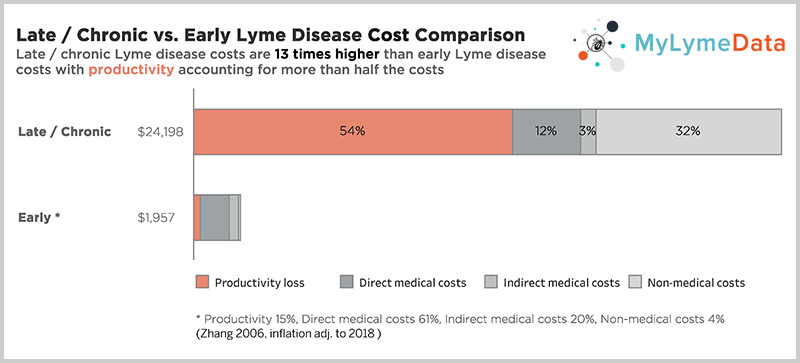
In addition to the human toll this exacts, this also makes it a costly problem to ignore.  According to a CDC study by Dr. X. Zhang the cost of late or chronic Lyme disease is 12 times higher than the cost of treating early disease —about $24,000 per person/per year when adjusted for inflation. (Zhang 2006)

And we can’t make the progress we need with the traditional way of doing research—one sequential randomized controlled trial followed by another.  It simply takes too long, costs too much, and doesn’t apply to most people, as Dr. Rob Califf at the FDA often points out.

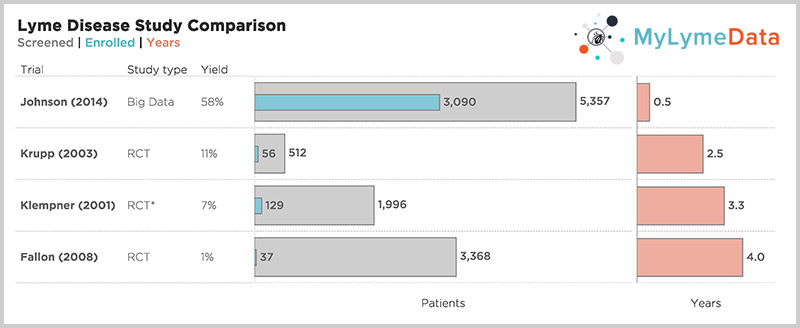
For example, the NIH funded Lyme trials took 2.5 to 5 years to complete recruitment alone and most patients were screened out. Hence, the Klempner study, screened out 97% of those who applied. But look at the top bar—one of our published studies—where it took 6 months to recruit over 3,000 patients. (Krupp, 2003; Klempner 2001; Fallon 2008; Johnson 2014)

Big Data and Lyme Disease Research

Today with big data, we can and must accelerate the pace of clinical research and include real world patients.

But it is important to recognize that research orphaned diseases—like Lyme disease—require more targeted concerted research efforts. It requires that disease communities shoulder more of the research burden early on by collaborating with others to build a knowledge base, and identify biomarkers and treatment endpoints. This approach accelerates the research process so that industry is stepping into the disease later in the process when many of the challenges have been identified and resolved. It also de-risks the investment of time and money that industry must expend to develop better diagnostics and more effective treatments.

Dr. Stephen Groft, who until his retirement a few years ago headed the Office of Rare Diseases Research for the NIH, tells us how to do this. In his process—patient registries play a vital role by linking with biorepositories, helping develop the disease knowledge base, shaping clinical trial hypothesis, speeding up recruitment times, expediting FDA approval and reducing the burden of post approval studies. (Groft 2014)

Patient Registries Play A Pivotal Role

Patient registries play a pivotal role in Groft’s research engine because patients have access to sources of information that other stakeholders do not. They are the monkeys in the middle who hold the key to unlocking data silos—such as:

  • electronic health records,
  • insurance records,
  • biorepository sample results,
  • lab results and
  • of course, the information that can only be gleaned from patients—their symptoms and their response to treatment.

The bottom line is that patients have more complete information about their health than any other stakeholder, and as Eric Topol, Editor in Chief at Medscape points out “given the appropriate tools, [patients] represent [the] true “blockbuster” potential for improving their outcomes.”(Topol 2017)

MyLymeData – Largest Study Of Lyme Disease

LymeDisease.org has been conducting big data research using patient generated data for over 10 years. We published our first study on Access to Care in 2011 and in 2014 we published our Quality of Life study. (Johnson 2011; Johnson 2014) In 2015, we launched MyLymeData, our patient registry and research platform. With over 12,000 patients enrolled, today, it is the largest observational study of Lyme disease ever conducted—and actually one of the largest patient driven registries in the nation—for any disease. We have patients enrolled from every state in the nation and have collected over 2.5 million data points.

We are collaborating with researchers from the University of Washington and from UCLA—the UCLA researchers were awarded a grant from the National Science Foundation to pursue their research using the data from the registry.

We have also collaborated with the National Disease Research Interchange–the leading source for research tissues in the nation–and with one of the sponsors of the HHS Lyme Innovation conference –the Bay Area Lyme Foundation on a tissue specimen biorepository. This is the type of collaboration that is essential to build out a big data research engine and accelerate research in Lyme disease. All of these efforts align with Groft’s research engine components.

First Lyme Disease Study Published Using Registry Data

This year we published our first study using registry data. This study focuses on another component of the engine—the development of clinical treatment endpoints

The outcome measure to determine success in past treatment trials for late/chronic Lyme disease has been the average treatment response. But average treatment response is inherently flawed as an outcome measure because it ignores individual treatment response variation. Think of it this way– if one person gets better and another gets worse, their responses cancel each other out– on average.

Other diseases—like cancer and tuberculosis—identify and learn from high treatment responders.  They are called super-responders.  But to do this you need large samples and you need to be able to really hone in on individual treatment response variation at a highly granular level to identify how different subgroups of patients respond.

We used a widely recognized validated outcome measure called the Global Rating of Change scale. You simply ask a patient: “would you say that since you started treatment you are better, worse, or unchanged?” Those who said they were better or worse, are asked how much better or worse on a scale ranging from hardly better at all to a very great deal better. “On average” there was not much treatment response for the group as a whole, but individual treatment response varied widely.

Because this sample was so large—close to 4,000 and because the question was so granular—essentially a 15 point scale—we could really look at treatment variation within subgroups.  This allowed us to identify a group of high treatment responders—about 34%–who reported improving moderately to a very great deal.

Identifying high treatment responders is important in Lyme disease so that we can learn from their success and look at the factors that may have contributed to that success—for example, time to diagnosis or type of treatment. It is also the first step in moving Lyme disease toward personalized medicine and individualized care.

Another key value of this global rating of change scale outcome measure is that it can be asked by a patient registry, by a healthcare provider, or by a researcher in a controlled trial.  This means it can bridge different types of research and create interoperability of data—which helps fuel that research engine we are trying to build to accelerate research.

We are excited with the progress we have made with MyLymeData and the promise of big data and patient-centered research to accelerate the pace of research. We believe that Lyme communities need to build the components of an effective research engine by using MyLymeData, developing biorepositories, identifying biomarkers for the disease, compiling a knowledge base for the disease, and identifying clinical endpoints for trials that are relevant to patients. It is only by doing this that we can create the future that patients need in Lyme disease.

If you are a patient who is not enrolled in MyLymeData,  please enroll today. If you are a researcher who wants to collaborate with us, please contact me directly.


First Report of Bb Antibodies in South American Veterinarians

https://www.ncbi.nlm.nih.gov/m/pubmed/27504018/?i=60&from=/30422489/related

Antibody profile to Borrelia burgdorferi in veterinarians from Nuevo León, Mexico, a non-endemic area of this zoonosis.

Skinner-Taylor CM, et al. Reumatologia. 2016.

Abstract

OBJECTIVES: Lyme disease is a tick-borne disease caused by infections with Borrelia. Persons infected with Borrelia can be asymptomatic or can develop disseminated disease. Diagnosis and recognition of groups at risk of infection with Borrelia burgdorferi is of great interest to contemporary rheumatology. There are a few reports about Borrelia infection in Mexico, including lymphocytoma cases positive to B. burgdorferi sensu stricto by PCR and a patient with acrodermatitis chronica atrophicans. Veterinarians have an occupational risk due to high rates of tick contact. The aim of this work was to investigate antibodies to Borrelia in students at the Faculty of Veterinary Medicine and Zootechnics, at Nuevo León, Mexico, and determine the antibody profile to B. burgdorferi antigens.

MATERIAL AND METHODS: Sera were screened using a C6 ELISA, IgG and IgM ELISA using recombinant proteins from B. burgdorferi, B. garinii and B. afzelii. Sera with positive or grey-zone values were tested by IgG Western blot to B. burgdorferi sensu stricto.

RESULTS: All volunteers reported tick exposures and 72.5% remembered tick bites. Only nine persons described mild Lyme disease related symptoms, including headaches, paresthesias, myalgias and arthralgias. None of the volunteers reported erythema migrans. Nine samples were confirmed by IgG Western blot. The profile showed 89% reactivity to OspA, 67% to p83, and 45% to BmpA.

CONCLUSIONS: Positive sera samples shared antibody reactivity to the markers of late immune response p83 and BmpA, even if individuals did not present symptoms of Lyme arthritis or post-Lyme disease. The best criterion to diagnose Lyme disease in our country remains to be established, because it is probable that different strains coexist in Mexico. This is the first report of antibodies to B. burgdorferi in Latin American veterinarians. Veterinarians and high-risk people should be alert to take precautionary measures to prevent tick-borne diseases.

_____________

**Comment**

Wish they would have screened them for Bartonella too.

https://madisonarealymesupportgroup.com/2018/09/20/humana-bartonellosis-perspectives-of-a-veterinary-internist/

https://madisonarealymesupportgroup.com/2018/10/28/tick-flea-louse-borne-diseases-of-public-health-veterinary-significance-in-nigeria/

https://madisonarealymesupportgroup.com/2016/08/09/a-bartonella-story/

https://madisonarealymesupportgroup.com/2018/05/07/fox-news-bartonella-is-the-new-lyme-disease/


Deer Ticks Are Surviving Winter & Becoming a Year-round Problem

https://www.newscentermaine.com/article/news/local/deer-ticks-are-surviving-winter-and-becoming-a-year-round-problem/97-618839666

https://media.newscentermaine.com/embeds/video/8347221/iframe“>https://media.newscentermaine.com/embeds/video/8347221/iframe  (News Story here)

Deer ticks are surviving winter and becoming a year-round problem

Deer ticks are being found for the first time in Jackman and Houlton.


CAPE ELIZABETH (NEWS CENTER Maine)– Researchers are discovering more evidence that deer ticks carrying Lyme and other diseases are now is a year-round problem.

An ongoing study by the Maine Medical Center Research Institute into how deer ticks withstand cold temperatures shows that ticks can hibernate until spring under leaves and snow. Temperatures above freezing and melting snow actually activate adult ticks so people and pets spending time outdoors need to wear protective clothing and use repellant.

Another concern — deer ticks are spreading to remote areas of the state. The parasites were discovered in Jackman and Houlton for the very first time.

“We don’t have any record of that occurring that far north in that part of the state yet, we were a few miles from the Quebec border so I think we are going to go back in the spring to see how well they do,” said Chuck Lubelczyk, field biologist with the Maine Medical Center Research Institute.

Researchers plan to study will also look at ticks that carry bacteria that causes Anaplasmosis to see if they can endure extreme temperatures than ticks that don’t carry it. Cases of the disease which causes flu-like symptoms have exploded in Maine. The CDC says more than 430 cases were reported this year up from 52 five years ago.

_________________

**Comment**

Deer ticks have long survived the winter.  Just because it hasn’t been on official record doesn’t mean it hasn’t happened.

Please see this:  https://madisonarealymesupportgroup.com/2016/01/20/polar-vorticks/  Tom Mather, the tick guy, shows ticks surviving in three degrees overnight under snow.

This fact again shows that ticks are marvelously ecoadaptive.

Here, they survive in blazingly hot beaches:  https://madisonarealymesupportgroup.com/2018/06/07/ticks-on-beaches/

Independent tick researcher, John Scott, demonstrates that this ability, along with migrating birds and photoperiod are what is causing tick proliferation and the spread of Lyme disease, NOT climate change:  https://madisonarealymesupportgroup.com/2018/08/13/study-shows-lyme-not-propelled-by-climate-change/

Scott’s in-house tick studies have shown that black-legged ticks require 14 hours of daylight to molt. If ticks can’t molt, they can’t move on to their next life-cycle. Photoperiod is innate and can not be altered by the climate. He states:
“The hypothesis that I. scapularis ticks will expand further north in the Prairie Provinces because of climate change is not only unscientific, but deceiving.”