Archive for the ‘Psychological Aspects’ Category

IDSA Guidelines Ignore Psychiatric Consequences of Lyme Disease

https://www.lymedisease.org/bransfield-psychiatric-lyme-disease/

27 AUG 2021

Bransfield: IDSA guidelines ignore psychiatric consequences of Lyme disease

Dr. Robert Bransfield delivered the following public comment at the recent meeting of the federal Tick-Borne Disease Working Group.

I’m a psychiatrist from New Jersey, who has treated thousands of Lyme disease patients over the past thirty years. I have also performed research. Three issues I would like to raise:

*A recent study unequivocally proves Lyme disease causes mental illnesses.

*This Working Group needs to be more attentive to the psychiatric symptom from TBD.

*The IDSA guidelines fail to recognize this causal association.

I recommend the following

The Working Group needs to gather and share information on psychiatric symptoms caused by Lyme/TBD.

Since the IDSA guidelines fail to recognize this causal association, they are outdated and the committee needs to recommend that all federal references and links to their guidelines must be removed.

To expand:

A recent article using the 7 million patients in the Danish nationwide database was published in the American Journal of Psychiatry, the number one psychiatric journal in the world. It proved the causal association between Lyme and any mental disorder, affective disorders, suicide attempts and death by suicide.

There are 400 other peer-reviewed journal articles proving the causal association between tick-borne diseases and psychiatric symptoms and 73 with dementia. Mental illness is the major cause of disability and death from tick-borne disease.

Psychiatric findings from TBD can include

  • developmental disorders
  • autism spectrum disorders
  • affective disorder
  • depression
  • anxiety disorders
  • addiction
  • opioid addiction
  • cognitive impairments
  • dementia
  • suicidality
  • violence
  • other impairments
This has caused chronic disability and deaths from suicides, drug overdoses, auto accidents and homicides.

This working group needs input from psychiatrists who understand tick-borne diseases and psychoimmunology. Addressing the causal association between tick-borne diseases and psychiatric symptoms and sharing this information with legislators and the public is critical.

When the psychiatric morbidity, mortality and disability are adequately considered, it greatly shifts risk/benefit clinical decision making involving diagnosis and treatment.

The American Psychiatric Association guidelines recognize this association, but the IDSA guidelines fail to consider the psychiatric consequences of Lyme disease. Therefore, these guidelines are outdated, unscientific, and hazardous.

The Working Group needs to recommend that all federal government links and references to these guidelines be removed.

Robert Bransfield, MD, DLFAPA, a past president of the International Lyme and Associated Diseases Society, is an internationally recognized expert in how Lyme disease affects mental health.

Dr. Bransfield’s list of 473 peer-reviewed articles that support the evidence of Lyme and other tick-borne diseases causing neuropsychiatric illness: List of citations

____________________

**Comment**

Dr. Bransfield is a true pioneer when it comes to psychiatric manifestations of Lyme/MSIDS.  He has fought long and hard on this arena.  He’s a rock star in my book.

For more:

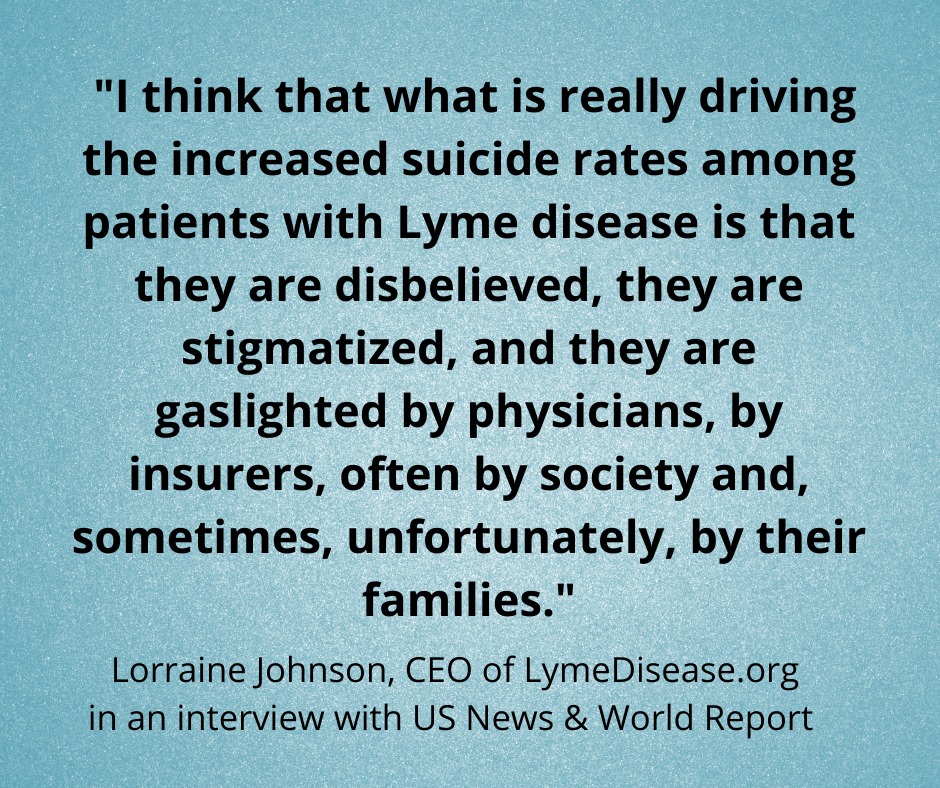
US News & World Report: Lyme Disease Can Wreak Havoc On Mental Health

https://www.lymedisease.org/us-news-world-report-lyme-disease-can-wreak-havoc-on-mental-health/

US News & World Report: Lyme disease can wreak havoc on mental health

US News and World Report, August 17, 2021

by Steven Reinberg

Lyme disease can exact a significant mental toll as well as a physical one on its sufferers, a new study confirms.

Patients hospitalized for Lyme disease had a 28% higher incidence of mental disorders and were twice as likely to attempt suicide than people without Lyme, researchers report.

“These findings highlight the need for greater awareness in the medical community that patients after a serious case of Lyme disease are at increased risk of mental disorders and suicidal behaviors, particularly during the first year after diagnosis,” said study author Dr. Brian Fallon….

“While most people with Lyme disease do not develop subsequent psychiatric problems, some do. Clinicians need to ask about suicidal thoughts and depression in particular, if symptoms persist,” Fallon said. READ MORE

Learning to Be Supportive When Your Partner Has Lyme Disease

https://www.lymedisease.org/challenges-partner-lyme-disease/

Learning to be supportive when your partner has Lyme disease

By Fred Diamond

The woman I love has been coping with chronic Lyme for many years. For most of the 11 years we’ve been together, I thought I was doing my best to support her.

However, I came to realize recently that her challenges went further than I had imagined.

My mantra was “pay attention and keep her stress-free.” Shortly after I met her, she told me she had Lyme disease. I knew that meant she was easily fatigued, often in pain, and sometimes anxious. But she also had good energy, was very funny and beautiful.

I also knew that she had dietary restrictions, which meant we had to find the best gluten-free pizza in town. I knew she was concerned about heavy metals which meant she did not eat fish which might have mercury. It meant she had beef and rice when I had sushi.

I knew she was concerned about going into the basement when we realized there was mold there.

But I had no idea about the challenges she faced with Lyme and the stress she was under until I decided to really understand what her life was like battling this insidious disease.

You see, I pictured her as beautiful, funny, warm, and kind. My family loved her. My friends were happy for me knowing that I had such an amazing, loving, and supportive partner.

But I would always wonder why she seemed guilty whenever I did something for her and why she would often say I was working too hard for her when I had so many other things to worry about.

So, recently I decided to go deep into her world to understand the Lyme life she was living.

And I recommend that all partners of people with Lyme do the same. It changed my life in ways I never could have imagined.

Seeking to understand her illness

First off, I went online and purchased a few dozen books on Lyme, chronic illness, and anxiety. It was eye-opening! I joined a half-dozen Facebook groups and signed up for mailing lists at LymeDisease.org and other care organizations. I also called everyone I knew who ever uttered the word “Lyme.”

And I was shocked at what I discovered.

I thought I knew everything she dealt with, but I learned it was a constant battle for her to stay on top of treatments, supplements, and relief tools. Many days, all she could do was try to eliminate the pain, remove the anxiety, and find relief.

Even though I thought I was on top of things, I did not have a clue why certain things were so important.

Here are some things I discovered.

She felt a lot worse than I ever imagined

In a loving relationship, the balance of care shifts. When one partner is struggling at work, the other steps in and maybe takes a second job. When one partner is fatigued, the other does the housework and cooks the meals. I came to learn that she often felt the balance was uneven. Since she was sometimes unable to do some of the chores, she felt that since I was devoting more time and energy to her it was not fair. It never once occurred to me that this was an issue.

I had never thought of her as a Lyme sufferer.  I knew she had Lyme, but I never thought that was her identity. I always saw her as beautiful, caring, and funny, while she often saw herself as sick and was often in more pain than I ever knew.

I saw the anxiety and depression but never appreciated it. I always thought some rest and time would help. The supplements and herbals? I always saw them as merely vitamins, not part of a protocol. I had no idea that it took everything she had just to make it through the day, plagued by pain in her legs, or her neck, or her head.

Mold

We had mold in the basement after a leak. I didn’t realize how devastating mold can be for someone with Lyme. There are hundreds of thousands of people suffering from mold allergies. I now understand what mold can do and how someone who is susceptible can suffer from even a brief exposure.

Genes and heavy metals

We liked watching the “Finding Your Roots” show together but I was always watching for the aha moment or when they disclose the family member who was a slave owner. She was watching to see how the genetic matching might have affected the guest.

I would hear her talk about how genetic makeup may impact your body’s ability to detoxify. Who must spend a second of their life knowing about these enzymes and how they may or may not impair the detox? And that’s why she was always so concerned about copper, iron, zinc and the other heavy metals and how they can get in the way of your healing.

Letting healing take its course

I’ve come to realize that healing from Lyme is a personal, private, and sensitive process that only the person going through it can figure out. Hopefully there’s a good Lyme literate doctor who can help. For many, there are not. I’m amazed at how many doctors still do not understand Lyme.

I had often said that her health was one of my two top priorities, since I know it was her main priority. With my business background, I might have treated it like a business process. What are all the steps we need to do to get to healing? But it does not work that way.

As you let the healing take its course, you need to let the person going through it lead the way. They know their body; you do not.

No one has ever said they wanted to get Lyme. No one in their right mind would be thankful they have it. No one really wants to be a “Lyme Warrior,” But until acceptance comes in, healing is near impossible. I have come to realize that her recovery must be on her own terms and all I can do is educate myself and be as sensitive and available as needed.

Recovering from Lyme is a very personal process. It’s different for everyone.

How to be a better source of support

I didn’t know what healing meant until recently. As a spouse, all you can do is get educated, be considerate, and supportive where needed.

You can’t do it alone. It’s too overwhelming. Life’s overwhelming. Getting through the day even when everything is going your way is hard enough.

As a partner, you need to make the extra effort to understand your partner’s world and what they must do to make it through the day with chronic Lyme.

When I realized this, our lives changed for the better.

Fred Diamond lives in Fairfax, Virginia.

PTSD, COVID-19 & Lyme Disease: A Perspective

https://danielcameronmd.com/ptsd-covid-19-and-lyme-disease-a-perspective/

PTSD, COVID-19 AND LYME DISEASE: A PERSPECTIVE

man with PTSD and COVID-19 getting console in therapy

“Post-traumatic stress disorder (PTSD) is a severe mental health condition caused by a terrifying event outside the normal range of usual human experience.”[1] While it is often associated with events such as an assault or disaster, post-traumatic stress disorder can occur in people with severe health problems.

Patients with chronic Lyme disease have reported symptoms of PTSD. Now, an article entitled “PTSD as the second tsunami of the SARS-Cov-2 pandemic,” by Dutheil et al. indicates that some COVID-19 patients are experiencing post-traumatic stress disorder, as well.¹

The authors highlight several observations on the SARS-Cov-2 pandemic and PTSD that would also apply to Lyme disease patients that I have seen in my practice.

PTSD in COVID-19 pandemic

  • “With a poor understanding of viruses and spreading mechanisms, the evocation of SARS is generating a great anxiety contributing to promote PTSD.”
  • “In the families of cases, the brutal death of family members involved a spread of fear and a loss of certainty, promoting PTSD.”
  • “PTSD symptoms involve chronic severe anxiety with re-experiencing the traumatic event, flashbacks, nightmares, increased arousal, and reduced social life.”
  • “People suffering from PTSD are prone to not seek care, because of barriers such as lack of information and cost of mental health care, being afraid of stigmatization, or beliefs that symptoms may increase with time.”
  • “PTSD individuals are more at-risk of suicidal ideation, suicide attempt, and deaths by suicide, in huge proportions.”

PTSD in chronic Lyme disease

  • The poor understanding of Lyme disease and associated tick-borne illnesses has generated a great deal of anxiety.
  • The severity of chronic illness following Lyme disease involves a spread of fear and a loss of certainty.
“People suffering from PTSD are prone to not seek care, because of barriers such as lack of information and cost of mental health care, being afraid of stigmatization, or beliefs that symptoms may increase with time.”
  • I have Lyme disease patients who re-experience the traumatic event, flashbacks, nightmares, increased arousal, and reduced social life, as described by the authors.
  • I have seen Lyme disease patients who “are prone to not seek care, because of barriers such as lack of information and cost of mental health care, being afraid of stigmatization, or beliefs that symptoms may increase with time.”
  • I have seen suicidal ideation in patients I have treated. Dr. Robert Bransfield, a psychiatrist specializing in tick-borne illnesses, has described suicidal ideation, suicide attempt, and deaths by suicide in patients in his practice.²

Author’s perspective: I hope that a better understanding of post-traumatic stress disorder in COVID-19 patients will lead to a better understanding of PTSD in Lyme disease.

References:
  1. Dutheil F, Mondillon L, Navel V. PTSD as the second tsunami of the SARS-Cov-2 pandemic. Psychol Med. Apr 24 2020:1-2. doi:10.1017/S0033291720001336
  2. Bransfield RC. Aggressiveness, violence, homicidality, homicide, and Lyme disease. Neuropsychiatr Dis Treat. 2018;14:693-713. doi:10.2147/NDT.S155143

______________________

**Comment**

PTSD is very, very real.  I’ve had it myself.  My husband had it. People don’t typically understand that Lyme/MSIDS IS a brain disease and can affect you psychologically in many ways.  You can hear voices, hallucinate, have PTSD or OCD, depression, de-personalization, and so many other mental issues.

It’s important to get to the root of the issue – and that’s treating the infections; however, you may also need to address the mental health aspects as well with a trained professional.  A word of warning; however, I would highly recommend a Lyme literate professional as many patients have been abused at the hands of uneducated professionals who blindly follow the CDC/IDSA ideology.  These people can cause more harm than good.  I would also seek to get a referral from either a knowledgable patient or health professional you know and trust.

For more:

Combating Isolation By Creating Online Space For Teens With Lyme & Coinfections

https://www.lymedisease.org/online-space-teens-lyme-disease/

Combating isolation by creating online space for teens with Lyme disease

By Camille Deschapelles 

Many of you reading this don’t need me to explain what often happens when you bring up chronic Lyme disease to others. You’ve probably dealt with it plenty of times.

When you talk about your chronic illness that affects you every day, people assume it’s like a two-week cold. In places outside of the Northeastern US, Lyme is often assumed to be rare. This makes it even less likely that people will believe your diagnosis.

Some illnesses automatically bring out sympathy and consolation from others. But Lyme generally brings about confusion, even after an awkward and often long-winded explanation.

Here’s a bit little about me. I’m 17 years old and was diagnosed with juvenile rheumatoid arthritis at 14, and later chronic Lyme and Bartonella at 16. My arthritic symptoms greatly limit what I can do most days.

This was especially true at the start of my treatment. If I mustered up the strength to hang out with my friends, I would limp behind them or struggle to keep up as they rushed through shopping malls or parks.

Although they would always ask what was wrong, I never wanted to get into the nitty gritty of my complicated diagnosis and treatment. So, I’d brush it off, telling them it was just a small injury. When I pulled out my pills after meals, I’d swallow them off to the side so my friends couldn’t see.

When school started in person, I tried to avoid limping and used the stairs instead of the elevator. I didn’t want anyone to know, because I knew that none of them would understand even if I explained it to them. Thus, I absolutely refused to talk about my illness with others.

A breakthrough

But this denial kept everything bottled up inside. Then, I came across an article by a 17-year-old girl who dealt with Lyme disease throughout high school. She wrote about feeling robbed of teenage experiences that she should have enjoyed, because of a disease that went undiagnosed for too long.

Those were my exact thoughts and feelings! That article has stuck with me, as I realized that, of course, there are other people like me. Other teenagers with Lyme who feel just as lonely and isolated as me and would give anything for people to understand them.

I searched for support groups for those with Lyme disease. But most groups I found were made up of adults who didn’t have the same experiences as me – going to school while sick, missing out on social events like prom, or the combined weight of being a teenager and a Lyme disease patient. My parents put me in touch with some adults they knew with Lyme, but talking to them, while helpful, was sometimes awkward.

On-Lyme

I decided to make my own support network. Called On-Lyme, it’s an online community of adolescents with Lyme and co-infections. I chose a Discord server to be the core of it because it’s essentially a large group platform that makes it easy to chat with others casually.

[Editor’s note: Discord is an online platform that allows users to communicate with voice, video, text messaging, media and files.]

Through this, I’ve made meaningful connections with people in different states, countries and even continents. Other teens have shared their stories with people who won’t judge but sympathize. We complain about painful symptoms, the messed up medical system, or laugh about Shrek. We share advice and comfort each other when times are tough.

My closest online friends are fellow Lyme patients. One lives in Massachusetts, and we Zoom call weekly, talking about whatever is on our minds. Lyme does come up often. It’s easy with her. I know that she understands my frustrations with friends or experimenting with a new round of antibiotics.

My other friend lives in Scandinavia. We talk almost every day, regardless of the distance or time difference. Our shared experiences connect us in a way that I don’t feel with even my closest in-person friends.

The importance of community

With a disease as stigmatizing as Lyme or Bartonella, it’s important to have a supportive community behind you. A community that understands and sympathizes with you. And while teenagers and young people with Lyme aren’t the most common types of Lyme patients, we still exist.

So, to the teen out there who is desperately searching for others who understand, I hope this article impacts you like the one that I read impacted me.

Find comfort in knowing that you aren’t alone, and that there are better days ahead, even if today sucks.

That’s something I’d wish someone who understood how bad it was in the moment could have told me months ago.

For those rough days, for those good days, and the ones in between, On-Lyme or whatever support community you end up falling into is there for you. You are stronger than you know and will get through this. But it doesn’t hurt to have some people backing you up as well.

Camille Deschapelles lives in FloridaClick here to reach the On-Lyme website.