Archive for the ‘Pain Management’ Category

PEMF (Pulsed Electro-Magnetic Field) Therapy: Benefits & How It Works

https://holtorfmed.com/articles/mens-health/pemf-pulsed-electro-magnetic-field-therapy-benefits-and-how-it-works

Pulsed Electro-Magnetic Field therapy sends magnetic energy (via waves) into the body that works with your natural magnetic field in order to improve repair and recovery processes.

Understanding the Body’s Electromagnetic Field

The body’s magnetic field is generated by all of its internal electrical activity. In fact, the body naturally conducts electricity as every organ and cell has its own field. These fields are present because the body produces electrical activity via several different types of cells including neurons, endocrine cells, and muscle cells (all of which are called “excitable cells”). As with all electricity, this activity creates a magnetic field.

It is important to note that the body’s electrical activity primarily occurs in the cell membrane. A typical healthy cell has a “transmembrane” potential of 80-100 millivolts. In comparison, a sick cell or a cancer cell has a transmembrane potential as low as 20 or 25 millivolts. When a cell becomes damaged, the voltage drops, and when the membrane voltage is low, the membrane channels do not function properly. This leads to poor cell communication and quickly cascades into potential health problems and illnesses.

This is what PEMF therapy addresses.

How Does PEMF Therapy Work?

PEMF therapy sends magnetic energy into the body that helps increase the body’s electrolytes and ions. In turn, this leads to electrical changes in the body that help improve cellular functions and activity. Because any disruption in electrical currents can lead to dysfunction and/or illness, PEMF therapy helps restore this disruption.

In other words, PEMF therapy works with the body’s natural recovery processes in order to help improve cellular repair and even alleviate chronic pain.

Benefits of PEMF Therapy

According to over 2,000 studies, because PEMF therapy provides restoration and healing on a cellular level, there is a multitude of benefits including:

  • Reduced (chronic) inflammation
  • Improved injury recovery time
  • Better circulation
  • Alleviated (chronic) pain
  • Improved oxygenation in tissue
  • Enhanced cellular repair and recovery
  • Improved immune system
  • Better quality of sleep
  • Improved muscle relaxation and performance

Who Can Benefit from PEMF Therapy?

Anyone can benefit from PEMF therapy as it can help restore your overall feeling of wellness but it may be of particular interest to those who suffer from:

  • Pain or dysfunction in their ankles, back, elbows, hips, knees, or shoulders
  • Chronic inflammation in joints or the soft tissues
  • Chronic fatigue syndrome or Fibromyalgia
  • Peripheral neuropathy
  • Osteopenia or osteoporosis
  • Poor wound healing
  • Chronic pain

Interested in PEMF Therapy?

Holtorf Medical Group now offers PEMF therapy. Contact us today to find out if it is right for you.

_______________

For more:
Alternative Treatments for Lyme Disease Symptoms Brings New Hope

http://  Approx. 3 Min

Alternative Treatments for Lyme Disease Symptoms Brings New Hope

Sept. 21, 2021

News Center Maine

The multi-step, laser therapy treatment targets the biofilm that surrounds the bacteria that causes Lyme disease.

Correction: 

The news segment falsely states that only 25% go on to suffer from lingering symptoms.  This article, reveals that they achieve that low number by only counting patients who are diagnosed and treated early.  There is a much larger patient group (30-40%) that due to being undiagnosed or misdiagnosed, that is diagnosed and treated much later (months to years).  When you simply add the two groups you discover that 60% of patients go on to suffer sometimes life-long symptoms. This is a big deal and needs to be corrected, but the CDC is constantly manipulating criteria and numbers for a pre-determined outcome that fits their accepted narrative.  And the accepted narrative for Lyme/MSIDS has always been and continues to be that it is hard to catch and easy to treat.

Some reasons these numbers matter:

  • using the faulty 25% downplays a real problem that is much larger in scope
  • research projects are typically done on issues involving the most people, so those suffering from persistent symptoms continue to be ignored in research
  • in order to qualify for entrance into research studies:
    • patients must test positive on the abysmally inaccurate 2-tiered CDC serology test that misses more than 70% of all cases and here 86%
    • patients must have the EM rash which is often missed or mischaracterized by physicians, can look different on patients, and which is often missing altogether in many
    • have a positive diagnosis which in a maddening never-ending loop is based on faulty testing 
Chronic Lyme patients are continually kicked to the curb due to faulty parameters that are regurgitated like a 3 year old reciting the alphabet with no understanding of it. 

I’ve posted on lasers before and we had a practitioner speak about them at support group. 

Please see:

Of course there are numerous types of lasers and the one presented in the news story is different then the class IV laser which I have had treatments with. Unlike the one presented in the news story, the class IV laser is very hot and must be moved continually or it would burn you.  The best way to describe the feeling is that it feels like your muscles have turned to butter.  I would compare it to a massage without the pain. It’s relaxing and quite effective against pain.  It does come with a price – when I had it done it was about $100 for about a 40 min. treatment.  I do highly recommend Raymond as he is not only trained with the laser but is a naturopath with great ideas. 

Until testing can distinguish between whether we are in active infectious state or just suffering from lingering symptoms that antimicrobials will not solve we are Guinea Pigs trying this and that for relief.

I’ve found the following things all help with pain:

Lastly, for me I had chronic headaches that felt like a horse kicked me in the head.  Seriously, I never knew that people could survive such unbelievable pain. Mostly at the brain stem (occipital area), the inflammation was so severe I eventually had a MRI to rule out Chiari.  I found that daily minocycline (a drug known to cross the blood/brain barrier) truly was one of the most effective things I used (I would put tinidazole in this category as well).  I do feel it’s important to layer treatment to mitigate any antibiotic resistance, so we always took 2-3 other antimicrobials simultaneously as well as pulsed diflucan to mitigate any yeast issues.


Small Fiber Neuropathy in Lyme Disease & COVID

https://danielcameronmd.com/neuropathy-in-lyme-disease-covid-19/

Small fiber neuropathy in Lyme disease and COVID-19

person with neuropathy due to lyme disease rubbing their foot

Small fiber neuropathy (SFN) is a disorder that affects the small sensory cutaneous nerves, resulting in unusual sensations such as tingling, pins-and-needles and numbness. Some patients may experience burning pain or coldness and electric shock-like brief painful sensations. In most patients, these symptoms start in the feet and progress upwards.¹

Small fiber neuropathy with autonomic and sensory dysfunction has been described in Lyme disease patients. In fact, a small study suggests that SFN may be a viable biomarker of post-treatment Lyme disease syndrome, particularly for patients whose main symptoms involve sensory issues.²

In their article, “Resolution of Pain in the Absence of Nerve Regeneration in Small Fiber Neuropathy Following Treatment of Lyme Disease,” the authors describe the case of an 83-year-old woman with a 4-year history of diffuse burning pain in her face, arms, and legs, and muscle spasms in the legs.³

Lyme disease causes small fiber neuropathy in an elderly woman. Complete resolution of symptoms after antibiotic treatment.

Lyme disease testing was positive. “She was then treated with a 40-day course of oral antibiotics for Lyme disease with complete resolution of her neuropathic symptoms.”

“Painful small fiber neuropathy may be a manifestation of Lyme disease,” the authors suggest. “Antibiotic treatment of Lyme disease can result in resolution of the neuropathic pain symptoms.”

Small fiber neuropathy and COVID-19

Now, small fiber neuropathy is being recognized in patients with COVID-19.

Investigators describe the clinical presentation of SFN associated with COVID-19 in two patients.4

Patient 1

A 52-year-old man, who contracted SARS-CoV-2, developed moderate respiratory problems (shortness of breath and productive cough).

“About 3 weeks later, he began to experience burning pain in the feet that spread up to the knees that was associated with imbalance and falls,” the authors explain.

“The pain would wake him at night, impacted his functional capacity, and was associated with allodynia.” (Note: Allodynia is the experience of pain from stimuli that typically is not painful, for example, light touch.)

He was diagnosed with small fiber neuropathy based on symptoms and test results.

The patient’s symptoms were “most compatible with a small fiber-predominant sensory neuropathy unmasked by COVID-19 infection.”

His neuropathic symptoms improved with gabapentin, and a topical lidocaine cream improved his neuropathic symptoms.

Patient 2

A 67-year-old woman with a 10-year history of mild acral tingling and burning pain had been diagnosed with small fiber neuropathy associated with psoriatic arthritis, based upon biopsy results.

Her symptoms had been stable for 10 years until she contracted SARS-CoV-2 and developed severe burning pain in her hands and feet.

“She presented 6 months later with persistent symptoms and occasional orthostasis.”

Her examination and test results supported a diagnosis of small fiber neuropathy.

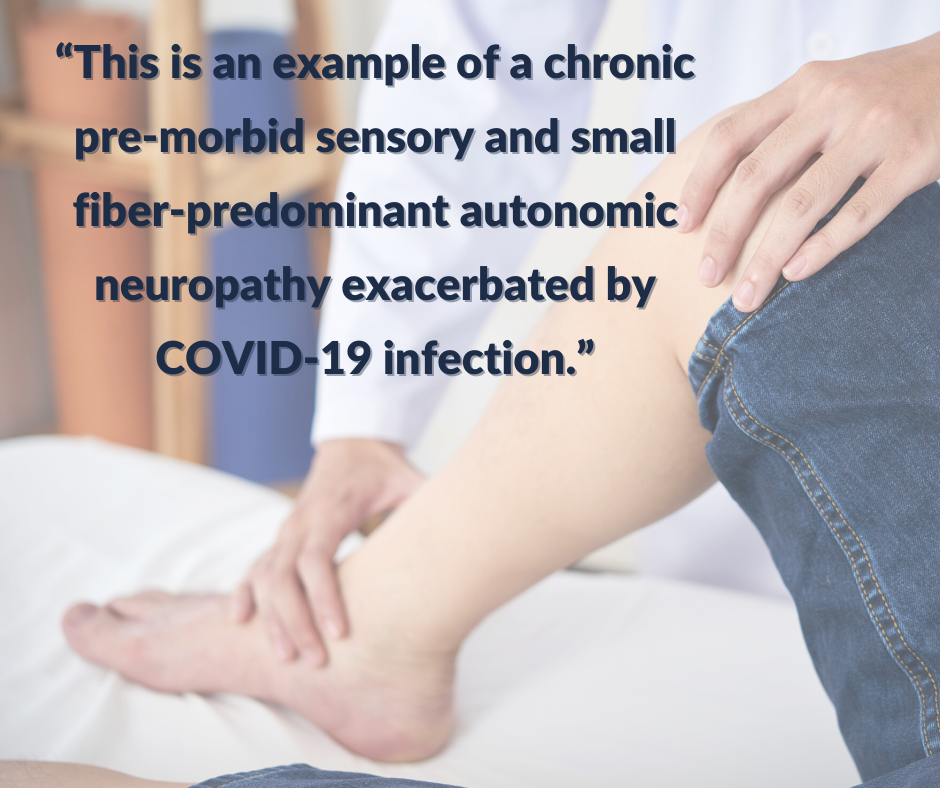
“This is an example of a chronic pre-morbid sensory and small fiber-predominant autonomic neuropathy exacerbated by COVID-19 infection,” the authors write.

This study was observational and “cannot draw reliable conclusions regarding causative relationships or underlying mechanisms.”

References:
  1. Johns Hopkins Medicine. Neurology and Neurosurgery. https://www.hopkinsmedicine.org/neurology_neurosurgery/
  2. Novak P, Felsenstein D, Mao C, Octavien NR, Zubcevik N. Association of small fiber neuropathy and post treatment Lyme disease syndrome. PLoS One. 2019;14(2):e0212222. doi:10.1371/journal.pone.0212222
  3. Resolution of Pain in the Absence of Nerve Regeneration in Small Fiber Neuropathy Following Treatment of Lyme Disease (P06.228) Naomi Feuer, Armin Alaedini Neurology Feb 2013, 80 (7 Supplement) P06.228;
  4. Shouman K, Vanichkachorn G, Cheshire WP, et al. Autonomic dysfunction following COVID-19 infection: an early experience. Clin Auton Res. Apr 16 2021;doi:10.1007/s10286-021-00803-8

_________________

**Comment**

For pain we have also found gabapentin to be extremely helpful as well as LDN, CBD, and MSM.  I’ve also used lidocaine patches with good success as well as a pain cream you can make yourself either with or without DMSO, which is a very powerful pain killer but please read and learn about it before using. You can also purchase ready-made DMSO creams but realize they are often stored in plastic and have other ingredients that are potentially harmful. The plastic issue is important because DMSO is a carrier/penetrating agent which will absorb/penetrate anything in or around it.

For more on small fiber neuropathy and Lyme/MSIDS:

Stomach Pain Can Be a Symptom of Lyme Disease

https://danielcameronmd.com/neurologic-lyme-disease-presenting-as-abdominal-pain-in-71-year-old-patient/

STOMACH PAIN CAN BE A SYMPTOM OF LYME DISEASE

woman with stomach pain from lyme disease

“Although abdominal pain is generally not considered a sign of LD [Lyme disease], in this case report we describe a patient with unexplained severe abdominal pain that eventually turned out to be LD due to radiculopathy,” explains Stolk from the Haga Teaching Hospital in the Netherlands. [1]

The 71-year-old woman underwent an exhaustive evaluation to determine the cause of her abdominal pain. Tests included: CT scan of the chest and abdomen; whole body emission tomography-CT scan (PET-CT); colonoscopy; gastroscopy, and an MRI of the small intestines. Initially, doctors did not consider testing for Lyme disease as a cause of the patient’s stomach pain.

The woman was admitted to the hospital for pain management and other diagnostic workups.

READ MORE: Lyme disease manifests as abdominal pain in a young child

Approximately 8 weeks prior to her hospitalization, she experienced temporary lower back pain, myalgia, fever, burning sensations and tenderness on her head and upper legs and moderate stomach pain. Several weeks later, her abdominal pain worsened.

“Going over the history again, she emphasized that she had stayed in a high endemic area for ticks and had suffered a possible tick bite without any sign of erythema migrans,” writes Stolk and colleagues.

Lyme disease associated with stomach pain

Serologic testing and a spinal tap were consistent with Neurologic Lyme disease. The spinal tap revealed an elevated IgM antibody to Borrelia burgdorferi (Bb), a lymphocytic pleocytosis, markedly elevated IgM antibody index to Bb, and markedly elevated IgG antibody to Bb.

The authors point out that “Since the incidence of LD is rising it is important to realize that severe abdominal pain could be the first clinical manifestation of early neuroborreliosis.”

After a 2-week course of intravenous ceftriaxone to treat Lyme disease, the woman’s symptoms, including stomach pain, resolved completely.

This case demonstrates the importance of re-examining a patient’s history when symptoms cannot be explained, the authors point out.

“Instead of doing extensive diagnostic tests, it is important to scrutinize the patient’s medical history in the presence of unexplained clinical signs.”

The authors note: Abdominal pain in the presence of facial paralysis has been described in Europe as Bannwarth Syndrome.

Editor’s note: I often see Lyme disease patients in my practice who present with stomach pain severe enough to warrant extensive diagnostic testing before Lyme disease is suspected.

UPDATED: May 28, 2021

Severe Neuropathic Pain Due to Lyme Podcast

https://danielcameronmd.com/pain-due-to-lyme-disease/

PODCAST: SEVERE NEUROPATHIC PAIN DUE TO LYME DISEASE

man with foot pain due to lyme disease

Hello, and welcome to another Inside Lyme Podcast. I am your host Dr. Daniel Cameron. In this episode, I will be discussing the case of a 36-year-old man with severe neuropathic pain due to Lyme disease.

(Listen here or go to top link)

I first read about this case in the journal Neuromodulation by Karri and colleagues.

A 36-year-old man suffered with a chronic pain syndrome associated with post-treatment Lyme disease syndrome (PTLDS). [1] PTLDS is a complication of Lyme disease. Individuals with PTLDS remain ill with pain, cognitive impairment, and fatigue and find it difficult to function.

The patient described severe neuropathic pain in both feet and categorized the pain at a level 10 out of 10 despite treatment with methadone 5 mg every 4 hours as needed. The doctors assumed that the tick-borne infection had resolved and elected not to treat with antibiotics.

Instead, they treated the patient’s symptoms. The pain remained severe despite trials of gabapentin, duloxetine, bupropion and narcotics. “The patient was unhappy with associated adverse effects, especially drowsiness and recurrent constipation,” the authors wrote. [1]

Surgical treatments for pain due to Lyme disease

Two surgical procedures were performed, which improved the patient’s pain. First, the man had a spinal cord stimulator surgically placed in the Dorsal Root Ganglion to mask the pain signals before they reach the brain. The pain dropped to a level 3 out of 10.

A spinal cord stimulator alone does not come cheap. “The Journal of Neurosurgery: Spine published an article estimating the cost per patient of spinal cord stimulator implantation at $32,882 for Medicare patients and $57,896 for Blue Cross Blue Shield, with annual maintenance reaching $5,071 to $21,390,” wrote Laura Dyrda in Becker’s spine review. [2]

The doctors then surgically placed a pulse generator in the right paraspinal-flank area. The patient reported the pain dropping to level 0-2. Narcotics were rarely needed and the man was able to return to work as a health-care provider.

The authors stressed the need for novel approaches to pain management for patients with pain associated with post-treatment Lyme disease syndrome.

Some of the following questions are addressed in the podcast:

  1. Have you seen severe pain in Lyme disease?
  2. What types of pain have you seen in Lyme disease?
  3. What is the treatment for Lyme disease pain?
  4. What is Post Treatment Lyme disease Syndrome (PTLDS)?
  5. What are the symptoms of PTLDS?
  6. What is controversial about PTLDS?
  7. What are your concerns with a surgical approach to Lyme disease pain?
  8. Would additional antibiotics have helped resolve the Lyme disease pain?

Thanks for listening to another Inside Lyme Podcast. You can read more about these cases in my show notes and on my website @DanielCameronMD.com. As always, it is your likes, comments, reviews, and shares that help spread the word about Lyme disease. Until next time on Inside Lyme.

Please remember that the advice given is general and not intended as specific advice as to any particular patient. If you require specific advice, then please seek that advice from an experienced professional.

Inside Lyme Podcast Series

This Inside Lyme case series will be discussed on my Facebook and made available on podcast and YouTube.  As always, it is your likes, comments, and shares that help spread the word about this series and our work. If you can, please leave a review on iTunes or wherever else you get your podcasts.

References:
  1. Karri J, Bruel B. Dorsal Root Ganglion Stimulation for Post-Lyme Disease Chronic Peripheral Neuropathic Pain. Neuromodulation. 2020.
  2. 5 Findings on Spinal Cord Stimulator Effectiveness for Failed Back Surgery Syndrome in Becker’s Spine,. Written by Laura Dyrda May 29, 2014. Last accesed April 22, 2020.

_____________________

**Comment**

I am happy to report that after dealing with pain of a magnitude I never knew existed before, I am PAIN FREE.  What got me here?  Antibiotics, herbs, blood ozone, and YEARS of treating this monster.  I want to offer hope that treatment can rid of you all pain or at least get you to a place you can manage it.

It’s truly unfortunate the ‘authorities’ made the decision that this man’s pain had nothing to do with a persistent infection.  The CDC/IDSA is directly behind this bad decision.  Antibiotics and other antimicrobials will not cost near as much as this surgical device, which comes with plenty of its own risks, BTW.

I had one experience where the pharmacist did not notify me they gave me 250mg tablets instead of 500mg so I was inadvertently taking half the dosage.  My pain shot through the roof.  When I finally read the bottle myself and realized the error, within ONE dose, PAIN GONE.  This little exercise taught me the importance of the right dosage.  Dr. Burrascano discusses this along with other treatment nuances: https://madisonarealymesupportgroup.com/2018/12/28/the-history-of-lyme-disease-dr-burrascano/

I highlight the video here:  https://madisonarealymesupportgroup.com/2019/02/22/why-mainstream-lyme-msids-research-remains-in-the-dark-ages/

Treatment for this takes finesse, savvy and experience.  Do not trust mainstream medicine with this or you may find yourself getting needless surgeries to mask something that appropriate treatment could resolve.  

Get to a LLMD asap:  https://madisonarealymesupportgroup.com/2020/11/25/what-makes-a-doctor-lyme-literate/