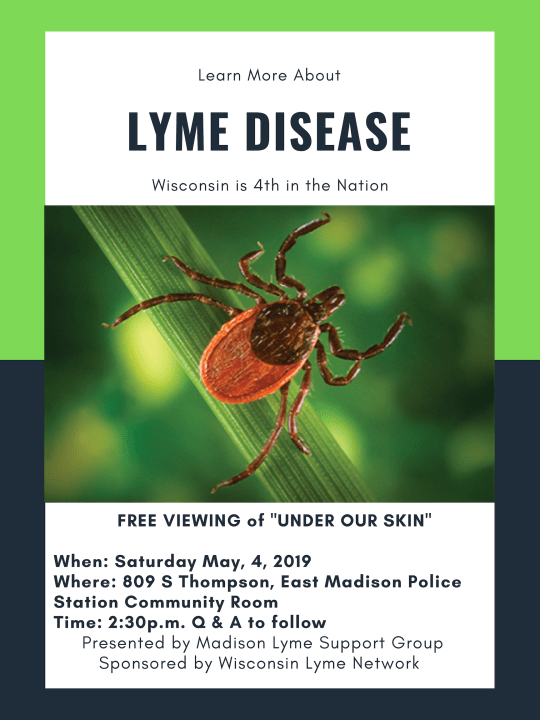
I will be bringing posters for you to take & distribute at the next Lyme support meeting on Saturday April 13. Details on the meeting here: https://madisonarealymesupportgroup.com/2019/03/11/april-2019-lyme-support-meeting/. A person from group has agreed to share practical tips on diet/nutrition. Bring a notebook and pen to take notes and ask questions.
Our last meeting until fall will be the May 4 viewing of “Under Our Skin” with a Q & A following. Please bring family, friends, co-workers, anyone who needs to learn about this 21st century plague that is a pandemic.
Presence of Babesia odocoilei and Borrelia burgdorferi Sensu Stricto in a Tick and Dual Parasitism of Amblyomma inornatum and Ixodes scapularis on a Bird in Canada
John D. Scott 1,*, Kerry L. Clark 2 and Lance A. Durden 3
Wild birds transport ticks into Canada that harbor a diversity of zoonotic pathogens. However, medical practitioners often question how these zoonotic pathogens are present in their locality. In this study, we provide the first report of an Amblyomma inornatum tick cofeeding with a blacklegged tick, Ixodes scapularis, which parasitized a Veery, Catharus fuscescens—a neotropical songbird. Using the flagellin (flaB) gene of the Lyme disease bacterium, Borrelia burgdorferi sensu lato, and the 18S rRNA gene of the Babesia piroplasm, a malaria-like microorganism, we detected Borrelia burgdorferi sensu stricto and Babesia odocoilei, respectively, in an I. scapularis nymph.After the molt, these ticks can bite humans. Furthermore, this is the first documentation of B. odocoilei in a tick parasitizing a bird.
Our findings substantiate the fact that migratory songbirds transport neotropical ticks long distances, and import them into Canada during northward spring migration. Health care practitioners need to be aware that migratory songbirds transport pathogen-laden ticks into Canada annually, and pose an unforeseen health risk to Canadians.
____________________
**Comment**
This study is important because it demonstrates a number of things:
There are many strains of these pathogens that aren’t being considered and tested for. Babesia odocoilei is a prime example but this is happening with each and every pathogen. This demonstrates another reason why patients are ill but test negative. Normally we think of B. microti, B. divergans, and B. duncani infecting humans http://www.ncagr.gov/oep/oneMedicine/noms/2010/Moncayo_Abelardo_Human_Babesiosis.pdf but there are others: https://www.ncbi.nlm.nih.gov/pmc/articles/PMC3998201/InAustria and Italy patients experienced a severe illness caused by EU1, a species closely related to B. odocoilei. InTaiwan it was (TW1) and in Korea (KO1). Human babesiosis is now reported from around the world. The study in this link states that reported human cases of babesiosis have been attributed, without strong molecular evidence to B. divergans: https://www.ncbi.nlm.nih.gov/pmc/articles/PMC3020600/
THE NUMBER OF SYMPTOMS AND DURATION OF ILLNESS IN PATIENTS WITH CONCURRENT LYME DISEASE AND BABESIOSIS ARE GREATER THAN IN PATIENTS WITH EITHER INFECTION ALONE
Outer surface protein C (OspC) is one of the most abundant surface lipoproteins produced during early infection by the Borrelia spirochete, the causative agent of Lyme disease. The high sequence variability of the ospC gene results in the production of several and strongly divergent OspC types. One of the known roles of OspC is the recruitment of blood components, including complement regulators, to facilitate the bloodstream survival of Borrelia at an essential stage of host infection. Here, we identify and describe a new interaction between OspC and human fibrinogen. To test the ability of OspC to bind fibrinogen, we developed a microscale thermophoresis assay using four fluorescently labeled types of OspC. We show that OspC binds fibrinogen tightly, with nanomolar Kd, and that the binding depends on the OspC type. The binding assays combined with SAXS studies allowed us to map the OspC-binding site on the fibrinogen molecule. Spectrometric measurements of fibrinogen clotting in the presence of OspC indicate that OspC negatively influences the clot formation process. Taken together, our findings are consistent with the hypothesis that OspC interacts with blood protein partners to facilitate Borrelia spreading by the hematogenous route.
Great article on homocysteine and fibrinogen, two biomarkers of inflammation: http://blog.wellnessfx.com/2013/09/16/take-deeper-look-two-biomarkers-inflammation/ There’s even a link between the two biomarkers. High homocysteine levels block the natural breakdown of fibrinogen, leading to a buildup of fibrinogen in the blood which can cause hyper coagulation.
If you struggle with hyper coagulation(thick blood) work with your practitioner as this can hamper the effectiveness of treatment as well as compromise nutrient and oxygen delivery to the body. Also, thicker blood requires the heart to work harder to circulate blood. Some also feel it can deprive the gut of nourishment and may be a factor in IBS. If the bowel is deprived of blood, cells will die too rapidly. https://www.diagnose-me.com/symptoms-of/hypercoagulation-thickened-blood.php. This link also explains testing as well as potential treatments to discuss with your doctor.
Many Lyme/MSIDS struggle with hyper coagulation. My husband does and took heparin for years during treatment. He felt better immediately. He has since weaned from that onto increased fish oil, Berberine, and Systemic Enzymes. Nattokinase is also recommended.
The take home from this study is that Bb uses components of our blood to propagate itself.
HB 0889, a bill to cover insurance for antibiotics, doctor visits, & testing passed unanimously in the Illinois House. It now moves to the State Senate.
Pennsylvania Senator Mike Regan & Prepresenative Greg Rothman recently held a townhall meeting featuring experts in the field to educate the public on Lyme disease
House Bill 174, which seeks to ensure patients have access to available and emerging diagnostics and treatment options for Lyme disease and related tick-borne diseases. The bill passed the House with a vote of 188-6 and is currently in the Senate.
House Bill 2288, which would require school nurses to remove a tick when it is found on a child during the school day, notify the parent or guardian with medical information and resources, and store the tick for seven days.
House Bill 2301, which would require physicians to complete two hours of continuing medical education focused on Lyme disease and related tick-borne illnesses to help physicians receive the most up-to-date information on pathogens, testing parameters, patient symptom profiles and current treatment options.
House Resolution 761, which would urge the federal government to dedicate a large portion of the $22 million it provides to states for Lyme disease financing to Pennsylvania.
House Resolution 943, which urges the Food and Drug Administration (FDA) to promptly consider candidates for Lyme disease vaccinations currently seeking approval under the drug approval process.
Antibiotics are often the default treatment path for many doctors when it comes to Lyme disease. However, they are not always effective. Lyme disease is a complicated disorder that we don’t yet fully understand. Yes, antibiotics work to a certain degree, but in some cases they don’t fully eradicate the disease, leading to years of debilitating symptoms for patients. So when are antibiotics effective, which types are effective, and in cases where they fail to get rid of the Lyme bacteria, what happens? These aren’t easy questions to answer, as much Lyme disease knowledge is still murky at best. However, it’s important to try to understand exactly how antibiotics and Lyme disease work in tandem.
Firstly, let’s look at when they are effective. Lyme disease can be broadly split into two stages: acute and chronic. Acute Lyme lasts for a few weeks, and is easily identifiable by the presence of a bullseye rash. This distinctive Lyme symptom is present in the majority of cases in the initial stages of the disease, and is one of the best indicators available to doctors and patients alike. If the condition is presented to a medical professional in the acute stages, Lyme disease can almost always be eradicated by antibiotics. Successful treatment is usually achieved by a short course of oral antibiotics, namely doxycycline or amoxicillin. However, if this acute stage of the disease is missed and it progresses to the chronic stage, antibiotics alone will not be enough to fight off the disorder.
Many doctors prescribe antibiotics for patients who have a diagnosis of Lyme disease.
Chronic Lyme disease is a much more diverse and complicated condition than acute Lyme. This is because inflammation also plays a significant role in the symptoms. Many doctors follow the traditional line of thinking that Lyme, being caused by the presence of bacteria, can be treated successfully using synthetic microbes (i.e. antibiotics), like many other conditions and diseases. While this reasoning may be structurally sound, it doesn’t take into account the body’s own reaction to the bacteria, and how that can kickstart a whole set of new and debilitating symptoms. On top of that, individuals will have different reactions to the borrelia bacteria, depending on their constitution. Lyme disease is not a one-size-fits-all condition like the flu, which has very little variance in its symptoms on a person-to-person level.
The symptoms of chronic Lyme vary wildly, but usually include joint pain, muscle pain, aches, soreness and a chronic sense of fatigue. All these symptoms are a result of the immune system’s response to the bacteria. For some reason, the immune system goes into overdrive when faced with a long-term borrelia infection, resulting in severely debilitating symptoms, even when the actual presence of the bacteria may be minimal. Obviously, antibiotics administered at this point will have zero effect on inflammation symptoms, as they are the body’s own doing. Yet Lyme-illiterate doctors will often insist on antibiotics as the only treatment path for chronic Lyme disease, if they believe the diagnosis at all (chronic Lyme is still not officially recognised by the CDC).
Treating chronic Lyme requires a more nuanced touch. The medical staff at BCA-clinic in Augsburg, Germany, have been experts in Lyme disease for a long time. Their approach to treatment is designed to tackle both the inflammation and infection symptoms of the disease. The first thing to do is test the patient to see what the ratio of inflammation and infection actually is. Some people might have a lot of inflammation and only traces of a bacterial infection, while some others might have the complete opposite. Successful Lyme disease treatment constitutes knowing the difference between the two, and responding accordingly. Antibiotics are only half of the approach here, as they solely deal with infection. For the inflammatory symptoms, herbal supplements and diet adjustments are necessary.
Antibiotics can be helpful in fighting chronic Lyme, but they really only deal with the infection side of the disease, not the inflammation.
Borrelia bacteria have been proven to be surprisingly resistant to antibiotic treatment. If they are left in the system, they can adapt to survive the natural immune response, as well as tolerating various forms of common antibiotic.Borrelia exists in two separate forms: the spirochete and the ‘cell wall’ variant, sometimes known as the ‘cyst’ form. Under stress, the spirochete will adapt to the cyst form, making it much more resistant to antibiotics. It is likely that the majority of chronic Lyme sufferers have both borrelia forms present in their systems at any given time. Therefore, it is crucial to combine antibiotics in order to attack the bacteria from all angles. This requires an experienced medical professional who is well-versed in Lyme; unfortunately, many doctors are not.
It’s important to back up any heavy antibiotic use with a probiotic, in order to keep your gut healthy. Knowing how long to stay on a course of a particular antibiotic is also necessary. If you suspect you have chronic Lyme disease, getting help from an expert in the field should be paramount. The disease can affect people for many years, and is very hard to treat if you don’t know what you’re doing. While antibiotics are an important component, they are not totally reliable in every case. When it comes to chronic Lyme, they should be used as part of a broader treatment process.
_____________________
**Comment**
A few points:
There is legitimate science behind antibiotics killing pathogens which is why it is a “default.”
The jury’s really still out on whether or not acute cases are “cured” by short-term antibiotics. According to Microbiologist Tom Greer, treatment failures have been documented since the beginning. Who’s to say a person treated early doesn’t go on to develop arthritis or even mental illness and never connects the dots to a past Lyme/MSIDS infection? The M.D. who wrote this thinks we should be concerned: https://madisonarealymesupportgroup.com/2017/06/10/the-coming-pandemic-of-lyme-dementia/
There are various reasons why antibiotics sometimes do not work. Until this is teased out, there is a lot that remains unknown. We know the organisms are stealthy and evade treatment, and I don’t believe that’s just in the case of antibiotics. Also, there are nuances with antibiotic treatment that most doctors aren’t privy to. For more on this see: https://madisonarealymesupportgroup.com/2016/02/13/lyme-disease-treatment/. Also, for an informative video by Dr. Burrascano, a well known and experienced Lyme literate doctor, see: https://www.ilads.org/dr-burrascano-happy-holidays/?. Drug blood levels are crucial and need to be addressed. I highlight the 40 minute video where he discusses treatment nuances here: https://madisonarealymesupportgroup.com/2019/02/22/why-mainstream-lyme-msids-research-remains-in-the-dark-ages/. I’ve seen a lot of patients through the years and the ones that do the poorest are those that have tried alternative things for years, unwilling to even try antibiotics, and those who have used antibiotics indiscriminately. What I mean by that is they’ve been given the CDC mono-therapy of doxycycline for long periods of time without consideration of and treatment for the various forms of Lyme or coinfections. Doxy, while a great front-line drug that works against many of the pathogens will not work against some – like Babesia for instance. Also, in my opinion, there are some doctors who have not taken a holistic approach and have neglected key aspects of treatment like detoxification and gut health. To steal a quote from Dr. Burrascano, “Now is the time for pristine health habits.” This illness will test your metal in every way, shape, and form. Learn ALL you can to improve your immune system, but let me be clear – antibiotics DO kill things. It’s proven. Lyme/MSIDS finds and uses your weaknesses against you. The best thing you can do is find out and address your weaknesses.
If you study the Lyme organism, you realize that it is pleomorphic and certain antibiotics (doxycycline) will only address certain forms – potentially leaving other forms to emerge later. This is a real concern. I think it folly to use the mono-therapy on anyone – acute or chronic. Researcher Eva Sapi has shown that high doses of doxy actually throws the spirochete into the non-cell wall form:https://www.dovepress.com/evaluation-of-in-vitro-antibiotic-susceptibility-of-different-morpholo-peer-reviewed-article-IDR. My main concern is the potential for this to be happening to folks treated early with only doxy. While this author states there are only 2 forms of the bacteria, there are actually 4 and effective treatment takes this into account:
Once infected, a person should be on the look-out for future symptoms and work with an experienced practitioner that understands the nature of the organisms involved.
What IS murky is the Bull’s-eye rash criteria that’s been used for decades keeping thousands from a proper diagnosis. The percentage who gets it varies wildly (27-80%) clearly demonstrating the need for better markers. While those who DO have the rash HAVE Lyme disease, those who DON’T – CAN ALSO HAVE Lyme disease. I can’t be any clearer.
In sum, treating this complex illness will be one of the most challenging things you’ve ever done. Partner with an experienced practitioner and learn all you can. Bring ideas to the table if you feel them worth consideration. Feeling overwhelmed is part of this process but if you learn one thing every day by the end of the year, you’ve learned 365 new things! Keep an open mind and talk to others. While what they’ve done may or may not work for you, you’ve learned something that may help someone else, and develop the attitude that you are willing to try everything and the kitchen sink if it works.