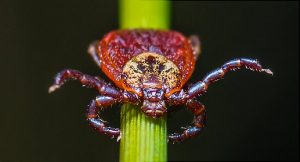
Identification of Borrelia bissettii in Ixodes scapularis ticks from New Brunswick, Canada.
Lewis J, et al. Can J Microbiol. 2019.
Abstract
Lyme disease is a tick-borne disease that is emerging in Canada. The disease is caused by spirochetes of the Lyme borreliosis group, which is expanding as new species are discovered. In Canada, Lyme disease risk has so far been assessed primarily by detection of Borrelia burgdorferi sensu stricto. Of Ixodes scapularis ticks collected between 2014 and 2016 in New Brunswick, Canada, 7 were shown to be infected with Borrelia bissettii by nested PCR and sequencing of 5 B. bissettii genes. Since different Borrelia species are associated with different clinical manifestations and are not detected with the same diagnostic tests, the identification of a previously undocumented or underreported pathogenic Borrelia species has important implications for public and veterinary medicine.
_________________
**Comment**
Again, the important issue here is that current CDC 2-tiered tests only test for ONE strain of borrelia when there are 300 and counting strains worldwide being transported everywhere by migrating birds, rodents, lizards, and mammals – including humans.
Before you discount Borrelia bissetti as being “somewhere else,” please know it was found in Chicago rodents:https://www.ncbi.nlm.nih.gov/pubmed/11075925. These strains are unlike previous Borrelia isolates from NW Illinois and Wisconsin.
This excellent pdf has studies of bissetti in everything from mice to human heart valves:ws-B.Bissettii1 The pdf also makes an excellent point that desperately needs to be addressed: Borrelia strains sequenced are strains that have been grown in culture medium. What about the diverse strains identified in the Southeastern United States that cannot be cultured? It also gives two studies showing that changing criteria of the Western Blot & mixing borrelia strains increased testing sensitivity.
Time for the CDC to roll up their sleeves and deal with this. It is way past time.
Lyme disease is a multisystem tick-borne transmissive disease with heterogeneous manifestations, frequently making the diagnosis difficult in clinical practice. Herein, we report a case of a 43-year-old female patient who presented with generalized lymphadenopathy requiring a further diagnostic evaluation towards lymphoma. The patient also had clinical signs of Sjögren’s syndrome. Lymph node excision with subsequent histological and immunohistochemical studies were performed. While light microscopy findings were suspicious for lymphoma, immunohistochemistry results were consistent with cortical and paracortical lymph node hyperplasia with no evidence of lymphoproliferative disorder. Further laboratory testing confirmed the presence of Lyme borreliosis.Effectiveness of the administered antibiotic therapy confirmed Borrelia burgdorferi infection. Interrelationships between Sjögren’s syndrome, lymphadenopathy and Lyme disease are discussed.
CDC to start monitoring tick distribution and their diseases
WebMD, March 27, 2019
by Bara Vaida
The CDC for the first time will be monitoring the nation’s tick population and the diseases the pests may be carrying.
The effort comes as the number of people diagnosed with serious diseases caused by things like ticks, fleas, and mosquitoes has more than doubled over the past few decades. Ticks caused the vast majority of those diseases.
Its aim is to assess where Americans might be most likely to get a tick-borne illness.
Green spaces in the city are important for human wellbeing, but are also zones in which humans can become infected with zoonotic diseases. Therefore, there is a need to understand how infection risk is related to green space characteristics, wildlife communities and connectivity with rural areas hosting reservoir populations of hosts. Our hypothesis is that wildlife hosts in urban green spaces, and thereby the prevalence of questing ticks and their Lyme disease causing pathogens (Borrelia burgdorferi s.l.), can be partly predicted based on green space characteristics as well as measures of connectivity to known source areas. We sampled ticks in twenty-two green spaces during Spring (2014 and 2016) and Autumn 2016, located along an urbanization gradient in Antwerp (Belgium). More than 18,000 m2 was sampled, with tick densities ranging from 0 to 386 individuals/100 m2. We estimated connectivity using the least-cost algorithm as either the cost distance to the nearest green space, or to a known population of roe deer (Capreolus capreolus), known to be an important tick propagation host. Both connectivity measures turned out to be correlated, reflecting a gradient in green space isolation from the periphery to the urban center.
In 87% of plots where ticks were trapped, at least one Borrelia-infected tick was found.
The overall Borrelia-prevalence in nymphs was 17.8%, in adults 32.6%.
Density of infected ticks decreased with urbanization and increased with connectivity.
Nymphs in larger green spaces were more likely to be infected.
Density and infection prevalence for adults increased with the amount of neighboring agricultural land, the larval density and nymphal infection prevalence decreased.
Interestingly, the proportion of Borrelia genospecies associated with birds or mammals was comparable in rural and (sub)urban areas (bird/mammal: 0.38), suggesting that even in small green spaces Borrelia infections can persist in local host populations.
This is a colony in urine. (spirochetes in pleomorphic colony in Lyme patient’s urine stain with acridine orange)
We get to the ways that burgdorferi is transmitted. I laugh at all this stuff about looking for the Woodtick. That’s so ridiculous because most of the people who get Lyme disease have never heard or seen a tick. We know now it’s in tears and people wipe their eyes and then you shake hands with them. Or we don’t laugh so hard about the physician we had in the hospital who wouldn’t touch the doorknobs in the hospital without taking his white coat and handling the doorknob through a coat. Maybe he wasn’t so insane after all.
So we think this is spread by what is called fomites(an inanimateobject or substancethat is capable of transmittinginfectiousorganismsfromoneindividual to another) which is the pencil in the bag as you pick up a pen to write a check or anything you handle. So it’s in urine and in tears and it’s also spread by mosquitoes and who hasn’t had a mosquito bite? We’ve tested the mosquitoes in Michigan and sure enough they can carry the Lyme spirochete.
Oh, this is very interesting, I thought. This is a culture of that dreadful spirochete of Lou Gehrig’s and it’s stained with acridine orange and it’s staining red showing it’s still full of pep and multiplying and it’s a 10 day culture. We repeat this with the spirochete of Lyme or MS and at 10 days they are only green so if you have your choice you’re not going to take this one are you? Lou Gehrig’s is the last thing you’d want.
And this is something else where the ordinary lab that doesn’t have florescent antibody – this is a simple stain – Sudan black B. Sudan Black only stains a few things. It stains pseudomonas, you don’t run into pseudomonas in the average patient. Sudan black B. is something you can purchase and doesn’t cost very money like a florescent antibody does – that is very useful. (slide says “membrane *& outgrowth of L-body in blood culture of Lyme patient. Stained with Sudan Black B.) That’s probably my last slide. (Slide says: “To me they’re not just a bunch of microbes – they’re personalities!”)
Together with her collegue JoAnne Whittacker, Mattman did groundbreaking work on Lyme testing. Her Gold Standard Culture Method has disappeared thanks to the concerted suppression on microscopy. In 2004 she already claimed that she could not find any uninfected blood in the USA anymore.
Dr. Lida Mattman studied borrelia for decades and was nominated for the Nobel Prize. She is recognized for her work with diseases such as rheumatoid arthritis, Lou Gehrig’s disease, scleroderma and Parkinson’s. She described the etiology of interstitial cystitis and worked to discern the causes of rheumatoid arthritis and anterior uveitis, the most common cause of blindness.She also taught and used a new method to diagnose tuberculosis in 48 hours.
Having earned her bachelor’s and master’s degrees in microbiology and virology respectively from the University of Kansas and a doctorate in immunology from Yale University in 1940, she was professor of microbiology at Wayne State University since 1949 and is credited with ushering thousands of would-be doctors and nurses into the medical profession. She was awarded the university’s President’s Award for Outstanding Teaching and Research in 1977, retired in 1982, and was inducted into the Michigan Women’s Hall of Fame in 2005. Her book, “Cell Wall Deficient Forms,” written in 1974, is regarded as an invaluable education tool among researchers, students and physicians in the field of microbiology.
In addition to doing research at the universities of Iowa and Pennsylvania, she served as director of clinical laboratories for the United Nations Relief and Rehabilitation Commission and was an instructor at the Harvard School of Public Health.Dr. Mattman died in 2008 at 96 due to liver failure. https://www.findagrave.com/memorial/29190964/lida-mattman
Mattman isolated living Borrelia spirochetes in mosquitoes, fleas, mites, semen, urine, blood, plasma and Cerebral Spinal Fluid. She discovered that this bacteria is dangerous because it can survive and spread without cell wall (L shape). Because L-forms do not possess cell wall, they are resistant to antibiotics that act upon the cell wall.
Others have found various ways Bb is transmitted as well:
Burgess could infect cats with Bb orally, ocularly, and via IV
“The presence of live spirochetes in a genital lesion strongly suggests that sexual transmission of Lyme disease occurs,” said Middelveen. “We need to do more research to determine the risk of sexual transmission of this syphilis-like organism.”
The CDC/IDSA/NIH are on vacation and still haven’t received the memo
But like so many other pioneers who expose inconvenient truths about Lyme, the Michigan State Attorney’s Office told Dr. Mattman to stop testing for Lyme using her gold standard direct culture technique. She also successfully duplicated the results of the Bowen Q-RiBb test, which provided a preliminary report of the findings within 24 hours of receiving the specimen. The final report included digital photographs of the finding, which was useful in evaluating treatment by comparing pre and post serial dilution results.
Mattman was subsequently threatened with time in jail or a fine of 5,000 dollars a day. State police arrived at her lab with handcuffs and tried to find evidence that she was still testing but they didn’t find what they were looking for. She was forced to stop her valuable work and leave her lab.
The continued adherence to worthless 2-tier CDC testing is on purpose. They don’t want an accurate test – they had two and buried them!

 1