Archive for the ‘Lyme’ Category

Do I Need IV Antibiotics?

https://danielcameronmd.com/iv-antibiotics/

Do I Need IV Antibiotics?
Dec22

Do I Need IV Antibiotics?

He Asked What Many Eventually Ask

He sat across from me and voiced something countless patients eventually reach: Doctor… do I need IV antibiotics?

The patient struggled with cognitive slowing, neuropathic pain, persistent headaches, sleep disruption, and mild dizziness. He was improving slowly with oral antibiotics — but anxious he was missing something.

He had seen images of patients with IV poles on social media and heard stories of recovery only after patients had been treated with IV antibiotics. He believed IV therapy represented the “real treatment.” He wasn’t alone. Many assume IV antibiotics are stronger, faster, or required.


What IV Antibiotics Can (and Can’t) Do in Recovery

IV antibiotics can help in some cases of Lyme disease, especially when there is significant neurological involvement and oral treatments haven’t brought noticeable improvement or symptoms keep getting worse.

However, IV therapy is not simply a stronger version of oral treatment. It carries catheter-related risks, varies in what it covers, and does not guarantee better outcomes. For some patients, it offers benefit; for others, progress occurs through different strategies. IV is a tool — not a universal upgrade.


Why Some Patients Don’t Improve Even After IV Therapy

Many patients aren’t aware that the most commonly used IV antibiotic for Lyme — ceftriaxone — doesn’t treat co-infections like Babesia, Bartonella, or Anaplasma.

If one of these infections is present, IV therapy alone may not help, even when it’s given correctly.

In many cases, it’s a mismatch in coverage, not a lack of effort, that explains why some people don’t get better after IV treatment.

How I Decide When IV Antibiotics Makes Sense

Many antibiotics offered in IV form — including doxycycline and azithromycin — exist orally with good tissue penetration and far fewer catheter-related risks.

Other IV antibiotics are still being studied, so I usually use them only in specific situations rather than as a first step or automatic next step.

Even when IV therapy is appropriate, drug selection matters. Ceftriaxone, for example, can affect the gallbladder, so in patients with prior concern, cefotaxime (Claforan) may be an alternative — though it requires far more frequent dosing.


The Turning Point Was Not IV — It Was Correct Treatment

Because Babesia was clinically suspected, we adjusted the patient’s oral regimen to include azithromycin (Zithromax) and Malarone.

His cognition sharpened. Neuropathy eased. Headaches settled. Sleep stabilized. Dizziness quieted.

A few weeks later he said, “I thought IV was my only shot. I didn’t realize I could get better without it.”

He never required IV treatment — he needed the right treatment, not a different route.

Sometimes progress isn’t escalation — it’s correction.

“Do I Need IV Antibiotics?”

When someone asks, “Do I need IV antibiotics?” the answer depends on symptoms, function, and treatment response.

There are situations where IV therapy is justified. But many improve when treatment is refined, not intensified.

If improvement stalls despite appropriate care — or neurological involvement is suspected — IV therapy may be considered.

But many regain ground when treatment targets co-infections and physiologic drivers.


If you have wondered whether you truly needed IV antibiotics, you are not alone. Share your experience below — someone else may feel less alone reading it.

Resources
  1. Columbia University. Lyme and Tick-Borne Diseases Research Center.
  2. CDC. Chronic Symptoms and Lyme Disease.
  3. Johns Hopkins Lyme Disease Research Center.
  4. Dr. Daniel Cameron: Lyme Science Blog. What Is the Best Treatment for Lyme Disease?
  5. Dr. Daniel Cameron: Lyme Science Blog. Lyme disease: One size does not fit all

**Comment**

I’m sure at some point every single patient asks this question. The sad truth about this complex illness is that it takes savvy, experience, and a whole lot of patience. It also typically takes more than one brain working on it and the challenge is being able to decipher what to use, when, and how much.

If ever there was an illness that is completely individualized, this is it!

It can also take YEARS to treat and this is really hard to wrap your mind around at first.  It took FIVE YEARS of highly individualized, expensive, and painful treatment for both my husband and me.  Painful due to the herxheimer reactions treatment causes and individualized because of the many coinfections that are often involved.

It’s also the reason why RCTs are futile, a waste of money, and why we desperately need N of 1 trials to be respected and accepted.

For more:


‘Grey’s Anatomy’ Star Dead From ALS (Did He Have Mycoplasma or Lyme Disease?)

https://apnews.com/article/eric-dane-dead

Eric Dane, ‘Grey’s Anatomy’ star and ALS awareness advocate, dies at 53

Eric Dane, the actor known for “Grey’s Anatomy” and “Euphoria,” has died at 53 from ALS. He’d become an advocate for awareness of amyotrophic lateral sclerosis, known also as Lou Gehrig’s disease, after announcing his diagnosis in April 2025. (Feb 19)

Eric Dane, the celebrated actor best known for his roles on “Grey’s Anatomy” and “Euphoria” and who later in life became an advocate for ALS awareness, died Thursday. He was 53.

His representatives said Dane died from amyotrophic lateral sclerosis, known also as Lou Gehrig’s disease, less than a year after he announced his diagnosis.

“He spent his final days surrounded by dear friends, his devoted wife, and his two beautiful daughters, Billie and Georgia, who were the center of his world,” said a statement that requested privacy for his family. “Throughout his journey with ALS, Eric became a passionate advocate for awareness and research, determined to make a difference for others facing the same fight. He will be deeply missed, and lovingly remembered always. Eric adored his fans and is forever grateful for the outpouring of love and support he’s received.”

(See link for article)

_______________

**Comment**

Many are unaware of the link between ALS, Lyme disease, and Mycoplasma  For more:

Dr. Miller:  


Podcast: Why Lyme Disease Happens to Some People and Not Others

https://www.lymedisease.org/why-lyme-happens-some-not-others/  Go here for video

PODCAST: Why Lyme disease happens to some people and not others

By Fred Diamond

One of the most common questions I hear from Lyme survivors is simple but deeply loaded: “Why did this happen to me? Why did I get Lyme when others didn’t?”

If you’ve ever asked yourself, “Why me?” know that you’re not alone.

Thousands of Lyme survivors have pondered that same question. They were healthy. They were hiking. They were gardening. They were kayaking. They were simply living their lives. And then something changed.

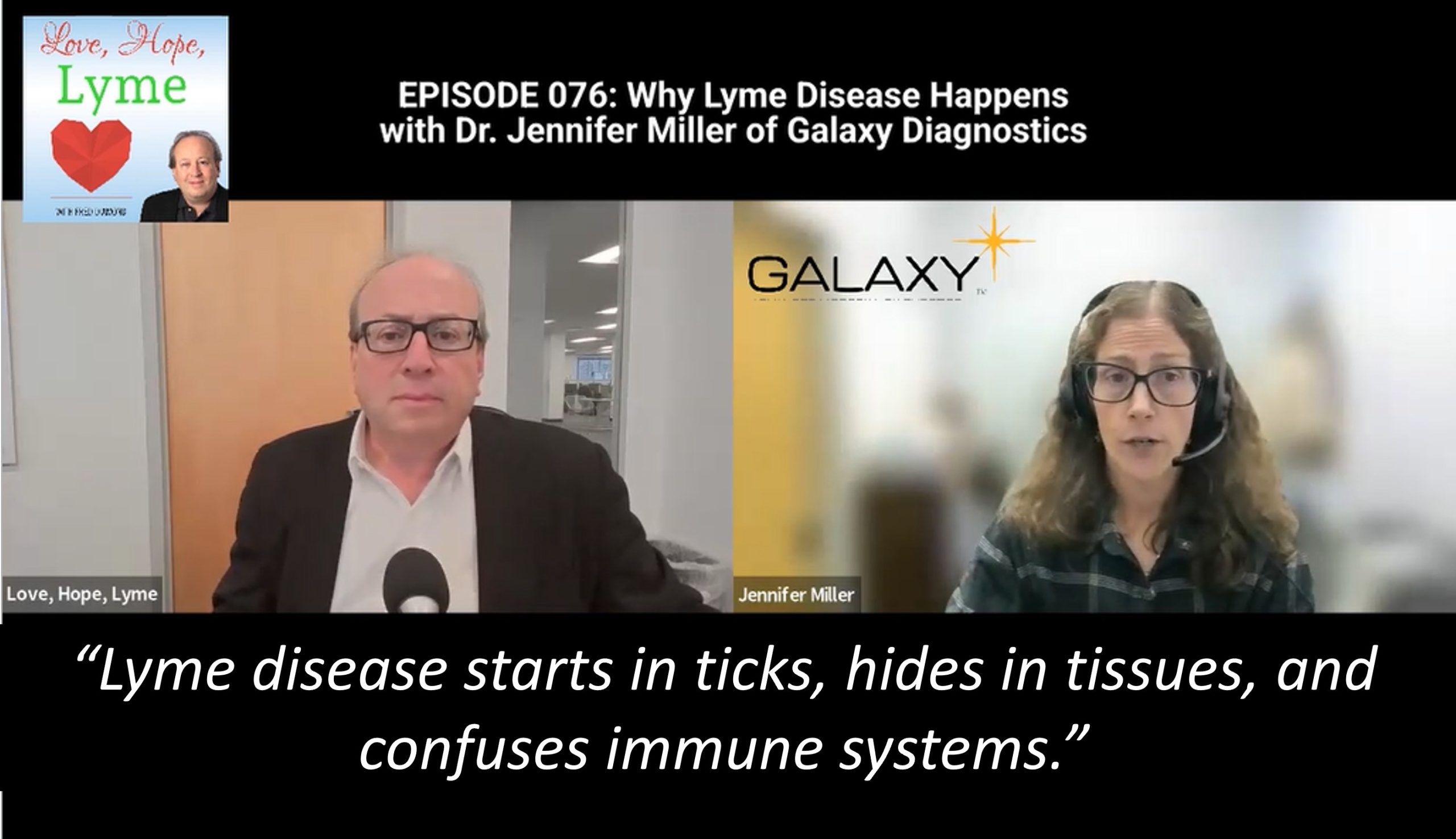
On this week’s Love, Hope, Lyme podcast, Dr. Jennifer Miller of Galaxy Diagnostics, a scientist who has spent her career studying the Lyme bacterium, Borrelia burgdorferi, discusses why Lyme happens and why its effect may differ from person to person.

Her explanation reveals just how complex, and insidiously strategic, this organism truly is.

It starts in the wild

Lyme disease is what scientists call a vector-borne infection. In simple terms, that means it is transmitted by a vector and in this case, ticks.

But ticks are not born infected.

“The tick has to pick it up from a host that’s already infected,” Dr. Miller explains. “The larval tick will feed on an infected animal… and acquire the infection.”

That infected animal is usually a small mammal such as a mouse, chipmunk, or squirrel. These animals act as reservoir hosts. They carry the bacteria without becoming visibly sick.

After feeding, the tick molts into a nymph which is the stage most responsible for transmitting Lyme to humans. Nymphs are tiny, often no bigger than a poppy seed, and difficult to detect.

Many people assume deer are the main source of Lyme. Dr. Miller clarifies the nuance.

“Deer can have Lyme disease, but people aren’t going to get it from a deer.”

Deer play a role in the tick life cycle, but they are not the direct cause of human infection. The real issue is ecological.

“Because we have all these reservoir hosts, it’s a big part of the problem as to why Lyme disease incidence is increasing and why it’s spreading,” she says. “As humans, we occupy and consume more and more space… we’re encroaching on the territory of the deer, and with that, very unfortunately, comes Lyme disease.”

In other words, Lyme is not random. It is the byproduct of an expanding interface between humans and the natural infection cycle.

Borrelia is not an ordinary bacterium

Lyme disease is caused by a bacterium, not a virus, but it behaves unlike most bacteria.

Borrelia belongs to a family called spirochetes. It has a corkscrew shape that gives it unusual mobility.

“Borrelia will literally outrun the immune system,” Dr. Miller says. “Because it’s a corkscrew, it literally will burrow into the tissues.”

That corkscrew motion allows it to penetrate deeply into connective tissue, joints, and even cross protective barriers like the blood-brain barrier.

Even more concerning, Borrelia is highly adaptive.

“It literally will coat itself with host proteins. That allows it to evade immune detection.”

Camouflage

In essence, the bacterium can camouflage itself. It changes the proteins on its surface depending on whether it is inside a tick or inside a human. Once inside the body, it can alter its “coat” again to hide from immune surveillance.

Unlike some bacteria that cause disease by releasing toxins, Borrelia’s damage often comes indirectly.

“They’re not making toxins or poisons like other bacteria,” Dr. Miller explains. “But a lot of what happens with Borrelia is triggered by the immune system.”

The medical literature uses the phrase immune dysregulation to describe this phenomenon.

“Borrelia really interferes with the immune system,” she says.

In some individuals, the immune response becomes excessive and inflammatory, leading to joint damage, neurological symptoms, and widespread pain. In others, the immune response is blunted or misdirected, allowing the bacterium to persist quietly.

Why do some people get so sick while others don’t?

This may be the most painful question Lyme survivors ask.

“That’s still the biggest question that we need to answer,” Dr. Miller says candidly. “What I’ll tell you quite openly is that we don’t have all the answers.”

But there are clues.

Different strains of Borrelia produce slightly different surface proteins.

“Depending on which version of those proteins they’re making, some of those versions disagree with certain humans more than others.”

Some strains provoke a strong immune reaction. Others may slip past immune detection more easily.

Borrelia also actively interferes with antibody production.

“Borrelia will interfere with the timing of the antibody response. It interferes with the strength of the antibody response,” she explains. “It will trick them and confuse them so that they don’t produce antibodies in the right timeframe or of the right strength.”

This has enormous implications. If the immune system does not respond in a predictable way, both symptoms and laboratory tests become harder to interpret.

Host factors matter too. Genetics, previous infections such as Epstein-Barr virus, co-infections, mold exposure, chronic stress, and environmental burdens may all influence how a person responds.

There is likely no single reason why one person clears infection and another develops chronic symptoms. It is a complex interaction between pathogen and host.

The complication of co-infections

Lyme rarely travels alone.

“The number of different pathogens that were in the tick was far more than anybody would’ve thought… easily dozens,” Dr. Miller notes.

Ticks may carry Borrelia along with Babesia (a parasite similar in some ways to malaria), Bartonella (a different type of bacteria), Anaplasma, Ehrlichia, and even viral pathogens.

“You really have a lot of diversity of pathogens with these co-infections. That’s part of why they can be so very difficult to treat.”

A tick can acquire pathogens from one animal, survive the molt, then feed on another animal and acquire additional organisms. Birds, which can transport infected ticks across geographic regions, add another layer of complexity.

This microbial diversity means that two people bitten by ticks in different environments may experience very different symptom patterns.

Why testing fails so often

Few topics frustrate Lyme patients more than testing.

The standard two-tier antibody testing protocol has been in use for more than three decades. It measures antibodies but not the bacteria itself.

“The current tests are detecting that antibody response, and that can be very tricky,” Dr. Miller explains.

Antibodies only tell you that your immune system has seen the pathogen at some point. They do not reliably indicate active infection. And because Borrelia interferes with antibody production, some people never produce a strong enough response to meet diagnostic thresholds.

“Not everybody even generates an antibody response to Borrelia, one that’s strong enough or in line with what our out-of-date tests measure.”

False negatives can occur. Partial antibody bands may appear but not meet reporting criteria. Cross-reactivity with other infections can create additional confusion.

Adding to the challenge, Borrelia does not remain in high concentrations in the bloodstream.

“They don’t hide out at large numbers in the blood. There’s just not a lot of Borrelia in the blood.”

After transmission through the skin, the bacteria migrate into tissues. Blood-based detection becomes inherently difficult. This is why some researchers are working to develop direct detection methods, including antigen testing strategies.

“Borrelia are unique,” Dr. Miller explains. “When Borrelia shed their outer proteins it just gets released into the environment.”

Unlike many bacteria, Borrelia sheds structural components that may be detectable in other bodily fluids, offering a potential alternative to antibody-based testing.

A final word to patients

Lyme disease is biologically complex. It is ecologically driven. It is immunologically disruptive, and it does not behave like many other infections.

The science is still evolving. Researchers do not have all the answers.

But one thing is clear.

“If you think you have symptoms of Lyme disease and you haven’t seen a tick and you don’t have that bull’s-eye rash, please don’t assume that you don’t have Lyme disease,” Dr. Miller urges. “Go and get checked out.”

For survivors searching for understanding, the question why did this happen may never have a simple answer. But understanding biology, ticks, the bacterium, the immune system, and the co-infections can bring clarity.

And the more we understand that organism, the closer we move toward better diagnostics, better treatments, and better outcomes for every Lyme survivor.

Visit the Galaxy Diagnostics website to learn more about Lyme disease testing.

Click here to listen to all episodes of the Love, Hope, Lyme Podcast or on YouTube.

The Hidden Truth About TBIs: IBS Treatment Center Article

https://www.ibstreatmentcenter.com/blogs/the-hidden-truth-about-tick-borne-illnesses

The Hidden Truth About Tick-Borne Illnesses

Dr Stephen Wangen
September 9, 2025

Today I want to talk with you about something that is often misunderstood and more common than most people realize: tick-borne illnesses.

When most people hear about tick-borne diseases, the first thing that comes to mind is Lyme disease—and usually only in the context of the northeastern United States. Maybe you’ve even heard about the “classic bullseye rash” that’s supposed to make Lyme easy to recognize. But the truth is much more complex—and more concerning.

Tick-Borne Illnesses Are Everywhere

One of the biggest misconceptions is that tick-borne diseases are only a problem in New England or a handful of rural areas. The reality is: ticks are found in every state in the U.S. They thrive in woodlands, grassy fields, parks, and even suburban backyards.

As our climate changes and animal populations shift, ticks are spreading into areas where they weren’t as common before. That means people all across the country—from the Pacific Northwest, to the Midwest, to the Southeast, and yes, the Southwest—are at risk of exposure.

More Than Just Lyme Disease

Yes, Lyme disease is the most well-known tick-borne illness. But ticks can and do carry and transmit many other infections, including:

• Babesiosis

• Anaplasmosis

• Ehrlichiosis

• Rocky Mountain spotted fever

• Bartonella

• And other infections

Each of these can cause significant health problems, and in many cases, people may not even realize that a tick bite was the original cause of their symptoms.

The Bullseye Rash Myth

Let’s talk about the rash. We’ve all heard about the “classic bullseye” rash that’s associated with Lyme disease. But here’s what most people don’t know:

• The majority of patients never develop a bullseye rash.

• Some might get a rash that looks nothing like the pictures online.

• Others may not have any noticeable skin reaction at all.

That means you can still have a tick-borne illness even if you’ve never seen a rash.  (See link for article)

_____________

**Comment**

Good article except for the climate change bit.  I won’t pontificate but if you are unfamiliar with this, please read:


Coinfection in Lyme Disease: Clinical Impact, Diagnostic Challenges, and Therapeutic Perspectives

https://www.mdpi.com/2076-2607/14/2/325

Tick-Borne Co-Infection in Lyme Disease: Clinical Impact, Diagnostic Challenges, and Therapeutic Perspectives

by Georgi Popov, Dzhaner Bashchobanov* and Radina Andonova
Clinic of Infectious Diseases, Sofiamed Hospital, 1797 Sofia, Bulgaria
*Author to whom correspondence should be addressed.
Microorganisms 2026, 14(2), 325; https://doi.org/10.3390/microorganisms14020325
Submission received: 8 January 2026 / Revised: 27 January 2026 / Accepted: 28 January 2026 / Published: 30 January 2026
Abstract
Tick-borne co-infections are an increasingly recognized and clinically important aspect of Lyme borreliosis, particularly in regions where Ixodes ticks transmit a wide range of bacterial, protozoan, and viral pathogens. In addition to Borrelia burgdorferi sensu lato, these ticks frequently harbor microorganisms such as Babesia spp.,   Anaplasma phagocytophilum, Ehrlichia spp., Borrelia miyamotoi, Bartonella spp., and several tick-borne viruses. Co-infections may increase disease severity, prolong symptom duration, and contribute to atypical or overlapping clinical presentations, thereby complicating diagnosis and management. Growing evidence from epidemiological studies, clinical case series, and experimental in vivo and in vitro models indicates that pathogen–pathogen and pathogen–host interactions can modulate immune responses and influence disease progression. Diagnostic challenges arise from non-specific clinical features and limitations of current laboratory methods. From a therapeutic perspective, although standard antibiotic regimens for Lyme disease are effective against some bacterial co-infections, they do not provide coverage for protozoan or viral agents, necessitating pathogen-specific and, in some cases, combination treatment strategies. This review synthesizes current knowledge on the epidemiology, clinical impact, diagnostic limitations, and treatment approaches for tick-borne co-infections associated with Lyme disease, and highlights critical evidence gaps and future research directions to improve patient outcomes.
For more: