Robert F. Kennedy Jr.: How to Fix America’s Health Crisis as HHS Secretary
Ultimate Human Podcast with Gary Brecka
May 27, 2025
RFK unpacks our $1.9 TRILLION sick care system.
If you scroll to 29.00, you can hear RFK explain the unbelievable corruption in research today – how it is completely bought out by Big Pharma:
NIH allocates $46 BILLION a year to science
This money goes to 56,000 researchers worldwide
The researchers getting the money are ‘approved’ by the industry and are part of an ‘old boy’s network’ that knows what they can research and what they can say and what they can’t say. Nothing is allowed that will diminish corporate profits
Nothing is published that doesn’t support corporate profits
All of this is allowed to happen because there’s no research replication. Researchers are safe because they know nobody will replicate their study and they aren’t going to be proven wrong – even if they are wrong.
RFK states they are probably going to allocate about 20% of NIH money to replication studies.
RFK states they are probably going to STOP publishing in the Lancet, New England Journal of Medicine, JAMA, and other journals that are corrupt and create their own in-house journals in each of the institutions. Many of the heads of these corrupt journals have stated publicly that they are no longer ‘science’ journals but promoters of pharmaceutical products.
The interim report for the hearing names 15 government officials (plus the Committee Chair Ron Johnson R-WI) who knew the COVID-19 vaccines were causing heart damage and worked to conceal and delay the information to the public. In five reports from the Daily Clout we counted 73 individuals named. This is probably the tip of the iceberg. (Go to link for names as well as news video)
Learn about the connection between Lyme disease, POTS, and Lyme carditis, and discover the importance of early diagnosis and specialized medical care.
Have you heard of POTS?
Between my freshman and sophomore years of college, I was bitten by a tick while working at a summer camp in the woods of Maine. As I’ve described in many of my blog posts, it took eight years for me to be accurately diagnosed, and during that time I suffered from a range of physical and neurological symptoms. During the fall semester of my sophomore year, I had flu-like symptoms as well as symptoms of what the college nurses thought were panic attacks.
Looking back now, I wonder if my heart palpitations, lightheadedness, and dizziness were in fact signs POTS, or Postural orthostatic tachycardia syndrome. At the time, POTS was little if at all understood, but now researchers and physicians are seeing POTS not just in Lyme disease patients but also in conditions like long COVID and ME/CFS.
POTS occurs when moving from lying to standing causes an increase in heart rate by at least 30 beats per minute for adults and 40 beats per minute for children. In addition to this abnormal increase in heart rate, the Heart Rhythm Society defines POTS as a clinical syndrome characterized by symptoms of lightheadedness, blurring of vision, palpitations, intolerance to exercise, and fatigue, as well as the absence of orthostatic hypotension[i] (meaning the blood pressure does not drop when the heart rate rises). I experienced all of these symptoms that fall in college. Had POTS been more well-known, its symptoms could have pointed puzzled medical practitioners in the direction of tick-borne disease. That was 1997; a recent study shows that the incidence of POTS has increased four-fold since 2000.[ii]
Another Lyme-related condition, Lyme carditis
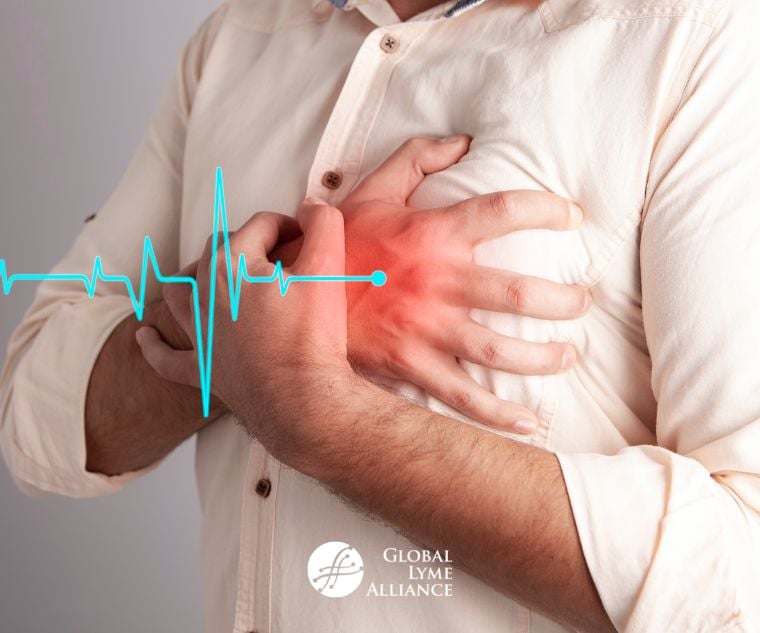
Heart-related symptoms such as racing heartbeat can also be a sign of another condition known as Lyme carditis, when the Lyme bacteria goes to the heart. This can cause atrioventricular block, often referred to as “heart block,” which is an electrical disconnect between the upper and lower chambers of the heart, causing them to beat at different rhythms. Lyme carditis can also manifest as costochondritis (inflammation of the cartilage that connects the ribs to the breastbone), tachycardia (racing heart rate) and bradycardia (slow heart rate). It can also cause myopericarditis (inflammation of the heart muscle and lining), which patients may feel as chest pain or shortness of breath.
Though Lyme carditis is rare, according to a 2008 study, 4% to 10% of all patients with Lyme borreliosis. Whenever the clinical suspicion of Lyme carditis arises, an ECG is mandatory to detect or exclude an atrioventricular conduction block.
If you have already been diagnosed with Lyme disease, it’s important that your doctor check specifically for Lyme carditis, and also evaluate you for POTS. If you are experiencing symptoms of either Lyme carditis or POTS, see a Lyme Literate Medical Doctor (LLMD) to find out if tick-borne disease may be the cause. I only wish I had seen a LLMD sooner; I might have avoided years of suffering.
[ii] Epidemiology of postural tachycardia syndrome. [Apr;2020 ];AbdelRazek M, Low P, Rocca W, Singer W. https://n.neurology.org/content/92/15_Supplement/S18.005 Neurology.2019 92:0.
The above material is provided for information purposes only. The material (a) is not nor should be considered, or used as a substitute for, medical advice, diagnosis, or treatment, nor (b) does it necessarily represent endorsement by or an official position of Global Lyme Alliance, Inc. or any of its directors, officers, advisors or volunteers. Advice on the testing, treatment or care of an individual patient should be obtained through consultation with a physician who has examined that patient or is familiar with that patient’s medical history.
Opinions expressed by contributors are their own. Jennifer Crystal is a writer and educator in Boston. Her work has appeared in local and national publications including Harvard Health Publishing and The Boston Globe. As a GLA columnist for over six years, her work on GLA.org has received mention in publications such as The New Yorker, weatherchannel.com, CQ Researcher, and ProHealth.com. Jennifer is a patient advocate who has dealt with chronic illness, including Lyme and other tick-borne infections. Her memoir, One Tick Stopped the Clock, was published by Legacy Book Press in 2024. Ten percent of proceeds from the book will go to Global Lyme Alliance. Contact her via email below.
The FDA has just released a briefing document for the December 12, 2024, Vaccines and Related Biological Products Advisory Committee (VRBPAC) Meeting titled, Considerations for Respiratory Syncytial Virus (RSV) Vaccine Safety in Pediatric Populations. The document revealed that, in July 2024, a Phase 1 trial assessing the safety, tolerability, and immunogenicity of two Moderna RSV vaccine candidates (mRNA-1365 and mRNA-1345) in infants aged 5 to 8 months was paused following reports offive severe to very severe cases of lower respiratory tract infection (LRTI) caused by RSV:
During the study, an imbalance in severe RSV cases was identified, based on a pre-specified study stopping criterion, among participants 5 months through <8 months of age who received the lower mRNA vaccine dose. In Cohorts 3 and 4, five (5) cases (12.5% of participants) of clinically significant (CS) severe/very severe RSV were identified in the vaccine groups (all of whom had received 1 or 2 doses of a 3-dose schedule), compared with one (1) case (5% of participants) in the placebo group. The percentage of participants with symptomatic RSV disease in Cohorts 3 and 4 who progressed to severe illness was 26.3% in the vaccine groups compared with 8.3% in the placebo group.
Of the six total severe cases (including one in the placebo group), five infants required hospitalization, and one required mechanical ventilation. (See link for article and tables)
According to Dr. Mary Talley Bowden, the RSV shots are also mRNA based. Further, and similarly to COVID shots, studies are not using mortality or even hospitalization as their end point but only reduction in symptoms. There were 12,000 adverse events. They only studied outcomes for 7 days.
“We are seeing the whole COVID shot fiasco all over again with RSV.” ~ Dr. Mary Talley Bowden
A leading cardiologist has warned that over 100 million Americans may now have irreversible heart damage after receiving Covid mRNA “vaccines.”
According to Dr. Thomas Levy, Covid vaccines are causing heart injury in at least 2.8% of people who receive the injections.
A minimum of 7 million Americans who took the Covid vaccine in 2021 now have severely damagedhearts, according to Dr. Levy.
However, the top doctor said that number is now likely to reach over 100 million people.
Dr. Levy is a renowned cardiologist and an attorney-at-law who also serves as the contributing editor for the Orthomolecular Medicine News Service.
Levy told MIT computer scientist and vaccine data expert Steve Kirsch that the spike protein’s effect on the heart is even worse than previously thought.
In an article, Kirsch, the founder of the Vaccine Safety Research Foundation (VSRF), highlighted the heart damage in vaccinated pilots.
As Slay News has previously reported, soaring heart damage among pilots was recently revealed in a change to Federal Aviation Administration (FAA) guidelines.
Back in 2022, the FAA quietly changed the electrocardiogram (ECG) parameters for pilots to accommodate those with cardiac injury.
The update suggests the injections are causing an unprecedented amount of pilots to fail their screening.
According to Kirsch, this range wasn’t widened by a little, it was a lot.“
The cardiac harm of course is not limited to pilots,” Kirsch explained in his article. (See link for article and videos)
Important quote:
Meanwhile, secret official data from Santa Clara County has exposed a shocking surge in all-cause deaths among residents who received Covid mRNA “vaccines.”
The spike in mortality rates was revealed in the county’s official statistics after the hidden records were unsealed by a Freedom of Information Act (FOIA) request.
Radiologist, oncologist, and cancer researcher, Dr. William Makis states COVID shots destroy the immune system and that 2 year olds are having heart attacks.
Twelfth Amendment to the Declaration under the PREP Act for COVID-19 Medical Countermeasures
On December 11, 2024, Secretary Becerra signed the 12th amendment to the declaration under the PREP Act for COVID-19 Medical Countermeasures. The Secretary issues this amendment pursuant to section 319F–3 of the Public Health Service Act to extend the duration of the Declaration to December 31, 2029, and to republish the Declaration in full.
A PREP Act declaration is specifically for the purpose of providing immunity from liability, and is different from, and not dependent on, other emergency declarations.
The end of the COVID-19 Public Health Emergency Declaration does not automatically terminate PREP Act coverage. To learn more, view our COVID-19 PREP Act FAQs.
Breaking: Former Trump Administration HHS Senior Advisor Provides Affidavit: “mRNA nanoparticle injections, are in fact biological and technological weapons of mass destruction”
Former Trump Administration Health and Human Services (HHS) Senior Advisor, and epidemiologist, Dr. Paul Alexander, provided an affidavit stating that mRNA nanoparticle injections are biological and technological weapons. Dr. Alexander, a Trump loyalist, provided the affidavit in a new case in the State of Florida.
Case # 2024-CA-001977 initiated by psychotherapist, Dr. Joseph Sansone is seeking an injunction to prohibit Governor Ron DeSantis and Attorney General Ashley Moody from allowing the continued distribution of COVID-19 and mRNA injections in the State of Florida because they are biological weapons. The complaint also seeks declaratory judgements that the COVID 19 injections and all mRNA nanoparticle injections violate Weapons of Mass Destruction § 790.166, Fla. Stat. (2023); Fraud § 817.034 Fla Stat. (2023); and Florida Medical Consent Law § 766.103 Fla Stat. (2023).
Kris Kristofferson’s shocking tale of Lyme-induced Alzheimer’s
By Dana Parish
Sept. 30, 2024
In 2016, I was floored by Rolling Stone’s cover story on Kris Kristofferson’s Lyme-induced Alzheimer’s.
Having almost died from heart failure after 12 “top” NYC doctors neglected to properly treat my own case of Lyme & Bartonella in 2014, I wanted every possible detail. I had a million questions.
I was introduced to Kris and his wife, Lisa, by a mutual friend, and honored that they trusted me to write an in-depth piece for my HuffPo column documenting his tumultuous health journey, from earliest symptoms of fibromyalgia and cardiac arrhythmias to severe memory loss, and astounding, significant recovery.
In light of the terrible news of his recent death, I couldn’t help but wonder if Lyme played a role, and felt compelled to shine light on this important story again. The media is largely ignoring it. Acknowledging the truth about chronic Lymeand the vastdriver of autoimmune, psychiatric and neurologic illness that it is, is touching the third rail.
I am also struck, again, by the uncanny overlap between chronic Lyme and LongCovid, from their dark politics and conflicts of interest, severe effects on the brain and body, to how they both can persist long after initial infection. It’s also notable that those with Lyme had worse COVIDoutcomes. There seems to be nothing a wily, misunderstood infection can’t do. Kris’s story is a perfect example.
I am forever grateful for the awareness he raised about Lyme and infection-mediated chronic illness. Sincere condolences to Lisa and the Kristofferson family.
Kris’s fierce, intuitive wife, Lisa, tells us how she shepherded him through a haze of missed opportunities and misdiagnoses and got him back.
When and how did Kris’s Lyme symptoms begin?
About 12 years ago he was diagnosed with fibromyalgia, which looking back, should have been the first indication that a test for Lyme was warranted. But we suspect he’s been infected with Lyme anywhere from fourteen to thirty years because he used to have these chronic muscle spasms, which is a common symptom.
We were in LA at the time, in Malibu, and I just don’t think doctors were looking for it or aware of it there then. But now we know it’s everywhere. There are signs on my local playground that say beware of ticks.
Can you describe his fibromyalgia?
He had massive, painful spasms all over his back and legs– it was so horrible- his nerve endings were causing golf ball-sized, painful contractions that we battled with acupuncture, heat and massage, then finally a spinal cortisone shot by a rheumatologist, and a low dose anti-depressant.
This eight-month period he was in so much pain he could not work. Two years earlier he had spent six weeks in the woods in rural, remote Vermont making a film called Disappearances. He was on the forest floor for much of the shoot, being dragged in a makeshift sling and carried by his son in the film, because he had been “shot” in the leg.
So, after so many years, how did he finally get diagnosed with Lyme?
During the aftermath of that film, Kris was diagnosed with moderate to severe sleep apnea, warranting a bi-level CPAP machine, which he tried and refused to use. He had painful knees and annual knee shots, a pacemaker for arrhythmias–which we now know could be from Lyme–so much Advil for headaches that he got anemic.
After a year of iron supplements and seeing a hematologist, he just wasn’t healthy-looking so I took him to an integrative doctor, Mark Filidei, at Whitaker Wellness Institute. Upon examining Kris and watching the muscles in his forearms constantly twitching, he announced, “He’s got Lyme disease,” and ordered a blood test. The first test from LabCorp came back suspicious, the second test by IGeneX was positive. This was in February 2016.
Excellent that the doctor knew to go to a reliable lab for Lyme like IGeneX. I also like MDL Labs. Most physicians don’t know that the tests are only about 50% accurate at the major labs and that Lyme should be clinically diagnosed based on symptoms. What did you do when you found out his diagnosis of Lyme?
Well, we got the news when we were on tour in the UK and Ireland, so immediately upon landing in the US, I went to a local pharmacy and picked up Kris’s prescriptions for doxycycline and alinia. Soon after, we also started hyperbaric oxygen therapy (HBOT) and transcranial magnetic stimulation (TMS) of the frontal lobe.
At this point, did anyone refer you to a Lyme-Literate doctor?
Yes, luckily, Kris’s cardiologist did her residency in New Jersey so she understood the cardiac involvement in Lyme and said go to a Lyme specialist. We began working with Dr. Steve Harris in California, who added antibiotic intramuscular injections to Kris’s protocol and is continuing to treat Kris.
But before this, wasn’t Kris misdiagnosed with Alzheimer’s?
Yes, for the past three years, he was treated for Alzheimer’s by two different neurologists. He was on two drugs for it, Namenda and Exelon patches. But finally, a spinal tap and functional MRI ruled out Alzheimer’s, so he quit those meds and the antidepressant for fibromyalgia. They also tested him for Lyme disease in the spinal fluid and it was negative but the doctor explained to me that Lyme does not live in fluid, it lives in tissue. It bores into tissue so you would really have to do a biopsy of the brain to find it.
That’s what makes Lyme blood tests so unreliable. I always encourage people suffering with Lyme symptoms or an autoimmune illness that’s linked to Lyme like MS, RA, Alzheimer’s etc to seek a second opinion from a Lyme-Literate doctor.
Exactly. People need to know this! I can’t wrap my head around why this information is not more widespread! Since Kris was diagnosed, so many people–even close friends of ours–are coming out of the woodwork telling us their stories and they’re not being heard. This is why Kris and I are glad to come forward. If it helps anyone, then great.
Were you told Kris was going to die from Alzheimer’s?
Well, no, but eventually Alzheimer’s is fatal, as is life. What we were doing was keeping him on these medications that would keep him from declining further for long stretches of time and then he would get worse and then he would plateau again. We had a very fatalistic attitude than none of us were getting out of this alive.
Why did you start transcranial magnetic stimulation?
The TMS targets the frontal lobe of the brain that was abnormal on the MRI. His neurologist is such a proactive, positive person and when she said, “let’s do this,” I was so ready to agree.
Can you describe his memory symptoms?
He could always remember songs, music is deeply embedded in the brain. The first thing I noticed was that he lost his keen sense of smell. The next thing I noticed was his spatial awareness was off. Like, if he would come out of the men’s room in the airport, he would start looking around and having no idea where to go. I had to watch him constantly, it was very consistent with Alzheimer’s. And he would do these mini-mental status tests where they have you remember certain presidents and things like that, and he was consistently failing them.
Did Kris think he had Alzheimer’s?
Actually, he has been complaining about having memory loss to his doctors for about 12 years and my understanding of Alzheimer’s is that you’re not even aware you have memory loss. That was a big clue to me that maybe it was not really Alzheimer’s. He would say “my memory’s shot, my memory’s gone.”
What were the doctors saying?
Well, after I questioned it, one of the head injury specialists that we saw looked at me and said, with a sad look on his face, “You really don’t want this to be Alzheimer’s.” I said, “It’s not that I want it to be something else, it just does not feelright to me.” Also, Alzheimer’s patients often fight things and don’t want to do certain things and Kris has always been a very compliant patient. That was another clue to me. Subtle things.
Do you think he felt hopeless?
I don’t think he even knew to feel that way, he just kind of floated. He did a film with the director feeding him lines and a teleprompter, and he is such a soldier. He never gives up.
What has treatment been like?
We had tremendous improvement after the intramuscular injections of Invanz, the Doxy and Alinia, thirty days of hyperbaric oxygen and twenty days of TMS of the frontal lobe. How it all worked is impossible to say but I can tell you that twenty days into theTMS, his personality was back. Of course, we are not done but that’s where we are right now.
Did he have Herxheimer reactions?
Oh, God, yes. He had three episodes of the most severe herxing. I wish I had him under medical surveillance because it was so bad. The first time, he violently threw up all over the hotel bathroom- the shower curtain- and he was so confused, he kept asking, “What’s happening? Why is this happening to me?” He was so disoriented. I’m gonna cry thinking about it.
Then it calmed down til the next evening when he had another episode in the restaurant bathroom where he kept saying, “What’s wrong with me,” and the way he was saying it, it was like when a little kid is confused. He just didn’t know why. Then, his third episode gave him a tremendous amount of shaking and spasming in his body, and again, the next day, he was totally fine. It’s the craziest thing. And so scary, I almost called 911.
How is he feeling now?
He still has spatial awareness issues and short-term memory loss. He sometimes even forgets he has Lyme! He shook the hand of a lady the other day and she told him she had Lyme and he said, “Oh! Is it contagious?”
So, he really lives in the present and he feels good. We walked two miles yesterday. His physical health is incredibly good. All his symptoms of fibromyalgia, sleep apnea and twitching are now gone with the Lyme treatment. He has stayed off the two Alzheimer’s drugs and the antidepressant he was taking for the fibromyalgia. He is continuing to do treatment as needed. When I look back, his symptoms really should’ve caused his doctors to test him for Lyme and they missed it. Most doctors are just not looking for it.
It’s a balance trying to work with all these doctors and telling them that even if they don’t all agree, we have to keep Kris’s best interest and we have to acknowledge he is getting better with Lyme treatment. His internist does not trust the Lyme tests and doesn’t want him doing more antibiotics.
It’s alarming that so many doctors don’t seem to even want to understand the seriousness of this disease.
I know! You and Dr. Phillips did a great job of conveying that onyour Fox interviewlast week. Seeing that young girl on the special broke my heart. I don’t understand the stigma or lack of awareness. It’s like doctors don’t wanna touch it. I think what I am teaching doctors now is that there is no downside in testing for and treating for Lyme when you can’t find anything else that makes sense. Because not acknowledging Lyme can be so devastating.
I had one doctor say to me that unless you live in New Hampshire, you can’t have Lyme. I’m like, “Why won’t you acknowledge Lyme? What is it, a religion?”
With over five million Americans living with an Alzheimer’s diagnosis, I have to wonder how many actually have Lyme and not Alzheimer’s, and what it will take for doctors to look for Lyme before giving someone a sentence like that. Malpractice suits? Complaints to medical boards?
Sadly, the average doctor doesn’t even check or test for Lyme, it’s not the norm. But they should! And now, with treating it, Kris is doing so much better than he was three years ago. I couldn’t even get certain doctors to look at his blood test and agree it was positive. But once he got his clinical assessment from his Lyme doctor, they all seemed to finally agree. And then we got him off all the Alzheimer’s meds and it was like, “I’ll be damned!”
How was Kris able to function on the road before his Lyme diagnosis?
Right before he started treatment, he had two fainting episodes where we got really worried about him. We were in Ireland and he was walking through the hotel lobby doors and he fainted. I grabbed him and yelled for help. He was completely passed out. This happened two nights in a row at exactly the same time, after his shows, walking back into the hotel lobby.
Thank God it was there because it was caught on camera and the hotel was nice enough to give us the footage to show our neurologist. Since then, I’ve learned that that is failure of the autonomic nervous system, which Lyme attacks.
Did he have any neuropsychiatric symptoms? You mentioned depression earlier. Do you think this was related?
In 1988 he was first given a diagnosis of clinical depression and he went on an antidepressant for a while but it was also in a period of a life where things were difficult. As he worked through his issues, he went off of the antidepressant and then went back on a very low dose because of the fibromyalgia symptoms.
In terms of other psych symptoms, it was more that his confusion would trigger anxiety. He would ask, “where are we going, what are we doing?” That kind of repeated thing. And that still persists today to some degree. It seems like most of the damage is in his short-term memory and spacial awareness.
Did any of that get better?
Not so much his working, short-term memory yet, but his whole personality came back after three years. I could cry now thinking about it. We were driving back from his sixth HBOT treatment and he looks over at me and says, “Wow, I feel like I’m back.” And I looked right in his eyes and I said, “OH MY GOD, HE’S BACK! It was like, WHOA!”
When you say his personality is back, what was it like before his Lyme treatment?
I think describing it as flat is the best way to explain it. Because he is such a charismatic, funny, fun person and his intellect is so amazing. Over the course of treating him for Alzheimer’s, there was a slow slipping away.
Looking back over the years, how do you think none of Kris’s doctors caught this?
All these doctors were wonderful in treating him and caring, but nobody was finding the cause or connecting the dots. The neurologist suggested anti-seizure medications for passing out, the fibromyalgia doctor was giving him antidepressants for his body pain, his cardiologist gave him a pacemaker for his cardiac arrhythmias, his knees were sore, so he got annual shots from his orthopedist.
Nobody was connecting the dots at all.
It wasn’t until I took him to the integrative doctor, Dr. Filidei, that he looked at everything and said, “This looks like Lyme disease.” I’m just so grateful that he is so much better now. And I feel really lucky that our doctors are willing to work with our Lyme-literate doctor. I know that is not always the case.
I bet he saw the best doctors money could buy.
The most expensive doctors don’t necessarily buy you the best treatment, that’s one thing I’ve learned. It’s not like he’s immortal at eighty, but there’s not that big black void ahead of us anymore. He is so much better now than he was three years ago. We are back hitting the road again.
You must be so relieved, Lisa!
I am relieved! And now we’re at a point where we can acknowledge and look at each other’s deficits with humor. I am deaf in one ear and everybody is patient about that, and we laugh about it. It’s OK, everybody has a challenge.
We understand Kris’s deficits in spatial awareness and short-term memory loss and we laugh about it all the time. We laugh at him and with him and we make the best of it because Lyme is so tragic that if you don’t have something to counterbalance the sadness of that, it’ll take you down. The more we can get Kris to laugh, the healthier he is. Being on the road, the laughter, the music. It’s great medicine. And I understand that when you have Lyme disease, your quality of life will vary with each different person. You have to just do the best you can.
Also, I tell people to exercise because Lyme can only live in a low-oxygen environment. The more you get out and do some aerobic exercise to get oxygen flowing through your body― if you are able to do that― the better.
Do you have any Lyme symptoms?
Well, I don’t, but the doctor thinks I should be tested since it potentially can be sexually transmitted and he doesn’t want me to reinfect Kris as he’s getting better.
Are you happy with Kris’s care now?
Yes! The good news is that the doctors we have now support us going to a Lyme specialist and when they don’t know the answers to certain things, they tell me to ask him.
That’s really unusual and wonderful. Certainly, that was the opposite of my experience.
Yeah, what’s that about? Again, I just don’t get it. People are coming up to us all the time now with their Lyme stories and it’s just so tragic! Doctors are not looking for this and then people end up down the road so much sicker. It’s heartbreaking. I am fortunate my doctors are willing to admit when they are unsure about something and have Kris’s best interest at heart.
What’s life like now for Kris?
We’re on the road right now with Willie [Nelson] and the Haggard boys. Kris is doing what he loves, he’s eighty and he’s healthy – we just walked for four hours in the LA Zoo with our grandchildren.
He doesn’t remember bypass surgery, and so many things, but recently, he did this big Q&A in front of 600 people and my daughter and I were scared to death about how it would go, but it turned out to be the best, funniest thing ever.
And that’s the deal now, Kris is totally present and sometimes we forget he’s battling anything. At times, he’ll still say, “where are we going, what are we doing,” but he really rolls with it now. That’s just how it is. He is right here, right now. We’re jamming with it. It’s such a weird, beautiful journey.
Dana Parish is a singer, songwriter, author, and a major advocate for Lyme disease patients. She co-authored the book Chronic with Dr. Steven Phillips. This interview and other writings are available on her Substack newsletter Third Opinion. Click here to subscribe.
______________
**Comment**
And that is a typical Lyme/MSIDS story – which can vary in little details but overall explains what a chronic/persistent case looks like.
Notice the vast improvement with treatment.
A patient would not have this improvement IF they weren’t infected.
DO NOT PASS THIS BY… MAJOR COLLABORATIVE STUDY FINDS ALL RISK AND NO BENEFIT – STUDY SHOWS 100% OF MYOCARDITIS IN KIDS IS FROM COVID19 SHOTS. MEANWHILE, EFFECTIVENESS DATA SHOW NO BENEFIT TO KIDS.
Study Links COVID-19 mRNA Shots, Not Infection to Heart Failure in Children. This MASSIVE study also shows no benefit in reduction of infection.
ACTION ITEM: CONTACT THE FDA AND DEMAND THEY PREVENT ALL CHILDREN FROM GETTING THESE INJECTIONS. LET THEM KNOW – ENOUGH IS ENOUGH.
A groundbreaking study by researchers from Oxford, Leeds, Harvard, and Bristol has confirmed that myocarditis and pericarditis only appear in children and adolescents following COVID-19 vaccination, not after infection. This extensive research analyzed official government data from over 1 million English children and adolescents, comparing vaccinated and unvaccinated subjects aged 5-11 and 12-15.
Key findings include:
All cases of myocarditis and pericarditis during the study period occurred in vaccinated individuals.
Most myocarditis and pericarditis cases were recorded after the first dose of the vaccine.
Hospitalizations related to COVID-19 were extremely rare among children and adolescents.
Over 50% of children who had myocarditis following the shot required hospitalization.
Read the full study here for more detailed insights. (See link for article, study, and to contact the FDA)
_______________
Remember that Aldén et al has been highly censored but critical to understand. Reverse transcription of mRNA, inserting the foreign code into human DNA has been one of the greatest fears during the mass, indiscriminate ‘vaccination’ campaign. Go here to watch Dr. Peter McCullough discuss how getting the Pfizer or Moderna COVID-19 shot may be permanent for the vaccinated and their progeny.
Prenatal Exposure to COVID-19 mRNA Vaccine BNT162b2 Induces Autism-Like Behaviors in Male Neonatal Rats: Insights into WNT and BDNF Signaling Perturbations
Prenatal Exposure to COVID-19 mRNA Vaccine BNT162b2 Induces Autism-Like Behaviors in Male Neonatal Rats: Insights into WNT and BDNF Signaling Perturbations
The COVID-19 pandemic catalyzed the swift development and distribution of mRNA vaccines, including BNT162b2, to address the disease. Concerns have arisen about the potential neurodevelopmental implications of these vaccines, especially in susceptible groups such as pregnant women and their offspring. This study aimed to investigate the gene expression of WNT, brain-derived neurotrophic factor (BDNF) levels, specific cytokines, m-TOR expression, neuropathology, and autism-related neurobehavioral outcomes in a rat model. Pregnant rats received the COVID-19 mRNA BNT162b2 vaccine during gestation. Subsequent evaluations on male and female offspring included autism-like behaviors, neuronal counts, and motor performance. Molecular techniques were applied to quantify WNT and m-TOR gene expressions, BDNF levels, and specific cytokines in brain tissue samples. The findings were then contextualized within the extant literature to identify potential mechanisms. Our findings reveal that the mRNA BNT162b2 vaccine significantly alters WNT gene expression and BDNF levels in both male and female rats, suggesting a profound impact on key neurodevelopmental pathways. Notably, male rats exhibited pronounced autism-like behaviors, characterized by a marked reduction in social interaction and repetitive patterns of behavior. Furthermore, there was a substantial decrease in neuronal counts in critical brain regions, indicating potential neurodegeneration or altered neurodevelopment. Male rats also demonstrated impaired motor performance, evidenced by reduced coordination and agility. Our research provides insights into the effects of the COVID-19 mRNA BNT162b2 vaccine on WNT gene expression, BDNF levels, and certain neurodevelopmental markers in a rat model. More extensive studies are needed to confirm these observations in humans and to explore the exact mechanisms. A comprehensive understanding of the risks and rewards of COVID-19 vaccination, especially during pregnancy, remains essential.





 Madison Area Lyme Support Group