Proteinuria is a risk factor for progressive kidney injury in dogs. Enhanced understanding of potential associations between canine vector-borne diseases (CVBD) and proteinuria is needed.
OBJECTIVES:
To determine the proportion of evaluated proteinuric dogs exposed to ≥1 CVBD, including Babesia spp., Ehrlichia spp., spotted-fever group Rickettsia, Bartonella spp., Anaplasma spp., hemotropic Mycoplasma spp., Borrelia burgdorferi, and Dirofilaria immitis, and to determine if demographic or clinicopathologic differences exist between proteinuric dogs exposed to CVBD versus proteinuric dogs with no evidence of CVBD exposure.
ANIMALS:
Two-hundred nine proteinuric dogs, concurrently tested for CVBD, which were examined at a single academic veterinary hospital between January 2008 and December 2015.
METHODS:
Retrospective cross-sectional study. Demographic, clinicopathologic, and CVBD test results were extracted from medical records. A multivariable logistic regression model was used to assess associations between CVBD and selected variables.
RESULTS:
Based on serology and polymerase chain reaction testing,
34% of proteinuric dogs (72/209) were exposed to ≥1 CVBD
Exposure to Rickettsia spp. (19%)
Ehrlichia spp. (12%)
B. burgdorferi (9%)
The CVBD exposure was lower in dogs tested in autumn or spring, higher in intact dogs, and higher in dogs with lower serum albumin and higher serum creatinine concentrations.
CONCLUSIONS AND CLINICAL IMPORTANCE:
Exposure to CVBD, particularly exposure to Rickettsia spp., Ehrlichia spp., and B. burgdorferi was found in proteinuric dogs from the southeast United States. Additional controlled prospective studies examining a potential causal relationship between CVBD and proteinuria are warranted.
__________________
**Comment**
The question of course is – does this also happen in humans and to what degree?
CATS CARRY ALL TYPES OF TICKS AND TICK-BORNE DISEASES
Did you know the cat you may be cuddling with on your couch every evening could be infected with a host of tick-borne diseases? Unlike our canine friends, cats are typically not symptomatic when it comes to such diseases. But as researchers have found, that doesn’t mean they are free from disease.
In a study by Shannon and colleagues, 160 ticks and blood samples were collected from 70 healthy cats brought to the Mid Atlantic Cat Hospital in Queenstown, Maryland. [1]
The authors found that the cats were carrying 3 species of ticks including 83 Lone Star ticks (Amblyomma americanum), 7 American dog ticks (Dermacentor variabilis) and 70 black-legged ticks (Ixodes scapularis.)
Out of the 160 ticks, 22 (13.8%) tested positive by PCR for Bartonella spp., Borrelia burgdorferi, or Borrelia miyamotoi.However, only 25 of the 70 cats were able to be fully tested.
Nine of those cats (36%) were positive for exposure to at least one of the following tick-borne pathogens: Borrelia burgdorferi, Ehrlichia ewingii, Anaplasma phagocytophilum, Borrelia miyamotoi, Bartonella clarridgeiae and Bartonella henselae.
“We also found at least one cat blood sample to test positive for antibodies to each of the four tick-borne agents we screened for,” the authors state.
According to the authors’ review of the literature, the risk to pet owners is unclear. “Pet ownership has been implicated in vector-borne pathogen transmission and has been identified as a potential risk factor for such diseases in some studies, but not others.”
Nevertheless, screening for ticks may prove helpful, providing advanced warning of disease risk to humans “upon recognition of an uncommon or unexpected pathogen in a pet or pet-derived parasite,” Shannon concludes.
Author’s note: Keeping your cat indoors can prevent it from picking up ticks that could be passed onto you or other family members.
Shannon AB, Rucinsky R, Gaff HD, Brinkerhoff RJ. Borrelia miyamotoi, Other Vector-Borne Agents in Cat Blood and Ticks in Eastern Maryland. EcoHealth. 2017.
___________________
**Comment**
For some reason many people believe cats are immune to tick bites. This article clearly shows this to be a fallacy. Besides being bitten by ticks and infected with the pathogens within them, cats are known for carrying and transmitting Bartonella:
In my experience, not only do many Lyme patients also have Bartonella, it is often harder to resolve than Lyme. Testing for these coinfections is just as abysmal as Lyme testing is so knowing symptoms is a must for a clinical diagnosis as many will never test positive. This website is full of patients who had Bartonella who were negative on testing.
Rickettsial diseases or rickettsioses are infections caused by various bacteria belonging to the genus Rickettsia. These bacteria are transmitted through the bites of certain hard-bodied ticks and some other arthropods. Rickettsial diseases are not to be confused with rickets, which is a condition affecting the bones and resulting from vitamin D deficiency.
The infections caused by Rickettsia bacteria have traditionally been classified into two groups: spotted fever and typhus. However, they’re sometimes divided into further categories. Either way, all groups include species of pathogens that can infect humans. Although Rickettsia bacteria can be found worldwide, the most common rickettsial illnesses are normally contracted in Africa and Asia.
Lyme disease is also transmitted to humans by ticks. It’s the most common tick-borne illness in the northern hemisphere. However, Lyme isn’t a rickettsial disease, since it’s caused by a bacterium of a different genus: Borrelia burgdorferi.
However, the same tick that carries Rickettsia bacteria might also be infected with Borrelia burgdorferi. Therefore, it’s possible to contract both illnesses via one tick bite. Therefore, the answer to question ‘is Rickettsia a Lyme co-infection?’ is that yes – rickettsiosis can be a potential co-infection of Lyme disease.
What Are The Symptoms of Rickettsia Diseases?
Some of the most common rickettsial diseases are Rocky Mountain spotted fever, anaplasmosis, ehrlichiosis and typhus. All of these are generally difficult to diagnose. Some of them rarely cause symptoms, and most of them only cause moderate illness even when symptomatic. However, certain forms of spotted fever and typhus may be fatal if left unrecognised and untreated. The sooner these illnesses are diagnosed, the easier they are to treat using antibiotics.
The clinical presentation of rickettsial diseases varies greatly. Even infections caused by the same species of bacteria may produce different symptoms in different patients. Nonetheless, the most common symptoms include
fever
headache
fatigue
malaise
nausea
vomiting
rashes and eschar (a piece of dry and dark dead skin at the site of the bite). These tend to develop within two weeks after the bacteria have entered the body.
African tick bite fever is one of the mildest forms of rickettsiosis. Patients usually present with fever, headache, muscle pain and an eschar shortly after contracting the disease during a visit to southern Africa.
Fever is a common symptom of all rickettsial diseases.
Mediterranean spotted fever is a serious and potentially life-threatening illness. It’s prevalent in the Mediterranean region, including northern Africa. In addition to fever, rashes and an eschar are typical signs of the illness.
Patients with Rocky Mountain spotted fever often experience fever, headache, nausea, and stomach pain. A rash at the site of the bite is also commonly seen, but eschars aren’t usually present.
The only common symptom of murine or endemic typhus is fever. About half of all patients also develop a rash. Scrub typhus can be contracted in Asia, and it’s characterised by a severe fever, headache and muscle pain. An eschar, cough, enlarged lymph nodes and encephalitis (inflammation of the brain) may also occur in some patients.
The symptoms of ehrlichiosis and anaplasmosis are similar to those of other rickettsial diseases. However, they’re also known to significantly reduce white blood cell count in affected people.
Is Rickettsia The Same As Lyme Disease?
Rickettsiosis and Lyme disease share several symptoms in their early stages, such as fever, headache, fatigue, malaise and muscle pain. Moreover, all of these symptoms also overlap with those of the flu and other non-specific viral infections, making diagnosis even more challenging.
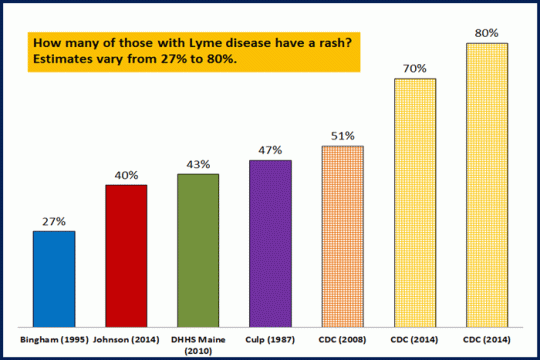
The only distinctive sign of Lyme disease is the circular bull’s eye rash that develops around the tick bite within a few weeks. However, the rash can also appear elsewhere on the body, and in 20-30% of patients it’s not seen at all.
The diagnosis of Lyme and rickettsial diseases is usually based on a combination of factors, including signs, symptoms, patient history and laboratory tests. Unfortunately, currently there aren’t any completely reliable diagnostic tests available for Lyme disease: in the first weeks after infection, there’s a 60% rate of false negative results. Serological assays for rickettsiosis are more reliable, but these can take 10–12 days to provide a decisive result.
Tests such as serological assays are required to identify rickettsiosis.
What To Do If You Think You’ve Been Infected With Rickettsia
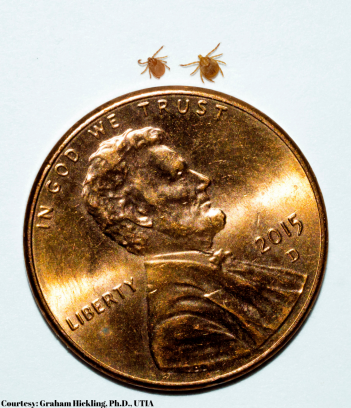
Ticks are very tiny, and their bites aren’t painful. Many people don’t even realise they’ve been bitten.
It’s important to note that being bitten by a tick doesn’t mean you’ve contracted an illness. In fact, out of the approximately 800 different tick species in the world, less than 60 can transmit infections to humans and animals. Most types of tick also have to be attached to the host’s body for an extended period of time in order to pass on any bacteria.
Nevertheless, you must see your doctor if you have a fever and any other flu-like symptoms or a rash shortly after being bitten by a tick. You should also arrange a medical appointment if you don’t recall being bitten but you do experience some suspicious symptoms within a few weeks of returning from a high-risk area. Be sure to tell your doctor about your recent travels, so that they can evaluate the probability of a tick-borne infection and order any appropriate diagnostic tests.
_______________
**Comment**
According to information written in Carl Tuttle’s petition against the IDSA, he mentions an article that indicates the persistent form of Lyme disease might be caused by another organism altogether.
“The STAT article reports that both Jorge Benach and Allen Steere now say it is time to take a closer look at Rickettsia helvetica’s role in Lyme disease. Benach says the research “should be done” because public health concerns warrant a closer look.”
“Dr. Willy Burgdorfer reviewed and tested patient blood samples from Dr. Anderson for C9P09, which is a rickettsial helical Mycoplasma; P09 being a Rickettsia bellii and C9 being a Mycoplasma (FIG. 2).35 This is further supported by the theory that an endosymbiotic infection produces spirochetes that are uncultivable Mycoplasmas, which are also called spirochetes. 1, 22, 31, 32
The “Swiss Agent” is documented by Dr. Willy Burgdorfer (FIG. 3),25 who also wrote a speech on “Pandora’s Box”.5 Although the Swiss Agent paper is associated with the suspected African Swine Flu, Dr. Willy Burgdorfer appears to be famous for leaving clues throughout his work regarding Lyme disease. Upon reviewing the structure of the Lyme disease “Swiss Agent” and the “Pandora Giant Virus”, there is a striking resemblance that deserves further examination.”
I don’t think we actually know precisely what the agent(s) causing Lyme disease is. This would explain why it can’t be picked up in current testing and why many fail treatment.
While it’s true that the early stages can often yield unspecific symptoms, an experienced eye will be able to diagnose a patient with tick borne illness. Also, please remember that in some patients their only symptoms are psychological: https://madisonarealymesupportgroup.com/2015/10/18/psychiatric-lymemsids/Any acute onset behavior changes should be suspect. Please don’t mess around with mainstream medicine should this occur. Get to an experienced and recommended ILADS practitioner who understands the mental illness aspect of tick borne disease.
The article’s statement that 20-30% of patients don’t get the rash must be taken from the inaccurate CDC count which is always abysmally low. No one I work with gets the rash. No one!
Please read this well written article on why we need to stop treating tick-borne illness like a typical infectious disease:
Seventeen (6.8%) samples were seropositive for antibodies against at least one pathogen: five for A. phagocytophilum, eight for B. burgdorferi, and four for Rickettsia spp.
Invasive Tick Detected in Six Additional Tennessee Counties
Thursday, October 17, 2019
NASHVILLE – The Tennessee Department of Agriculture, United States Department of Agriculture – Animal and Plant Health Inspection Services, Tennessee Department of Health, and University of Tennessee Institute of Agriculture today announced the detection of the invasive Asian longhorned tick in an additional six Tennessee counties: Knox, Jefferson, Claiborne, Cocke, Putnam, and Sevier. The tick was detected in Union and Roane Counties in May.
The Centers for Disease Control and Prevention reports that there is no evidence to date that the tick has transmitted pathogens to humans in the U.S. There are concerns that the tick may transmit the agent of Theileriosis in cattle, and heavy infestations can cause blood loss and lead to death.
It is important to be aware of this tick, as cattle and canines are particularly susceptible to tick bites. Livestock producers are reminded to be vigilant when purchasing animals, apply a tick treatment to cattle prior to bringing them to your farm, and always use best practices for herd health. Dog owners should provide their animals with a tick preventative and check for ticks.
“Tennessee has numerous animal hosts and a suitable habitat for this tick species,” Dr. R.T. Trout Fryxell, Associate Professor of Medical and Veterinary Entomology for UTIA, said. “While it is always important to be diligent and keep an eye out for all ticks, the unique biology of the Asian longhorned tick helps this species to establish quickly and become a problem.”
Tips to prevent tick bites in animals and livestock include:
· Coordinate with your veterinarian to determine appropriate pest prevention for pets and livestock.
· Check pets and livestock for ticks frequently.
· Remove any ticks by pulling from the attachment site of the tick bite with tweezers.
· Monitor your pets and livestock for any changes in health
If your animals are bitten by a tick, Dr. Trout Fryxell suggests putting the tick in a ziplock bag, writing down the date and where the tick was most likely encountered, and storing it in a freezer.
For additional information about the longhorned tick in the United States, click here. To find more information on tick-borne diseases, click here.
________________
**Comment**
The Asian Tick has been found in the following 12 states: Arkansas, Delaware, Kentucky, New Jersey, New York, North Carolina, Virginia, West Virginia, Pennsylvania, Maryland, Connecticut and Tennessee.
Deer, fragmented forests, ticks, a Lyme-like disease … and a little praise for possums
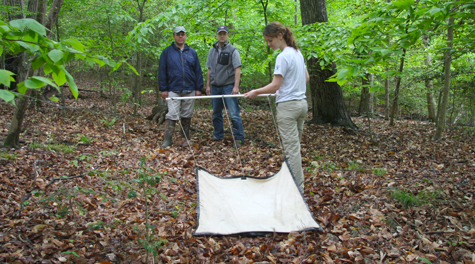
It’s a drag: In a photo from 2013, Joanna Weeks ’13 drags a cloth to collect ticks working with W&M biologists Matthias Leu (left) and Oliver Kerscher. The three were among the co-authors on a 2019 paper that examines the link between a Lyme-like tick-borne disease and fragmented forested habitat. Photo by Joseph McClain
by Joseph McClain | October 17, 2019
“…Say — what’s that?”
“Nothing but a tick.”
“Where’d you get him?”
“Out in the woods.”
“What’ll you take for him?”
“I don’t know. I don’t want to sell him.”
—Tom and Huck, in Tom Sawyer
Ticks were evidently so rare in Samuel Clemens’ Hannibal that a single live specimen had value enough to tempt Tom Sawyer to part with his newly shed tooth. Matthias Leu says it was the same in the Switzerland of his more recent youth.
“When I was a boy, I spent all my time in the forest,” Leu said. “I never saw one tick. And in Switzerland now, you should not leave the trails because there are so many ticks. So, it’s not just in North America; it’s global.”
__________________
**Comment*
Great read which exposes the fact that little is known about the Ehrlichia chaffeensis bacterium which gives similar symptoms as Lyme disease. According to biologist Matthias Leu, “There probably has been a lot of ehrlichiosis that was misdiagnosed as Lyme.” Leu and his colleagues studied the habitat of the Lone Star Tick and found that forest fragmentation causes more edges which deer love, giving ticks an easy meal.
Leu explains that deer are “competent hosts,” serving not only as a meal for the tick, but also a reservoir for ehrlichiosis, capable of infecting the next feasting tick with Ehrlichia chaffeensis. He states that fawns and yearling deer are especially important in transmission of the bacterium.
“The failure to test for Ehrlichia, even as more and more evidence suggests that the infection may be just as common as other endemic tick-borne diseases, appears to impact patient care with antibiotics prescribed less frequently when testing is not ordered.”





 Madison Area Lyme Support Group