Background: Fenbendazole (FBZ), an inexpensive and widely accessible antiparasitic drug used in veterinary medicine, has garnered growing interest for its potential as an anticancer therapy. Preclinical studies suggest that FBZ exerts its anticancer effects through a wide variety of mechanisms. While FBZ has shown promise both in vitro and in vivo studies, clinical evidence supporting its use and efficacy in treating metastatic cancer is currently limited.Case Presentations: This report highlights 3 cases of patients with advanced cancer – including breast, prostate, and melanoma. Two patients achieved complete remission, and one achieved near-complete remission after incorporating FBZ into their treatment regimens alongside other therapies (excluding chemotherapy). All three patients tolerated FBZ without any reported adverse effects, and remission was sustained during follow-up periods ranging from 11 months to nearly 3 years.
Conclusion: FBZ demonstrates potential as a novel promising therapeutic option for repurposing in oncology. Its ability to contribute to tumor regression and achieve disease remission warrants further clinical research to establish its efficacy and optimize its use.
For all my readers who are now familiar with our Cancer Stem Cells (CSC) Cancer Tree which was featured in the 2020 book, Surviving Cancer, COVID-19 and Disease: The Repurposed Drug Revolution, we have news! The tree has just been given a makeover by Dr. Paul Marik and the Independent Medical Alliance (IMA) artists.
Dr. Marik and the IMA have improved on the tree’s illustration as shown in their recent Substack here. But more importantly, they have helped reach a vastly wider audience. There is now much realistic hope that the word will get out to patient and oncologist alike. And once this has happened, we will witness improved clinically outcomes. We will witness the long-awaited paradigm shift in cancer care.
The timing is perfect as we are now in an era where cancer is overtaking heart disease as the number one cause of death. The timing is perfect because we are now witnessing a dramatic uptick in cancer cases as a result of widespread spike protein toxicity. And the timing is perfect because using the CSC model, we now have a God-given opportunity to intervene and prevent cancer recurrences following remission. (See link for illustrations, articles, and graphs of effective repurposed agents against cancer)
Autism Reversal in Twin Girls Through Lifestyle and Environmental Changes: Case Study
Article Excerpts:
The twins received routine vaccinations at three and six months, but no further vaccination until 14 months. The girls were given acetaminophen before and after vaccination.
Initial Symptoms
The girls’ parents observed some initial symptoms. One twin had sensitivity to changes, eczema, and digestive issues, and the other had problems making eye contact, babbling communication, difficulty breastfeeding, and decreased muscle tone (hypotonia).
In March 2021, the girls received the series of vaccines that had been delayed due to the COVID-19 pandemic. After this round of vaccinations, their parents noticed a worsening of some symptoms, including “significant language loss” for one of the girls, who began communicating using only single words.
ASD Diagnosis
Due to the worsening symptoms, the twins were evaluated for ASD, and both subsequently met the criteria for DSM-5 (Diagnostic and Statistical Manual of Mental Disorders, Fifth Edition) ASD diagnosis.
Lifestyle and Environmental Interventions
After their diagnosis, the twins’ parents began a comprehensive, personalized approach to address their daughters’ condition. Their approach was holistic and non-pharmacological and considered a variety of potential environmental and biological factors influencing ASD.
The interventions and support for both the twins and their parents began after the twins’ diagnosis at approximately 20 months of age and continued over the following two years. The following is a summary of their interventions and support:
Brief SUMMARY:
Dietary changes
Supplements
Speech and occupational therapy
Addressed environmental toxins
The twins achieved a reversal of their diagnoses of level 3 ASD. Significant improvements were seen in their social interactions, communication skills, and behavioral patterns. Both twins “improved dramatically,” with one going from a score of 76 to 36 in seven months, and the other from 43 to 4 over the same period.
The study notes that the improvements were so profound the pediatrician exclaimed that one of the girls had undergone “a kind of miracle.”
(See link for article)
______________
HHS Secretary Robert Kennedy Jr. Announces Thimerosal ban.
After more than 20 years of delay, I’m proud to finally deliver on a long-overdue promise: protecting our most vulnerable from unnecessary mercury exposure. ~ Robert F. Kennedy, Secretary HHS
More and more experts are calling for a retraction of the terribly flawed Danish study supposedly proving aluminum in vaccines isn’t harmful or in anyway cause autism. RFK calls the study a ‘deceitful propaganda stunt,’ and Steve Kirsch states an AI analysis cites 5 reasons for retraction:
the ‘evolving’ supplement and data manipulation which now reports 5,200 neurodevelopmental events (autism, ADHD, etc.), up from the 2,239 events in the original version Oops
the short follow-up period which gives a systematic underestimation of risk
institutional conflicts of interest and data suppression
statistical obfuscation and suppression of supplementary data
the erosion of public trust if left as is due to conflicts of interest, data manipulation, selective reporting, and institutional whitewashing
NEW STUDY – Seed Oil Fats Fuel Aggressive Breast Cancer Growth
Omega-6 fatty acids increase triple-negative breast cancer growth through mTORC1 pathway; population data links high omega-6/omega-3 ratio to increased all-cause and cancer mortality.
ω-6 linoleic acid (LA) is the most abundant unsaturated fat in Western-style diets and is derived from animal products [grain-fed instead of grass-fed] and processed foods containing vegetable oils, such as safflower oil. Many case-controlled retrospective and prospective studies have been conducted that explore associations between ω-6 LA intake and breast cancer incidence, but the conclusions are often contradictory. Adding to this complexity is breast cancer heterogeneity: Patients are stratified into four main clinical subtypes on the basis of expression of hormone receptors or lack thereof, each with distinct molecular characteristics and therapeutic sensitivities. Because ω-6 LA is an essential nutrient, we hypothesized that the mTOR pathway senses and is activated by its availability, leading to increased breast cancer cell proliferation in a subtype-specific manner.
RESULTS
By leveraging an extensive panel of breast cancer cell lines and patient-derived xenograft (PDX) tumors, we observed that ω-6 LA could activate mTORC1 but only in models of triple-negative breast cancer (TNBC), which is the most aggressive subtype that lacks any targeted therapy. We found that levels of the lipid chaperone fatty acid–binding protein 5 (FABP5) were significantly higher in TNBC compared with hormone receptor–positive tumors and that FABP5 directly interacted with mTORC1 to regulate complex formation, substrate binding, and subcellular localization. Notably, we demonstrated the relevance of this FABP5-mTORC1 signaling pathway in vivo by feeding animals a diet enriched for safflower oil that promoted TNBC tumor growth. FABP5 and ω-6 PUFAs appear to trigger a “perfect storm” of nutrient-driven signaling events, and both factors are also elevated in the serum of newly diagnosed TNBC patients.
CONCLUSION
Accumulating evidence suggests that dietary patterns may influence cancer outcomes, and there is substantial clinical interest in understanding the molecular mechanisms behind these associations to better inform nutritional recommendations. Our findings not only provide a mechanistic explanation for the heterogeneous responses of distinct breast cancer subtypes to dietary fats but also reveal an important perspective on how interactions between ω-6 LA intake and breast cancer need to be studied. Future nutritional studies might consider stratifying patients on the basis of FABP5 expression and triple-negative status.
It takes EIGHT years to completely detox from linoleic acid! Soybean oil causes the most damage to the body, followed by corn oil, sunflower oil, and canola oil. Healthier cooking oils for frying include avocado oil, coconut oil, palm oil, olive oil, beef tallow, butter, and ghee. It’s best to cook over low or medium heat. Pan-frying, air-frying, and stir-frying are healthier options than deep-frying over high heat.
Here’s A Thought… What If Everything We Were Told About Sunscreen Was a Lie?
While sunscreen does reduce the risk of some non-lethal skin cancers, the promise that it is the holy grail of preventing the killer ones is questionable at the very, most generous best.
While sunscreen does reduce the risk of some non-lethal skin cancers, the promise that it is the holy grail of preventing the killer ones is questionable at the very, most generous best.
Perhaps more importantly, sunscreen—not to mention the fear of the sun that keeps some folks indoors or completely covered up—can also reduce vitamin D production and lead to a deficiency of the vitamin, which itself has been linked to higher incidence of cancer. In fact, a study published in 2016 in the Journal of Internal Medicine found that avoiding the sun might be as bad for you as chain-smoking on the beach. Nonsmokers who shunned sunlight had the same life expectancy as smokers who soaked up the rays, suggesting that dodging the sun could be as dangerous as regularly lighting up.
But the reality is, most sunscreens focus on blocking UVB rays, which cause sunburn, but don’t offer much protection from UVA rays, which penetrate deeper into the skin and can trigger oxidative stress, potentially contributing to melanoma risk. This means you might spend longer in the sun (because you’re not burning!) while still suffering DNA damage and increasing your chances of developing melanoma. (See link for article)
______________
**Comment**
As I have been in a battle for over 6 months with basal cell carcinoma on my face and inner thigh, this topic is something I’ve been forced to learn about.
You won’t find it in mainstream media but many in alternative health and several cancer researchers have concluded that increasing omega-6 linoleic acid (PUFAs) intakes better explain the phenomenon of rising melanoma rates than increases in sun exposure over the same period. These oils have been linked to inflammation and chronic disease.
What dermatologists and mainstream medicine isn’t telling you is that full spectrum sunlight is probably the most important nutrient for the human body. We are now bombarded with unhealthy blue light from technology as well as damaging fake, narrow spectrum lighting in LED lights that have completely replaced incandescent lighting.
In fact, Dr. Richard Weller’s research suggests that sunlight exposure may trigger the release of nitric oxide in the skin, providing cardiovascular benefits and potentially other health advantages. When the skin is exposed to sunlight, it triggers the release of nitric oxide, which has various health benefits:
Lowered blood pressure: Nitric oxide helps to dilate blood vessels, reducing blood pressure and promoting better cardiovascular health.
Improved immune system function: Nitric oxide modulates immune responses and protects the body against infections.
Enhanced wound healing: Nitric oxide is involved in various stages of wound healing, such as inflammation, tissue regeneration, and remodeling.
Weller and other researchers have hypothesized that not wearing sunglasses could enhance the skin’s natural photoprotection mechanisms, leading to increased melanin production. This hypothesis is based on the idea that our eyes play a role in signaling our skin to produce melanin in response to sunlight. This work substantiates Dr. Otts work.
A 20-year study of nearly 30,000 Swedish women found that those who avoided the sun had a 60% higher risk of death than those who regularly got sunlight. Non-smokers who avoided the sun had the same mortality risk as smokers who got sun exposure.
The Myth That Sun Exposure Causes Deadly Skin Cancer
The numbers say otherwise:
Most skin cancers aren’t deadly. Basal cell carcinoma (BCC) and squamous cell carcinoma (SCC) are common but rarely life-threatening.
Melanoma, the deadliest skin cancer, isn’t primarily caused by sun exposure.
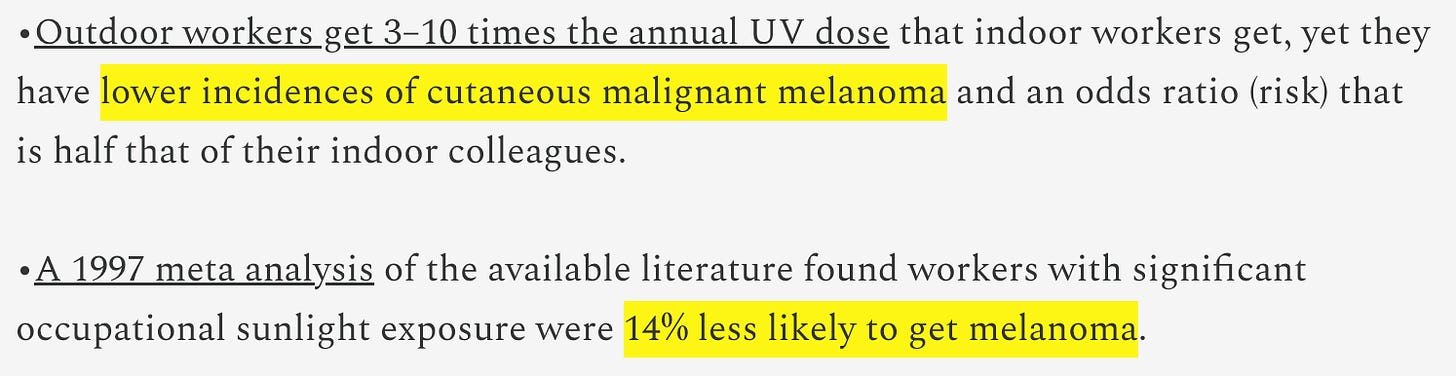
Outdoor workers get 3–10 times more UV exposure than indoor workers—yet have lower rates of melanoma.
“SCC (squamous cell carcinoma) and BCC (basal cell carcinoma) occur in sun-exposed areas, but melanoma is overwhelmingly found in areas that get almost NO sunlight.”
Go here to listen to Jimmy Dore discuss AMD’s article on dermatology’s war against the sun.
Personally I’ve had two MOHS surgeries on my face (not fun) where they cut out cancer, send samples to pathology and keep cutting until every cell is removed. You are then sent home with a wound you must keep open and wet which means you look pretty gruesome for a spell. It’s painful, takes time to heal, and can leave scars. When done on the face it can interfere with blinking and producing tears. Go here for my article on MSM and DMSO, and here for how people are using ivermectin and fenbendazole for many types of cancer.
Now, I am using CURADERM BEC5, an eggplant based cream that targets and destroys cancer cells and salicylic acid sloughs off the dead skin eventually leaving new virgin skin. This process, I’m not going to lie, is also painful. Think of burning acid ….. but it does not involve removing skin from vulnerable places or leaving scars. It can also take time depending on how deep the cancer goes. There can also be pus and sores until the cancer cells are all removed. Depending upon the size of the area you can also really go through the tiny tubes which are $200 a pop. Go here for a video on my process: https://madisonarealymesupportgroup.com/2018/03/02/dmso-msm-for-lyme-msids/
Since this self-experiment using CURADERM I’ve read some promising testimonials on Dr. Makis’ Substack where people are using ivermectin paste successfully on cancers that are topical. Unlike CURADERM, this paste isn’t painful to use. This will be my next experiment.
NOTE: If you have a scab or skin area that will not heal, have it checked out. All of my basal cell carcinomas where little areas that wouldn’t heal over time. In nearly every case the cancer was deeper and wider than the initial spot. Now, if I have a suspicious spot, I simply apply a tad of CURADERM and wait. If it becomes red and inflamed I know I’m dealing with cancer.
The Warburg effect — Otto Warburg’s seminal observation that cancer cells preferentially ferment glucose into lactate even in oxygen-rich conditions — represents a metabolic vulnerability ripe as the perfect therapeutic target for cancer treatment.
Yet, a century after its elucidation, oncology remains tethered to genetic paradigms, sidelining metabolic strategies in favor of cytotoxic and targeted interventions that work at best on about 15% of cancers, representing an abysmal “treatment” model.
Early anecdotal findings of thousands upon thousands of patients show that administering a synergistic combination therapy of repurposed miracle drugs across a large variety of cancers is efficacious in about 80%+ of patients, representing the all-elusive until now ‘holy grail’ cancer cure.
This willful neglect of the cure in plain sight, rooted in Rockefeller Eugenics, allopathic BigPharma, and industrial influences traceable to the early 20th century, has perpetuated a cancer “care” model that prioritizes profit over lives that is designed to relieve patients of the maximum amount of money en route to torturous iatrogenic outcomes, and/or being sent home to die.
Emerging metabolic therapies, including repurposed drugs like Ivermectin (IVM) and Fenbendazole (FBZ), alongside the rare sugar allulose, challenge this orthodoxy by directly targeting the glycolytic dependency of malignant cells. (Cancer cells are sugar dependent, whereas healthy cells use mostly oxygen to convert to energy stores.)
This highlights the IvermectinFenbendazoleAllulose revolution sweeping the planet, with recent supply chain strains of IVM and FBZ from India with huge increases in Worldwide demand.
Hundreds of thousands of late stage cancer prognoses are being declared full remission as borders across the world are doing there level best to seize IVM and FBZ on behalf of the corrupt governmental agencies that are bought and paid for by BigPharma and their Deep State partners-in-crime.
We will now explore the mechanisms underlying these agents (Ivermectin, Fenbendazole and Allulose) with Warburg’s insights, and their broader implications for cancer, type 2 diabetes, and obesity—conditions united by metabolic dysregulation. (See link for article)
Blueprint for Government-Controlled Medicine Sidesteps RFK Jr.
By The ANH Team
Just as RFK Jr. gets his legs under his desk at HHS, a centralized public health agenda is gathering pace that threatens medical freedom, farmers’ rights, food security, and individual choice. Action Alert!
The CDC’s One Health Framework centralizes authority over public health decisions, potentially limiting independent research, open discussion, and medical freedom.
The rollout of One Health is part of the public health response to bird flu, mirroring the COVID-19 playbook.
The One Health approach sets the stage for greater government control, mandated health policies, and reduced medical autonomy.
The Centers for Disease Control and Prevention (CDC), the US Department of Agriculture (USDA), and the Department of Interior (DOI) have jointly unveiled their National One Health Framework to Address Zoonotic Diseases and Advance Public Health Preparedness in the United States. Framed as a way to address zoonotic diseases and public health challenges—like the H5N1 bird flu—the One Health approach claims to integrate human, animal, plant, and environmental health concerns into a unified strategy. In our view, this framework lays the groundwork for sweeping governmental control over medical (and veterinary) decision-making and, in the case of the bird flu, direct intervention in the nation’s food supply.
One Health: Centralized Control Disguised as Public Health
The One Health approach has been around for several years but had not become official policy until January 2025. The policy effectively consolidates power in the hands of three federal agencies led by the CDC, USDA and DOI, dictating public health responses during crises. Instead of allowing independent research, open discussion, and medical freedom, this framework ensures that a “unified federal voice” dictates the narrative and available treatment options.
Crucially, the powers-that-be appear to be deploying One Health policies primarily through the USDA and not the CDC, which comes under the jurisdiction of the Department of Health and Human Services (HHS). This shift away from CDC control is likely linked to Robert F. Kennedy Jr.’s role as new head of HHS, and he has been vocally resistant to pharmaceutical-driven health policies. The rollout of One Health, which emerged during the COVID era under the Biden administration, is being justified by rising concerns over the bird flu situation.
COVID Redux: H5N1
H5N1 avian influenza, aka ‘bird flu’, renamed more recently (presumably because it sounds more dangerous?) as ‘highly pathogenic avian influenza’ (HPAI) is a highly transmissible viral infection that primarily affects wild birds but has spread among poultry and dairy cows in the US. There have been a handful (70) human cases so far in the US with 1 death, according to the CDC. (You can reference our earlier coverage of the bird flu hereto get more background.)
The unfolding public health response to H5N1 bird flu mirrors the tactics used during COVID-19, except this time the food supply is involved. Scientists working under the pretext of pandemic preparedness have long manipulated avian influenza viruses, increasing their ability to cross species and infect humans (sound familiar?). Pharmaceutical interventions like mRNA vaccinesare already in development using half a billion dollars of taxpayer money, ensuring that government-backed solutions are already in place if/when further outbreaks occur.
Federal agencies have used this situation to justify mass culling of poultry, purportedly to prevent further spread. Just as during COVID-19, PCR testing—known for its high false-positive rates—is being used to assess the number of infections. Inflated case numbers fuel media hysteria and the sense that there is a public health crisis. The result is artificial food shortages and price inflation.
You can see where this is going: to return to “normal,” we’re going to be told to accept mandatory vaccination of farm animals under the guise of disease prevention—no matter what the human health consequences may be of eating food that has been treated with mRNA vaccines. This crisis ultimately forces farmers and the public into compliance, making acceptance of One Health measures a prerequisite for food security.
Why This Matters
The One Health Framework is, in essence, an infrastructure for centralized medical and veterinary control. By ensuring a unified government voice, dictating public and animal health responses, and training agencies to enforce these directives, the plan undermines medical and health freedom as well as the right to informed choice. Under One Health-style frameworks, it’s not hard to imagine what the next round of lockdowns might look like, with public health authorities having learned from the mistakes of the first round during COVID.
A similar push for centralized control is evident in the World Health Organization’s (WHO) plans to exert greater influence over global health policies (see ANH International’s analysis). President Trump’s decision to withdraw from the WHO was driven by desire to resist global control, but only time will tell how the new Administration will respond to centralized, coordinated responses like One Health that develop within America’s borders. There is also the specter of how future presidents might act in relation to the WHO, the Food and Agriculture Organization (FAO), and other United Nations’ agencies. The One Health Framework is, oddly, entirely in alignment with the global doctrines of UN agencies, and they potentially lay the foundation for international directives that override national sovereignty in health or veterinary policy.
Farmer First and Health Freedom
Outbreaks of highly contagious diseases like bird flu have already led to large-scale culling of poultry in the US, with over 35 million birds in commercial flocks being killed so far. This has caused significant distress and financial hardship for poultry farmers. The policy is part of the ‘stamping-out’ policy for avian influenza that meets World Organization for Animal Health (WOAH) standards in an effort to maintain international poultry exports. Accordingly, the USDA is using the policy to force farmers to cull their flocks when ‘HPAI’ is detected, regardless of whether or not animals are sick. Many farmers and farmers’ groups are questioning the ethical and animal welfare impacts of the ‘stamping-out’ policy.
But it’s not just farm animals that are at risk of these draconian policies. One Health envisions coordinated responses against human cases that follow the rubric that was so widely adopted—and rarely questioned—by government authorities during the COVID-19 pandemic. Rather than consolidating authority into a top-down bureaucracy, we should encourage open scientific debate rather than enforcing a unified narrative, promote individual choice in medical treatments, ensure transparency and accountability in public health decisions, and prioritize local or regional responses and health strategies over broad federal mandates.
Public health should empower individuals, not enforce compliance. The CDC’s One Health Framework moves us toward an era where governments dictate medical choices, silencing those who dare to question official recommendations.
It’s time to reject centralized medical authoritarianism and advocate for a diverse, open, and decentralized health system that encourages the dissemination of truthful health information and respects the right of individuals to make informed choices about their own bodies and well-being.
Action Alert! Write to Congress and tell them to reject the One Health framework to protect individual medical autonomy. Please send your message immediately.
Go to top link to write Congress to oppose One Health Framework.
______________
**Comment**
Sadly, a lot of Lymeland has embraced One Health, and research is nearly all earmarked with this Trojan Horse euphemism. The similarly and disastrously named PTLDS comes to mind.
Reggie Littlejohn, founder and president of Women’s Rights Without Frontiers and co-chair of the Stop Vaccine Passports Task Force, described One Health as “a very holistic-sounding approach to healthcare” that emphasizes “the interface between human health, animal health, plant health and ecological health.”
“All of that sounds very inclusive and holistic,” said Littlejohn, but “my concern is that it gives the WHO, under the pandemic treaty, the ability to intervene in any aspect of life on earth. So, if they find a health risk that involves animals or plants or even the environment, not just humans, then they can go into operation concerning that.”
“The entire One Health Scheme is based upon the patent lie and obvious disinformation that COVID-19 somehow magically leaped from some animal in the Wuhan wet-market instead of being an offensive biological warfare weapon with gain-of-function properties that leaked out of the Wuhan BSL4 [biosecurity level 4 lab].”



 Madison Area Lyme Support Group