Archive for the ‘Bartonella’ Category

Disseminated Cat Scratch Disease in Pediatric Patients in Hawaii

https://www.ncbi.nlm.nih.gov/pmc/articles/PMC7260883/

. 2020 May 1; 79(5 Suppl 1): 64–70.
PMCID: PMC7260883
PMID: 32490388

Disseminated Cat Scratch Disease in Pediatric Patients in Hawaii

Abstract

Cat scratch disease is known to be a generally benign, self-resolving illness associated with non-specific symptoms, including lymphadenopathy, fever, fatigue, anorexia, and headaches. However, it can also cause disseminated disease with a wide range of manifestations, including liver and spleen microabscesses, osteomyelitis, encephalitis, and uveitis.

Eighteen pediatric cases of disseminated cat scratch disease at a single center in Hawaii are described. This case series emphasizes the importance of disease recognition and use of appropriate diagnostic tools and disease management. The disease burden of pediatric patients with disseminated cat scratch disease in the state of Hawaii has a high incidence and should be considered in pediatric patients with prolonged febrile illnesses.

____________________

**Comment**

This is important because few doctors will consider Bartonella in pediatric patients.  Like the article states, most doctors consider Bartonella to be a benign, self-resolving disease when nothing could be further from the truth.  In fact, I’d go as far to say it can be as bad as Lyme if not worse.  It’s very tenacious.

For more:  https://madisonarealymesupportgroup.com/category/bartonella-treatment/

https://madisonarealymesupportgroup.com/2019/04/24/human-bartonellosis-an-underappreciated-public-health-problem/

https://madisonarealymesupportgroup.com/2019/11/14/bartonella-vs-borrelia-key-differences-you-should-know/

https://madisonarealymesupportgroup.com/2019/02/06/uh-study-shows-hawaii-kids-more-vulnerable-to-bartonella/  University of Hawaii study shows Hawaii keiki are more than three times more likely to get severe forms of cat scratch disease than mainland kids.

This is an interesting finding.  I wouldn’t blame only cats. Bartonella can be transmitted from many, many things:

Mode of Transmission: Arthropod vectors including fleas and flea feces, biting flies such as sand flies and horn flies, the human body louse, mosquitoes, and ticks; through bites and scratches of reservoir hosts; and potentially from needles and syringes in the drug addicted. Needle stick transmission to veterinarians has been reported. There is documentation that cats have received it through blood transfusion. 3.2% of blood donors in Brazil were found to carry Bartonella in their blood. Bartonella DNA has been found in dust mites. Those with arthropod exposure have an increased risk, as well as those working and living with pets that have arthropod exposure. 28% of veterinarians tested positively for Bartonella compared with 0% of controls. About half of all cats may be infected with Bartonella – as high as 80% in feral cats and near 40% of domestic cats. In various studies dogs have close to a 50% rate as well. Evidence now suggests it may be transmitted congenitally from mother to child – potentially leading to birth defects.

**On a personal note**

If my husband and I have symptoms – they are typically Bartonella symptoms. After years of treatment, we both use Berberine, which has served as a wonderful maintenance treatment for both of us:  https://madisonarealymesupportgroup.com/2019/05/05/good-news-for-bartonella-patients-identification-of-fda-approved-drugs-with-higher-activity-than-current-front-line-drugs/
 

Formidable Evidence For Sexual Transmission of Lyme Disease – First Study to Document ACA Rashes in Canadian Patients

healthcare-08-00157-v2 Full study Here

Presentation of Acrodermatitis Chronica Atrophicans Rashes on Lyme Disease Patients in Canada

John D. Scott

International Lyme and Associated Diseases Society, 2 Wisconsin Circle, Suite 700, Chevy Chase, MD 20815-7007, USA; jkscott@bserv.com; Tel.: +1-519-843-3646 Received: 13 May 2020; Accepted: 29 May 2020; Published: 4 June 2020

Abstract:

Lyme disease (Lyme borreliosis) is a complex multisystem illness with varying clinical manifestations. This tick-borne zoonosis is caused by the spirochetal bacterium, Borrelia burgdorferi sensu lato (Bbsl) and, worldwide, presents with at least 20 different types of rashes. Certain cutaneous rashes are inherently interconnected to various stages of Lyme disease. In this study, five Canadian Lyme disease patients from a multi-age range presented various phases of the acrodermatitis chronica atrophicans (ACA) rash. In each case of ACA, the underlying etiological pathogen was the Lyme disease spirochete. Although ACA rashes are normally found on the lower extremities, this study illustrates that ACA rashes are not directly correlated with a tick bite, geographic area, age, Bbsl genospecies, exercise, or any given surface area of the body.

  • Case 4 provides confirmation for an ACA rash and gestational Lyme disease (club feet at birth).  Both parents tested positive for Bbsl.
  • One patient (Case 5) puts forth a Bbsl and Bartonella sp. co-infection with a complex ACA rash.
This study documents ACA rashes on Lyme disease patients for the first time in Canada.

**Comment**

The study states that about 63% of patients infected with Lyme develop chronic Lyme disease.  Authorities keep telling us it’s only 10-20%. It also states Lyme colonizes in many immune-privileged sides including bone, brain, eye, ligaments & tendons, heart, kidney, bladder, liver, muscle, synovial cells, central nervous system, claim and neuronal cells, and fibroblasts/scar tissue.  It states Lyme can be an insidious neurologic pathogenesis with demyelination, and even fatal.

The study points out that Bb is pleomorphic with diverse forms (spirochetes, round bodies, blebs, granules, and biofilms). The study also touches upon the hopelessness many patients can experience which can lead to despair and suicide. Lyme may be potentially transmitted via intimate relations as well as gestationally.

For more:  

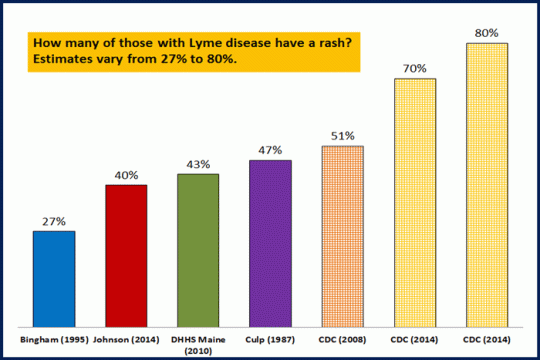
Rashes-larger-blog-4Various studies showing how many get the EM rash.

Intracranial Infection in Homeless Patient – Bartonella Diagnosis By Molecular Approach

https://pubmed.ncbi.nlm.nih.gov/32429864/?from_term=bartonella&from_filter=years.2020-2020&from

. 2020 May 19;20(1):357.

doi: 10.1186/s12879-020-05088-2.

Unusual Subdural Empyema in a Homeless Patient Diagnosed by Molecular Approach: A Case Report

Affiliations expand

Abstract

Background: We report a case of subdural empyema in a homeless patient caused by Bartonella quintana. B. quintana is a facultative intracellular bacteria for which bacterial growth is fastidious. The molecular biology approach has been a real help in establishing the diagnosis.

Case report: A 59-years old homeless patient, with a history of chronic alcohol abuse, was brought to the emergency department with a massive subdural empyema. Extensive microbiological evaluation didn’t reveal any pathogen in the pus collected before antibiotic treatment. B. quintana was detected in the pus from the empyema using a 16S rRNA-based PCR. Histology of intraoperative samples was consistent with the diagnosis and a serological assay was positive. The patient responded well to a treatment that included craniectomy with drainage of the loculated pus, total removal of the infected capsule and a combination of antibiotics.

Conclusion: This unique case of B. quintana-related empyema illustrates the risk of secondary infection of subdural hematoma with B. quintana since such infections have recently reemerged, predominantly among the homeless populations. Patients with subdural empyema in at-risk populations should be systematically evaluated for B. quintana with an appropriate diagnostic approach involving molecular biology.

_____________________

For more:  https://madisonarealymesupportgroup.com/category/bartonella-treatment/

https://madisonarealymesupportgroup.com/2019/04/24/human-bartonellosis-an-underappreciated-public-health-problem/

https://madisonarealymesupportgroup.com/2020/02/19/bartonella-infection-everywhere-but-we-dont-know-about-it/

https://madisonarealymesupportgroup.com/2018/05/07/fox-news-bartonella-is-the-new-lyme-disease/

https://madisonarealymesupportgroup.com/2016/08/09/a-bartonella-story/

https://madisonarealymesupportgroup.com/2017/01/04/endocarditis-consider-bartonella/

Ocular Complications of Cat Scratch Disease

https://www.ncbi.nlm.nih.gov/pubmed/32122915/

2020 Mar 2. pii: bjophthalmol-2019-315239. doi: 10.1136/bjophthalmol-2019-315239. [Epub ahead of print]

Ocular complications of cat scratch disease.

Abstract

Cat scratch disease (CSD) in humans is caused by infection with Bartonella henselae or other Bartonella spp. The name of the disease reflects the fact that patients frequently have a history of contact (often involving bites or scratches) with infected cats. Patients with CSD typically develop lesions at the site where the skin is broken together with regional lymphadenopathy but may go on to exhibit systemic symptoms and with deep-seated infections at a range of sites including the eye. Patients with CSD may present with a range of inflammatory eye conditions, including Parinaud’s oculoglandular syndrome, neuroretinitis, multifocal retinitis, uveitis and retinal artery occlusion. Bartonella spp. are fastidious bacteria that are difficult to culture from clinical specimens so microbiological diagnosis is frequently made on the basis of positive serology for anti-Bartonella antibodies or detection of bacterial DNA by PCR. Due to the lack of clinical trials, the evidence base for optimal management of patients with CSD-associated eye infections (including the role of antibiotics) is weak, being derived from single reports or small, uncontrolled case series.

________________

**Comment**

This study states what the rest of us all know – there is a lack of research on Bartonella yet it is everywhere:  https://madisonarealymesupportgroup.com/2020/02/19/bartonella-infection-everywhere-but-we-dont-know-about-it/

https://madisonarealymesupportgroup.com/2019/04/24/human-bartonellosis-an-underappreciated-public-health-problem/

https://madisonarealymesupportgroup.com/category/bartonella-treatment/

https://madisonarealymesupportgroup.com/2019/01/02/bartonella-in-entire-canadian-family/

https://madisonarealymesupportgroup.com/2019/04/08/case-series-bartonella-ocular-manifestations/

https://madisonarealymesupportgroup.com/2018/09/06/ocular-manifestations-of-bartonellosis/

And please know you don’t have to be exposed to cats to get it:  https://madisonarealymesupportgroup.com/2018/07/10/bartonella-henselae-neuroretinitis-in-patients-without-cat-scratch/

You also don’t have to be immunocompromised to get it:  https://madisonarealymesupportgroup.com/2019/12/18/multifocal-hepatic-abscess-in-immunocompetent-patient-due-to-bartonella-henselae-case-report-with-review-of-literature/

Bartonella Case – Eschar & Enlarged Lymph Nodes

https://www.ncbi.nlm.nih.gov/pubmed/32164559

2020 Mar 12;20(1):216. doi: 10.1186/s12879-020-4940-0.

Scalp eschar and neck lymphadenopathy after tick bite (SENLAT) caused by Bartonella henselae in Korea: a case report.

Abstract

BACKGROUND:

Tick-borne lymphadenopathy (TIBOLA) is an infectious disease, mainly caused by species from the spotted fever group rickettsiae and is characterized by enlarged lymph nodes following a tick bite. Among cases of TIBOLA, a case of scalp eschar and neck lymphadenopathy after tick bite (SENLAT) is diagnosed when an eschar is present on the scalp, accompanied by peripheral lymphadenopathy (LAP). Only a few cases of SENLAT caused by Bartonella henselae have been reported.

CASE PRESENTATION:

A 58-year-old male sought medical advice while suffering from high fever and diarrhea. Three weeks before the visit, he had been hunting a water deer, and upon bringing the deer home discovered a tick on his scalp area. Symptoms occurred one week after hunting, and a lump was palpated on the right neck area 6 days after the onset of symptoms. Physical examination upon presentation confirmed an eschar-like lesion on the right scalp area, and cervical palpation revealed that the lymph nodes on the right side were non-painful and enlarged at 2.5 × 1.5 cm. Fine needle aspiration of the enlarged lymph nodes was performed, and results of nested PCR for the Bartonella internal transcribed spacer (ITS) confirmed B. henselae as the causative agent.

CONCLUSION:

With an isolated case of SENLAT and a confirmation of B. henselae in Korea, it is pertinent to raise awareness to physicians in other Asian countries that B. henselae could be a causative agent for SENLAT.

________________

For more:  https://madisonarealymesupportgroup.com/category/bartonella-treatment/

https://madisonarealymesupportgroup.com/2019/04/24/human-bartonellosis-an-underappreciated-public-health-problem/

https://madisonarealymesupportgroup.com/2020/02/19/bartonella-infection-everywhere-but-we-dont-know-about-it/