
Case of Cerebral Vasculitis Due to Neurobartonellosis
https://nn.neurology.org/content/7/5/e791
We report a case of a 60-year-old right-handed woman with hypertension, hyperlipidemia, and hypothyroidism who presented with a three-week history of:
- recurrent thunderclap headaches
- photophobia (aversion to light)
- phonophobi (aversion to sound)
- nausea
- vomiting
She reported one brief episode of:
- slurred speech
- expressive aphasia (inability to understand and formulate language)
- right facial droop
- right hemiparesis suggestive of a TIA
Family history was remarkable for primary angiitis of the CNS (PACNS) in the mother. Neurologic examination was unremarkable. CT of the head was negative; CT angiography (CTA) of the head and neck suggested fibromuscular dysplasia in bilateral cervical internal carotid arteries and distal right vertebral artery. MRI of the brain showed no correlating abnormalities. A digital subtraction angiography (DSA) revealed multivessel intracranial medium and large vessel narrowing and fusiform dilatations, suggestive of reversible cerebral vasoconstriction syndrome (RCVS) vs vasculitis. Subsequent MR intracranial vessel wall imaging (IVWI) showed multifocal concentric vessel wall thickening and enhancement consistent with vasculitis (figure). Transcranial Doppler showed no evidence of elevated intracranial velocities. CSF studies were unremarkable with an opening pressure of 10 cm H2O, 2 white blood cells (normal 0–5/mm3), 2 red blood cells (normal 0–1/mm3), 58 mg/dL glucose (normal 40–70, serum glucose 87), 41 mg/dL protein (normal 15–45), normal Q-albumin ratio, normal IgG synthetic rate, and IgG index. Serum inflammatory and infectious studies had been negative thus far. Empiric high-dose IV steroids lead to complete symptom resolution.
Final infectious workup revealed strongly positive serum Bartonella IgM titer of 1:256 and negative IgG, consistent with her reported cat exposure.
She was started on an outpatient two-week course of doxycycline, rifampin, and oral steroids. Four weeks later, repeat vessel wall MRI and Bartonella serologies (IgM titer 1:80) showed improvement.

(A) Angiogram of the left internal carotid artery showing multifocal narrowing and fusiform dilatations (arrows) pretreatment. (B) Intracranial vessel wall MRI showing multifocal concentric vessel wall thickening and enhancement (arrows) pretreatment. (C) Intracranial vessel wall MRI showing reduction in vessel wall enhancement (arrows) posttreatment. (D) Magnetic resonance angiography (MRA) head showing multifocal stenoses (arrows) pretreatment. (E) MRA head showing improvement of stenoses (arrows) posttreatment.
Discussion
We present an individual with symptoms initially concerning for RCVS vs vasculitis who was subsequently found to have secondary CNS vasculitis due to cat-scratch disease (CSD). To our knowledge, this is the first adult case of Bartonella henselae-associated CNS vasculitis, particularly without encephalopathy as the presenting symptom.
CSD typically presents with self-limited regional lymphadenopathy and fever.1 Neurologic complications are rare, occurring in 2% of cases with encephalopathy as the most common manifestation.2 Neuroretinitis, seizures, coma, myelopathies, and cranial and peripheral nerve involvement have also been reported. CNS vasculitis associated with CSD, however, has only been reported in 2 pediatric cases which presented with strokes.3,4
Diagnostically, identifying primary and secondary CNS vasculitis can be challenging both clinically and radiographically. No specific studies in serum or CSF are available for the diagnosis of CNS vasculitis. As in neurobartonellosis, CSF may be unremarkable or reveal nonspecific mild lymphocytic pleocytosis. Cerebral vasculopathies can present with similar luminal patterns, and therefore, imaging modalities such as DSA, magnetic resonance angiography (MRA), and CTA provide nonspecific results leading to difficulties identifying and differentiating between common etiologies of intracranial disease including vasospasm, atherosclerosis, and inflammation. Although DSA remains the gold standard for vessel imaging, it is an invasive study that provides information limited to the vessel lumen. Conversely, IVWI allows direct visualization of the vessel wall by subtracting the signal of blood in the vessel lumen and has shown to improve diagnostic specificity.5 In CNS vasculitis, IVWI shows multifocal concentric vessel wall enhancement and thickening as seen in our patient. In RCVS, vessel wall thickening may be present but with minimal or no enhancement.5
At this time, there is no clear evidence-based treatment regimen or duration for neurologic manifestations of CSD including CNS vasculitis.1 We recommend concomitant treatment of the infection with antibiotics and secondary vasculitis with high-dose steroids. Our patient received a 2-week combination of doxycycline 100 mg and rifampin 300 mg twice daily per current expert opinion.6 In addition, we initiated 5 days of high-dose IV steroids, followed by a 1-week oral steroid taper. To avoid recurrent invasive testing, we repeated IVWI 4 weeks later for treatment monitoring and found significant reduction in vessel wall enhancement (figure).
Our case reiterates the importance of ruling out rare causes of CNS vasculitis including assessing animal exposure before diagnosing PACNS. Detection of the etiology of vasculitis is essential to guide treatment and for prognostication. Noninvasive imaging such as an IVWI provides valuable diagnostic information and can be useful in assessing the treatment response over time by minimizing the need for repeat invasive DSA.
Study funding
No targeted funding reported.
Disclosure
M. Poursheykhi, F. Mithani, T. Garg, C. Cajavilca, S. Jaijakul, S. Fung, R. Klucznik, and R. Gadhia report no disclosures. Go to Neurology.org/NN for full disclosures.
Acknowledgment
The authors thank Dr. Gadhia for his mentorship.
_____________________
**Comment**
Since Bartonella is a vascular disease, it follows that it will cause vasculitis pretty much anywhere in the body. https://madisonarealymesupportgroup.com/2020/01/05/bartonella-endocarditis-masquerading-as-systemic-vasculitis-with-rapidly-progressive-glomerulonephritis/
It also creates tumors, many neurological manifestations including PANS and other mental health issues.
The concern with their treatment is it wasn’t long enough and she could relapse, which is common. Bartonella, in my opinion, is as bad if not worse than Lyme disease and together it’s a one, two punch – you are out.
Marna Ericson’s work has demonstrated it to survive right along side a PICC line with antibiotics being pumped directly into the body: https://madisonarealymesupportgroup.com/2019/02/27/advanced-imaging-found-bartonella-around-pic-line/ The subject is her son who has chronic bartonellosis.
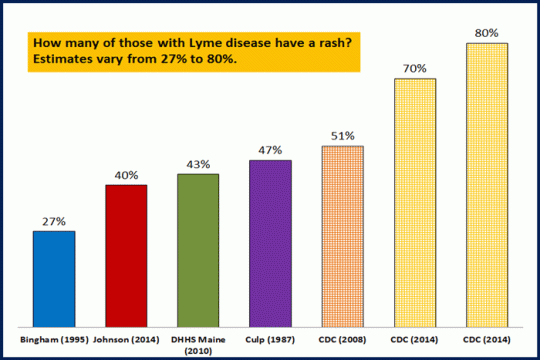 Various studies showing how many get the EM rash.
