Winter thaws bring out the ticks. Take precautions when heading outdoors on warm winter days to avoid tick bites. Wearing light-colored clothing and tucking pantlegs into socks can help. Credit: Pavla Zakova | Dreamstime.com
We asked disease ecologist Rick Ostfeld if we need to worry about ticks during the winter. His response is below. (TL; DR = yes)
Blacklegged ticks, which transmit the agents of Lyme disease, babesiosis, and anaplasmosis, disappear in winter, right? Well, not entirely. Although human encounters with these ticks are less likely in winter, there are plenty of ticks out in the environment lurking in a state of (almost) suspended animation.
Larval ticks that hatched the prior summer but failed to find an animal host can become dormant and remain on the forest floor in a quiescent state. The same is true of nymphal ticks, which are normally most active in spring and early summer. These two stages are unlikely to activate until day-length and temperature both increase dramatically. Adult stage ticks, in contrast, most actively seek hosts in the late fall.
The females that were able to engorge on host blood last fall are overwintering in soil pores or under leaf litter, while slowly converting host blood into eggs that they will lay next spring or summer. Some of the adults that did not find a host have died of starvation or other causes, but the unfed survivors will activate any winter or spring day with above-freezing temperatures. In the southern United States, these ticks can be active all year, but even in the northeastern and upper Midwestern regions, ticks can bite during any warmish spell in January, February, and beyond.
As part of The Tick Project, we invite participating households to mail us ticks found embedded in or crawling on people or pets, and we typically receive quite a few even in the coldest months. The riskiest seasons for diseases transmitted by blacklegged ticks are spring and summer, but risk never goes away entirely. And, our 25-years of data from Dutchess County, NY show that, as the climate warms, the ticks come out earlier in the year, advancing the dates of greatest risk.
Patients and physicians managing chronic illnesses are often unsure of what is causing the mysterious symptoms.
They could be caused by autoimmune diseases or difficult-to-diagnose stealth infections. Flea-and tick-borne pathogens cause a variety of similar non-specific symptoms despite their distinct morphologies and pathogeneses.
Furthermore, more than one pathogen can be transmitted during a single bite from a vector (co-infection). The complex interaction between the environment, animals such as those that harbor these pathogens, and humans is called “one health.”
Galaxy Diagnostics works with a one health framework and offers advanced testing for a spectrum of common tick-borne pathogens. This week, we are introducing an updated Babesia species page to offer more insight into the health significance of these species and how our PCR test can help provide an accurate diagnosis.
Unlike Bartonella and Borrelia bacteria, Babesia species are protozoans that typically remain active in the bloodstream. Babesia species are primarily transmitted by ticks and selectively attach to and infect the red blood cells of their hosts. Once infected, red blood cells can lyse (burst open), spilling their infectious cargo and resulting in the range of symptoms that are seen in patients struggling with babesiosis (infection with Babesia species or closely related Theileria species).
Babesiosis is primarily caused by Babesia microti in the United States, while Babesia divergens infection is more common in Europe. Infections caused by Babesia duncani have also been reported along the Pacific coast of the United States.
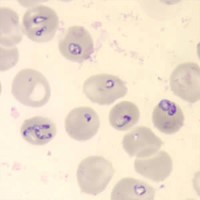
Red blood cells infected with Babesia (Source: CDC Website)
The most common method of diagnosing babesiosis is a combination of clinical symptoms and laboratory evidence. As seen to the right, it is possible to see Babesia species infection under the microscope using a staining technique. However, this can look similar to other protozoal infections.
Another form of testing called antibody testing or serology looks for an immune response to specific antigens, but it can be difficult to interpret whether serology test results indicate a past or current infection.
Galaxy Diagnostics offers PCR testing of blood to locate Babesia species DNA and confirm active infection. With genus-level DNA primers, our Babesia/Theileria species PCR test can detect a variety of pathogenic species. Please see the updated page on our website to learn more about Babesia species and how we test for them.
________________
**Comment**
Babesia alone is a formidable foe. Couple it with Lyme and you are one sick dog. Dr. Krause published in the New England Journal of Medicine that when a patient has Lyme and Babesia, Lyme is found three-times more frequently in the blood, proving Babesia suppresses the immune system. https://madisonarealymesupportgroup.com/2017/06/28/concurrent-babesiosis-and-lyme-in-patient/
THE NUMBER OF SYMPTOMS AND DURATION OF ILLNESS IN PATIENTS WITH CONCURRENT LYME DISEASE AND BABESIOSIS ARE GREATER THAN IN PATIENTS WITH EITHER INFECTION ALONE.
The challenge with diagnosis, as always, is the testing which is poor as these organisms are not often found in high enough numbers in the blood, as well as people present subclinically. In other words, their Lyme case is more severe and they have malarial-type symptoms, but they can’t find Babesia in the blood in a Giemsa stain. this is why it’s imperative to see a LLMD trained in recognizing symptoms.
Regarding the article’s statement that certain strains are found in certain places, remember, ticks are migrating everywhere and taking their crud with them. Migrating birds haven’t been told they can’t cross an imaginary line on a map. All three of the strains listed are in the U.S.
In December of 2018, the Tick-Borne Disease Working Group released its first report to Congress regarding the epidemic of emerging disease. This article gives a basic rundown of relevant statements contained in the first of three TBDWG reports to Congress.
What is the Tick-Borne Disease Working Group?
The TBDWG is a fourteen-member panel of infectious disease professionals called together in light of the 21st Century Cures Act and organized by the Department of Health and Human Services. This group is tasked with reviewing the current science and treatment progress of the various tick-borne diseases and reporting their findings to Congress every two years in December. December 2018 saw the first report, there will be a second report in December 2020 followed by final recommendations at the end of 2022.
So what does this first report detail regarding Morgellons disease? Let’s dive in and find out!
Chronic Lyme Disease
At the start of the first TBDWG report it is stated,
“While most Lyme disease patients who are diagnosed and treated early can fully recover, 10 to 20% of patients suffer from persistent symptoms, which for some are chronic and disabling. Studies indicate that Lyme disease costs approximately $1.3 billion each year in direct medical costs alone in the United States.”
Sounds promising, but what about the insensitive testing methods? What does the report say about early diagnosis and why there are so many false negatives? Amazingly the report addresses these concerns directly, “Today, available diagnostic tests can be inaccurate and complex to interpret, especially during the earliest stage of infection when treatment is most effective. Unlike in other infectious disease settings, tests to directly measure the presence of the infecting organism, such as cultures or tissue biopsies, are not available for some tick-borne diseases such as Lyme disease. This leaves physicians without the tools needed to diagnose; and without an accurate diagnosis, it is challenging for physicians to provide early treatment.”
Wow! With that kind of admission about standard Lyme testing, you would expect similar honesty regarding other controversial aspects of Lyme disease. What about congenital transmission then, what does this report state about Lyme infecting unborn children?
Lyme Congenital Transmission
From the report, the sole instance of recognition appears on page 53 in the chapter titled “Treatment”. It states,
“Pregnancy: Transplacental infection of the human fetus has been recognized for relapsing fever borreliosis, as well as Lyme disease, babesiosis, and certain arthropodborne flaviviruses. Pregnancy poses particular challenges for treatment because few antimicrobials have been approved and are safe to use during pregnancy. Additional research into appropriate treatment options are needed.”
It’s right there in black and white and from the red, white and blue state of American Freedom and Democracy! Why then would the World Health Organization remove such an apparent consideration from its medical coding system?
But what about Morgellons specifically? What does this report elicit about those afflicted with this particular skin manifestation that’s been thoroughly associated with tick-borne disease?
What’s in the report for Morgellons?
Keyword analysis of the report reveals seventeen instances of the term “skin” speckled throughout. The first instance is regarding frequent skin lesions that occur early in the infectious process. It continues to state that with early treatment the better prognosis can be achieved. While that’s great and everything, what else does it say about skin lesions that may be particularly relevant?
Morgellons Disease
The next two instances of “skin” in the report occur regarding utilizing skin agents to deter ticks from attaching to the skin. The following six instances regard the characteristic erythema migrans bullseye rash and that relates to early diagnosis. This section is interesting in that it elaborates on the many kinds of erythema migrans that can occur and gives a visual presentation of each. Still, none of these erythema migrans look anything at all like Morgellons ulcerations.
The tenth and eleventh occurrence of the term “skin” in the first of three TBDWG reports to Congress are of interest as they describe Figure 10 in the report, “Skin Rashes of Tick-Borne Diseases”. Figure 10.a depicts Tularemia which is a Tick-Borne Infection (TBI) that produces lesions in the skin. The difference between Tularemia and Morgellons, however, is Tularemia does not produce collagenous fibers, which are the defining characteristic of Morgellons disease.
Tularemia Lesion
Occurrence twelve describes how skin rashes present early in dissemination and appears alongside a figure that demonstrates how the IgM response falls off over time, leaving a patient with primarily elevated IgG antibodies.
“Skin” appears for the thirteenth and fourteenth time in the report regarding the challenges of diagnosing skin rashes in individuals with darker skin tone. This section stresses the importance of TBI education in areas where Lyme is not considered endemic, as a lapse in diagnosis can result in severe patient complications.
The fifteenth and sixteenth use of the term “skin” appear alongside information regarding how the disease disseminates from the skin to other organs of the body in the sixth chapter which details treatment. This section is completely fascinating, eliciting how infected patients are more susceptible to re-infection and how mice vaccinated against influenza produced a suppressed immune response to the flu in light of their infection with Borrelia burgdorferi.
If Lyme disease can suppress the immune response for diseases other than itself, what else can it accomplish?
The final instance of the term “skin” in the TBDWG report to Congress is alongside recognition of NIAMS, the National Institute of Arthritis and Musculoskeletal and Skin Diseases. We went to the NIAMS website and was not at all surprised to produce a lack of search results for the term “Morgellons“.
The first TBDWG Report is surprising. It’s not at all littered with propaganda and falsehoods that plague our esteemed medical establishments. Besides not directly addressing Morgellons the report does reveal several controversial facts about Lyme disease that many in official health agencies currently disagree about. This is a refreshing move in what could be considered a positive direction.
This report did not try to appease the establishment, but at the same time, it doesn’t explore the full extent of the Lyme pandemic. The fact is the fourteen members of the TBDWG have two more reports to produce, and we know for certain many of them are aware of the significance Morgellons has relating to their efforts.
If a grade was to be applied to the first report it feels like this initial effort deserves a solid B+.
The blacklegged tick, Ixodes scapularis, is the primary vector to humans in the eastern United States of the deer tick virus lineage of Powassan virus (Powassan virus disease); the protozoan parasite Babesia microti (babesiosis); and multiple bacterial disease agents including Anaplasma phagocytophilum (anaplasmosis), Borrelia burgdorferi and Borrelia mayonii (Lyme disease), Borrelia miyamotoi (relapsing fever-like illness, named Borrelia miyamotoi disease), and Ehrlichia muris eauclairensis (a minor causative agent of ehrlichiosis).
With the notable exception of Powassan virus, which can be transmitted within minutes after attachment by an infected tick, there is no doubt that the risk of transmission of other I. scapularis-borne pathogens, including Lyme disease spirochetes, increases with the length of time (number of days) infected ticks are allowed to remain attached. This review summarizes data from experimental transmission studies to reinforce the important disease-prevention message that regular (at least daily) tick checks and prompt tick removal has strong potential to reduce the risk of transmission of I. scapularis-borne bacterial and parasitic pathogens from infected attached ticks.
The most likely scenario for human exposure to an I. scapularis-borne pathogen is the bite by a single infected tick. However, recent reviews have failed to make a clear distinction between data based on transmission studies where experimental hosts were fed upon by a single versus multiple infected ticks. A summary of data from experimental studies on transmission of Lyme disease spirochetes (Bo. burgdorferi and Bo. mayonii) by I. scapularis nymphs indicates that the probability of transmission resulting in host infection, at time points from 24 to 72 h after nymphal attachment, is higher when multiple infected ticks feed together as compared to feeding by a single infected tick.
In the specific context of risk for human infection, the most relevant experimental studies therefore are those where the probability of pathogen transmission at a given point in time after attachment was determined using a single infected tick. The minimum duration of attachment by single infected I. scapularis nymphs required for transmission to result in host infection is poorly defined for most pathogens, but experimental studies have shown that Powassan virus can be transmitted within 15 min of tick attachment and both A. phagocytophilum and Bo. miyamotoi within the first 24 h of attachment. There is no experimental evidence for transmission of Lyme disease spirochetes by single infected I. scapularis nymphs to result in host infection when ticks are attached for only 24 h (despite exposure of nearly 90 experimental rodent hosts across multiple studies) but the probability of transmission resulting in host infection appears to increase to approximately 10% by 48 h and reach 70% by 72 h for Bo. burgdorferi. Caveats to the results from experimental transmission studies, including specific circumstances (such as re-attachment of previously partially fed infected ticks) that may lead to more rapid transmission are discussed.
________________
**Comment**
There are a number of problematic issues with this study:
This is a review of previous studies. There is nothing NEW here.
They assume that the most likely scenario is for a person to be bitten by one tick. Assuming makes an ass out of u and me. When you take into account the latest information on the Asian tick, you quickly realize the probability of coming into contact with hundreds if not thousands of ticks at one time: https://madisonarealymesupportgroup.com/2018/09/12/three-surprising-things-i-learned-about-asian-longhorned-ticks-the-tick-guy-tom-mather/ While human infection has yet to be found in the U.S., this tick is responsible for plenty of misery in Asia: https://madisonarealymesupportgroup.com/2018/06/12/first-longhorned-tick-confirmed-in-arkansas/It spreads SFTS (sever fever with thrombocytopenia syndrome), “an emerging hemorrhagic fever,” but the potential impact of this tick on tickborne illness is not yet known. In other parts of the world, it has been associated with several tickborne diseases, such as spotted fever rickettsioses, Anaplasma, Ehrlichia, and Borrelia, the causative agent of Lyme Disease.
While they discuss the probability of multiple tick attachment, they never discuss the issue of partially fed ticks, where spirochetes would be in the salivary glands – leading to quicker transmission: http://iai.asm.org/content/61/6/2396.full.pdf Ticks can spontaneously detach – and the authors of this study found that they did so 15% of the time in mice. They also state that about a tenth of questing nymphs appear distended with partially fed sub-adult ticks being common.
While the current review states, “There is no experimental evidence for transmission of Lyme disease spirochetes by single infected I. scapularis nymphs to result in host infection when ticks are attached for only 24 h (despite exposure of nearly 90 experimental rodent hosts across multiple studies), this study shows transmission can occur in under 16 hours: https://www.ncbi.nlm.nih.gov/pmc/articles/PMC4278789/
Age-Related Differential Stimulation of Immune Response by Babesia microti and Borrelia burgdorferi During Acute Phase of Infection Affects Disease Severity.
Lyme disease is the most prominent tick-borne disease with 300,000 cases estimated by CDC every year while ~2,000 cases of babesiosis occur per year in the United States. Simultaneous infection with Babesia microti and Borrelia burgdorferi are now the most common tick-transmitted coinfections in the U.S.A., and they are a serious health problem because coinfected patients show more intense and persisting disease symptoms.B. burgdorferi is an extracellular spirochete responsible for systemic Lyme disease while B. microti is a protozoan that infects erythrocytes and causes babesiosis. Immune status and spleen health are important for resolution of babesiosis, which is more severe and even fatal in the elderly and splenectomized patients.
Therefore, we investigated the effect of each pathogen on host immune response and consequently on severity of disease manifestations in both young, and 30 weeks old C3H mice.
At the acute stage of infection, Th1 polarization in young mice spleen was associated with increased IFN-γ and TNF-α producing T cells and a high Tregs/Th17 ratio. Together, these changes could help in the resolution of both infections in young mice and also prevent fatality by B. microti infection as observed with WA-1 strain of Babesia. In older mature mice, Th2 polarization at acute phase of B. burgdorferi infection could play a more effective role in preventing Lyme disease symptoms. As a result, enhanced B. burgdorferi survival and increased tissue colonization results in severe Lyme arthritis only in young coinfected mice. At 3 weeks post-infection, diminished pathogen-specific antibody production in coinfected young, but not older mice, as compared to mice infected with each pathogen individually may also contribute to increased inflammation observed due to B. burgdorferi infection, thus causing persistent Lyme disease observed in coinfected mice and reported in patients.
Thus, higher combined proinflammatory response to B. burgdorferi due to Th1 and Th17 cells likely reduced B. microti parasitemia significantlyonly in young mice later in infection, while the presence of B. microti reduced humoral immunity later in infection and enhanced tissue colonization by Lyme spirochetes in these mice even at the acute stage, thereby increasing inflammatory arthritis.
___________________
**Comment**
Glad to see more work done on the polymicrobial nature of Lyme/MSIDS as most of us out here in Lyme-land struggle with numerous pathogens, not just Lyme (borrelia).
Key Quote: “Our findings recognize that microbial infections in patients suffering from TBDs do not follow the one microbe, one disease Germ Theory as 65% of the TBD patients produce immune responses to various microbes.”
Another problem:
83% of all commercial tests focus only on Lyme (borrelia), despite the fact we are infected with more than one microbe.
https://madisonarealymesupportgroup.com/2017/05/01/co-infection-of-ticks-the-rule-rather-than-the-exception/ Our study reveals high pathogen co-infection rates in ticks, raising questions about possible co-transmission of these agents to humans or animals, and their consequences to human and animal health. We also demonstrated high prevalence rates of symbionts co-existing with pathogens, opening new avenues of enquiry regarding their effects on pathogen transmission and vector competence.




 Madison Area Lyme Support Group